
Two Firefighters Killed and One Firefighter and One Civilian Injured During Interior Fire Attack in Auto Salvage Storage Building – Goldsboro, North Carolina – November 6, 1998 – NIOSH Firefighter Fatality Report F98-32
Submitted by Rick DeGroot
On November 6, 1998, two firefighters died while performing an interior fire attack in an auto salvage storage building fire. Fire Chief Sidney Jones of the Thoroughfare Fire Department and Lieutenant Robby Blizzard of the Arrington Fire Department entered the structure through the front door with four additional firefighters to locate the origin of the fire. Approximately eleven minutes after they entered the structure, they became separated from their hoseline and knocked to the floor by intense heat and thick, black smoke. Chief Jones became disoriented, and his self-contained breathing apparatus (SCBA) ran out of air as he searched for an exit. Lieutenant Blizzard, who had exited earlier, reentered the structure to search for Jones, also became disoriented and his SCBA ran out of air. Both firefighter’s bodies were recovered from the structure approximately five hours later. One firefighter and one civilian were also injured and were transported to a local hospital where they were treated and released. Fire investigators later determined the fire was accidentally started by a spark from a welding torch being used in the building.
The structure involved in the incident was a metal clad Type V Wood Frame pole building being used as a parts storage warehouse by Wayne Auto Salvage, an automobile salvage yard operation located at 1911 US Highway 117 a short distance south of Goldsboro, North Carolina. The recently constructed one-story building measured 100 feet wide by 100 feet deep by 20 feet high on a concrete slab foundation with a low-pitched metal clad roof with multiple translucent panel skylights. The front entrance door was on Side Alpha near the Alpha/Delta corner. Two steel roll-up doors were on Side Delta near the Alpha/Delta corner. There were no other openings in the metal sided building on Sides Bravo and Charlie. Rows of 18-foot-high metal racks for the storage of auto parts filled the two-level interior of the structure with a small office near the front entrance. The building was not equipped with a fire alarm system or an automatic fire sprinkler system. There were no immediate exposures. A fire hydrant was located about 800 feet from the structure on the highway.
The City of Goldsboro is the county seat of Wayne County in eastern North Carolina. The 28.74 square mile city is situated in the state’s Coastal Plain and is bordered on the south by the Neuse River and the west by the Little River, approximately 50 miles southeast of the state capital of Raleigh. The city had a population of about 40,000 residents at the time of the incident.
Several Wayne County volunteer fire departments responded to this incident. Fire Department #1 was comprised of 23 firefighters and served a population of approximately 5,000 in a geographic area of 19.4 square miles. The Thoroughfare Fire Department was comprised of 31 firefighters and served a population of approximately 11,000 in a geographic area of 21 square miles. The Arrington Fire Department was comprised of 40 firefighters and served a population of approximately 11,000 in a geographic area of 15.6 square miles. Each fire department provided all new firefighters with their own training program which covered NPFA Fire Fighter Level I objectives, search and rescue, confined space entry, pump operations, and hazardous material operations. The State required each firefighter to complete 36 hours of department certification each year. Each firefighter was placed on a six-month probation period after acceptance in the department. Refresher training courses were continued throughout the year. The training records of both firefighters who were killed were also reviewed and appeared up to date. Chief Jones had 15 years of firefighting experience while Lieutenant Blizzard had eight years of experience.
Area weather conditions on the day of the fire included an air temperature of 48 degrees F with a relative humidity of 54% with brisk north winds at 12 mph under fair skies. Note: Research by the National Institute of Standards and Technology (NIST) has shown wind speeds on the order of 10 to 20 mph are sufficient to create wind-driven fire conditions in a structure with an uncontrolled flow path (Madrzykowski and Kerber 2009). The windy weather conditions likely were a significant factor in fire development and the outcome of the incident.
On Friday, November 6, 1998, at 1058 hours, the following departments responded to a possible structure fire at the Wayne Auto Salvage warehouse:
- Fire Department #1 which included Car 1 (Chief), Engine 5 (Assistant Chief), 1st Responder (Lieutenant), Tanker (Lieutenant), Utility Truck (firefighter), and 17 additional firefighters who arrived by privately owned vehicles (POV).
- Thoroughfare Fire Department included Engine 2 (Chief and Assistant Chief), and seven additional firefighters who responded by POV.
- Arrington Fire Department included Engine 1 (Lieutenant and firefighter), Tanker (Captain), Chief and six firefighters who responded by POV.
The Fire Chief in Car 1 was the first to arrive on the scene at 1104 hours and reported light smoke emitting from the Bravo/Charlie corner of a storage building at the auto salvage yard. Upon arrival, he assumed Command and completed a size-up evaluation of the metal-pole storage building. After completing his initial size-up, he was approached by the owner of the structure who informed him of the approximate location of the fire’s origin. The owner explained the structure was used to store metal hoods, light bulbs, radiators, oil pumps, fenders, and bumpers on the first level. The second level contained plastic, fiberglass, and rubber car components. The owner also described the layout of the structure as a grid of storage racks 6 feet wide standing approximately 18 feet high, with aisles ranging from 3 feet to 6 feet in width.
Fire Department #1 Engine 5 and Arrington Engine 1 and Tanker arrived on the scene at 1107 hours and Engine 2 from the Thoroughfare Fire Department arrived at 1109 hours. Engine 5 connected to a hydrant across the highway and laid 800 feet of 5-inch supply line to the Charlie/Delta corner of the structure. Engine 5 also placed a positive pressure ventilation (PPV) fan at the front door while the Captain from the Arrington Fire Department opened one of the steel roll-up doors on Side Delta for ventilation purposes. Command proceeded to Side Bravo with the building owner and ordered the owner to use his forklift to tear off the metal siding to assist in ventilation. Firefighters from each department pulled two, 200-foot, 1.5-inch hoselines off Engine 5 and placed them at the entrance. As the owner pulled sections of metal siding from the structure, Command relayed to the Arrington Chief, who was Outside Operations, that ventilation was taking place and black smoke was emitting from the opening. Vertical ventilation was attempted by removing sections of siding but proved to be unsuccessful due to lack of aerial apparatus on the fire ground. Firefighters were unable to reach the top sections of metal siding that covered the roof.
Command then ordered Outside Operations to have firefighters close the roll-up doors on Side Delta and prepare the attack and backup crews for entry through the front door of the structure. At 1121 hours, Command ordered Outside Operations to send the two crews inside the structure to locate the seat of the fire. The initial attack crew consisted of Thoroughfare Chief Sidney Jones, and a firefighter and the backup crew of Arrington Engine 1 with a Captain, Lieutenant Blizzard, and a firefighter. Both crews were equipped with turnout gear, SCBAs, and at least one member of each crew had a radio. The backup crew were all equipped with Personal Alert Safety System (PASS) devices, but the attack crew were not.
The two crews entered through the front door on Side Alpha walking in an upright position. They reported conditions of light gray smoke banking down from the ceiling approximately four feet from the ground with approximately five feet of visibility. The crews advanced inside approximately 20 to 25 feet before they stopped to evaluate conditions. They noticed small spot fires throughout the structure but still had not reached what they felt was the seat of the fire. The backup crew proceeded further into the structure and now became the attack crew. As they advanced, the backup crew stated they spotted fire trickling overhead across the ceiling. They also stated that the smoke above them was thick and black, but heat was never a problem at their level.
At 1124 hours, the Chief Jones radioed Command requesting additional hose. He also stated that conditions on the interior were good and the PPV fans apparently were working. Noticing the hoseline was getting caught outside the office door, Command ordered a firefighter from Department #1 to enter the structure and assist in advancing the hoseline. Proceeding further, the crew’s hoselines intertwined, and positions of the crews switched a second time. With the Thoroughfare crew back on the attack line, the Arrington hose crew proceeded further and located what they believed was the seat of the fire. As the Arrington Captain notified the attack crew to advance the line, Lieutenant Blizzard further evaluated conditions. At 1129 hours, the attack crew opened water on the fire. The Arrington Captain had to exit along with a Thoroughfare firefighter due to low-air alarms. Right before their exit, Lieutenant Blizzard exited, changed his bottle, and reentered the structure to his original position on the hoseline. Chief Jones exited the structure to obtain a flashlight and reentered the same way he exited during the initial attack. When the Arrington Captain and firefighter exited to change their air bottles, the same firefighter pulling hose advanced on the hoseline to replace one of the firefighters who had exited to change his air bottle.
Radio transmissions from the inside to Command were broken up and at 1132 hours the Command radioed the inside crews to exit and bring their hoselines with them. He also directed the Arrington Captain to enter the structure and verbally tell the crews to retreat and bring their hoselines with them. Believing the fire was under control, Command decided to pull the crews out to regroup and begin mop up operations. At 1132 hours, the Thoroughfare Assistant Chief and Chief Jones were pulling the attack hoseline out of the structure when they were hit by an intense blast of heat that created thick, black smoke, knocking them off the hoseline and to the floor. As they searched for the hoseline in total darkness, the Assistant Chief stated both his and Chief Jones’ SCBA low-air alarms began to sound.
The Assistant Chief stated that at this time he spotted heavy fire where they had previously applied water. The Assistant Chief found the hoseline but could not follow it because it was looped three times and intertwined with the backup hoseline. He then stood up to run and fell to the ground, finding that he was completely out of air. He yelled to Chief Jones to radio for help as he searched for a way to exit. At 1134 hours, Jones radioed Command in a loud, excited tone of voice which Command was unable to understand. Command told Jones to slow down and repeat the message. Chief Jones radioed Command a second time, telling him to send someone in on their line to get them out.
The Assistant Chief stated that he and Chief Jones were still within three to five feet of each other when he reached out and felt a hoseline which he thought was leading in the direction of exit. The Assistant Chief yelled at Jones and told him they needed to go in the direction of the hoseline, and Jones yelled back stating they should go a different way. They yelled the same statements a second time before the Assistant Chief decided to follow the hoseline. At that time, the Assistant Chief thought that Jones was following him on the hoseline. The Assistant Chief stated the heat was so intense that he recalled the concrete spalling during his exit.
Command sent two additional firefighters inside (firefighter from Department #1 and the Arrington Chief) to assist the two disoriented firefighters. As the two firefighters entered on the hoseline, they were met by firefighters dragging out an unconscious firefighter, later identified as the Assistant Chief. As they pulled the Assistant Chief to safety, firefighters stated they saw Lieutenant Blizzard at the front door assisting in the search. A second firefighter from Department #1 was also given assistance on his exit. At 1139 hours, all firefighters exited. Command ordered a head count of all department members and then radioed dispatch requesting a rescue for a downed firefighter.
About this time, Lieutenant Blizzard reentered the burning structure by himself. The Chief and firefighter reentered and split off into different directions, the firefighter following the backup line, while the Chief followed the attack line. Following the attack line, the Chief attempted to crawl to the area where Chief Jones was last seen but had to retreat and exit due to his low air alarm sounding. The Chief stated that conditions were deteriorating, and it was getting hotter as he proceeded to the rear of the structure. As the Chief exited, he came in contact with the firefighter who was following the backup line and they exited together.
Command donned his SCBA and transferred Command to a second Thoroughfare Assistant Chief and entered the building alone. After searching approximately five minutes the Chief exited and called off all rescue attempts due to deteriorating interior conditions. The Chief then took back Command and ordered the Assistant Chief to radio for a Snorkel Truck from a nearby city department and additional manpower from neighboring volunteer departments. Department #4 responded, and arriving upon the scene, their Chief took over as Outside Operations and completed the removal of both missing fire officers.
Chief Jones and Lieutenant Blizzard were removed approximately five hours after the initial call. Neither fire officer appeared to have been pinned or trapped by debris. Chief Jones was discovered lying in one of the storage racks near the rear of the structure, and Lieutenant Blizzard was discovered in an aisle near the front. Lieutenant Blizzard was recovered with a PASS device attached to his equipment, but it was in the off position. Chief Jones was known to have entered the structure without a PASS.
According to the medical examiner, the cause of death for Chief Sidney Jones was listed as carbon monoxide poisoning and smoke inhalation. The cause of death for Lieutenant Robbie Blizzard was listed as carbon monoxide poisoning.
Fire investigators later determined the fire was accidentally started by a spark from a welding torch being used in the building. Vehicle dashboards made of highly flammable plastic were stored on the top racks. Conditions inside the building changed the instant the flames reached those shelves.
NIOSH investigators concluded that, to reduce the risk of similar occurrences, fire departments should:
- ensure that fire command always maintains close accountability for all personnel at the fire scene.
- ensure that vertical ventilation takes place to release any heat and smoke directly above the fire.
- ensure that Rapid Intervention Teams be established and in position.
- ensure that firefighters wear and use PASS devices when involved in interior firefighting and other hazardous duties.
Thoroughfare Fire Chief Hubert Sidney Jones, age 29, was a 15-year member having joined the department as a junior member at age 14, following in the footsteps of his father, Hubert Jones. Sidney quickly rose through the ranks to become the youngest Chief at the time. He made a career at Cherry Hospital as a maintenance supervisor. He loved softball but most of all his fire department. He is survived by his daughter, Hannah; his parents, Theodore and Margie Jones; and a sister, Alice Jones. His funeral was held on November 11 in College Hall at Mount Olive College in Mount Olive, North Carolina. Interment followed at Providence United Methodist Church in Charlotte, North Carolina.
Arrington Fire Lieutenant Robby Dean Blizzard, age 24, had eight years firefighting experience. A graduate of Southern Wayne High School, Blizzard was also employed as a career firefighter with the Goldsboro Fire Department in addition to being a volunteer member of the Arrington Volunteer Fire Department and the Goldsboro Rescue Squad. He was survived by his mother and stepfather, Jo Ann and Randy Bruno; his maternal grandmother, Josephine Raynor; his father and stepmother, Danny G. and Wanda Blizzard; his paternal grandparents, James Gordon and Dorothy Blizzard; his brother, Richard G. Blizzard; his step-brother, Stephen Blizzard, and many aunts, uncles and cousins. His funeral was held on November 11 in College Hall at Mount Olive College in Mount Olive, North Carolina. Interment followed Wayne Memorial Park in Dudley, North Carolina.
On November 10 an overflow crowd paid its respects to the two Wayne County firefighters who were killed in the auto salvage yard blaze. The ceremony was held at Southern Wayne High School in Dudley, North Carolina.
A plaque memorializing Chief Jones has been installed near the flagpole at the Thoroughfare fire station.
The names of Chief Hubert Sidney Jones and Lieutenant Robby Dean Blizzard have been honored at the North Carolina Fallen Firefighters Memorial located in historic Nash Square in the state capitol of Raleigh. The central sculpture appropriately named “Heroism & Sacrifice” is comprised of four life-size bronze firefighters in a realistic action collapsed building fatal fire scene, uniquely the first time such has been created in a large prestigious memorial. One firefighter is dying, having been crushed by a fallen I-beam; a comrade is holding the fallen firefighter’s head and calling for help; another firefighter is struggling to lift off the heavy I-beam; and the fourth firefighter is using an attack hose to keep the fire away from the rest of the team. Their realistic facial expressions add to the intense drama and impact of this unique memorial. Designed for 360-degree viewing, wherever a visitor stands, the face of at least one firefighter is always visible. The sculpture contains lighting for night-time fire effects.
The names of Chief Hubert Sidney Jones and Lieutenant Robby Dean Blizzard have been inscribed on the 1998 plaque displayed at the National Fallen Firefighters Memorial on the Campus of the National Fire Academy in Emmitsburg, Maryland.
Commentary:
Maintaining orientation under heavy smoke conditions in large area commercial buildings can be challenging for firefighters. The use of search rope lines and thermal imaging cameras (TICs) can assist firefighters searching in limited visibility conditions. The storage building in this incident had high storage racks of combustible auto parts arranged in multiple narrow aisles that resulted in a maze-like configuration that seemed to disorient some of the firefighters. The building also had very limited exits which posed a risk to interior firefighters due to a lack of emergency egress points. Other than the front entrance door and the roll-up garage doors concentrated near the Alpha/Delta corner of the structure, there were no other window or door openings on the remainder of the building that could have afforded the lost firefighters’ emergency egress points. The high ceilings of the storage building may have also masked the severity of the fire by allowing high heat to accumulate at ceiling level misleading the firefighters about the extent of the fire.
We have attached photos from the incident.
The link to the NIOSH report is here: https://stacks.cdc.gov/view/cdc/163969
We have also attached a link to a Fire Engineering University article “Rope-Assisted
Search Procedures in Large-Area Structures” by Mike Mason: https://dam.clarionengage.com/content/dam/fe/online-articles/documents/FEU/FEU-Mason.pdf
Thanks to multiple media sources for additional information for this article.
Honor the service of Chief Hubert Sidney Jones and Lieutenant Robby Dean Blizzard by reviewing your department’s procedures for maintaining accountability on the scene of a working structure fire and the use of thermal imaging devices and large area search lines during interior operations in commercial occupancies with your crew members today.
Remember Fallen Brothers.
Get Out There And Know Your Local!!!
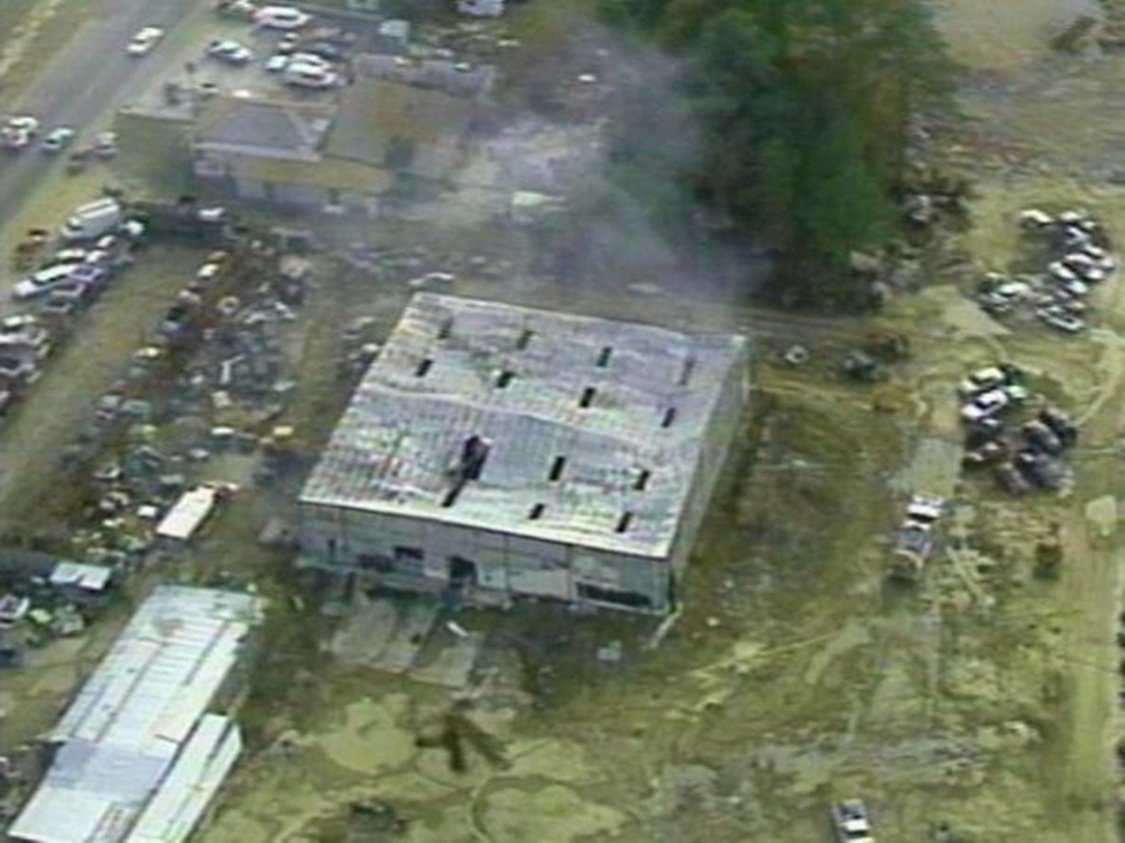
Aerial photo of the fire-gutted auto salvage warehouse.

Photo of the damaged warehouse. Note the heat damage to the metal roof.


