
Two Firefighters Killed by Collapsing Floors During Fire in Mercantile Loft Building – The Gray Building Fire – Los Angeles, California – November 6, 1939
Submitted by Rick DeGroot
On November 6, 1939, Los Angeles City Fire Department Fireman Joseph W. Kacl of Truck 3 and Auto Fireman John C. Hough of Engine 3 were tragically killed when the second floor of a downtown five-story commercial loft building collapsed. Fireman Kacl was operating a hoseline in the building and was killed in the initial collapse. Fireman Hough was struck in the head by a secondary collapse while attempting to rescue Kacl and later died from his injuries. The fire was caused when a hotplate was accidentally left unattended by a worker in the building.
The building involved in this incident, known as the Gray Building, was located midblock at 336 South Broadway between West 3rd and West 4th Streets in the downtown commercial district of the city. The five-story with basement Type III Ordinary construction mercantile loft building housed several businesses including a novelty shop and a manuscript printing company that housed heavy printing press machinery on an upper floor. The building measured 40 feet wide, 150 feet long and 65 feet high. Ceiling heights ranged from 20 feet on the first and second floors to 16 feet on the third and fourth floors, and 12 feet on the top floor. Similar Type III buildings flanked the Gray Building on Exposures Bravo and Delta. There was a parking lot and alley that ran behind the building on Side Charlie. An exterior metal fire escape and a two-foot-tall brick parapet wall with a masonry cornice were attached to Side Alpha. An exterior metal fire escape was attached on Side Charlie. The building had a flat roof with several skylights and an elevator served the upper floors. The building was not equipped with a fire alarm system or an automatic fire sprinkler system but had Class II standpipe outlets on the upper floors. Fire hydrants fed by a four-inch water main were available on South Broadway. The nearest fire alarm call box was located one-half block northwest at West 3rd Street and South Broadway.
Note: A mercantile loft-style building is a structure that was originally built in 19th‑ and early 20th‑century North American cities, especially in industrial and business districts, for commercial occupancies such as warehouses, garment factories and other manufacturing uses. The first floor was usually occupied by a mercantile use while the upper floors contained manufacturing and light industrial uses. They were often built using cast iron structural elements including cast iron columns to support the upper floors and cast iron decorative front facades that provided large arched windows to display merchandise at street level. Built with high ceilings and supported by large wooden beams with cast iron columns, loft buildings provided ample floor space for machinery and materials in manufacturing occupancies, and the display of merchandise in mercantile shops. In recent years, many loft buildings have been repurposed into residential apartments and condominiums. They are usually renovated leaving much of the interior brick walls exposed, and the cast iron columns, cast iron facades, and high ceilings retained for aesthetic purposes.
At the time of the fire, the Los Angeles City Fire Department (LAFD) had just received several pieces of new apparatus; heavy duty and innovative manifold wagons, duplex pumpers, a water tower/truck combination and an all metal 100-foot hydraulic aerial ladder. The ladder apparatus was equipped with windshields and completely enclosed crew cabs, a bucket tiller seat with windshield and tilt wheel, and the latest Mars figure-eight warning lights. The manifold wagons were equipped with the largest monitors ever mounted on land apparatus. Monitor tip sizes ranged from 1.75 inches to 3.5 inches, the 3.5 inch tip being capable of delivering 3500 gpm at 80 pounds nozzle pressure. Each manifold wagon carried 1000 feet of 3.5-inch hose in a split conventional hose bed and 1000 feet of 2.5-inch hose in a transverse bed.
On Monday afternoon, November 6, 1939, the fire in the Gray Building started as all big fires generally do from a seemingly inconsequential start which grew into a blaze that threatened to be of conflagration proportions and taxed the department with some ten hours of the toughest kind of firefighting. Room 201 on the northwest corner of the building housed the L.A. Novelty Company, a concern that did dish painting and other kindred novelty work, owned by a man named Sam Trieber. Mr. Trieber put some water on a hot plate in the back part of the room and plugged the electric cord in, then left to take his dog for a walk. Shortly after, an employee noticed smoke filling up the room and called the fire department but in her great excitement she gave the address as 3336 South Broadway, to which the signal office dispatched an assignment at 2:00 p.m. This incorrect address was later verified by the telephone company’s operator as the one having been given to the dispatcher.
At 2:03 p.m., Street Box 1133, at West Third Street and South Broadway was pulled by someone seeing smoke coming from the Gray Building located at mid-block. Engines 3, 4, 5, 16, Trucks 3 and 4, Salvage 3, and Rescue 23, and Battalion 1 were dispatched. Heavy smoke was coming from the second and third floor windows on Side Alpha as Engine 3 turned south on Broadway. There was no doubt in anyone’s minds that they had a working fire.
Over at Truck 3, the crew of the big new 100-foot aerial truck donned their turnouts and made ready to roll as the rounds of the box alarm rang out throughout the house. When the company made the turn onto Broadway from Third Street, the fire looked as though there might be possibilities, but not too serious. Fireman Ben Feighley of Salvage 3 was the first man up to the second floor and there he found a man pouring water from a hoseline into the smoky interior of the novelty company. Taking the line over, Feighley advanced into the room to find the seat of the fire but the aged hoseline broke and the heat and smoke soon drove him out.
The fire spread with an unbelievable rapidity as the second floor offered little resistance. It soon became apparent that the first alarm assignment had a real job cut out for them. The smoke spreading up through the unprotected vertical openings of the five-story building drove employees of establishments on the upper floors to the rear fire escapes where they piled up log jam fashion because the drop ladder to the ground was broken and would not lower. Heads up work by the crew of Truck 4 prevented disaster here for as they responded to the box, they noticed the smoke from the fire and decided to take the building from the Spring Street side. Wheeling in through a parking lot to the rear of the Gray Building they quickly raised ladders to the fire escapes and removed everyone to a place of safety.
In the front of the structure, the members of Truck 3 had laddered up the front of the building under the direction of Captain Barclay, placing two 35-foot portable ladders to the fire escapes and the long aerial to the roof. The company then took a line off of Engine 3’s manifold and proceeding via the second-floor fire escape balcony, started to bore their way into the red demon that was destroying everything in its path. By this time, the fire was involving the third floor and it looked as though it wouldn’t be long before the fourth would take off.
At 2:18 p.m., a second alarm was transmitted, bringing Engines 24, 28, 58, Truck 19, Chief Engineer Ralph Scott, Deputy Chief D.M. Blake and Division Chief George Davlin. Shortly after, Engine 23 and Water Tower Truck 24 were summoned and Chief Scott and Chief Davlin took charge of operations from the front and Chiefs Blake and Rothermel took command in the rear. By that time, a huge pall of smoke hung over the entire area as the fire continued to hold its own and make headway despite the terrific amount of water that was being poured on it. On the Broadway side, the big batteries of Manifolds 3 and 5, as well as lines operating from the aerial, pounded away at the flames and to the rear the same was being done by Manifold 23 and Water Tower 24, all this in addition to the 15 or more hoselines in operation. Around 3:30 p.m., the fire ate its way up through the roof via the elevator shaft and for a time threatened to spread to the Trustee building on Exposure Delta where the highly flammable supplies of the NuEnamel Company were stored.
At this time, the men working on hoselines in the rear of the building were ordered out but by then Firemen Kacl, Schumacher, Richter and Ed Dawson had worked some 50 feet back into the building on the second floor despite the heavy smoke, heat and terrific punishment in general. Kacl had just taken the nozzle over from Ed Schumacher when as though a trap door had suddenly sprung, the floor in front of Schumancer on which Kacl was standing, gave way and Joe went through to the main floor. Covered with plaster and debris and stunned by the suddenness of it all, the other three men scrambled back to a place of safety when they heard a creaking of timber that grew into a roaring crash as the fourth floor supporting the presses of the Wetzel Printing Company gave way and plunged through on top of their comrade.
Later in the afternoon, the fire being pretty well knocked out, a crew led by Ed Dawson and “Red” Hough, Chief Blake’s driver, were tearing into the rubble. E.W. Jones of Salvage 3 uncovered enough of Kacl’s body to report that there were no signs of life when there was a sickening rumble from overhead. The rumble developed into a roar and remaining portions of the upper floors broke away to head down toward the valiant rescuers as they made a hasty retreat. All reached a place of safety excepting Hough, who was struck across the helmet by falling debris and Jones, the last one to get away, was hit and had his legs crushed by one of the heavy timbers. Hough of Engine 3, who was struck in the head by a falling floor timber during the rescue operation later succumbed to injuries, passing away on December 12. Fireman Kacl’s body was recovered from the ruins shortly after midnight, the morning of Tuesday, November 7.
The Rude Building on Exposure Bravo was destroyed by a three-alarm fire in 1951. The Rude Building fire of 1951 raised serious fears during firefighting operations that there might be a floor collapse similar to the fate that befell the Gray Building. On November 6, 1961, 38 years after the Gray Building fire, the LAFD had a major conflagration that has come to be called the Bel Air fire. Thus, November 6 has seen two major incidents in the history of the LAFD.
Members of the Los Angeles City Fire Department fatally injured in the line of duty while operating at the Gray Building Fire on November 6, 1939:
- Fireman Joseph W. Kacl, age 24, joined the LAFD two years earlier and was assigned to Truck Company No. 3. Born in Winnipeg, Canada, on December 18, 1914, he came to Southern California in his early youth. He was a popular athlete at Lincoln High School where he received his education. He was survived by his parents, Mr. and Mrs. P. Kacl, his wife Kathryn Kacl and a son that he never saw, born several months after he was killed. His funeral mass was held on November 9 at All Saints Catholic Church in El Sereno with interment following at Calvary Cemetery in Los Angeles. The remains of their fallen comrade were carried to his last place of rest by the crew of Truck 3; Captain Barclay, Auto Fireman Cooper, and Firemen Dawson, Richter, Schumacher and Wood.
- Auto Fireman John C. “Red” Hough, age 46, joined the LAFD in 1918 and had been awarded the Medal of Valor for the daring rescue of a dying worker during a cyanide accident in a milling plant in 1920. He was assigned as the driver for Chief Blake on the day of the fire. Remarkably, he reported for duty the day after the Gray Building fire without a word to his companions about the pain that seared his head. Three weeks later, he fell ill while on duty and was hospitalized and died several days later. He was survived by his widow, Helen C. Hough. His funeral service was held on December 15 at the Bramble Funeral Home with interment following at Forest Lawn Memorial Park in Glendale, Los Angeles County, California.
The LAFD Fallen Firefighters Memorial is located in front of the Los Angeles Fire Department Museum located at Old Engine Co. No. 27 on Cahuenga Boulevard in Hollywood. The memorial consists of a wall listing the 280 Los Angeles firefighters who have died in the line of duty and five life-size statues of firefighters. The names of Firemen Joseph W. Kacl and John C. “Red” Hough have been inscribed on the memorial.
The names of Firemen Joseph W. Kacl and John C. “Red” Hough have been inscribed on the California Firefighters Memorial Wall on the grounds of the State Capitol Park in Sacramento. The memorial features a two-sided brushed limestone wall on which is inscribed the names of 1,593 California firefighters who have died in the line of duty since California became a state in 1850. A pair of bronze turnout jackets hang at both ends of the wall. The memorial wall is framed by two bronze statues depicting firefighters in action. “Holding the Line” honors the profession of firefighting and depicts four firefighters in action working a hoseline. The statue was created by renowned artist Lawrence Allen Noble. “Fallen Brother” honors our fallen heroes and portrays an anguished firefighter carrying his ‘fallen brother.’ The statue was created by Jesus Romo, a retired Sacramento firefighter.
The site of the fatal fire is now occupied by a one-story restaurant with an outdoor garden and dining area. There is no memorial marker at the site.
Commentary:
Firefighters must be cognizant of the amount of water that may be delivered into a fire building via heavy streams. In this incident, heavy caliber master streams were being operated into the fire building including from several large caliber truck-mounted monitors, portable deluge sets, and a water tower. The upper floors of the building were occupied by a printing business that used heavy printing machinery along with the companion supply of paper and newsprint. Type III structures also often feature fire-cut floor beams that are designed to release from the joist pockets when consumed by fire without damaging the masonry bearing walls. During master stream operations, fire officers need to monitor the amount of water that is draining from the fire building. Master streams will add literally tons of water per minute into a fire damaged structure and this must be factored into the decision-making process for allowing interior operations. Best practice is to appoint an experienced fire officer as an additional safety officer specifically assigned to monitor the structural stability of a heavily fire damaged fire building. Some progressive departments have begun employing transit level equipment to gauge any structural instability in a fire damaged building.
We have attached photos from the incident. We have also included the links to a two-part article published in Fire Engineering magazine by Mark van der Feyst on Master Streams: https://www.fireengineering.com/firefighting/firefighting-basics-master-streams-part-1/
https://www.fireengineering.com/features/firefighting-basics-master-streams-part-2/
We have also included a link to a short video of a Type III building collapse in Manhattan, New York: https://youtu.be/8SUuBXRQyXk
Thanks to the LAFD Historical Society for much of the content of this article.
Honor the service of Firemen Joseph W. Kacl and Fireman John C. Hough by reviewing your department’s standard operating procedures for master stream operations and for evaluating the structural stability of a fire damaged building with your crew members today.
Remember Fallen Brothers.
Get Out There And Know The History Of Your Local!!!
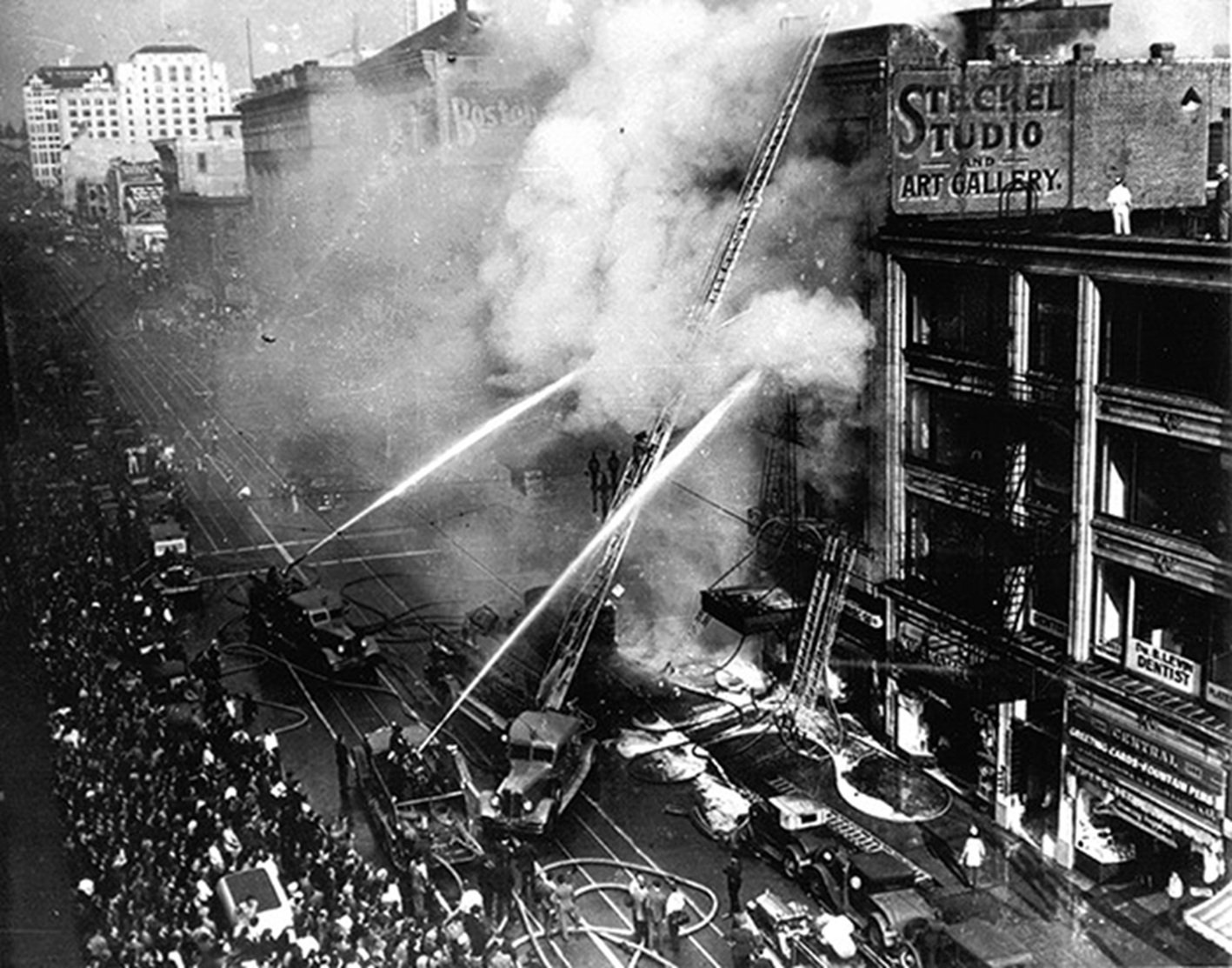
Photo: Multiple master streams are deployed to control the fire at the Gray Building in downtown Los Angeles. Note water cascading across the sidewalk from heavy streams being operated into building above.

Detail from the 1911 Sanborn fire insurance map of the area showing the configuration of the fire building (circled in red) and the surrounding exposures.


