
Firefighter Killed and Another Injured While Performing Rapid Intervention Team Tasks at Vacant Warehouse Arson Fire – Houston, Texas – November 6, 2024 – NIOSH Firefighter Fatality Investigation Report F2024-06
Submitted by Rick DeGroot.
On November 6, 2024, Houston Firefighter Marcelo Garcia of Station 23 was killed while battling a three-alarm arson fire in a vacant warehouse in Houston’s East End. Firefighter Garcia and other members of Engine 23 were assigned as the rapid intervention team to Side Delta of the burning warehouse and were attempting to remove window coverings and security bars from the doors and windows on the building when the flat roof of the warehouse suddenly collapsed pushing out the masonry exterior wall near where the firefighters were operating. Firefighter Garcia and another firefighter were trapped in a pile of debris but were quickly extricated from the rubble by other firefighters. Engine 23 Firefighter Shane Cox was first removed and transported to a local hospital for minor injuries. Firefighter Garcia was extricated shortly thereafter and rushed to a local trauma center but tragically died from his injuries. The incident lead to criminal charges against a woman who was identified as a suspect in the arson fire through video surveillance footage. Firefighter Garcia was the first Houston firefighter to be killed in the line of duty since 2013.
The structure involved in the incident was a vacant one-story 13,160-square-foot warehouse built in 1955 located at 6536 Supply Row on the southwestern corner of South 66th Street near Polk Street in an industrial area in the East End of the city. The building was rectangular in shape and measured about 200 feet wide on Sides Alpha and Charlie and about 65 feet wide on Sides Bravo and Delta. This total square footage included the 1,680 square feet of space that was designated for two-story offices. The flat roof was metal decking covered with rolled roofing material supported by lightweight steel bar joists placed on steel I-beams supported by masonry pilasters built into the masonry perimeter walls. The building also had a partial partition wall between the two overhead doors on Side Alpha, closest to Side Delta. This wall did not go from floor to ceiling or from wall to wall. The building had no cooling system but contained unit heaters. The wall construction was primarily concrete block with a brick veneer with a low parapet on what appeared to be the office portion of the building on Side Delta. The brick veneer post collapse had a gap or separation between the veneer and the block wall. One of the six overhead style doors on the loading dock on Side Alpha of the building that faced South 66th Street had a canopy roof over it. The Bravo side of the building also had one overhead style door in a small, enclosed yard. Side Charlie of the warehouse was separated by a narrow passageway from a one-story medical supply office and warehouse and an open yard at the rear of the medical warehouse. The office on Side Delta of the building had a small porch with steps on either side to a double door storefront style entrance with burglar bars over the doors and over all the exterior windows on this side of the building. This entrance also had a canopy over it with several slots in the brick veneer toward Side Alpha of the building where it appeared that an original, larger canopy had once been installed. The Side Delta canopy roof was constructed of dimensional lumber with a wooden veneer and topped with asphalt roofing material. Some of the window openings on the building were secured by plywood and several of the overhead doors were damaged and unsecured. The building had no fire protection system. Fire hydrants were located on the corner opposite the warehouse and opposite the Alpha/Bravo corner of the warehouse across South 66th Street.
The City of Houston is the most populous city in Texas, and the fourth-most populous city in the United States with a population of 2,304,580 residents in 2020. Located in the southeast portion of the state near Galveston Bay and the Gulf of Mexico, it is the seat and largest city of Harris County and the principal city of the Greater Houston metropolitan area. At the time of the incident the city had a total area of 656.3 square miles protected by the Houston Fire Department which was the fourth largest fire department in the United States and served a population of 2,239,000 residents. At the time of this incident the department consisted of approximately 4,000 uniformed personnel and approximately 100 civilian personnel. Approximately 3,800 of those personnel are assigned to the emergency response division that provides fire protection and emergency medical services (EMS). There are 93 fire stations located throughout the city that are divided into quadrants: northeast, northwest, southwest, and southeast. These are further divided into 21 districts. The emergency response division is made up of 2 deputy chiefs, 3 safety officers, 3 cascade units, 1 command van, 1 rehab unit, 21 district chiefs, 88 engine companies, 33 ladder companies, 5 tower companies, 57 ambulances with an additional 5 during peak times, 41 medic units, 5 squads, 7 ambulance supervisors, 2 senior ambulance supervisors, 1 EMS district chief, 3 rescue companies, and 4 hazardous materials companies. The department also deploys 16 aircraft rescue and firefighting vehicles at 2 airports within the city.
The minimum daily staffing for the department is 849 personnel across all companies. The deputy chiefs, safety officers, cascade units, command van, ambulance supervisors, senior ambulance supervisors, EMS district chief and rehab unit are each staffed with a single person. The district chiefs, ambulances, medic units, and squads are each staffed with two personnel. Engine companies, ladder companies, tower companies, rescue companies, and hazardous materials companies are each staffed with four personnel. Ambulance units are classified as basic life support (BLS) while squads and medic units are classified as ALS. The fire department provides EMS service up to and including ALS-transport. The fire department is certified as an Insurance Services Office Class 1 department and is accredited through the Commission on Fire Accreditation International as of 2021.
The fire department participates in a county wide mutual aid agreement for fire protection and suppression that was drafted in June 2017 and automatically renews every year. This agreement is across all departments within the county whether they are career, combination, or volunteer and it includes more than 71 different entities. The fire department responds to over 395,000 calls for service annually.
The fire department hires through a civil service process. The minimum requirements to apply are that the applicant must be between 18 and no more than 36 years old when they take the oath of office, have completed 15 accredited college hours or two years of full-time active-duty military service with an honorable discharge, and have two or less moving violations in the last 36 months. Upon accepting a conditional job offer, the applicant must attend the academy and complete between eight and ten months of daily rigorous physical training and classroom instruction. Upon graduation, applicants have certifications in the Texas Commission on Fire Protection fire basic, Texas Department of State Health Services emergency medical technician (EMT) basic, and the National Registry of Emergency Medical Technicians. Once the candidate successfully graduates from the academy, they are assigned to their fire station. Once assigned to their fire station and shift, all personnel complete a minimum of 24 hours of on-the-job training and continuing education per month.
Firefighter Marcelo Garcia had eight and a half years of experience with the department and had participated in a variety of monthly company level trainings including hazardous materials, RIT skills, building construction, multi-company drills, equipment and apparatus familiarization, EMS continuing education, area familiarization, and tactical decision making on offensive and defensive fires. Per department records, Firefighter Garcia routinely logged 30 hours of training per month.
Firefighter Shane Cox had approximately six years of experience with the department and had participated in a variety of monthly company level trainings. Fire department training records show participation in training such as Mayday training, building construction, operational readiness, EMS continuing education, and truck company tactics. Per department records, Firefighter Cox routinely logged between 24 and 30 hours of training per month.
Area weather conditions on the night of the incident included an air temperature of 76 degrees F and a relative humidity of 91% with no precipitation with east-northeast winds at 5 mph under mostly cloudy skies. During the incident, the relative humidity increased to 94% with no precipitation with winds from the east at 6 mph (Weather Underground). Note: The weather conditions did not appear to be a significant factor in fire development or the outcome of the incident.
On Wednesday, November 6, 2024, at approximately 22:50 hours, a 9-1-1 call was received by the city Office of Emergency Communications (OEC) for a three-story warehouse on fire with an approximate location on Supply Row near 66th Street in Northeast Houston. As the first call was being handled by civilian call takers, additional calls were being answered for the incident of a warehouse on fire near the location provided by the initial call. As the call taker began entering information into the CAD terminal, the first alarm suggested units populated. The OEC personnel dispatched the suggested units to the area the first caller provided the call taker.
The dispatched units included District Chiefs 20 & 08, Engines 18, 20, 40, & 23, Tower 18, Ladder 20, and Safety Officer 30. Within four minutes of the initial call, all first alarm units were enroute to the incident location. OEC assigned a tactical radio channel to the incident. At approximately 22:57 hours, Engine 18 updated “We’ve got a column, working fire.” OEC copied the update and rebroadcasted the working fire. At approximately 22:58 hours, Engine 18 arrived on-scene and sized the incident up as, “Large warehouse, fire showing from the roof, heavy fire, Alpha side is 66th street.” OEC copied the message. Engine 20 approached from the cross street (i.e., Side Delta) within seconds of Engine 18’s size up. Ladder 20 arrived and positioned behind Engine 20 on the Alpha/Delta corner and reported, “Working fire, mobile command.” Seconds later District Chief 20 arrived and updated, “Assuming command, heavy fire from a one-story warehouse.”
At approximately 22:59 hours, Engine 18 broadcasted this incident as a defensive fire. OEC asked Engine 18 to repeat their last message. Engine 18 repeated, “Defensive fire.” OEC transmitted an emergency tone and rebroadcasted “All units, this is a defensive fire.” Command ordered Ladder 20 to set up their ladder pipe. Tower 18 reported setting up their ladder pipe up and opening garage doors on Side Alpha. Command copied the report from Tower 18. At approximately 23:00 hours, the Ladder 20 Officer radioed, “Command, TIC reading through open doors is about 1,000 degrees at the roof, heavy smoke, fire, and some of the roof is starting to collapse.” Command acknowledged the report and requested the ladder pipes on Tower 18 and Ladder 20 be set up. Command updated all units that SDI (electronic accountability system) was in place. Engine 40 arrived and advised Command, “On location, connecting to a plug and supplying Ladder 20.” Engine 23 (with Firefighters Marcelo Garcia and Shane Cox aboard) arrived, and Command assigned them RIT responsibilities.
At approximately 23:01 hours, Tower 18 updated, “Command, we’re going to have Engine 18 supply Tower 18. We’ve got a plug right behind Tower 18.” Command acknowledged the message. Medic 18 requested to be added to the incident instead of Medic 40. Command ordered Engine 40 to supply Ladder 20 through the rear bumper. Engine 20 updated, “Command, Side Delta exposure, pulling 1.75-inck hoseline to protect it, we don’t have a supply.” Command acknowledged the update. The Engine 23 crew went to District Chief 20’s vehicle and retrieved the RIT equipment for their assignment. Engine 18 established their water supply. Engine 40 acknowledged their assignment and asked if they were to be RIT after establishing a water supply. Command advised Engine 23 was RIT. Ladder 20 advised they were setup for water. The Ladder 20 Officer called Command and was ready to give a CAN report.
At approximately 23:02 hours, Command was ready for the CAN report. The Ladder 20 Officer stated, “Collapse of the roof, heavy fire, exposure on C/D side going to have to get inside, already starting to smoke up. Trying to get water on it right now. Ladder 20 in position to hit it with the pipe, no further needs.” Command responded, “Received, District 20 to all companies, do not go interior.” Engine 20 requested personnel to assist with dragging a supply line to a nearby hydrant. Command assigned the crew of Medic 18 to assist. Engine 23 staged the RIT equipment on the ground near the Alpha/Delta corner of the building. At approximately 23:04 hours, Command requested the status of the water supply to which an Engine 18 firefighter responded, “Water’s coming.” Command updated OEC that a water supply was established to both ladder pipes. District Chief 08 arrived as Command updated all companies on scene, “Command to all companies on Delta Division, let’s stay clear of that wall, it looks like it’s going to collapse outwards.” Command assigned District Chief 08 to Side Alpha. Engine 23 Firefighters Garcia and Cox walked up onto the Delta side porch to “soften” the building as part of the RIT assignment.
At approximately 23:05 hours, as Command requested the second alarm be dispatched, Engine 20 called Command, “Command we got a collapse on the Delta side”. Note: It is believed that at this time the Side Delta wall collapsed trapping Firefighters Garcia and Cox under the rubble. Command responded, “That’s received. Command to all companies, stay away from Delta Division.” The Incident Command Technician noticed that Firefighter Garcia’s portable radio suddenly changed to the wrong channel for the incident and that their SCBA pressure dropped approximately 650 psi since their arrival on scene.
At approximately 23:06 hours, the Engine 23 Officer declared a Mayday. Command acknowledged the Mayday. OEC called Command, “Command you had a Mayday, possibly Ladder 20D.” Command confirmed the message, “we’re working on getting him out right now.” OEC confirmed to Command that the second alarm was dispatched and asked if Command wanted the third alarm for the Mayday. Command asked for the third alarm. Firefighter Garcia’s SCBA showed approximately 600 psi more drop as well as the PASS showing it was in full alarm.
At approximately 23:07 hours, Ladder 20 updated Command that one firefighter (Firefighter Cox) had been removed from the collapse area. The Incident Command Technician sent an electronic PAR check over the radio to Firefighter Garcia. Garcia’s SCBA pressure had dropped an additional 1,200 psi. Command asked how many personnel were missing. Ladder 20 thought one more and went to get a PAR. Engine 1 arrived and was ordered to report to the Command Post. Engine 40 updated that they had one more person trapped under debris. A moment later Ladder 20 advised Command there were two firefighters missing and actively working to get them. Ladder 20 requested operations go to a different radio channel so the rescue could have this one. Firefighter Garcia’s SCBA pressure dropped an additional 450 psi and the electronic accountability system showed there was 0 psi remaining in his SCBA.
At approximately 23:09 hours, Rescue 42 arrived and was assigned to Side Delta for extrication of the trapped firefighter. Command asked if there was another firefighter missing. At approximately 23:11 hours, Tower 18 requested water. OEC updated Command they were at the 10-minute incident clock and advised the Ladder 20 Officer was showing in alarm. Command requested a PAR for Ladder 20, other personnel responded he was ok and working the rescue. Tower 18 updated they had water flowing on Side Alpha of the building. Command updated the second firefighter was being extricated. Firefighter Garcia’s SCBA PASS alarm showed cleared in the electronic accountability system as well.
At approximately 23:13 hours, Ladder 20 updated all victims and personnel clearing the collapse zone were out. Command requested all personnel evacuate the area on Side Delta and that OEC cancel the third alarm. Ladder 20 exited the collapse zone with the injured Firefighter Garcia, and they needed ALS and AED protocols in effect. Command again asked all units to clear from Side Delta. Ladder 20 requested ALS meet them at the front of Ladder 20. Command ordered Medic 17 to Side Delta. At approximately 23:15 hours, Ladder 20 requested ALS a third time. Command ordered Engine 18 and Tower 18 to stay back from the wall on Division Alpha, Ladder 20 to be flowing water in that area. Safety Officer 30 arrived on location. At approximately 23:16 hours, Tower 18 reported the bulk of the fire was knocked down on Side Alpha and asked if Command wanted the stream redirected. OEC notified Command that the Ladder 20 Officer was showing in alarm and asked for confirmation that all personnel were accounted for. Command confirmed that all personnel were accounted for and requested all personnel stay away from the building. At approximately 23:18 hours, Ladder 20 updated that all injured personnel were out, and everyone was outside of the collapse zone. EOC updated Command they were at the 20-minute incident clock. Firefighter Cox was transported to the hospital by Ambulance 23 and treated for minor injuries. Firefighter Garcia was transported to Memorial Hermann Medical Center by Medic 18 and was later pronounced deceased at the hospital. Command declared the fire under control at 23:44 hours and the scene was turned over to the arson division.
Fire investigators determined that the cause of the fire was incendiary/arson. Fire officials said the fire that took Garcia’s life was started on purpose. The woman accused of starting the fire, Yesenia Espinosa Mendez, age 38, was identified as a suspect in the arson fire through video surveillance footage showing her leaving the building with several handbags. She was initially charged with first degree arson and was given a $100,000 bond. She was later charged with felony murder. Mendez has a lengthy criminal history going back to 2005 including multiple assault charges involving partners, two DWIs, and a child endangerment charge. She is awaiting trial.
The county medical examiner listed the cause of death for Firefighter Marcelo Garcia as mechanical asphyxia with the manner of death being listed as homicide (arson).
NIOSH investigators identified the following items as key contributing factors in this incident:
- Pre-incident planning
- SOPs/SOGs
- Strategy and tactics
- Risk versus benefit analysis
- Safety officer presence
- Change of occupancy
- Vacant/dangerous building inspections
The NIOSH report made several recommendations including:
- Develop pre-incident plans for structures within their first due response area, specifically dangerous or vacant structures.
- Develop and maintain standard operating procedures/standard operating guidelines.
- Ensure incident commanders match their tactical strategy with the incident at hand.
- Train all personnel to employ risk management principles when operating on the incident scene.
- Strategically deploy safety officers.
Firefighter Marcelo “Ox” Garcia III, age 42, was an eight-year member of the Houston Fire Department. Garcia had been assigned to Station 23, B shift for the previous six years. Marcelo attended De Zavala Elementary, Edison Middle School, Milby High School and Texas Southern University, where he majored in Business Administration before joining the Fire Department in 2015. From an early age, Marcelo excelled in athletics. He played football for the Magnolia Park Sharks and baseball at TSU, finding in sports the values of teamwork, discipline, and service. Over the years, he mentored younger athletes, volunteering with Angels in the Outfield, Our Lady of Guadalupe Catholic School, Milby High School’s baseball team, and the Magnolia Park Sharks. He was survived by his father, Marcelo Garcia Jr. and stepmother Diana Garcia; his mother, Rosa Giannukos and stepfather, Nalan Giannukos; his sister, Erica Garcia and her husband Kenneth Bou; his niece, Lily Bou and nephew, Jordi Bou; his grandparents, Esteban and Evangelina Ballesteros and Frances Garcia; his girlfriend Sylvia Ramos; his beloved dog, Santo Garcia; and numerous aunts, uncles, cousins, and friends.
The funeral service for Firefighter Garcia was held on November 13 with a massive procession from Houston Fire Station 8 to the Co-Cathedral of the Sacred Heart, where the service was held. Hundreds of firefighters came to show their support. Interment followed at Forest Park Lawndale Cemetery in Houston.
The name of Firefighter Marcelo Garcia III has been inscribed on the Wall of Honor at the Houston Firefighters Memorial Garden on the grounds of the Houston Firefighters Relief & Retirement Fund headquarters.
The name of Firefighter Marcelo Garcia III has been inscribed on the 2025 plaque displayed at the National Fallen Firefighter Memorial on the campus of the National Fire Academy in Emmitsburg, Maryland.
Commentary:
One of the primary focuses of an incident commander is to maintain situational awareness of the fire and how it is affecting the structural integrity of the building. This process starts with conducting a proper 360-degree size up of the structure upon arrival. This examination should include the construction type of the building, the position of the exposures, the location and extent of the fire, and any unusual construction features or hazards. The NIOSH report makes no reference to a 360-degree size up being performed as fire units were initially deployed. If a thorough size up of the building had been conducted, the unsupported brick parapet facade and the canopy roof over the entry doors on Side Delta may have been recognized as a collapse hazard. Canopy roofs are inherent collapse hazards: one end is unsupported, and when they collapse, they often pull down the supporting wall.
While important auxiliary duties of a rapid intervention team include such operations as “softening up” a building by removing security bars and other window and door coverings, conducting such operations should be viewed as actions of opportunity given the level of fire involvement and the structural condition of the building. During the initial minutes of fire operations at this incident, the structural instability of the Side Delta wall was noted, and Command made several radio announcements for fire units to stay clear of the unstable wall and had reinforced that the operation was to be in the defensive mode. Yet for unknown reasons the members of Engine 23 elect to enter the danger zone. Strong communication procedures need to be in place that effectively communicate to all members operating on the fireground any structural hazards that are found. Many departments utilize a system of effective messaging that uses an alert tone followed by an urgent message advising of the location and nature of any hazards. The communications loop is then closed by having all operating units verbally acknowledge receipt of the message.
We have attached photos and a site diagram from the incident. The link to the NIOSH report is here: https://www.cdc.gov/niosh/firefighters/programs/pdfs/face202406.pdf
This incident shares similarities with another firefighter fatality that also occurred in Texas:
On July 5, 2008, City of Teague, Texas Volunteer Fire Chief Robert Knight was killed when he was struck by a collapsing brick parapet wall during a commercial structure fire in an automotive repair and upholstery business. The fire department was operating at the scene of a grass fire prior to being alerted to the structure fire. Chief Knight and two firefighters responded directly to the scene while two other firefighters went to the nearby station to pick up a structural engine. Upon arrival of the engine, Chief Knight stretched and operated an exterior hoseline on Side Alpha of the structure. Less than five minutes after arrival of the engine, a brick parapet wall collapsed, striking the Chief and burying him under brick debris. Rescuers quickly uncovered him, and medical treatment was started immediately. Chief Robert Knight, still conscious, was transported to a trauma hospital where he died several hours later. The area of origin of the fire was determined to be in the rear of the structure in the automotive painting area. The structure was filled with various automotive parts, upholstery, gasoline, oil, paint, solvents and other highly flammable materials that contributed to the fuel load. The fire quickly spread throughout the structure resulting in total involvement: https://www.facebook.com/groups/192218352449074/permalink/1578127790524783/
We have also attached a BCFS Question of the Week article on parapet walls:
https://www.facebook.com/groups/192218352449074/permalink/1481729573497939/
And we have included the link to an article by FDNY Lt. Michael N. Ciampo on fire operations and parapet walls published in Fire Engineering magazine: https://www.fireengineering.com/fire-safety/the-problematic-parapet/
We have also added the link to an Emergency Traffic podcast on the incident produced by group member Paul Prevost: https://open.spotify.com/episode/0weSHWg60LRFbDVV1XNEiO?si=7cb795c1b0d84f08
Thanks to multiple media sources for additional information for this article.
Honor the service of Firefighter Marcelo Garcia by studying the collapse dangers of low parapets walls and lightweight bar joist warehouse roofs and by reviewing your department’s procedures for communicating urgent fireground hazards to all personnel operating at an emergency scene with your crew members today.
Remember Fallen Brothers.
Get Out There And Know Your Local!!!
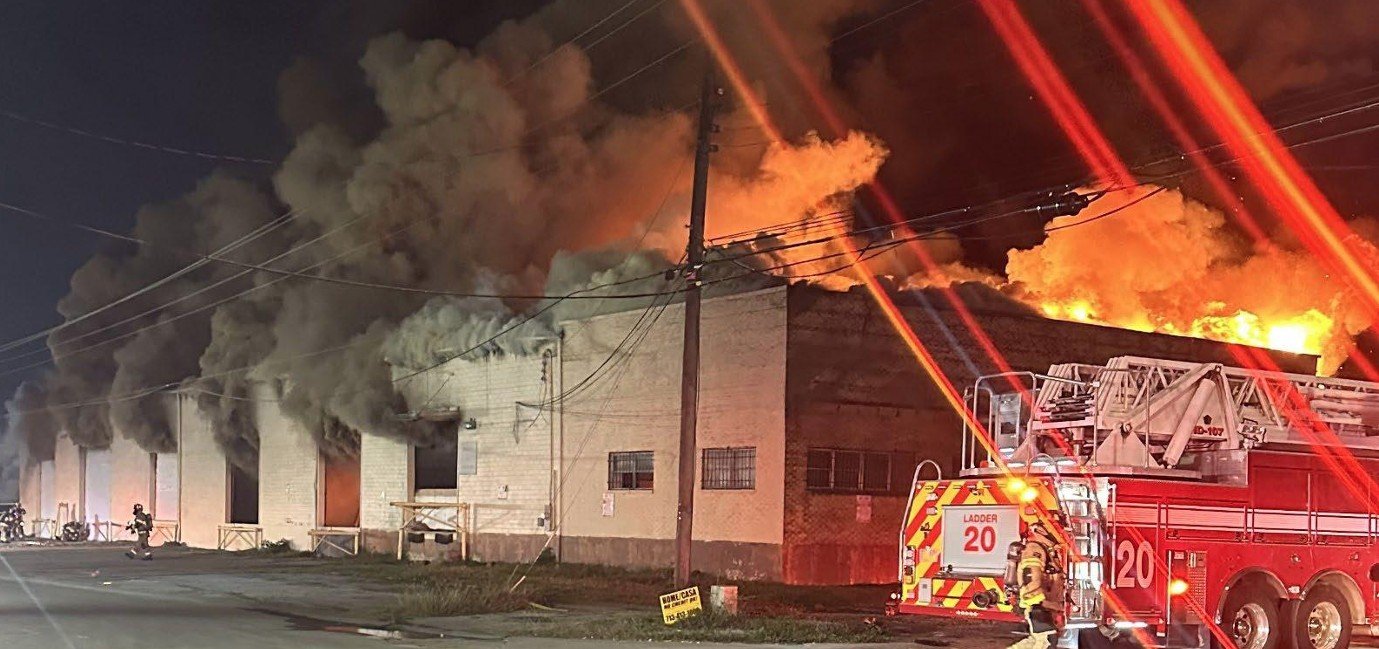
Photo of fire conditions found upon arrival of the first-due fire units.

View of the fire building a few years before the incident via Google Maps.


