
Fire Officer Killed During Three-Alarm Basement Fire in Furniture Store – Mutual Furniture Company Fire – Binghamton, New York – November 10, 1962
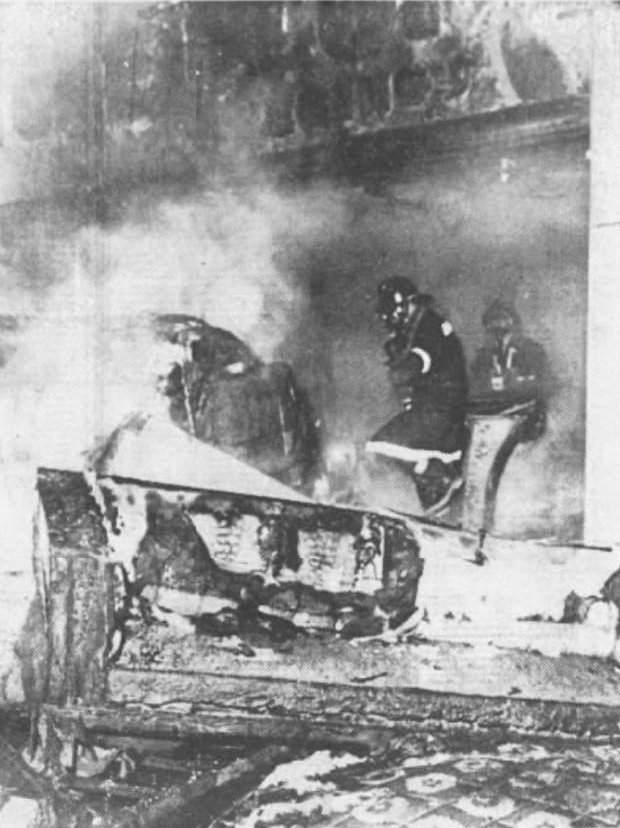
On November 10, 1962, Binghamton Fire Training Instructor James M. Sullivan was killed while operating during a three-alarm fire in the basement of a furniture store located in a commercial district on the West Side of the city. Firefighters were operating in heavy smoke and high heat conditions in the basement of the store when Sullivan became separated from the other members. Conditions in the basement deteriorated and personnel were withdrawn to the exterior as cellar pipes were operated into holes cut in the floor of the furniture showroom to combat the flames. The fire officer was not noticed missing until the next morning when his wife inquired about his absence. Searchers later found Sullivan’s body floating in the basement of the gutted building. Fire officials stated that Sullivan had earlier been seen searching for the seat of the fire in the building by himself. Officials said that as a ranking officer, Sullivan was not included in the buddy system, which was a way for firefighters to keep in contact with each other during a fire. The cause of the blaze was traced to a malfunction in a light fixture in the basement of the store that was packed with inventory for an upcoming sale. Training Instructor James M. Sullivan was the 14th member of the Binghamton Fire Department to have fallen in the line of duty.
The structure involved in the fire incident was a three-story with basement Type III Ordinary construction masonry and wood joist mixed-use building located midblock at 171 Main Street between Clarke Street and Laurel Avenue in a commercial area on the West Side of the city. The building measured about 60 feet wide and 80 feet deep with a flat roof and a two-foot-high masonry parapet wall on Side Alpha. The first floor was occupied by the Mutual Furniture Company, a retail furniture sales showroom. The basement was used for storage of furniture inventory for the store. The upper two floors contained a dozen occupied apartments. A central stairway accessed from the sidewalk on Side Alpha served the upper floor apartments. The exterior perimeter walls were terra cotta tile faced with brick. Side Alpha faced 60-foot-wide Main Street. On Side Bravo was a large one-story concrete block movie theater separated by a narrow alley. Side Charlie was a parking area. On Side Delta was a two-story wood frame row of stores separated from the fire building by a small vacant lot. The building was not equipped with a fire alarm system or an automatic fire sprinkler system. Fire hydrants fed by a 12-inch water main were available a short distance away in both directions on Main Street. The nearest fire alarm call box was located one and a half blocks east on Main Street at Jarvis Street.
Binghamton is a city that serves as the county seat of Broome County in central southern New York State. Surrounded by rolling hills, it lies in the state’s Southern Tier region near the Pennsylvania border, in a bowl-shaped valley at the confluence of the Susquehanna and Chenango Rivers. Binghamton is the principal city and cultural center of the Binghamton metropolitan area (also known as Greater Binghamton, or historically the Triple Cities, including Endicott and Johnson City), home to a quarter million people. The city’s population, according to the 2020 U.S. census, was 47,969. From the days of the railroad, Binghamton was a transportation crossroads and a manufacturing center and has been known at different times for the production of cigars, shoes, and computers. In the late 19th and early 20th centuries, many immigrants moved to the area, finding an abundance of jobs.
Fire protection in Binghamton began as a volunteer effort in 1834. The fire department evolved as the city grew and in 1911 became a fully paid municipal department with a contingent of 91 officers and firefighters. Today, the 11.5 square mile city is protected by the 117 career members of the Binghamton Fire Department operating from five fire stations deploying two engine companies, one tower ladder company, two quint companies, and a Special Operations Division consisting of a heavy rescue squad company and the HazMat team that is cross staffed by members of Quint 3. The Emergency Medical Services Division operates one ALS ambulance and five paramedic cars. One deputy chief and three assistant chiefs have command of one each of the four shifts that staff the apparatus. The ISO Class 1 agency responded to more than 10,000 calls for service in 2023.
Area weather conditions on the evening of the fire incident included an air temperature of 47 degrees F and a relative humidity of 98% with west-northwest winds at 7 mph gusting to 17 mph under cloudy skies (Weather Underground). Note: Research by the National Institute of Standards and Technology (NIST) has shown wind speeds on the order of 10 to 20 mph are sufficient to create wind-driven fire conditions in a structure with an uncontrolled flow path (Madrzykowski and Kerber 2009). The wind condition likely had a significant impact on fire development and the outcome of the incident.
On Saturday evening, November 10, 1962, witnesses reported that a large window was blown out by a fire in the front of the Mutual Furniture Company, a retail furniture salesroom at 171 Mian Street in a commercial area west of the downtown area of Binghamton, New York. The first alarm was turned in at 5:54 p.m., about half an hour after the store had closed and all employees had left for the evening. Binghamton Engine 2 and Truck 3, from the West Side Fire Station quartered across the street less than half a block away, responded almost immediately.
Arriving firemen found the first floor and basement of the three-story mixed-use building to be heavily involved in fire. Tenants in the apartments on the second and third floors of the brick and wood joist building were streaming down the front stairs. One second-floor tenant, Mrs. Grace Heverly, was rescued by Joseph Hagelstein, a third-floor tenant. He was assisted in the rescue by David Ellsworth, a checker at the A & P grocery store across the street. All occupants of the dozen apartments over the blazing furniture store got out safely, some with the aid of firemen, police and passersby.
Hoselines were stretched into the building as firemen focused their efforts on the fire in the basement of the building, which was heavily stocked with upholstered furniture. Training Instructor James Sullivan had responded to the scene of the working fire and entered the building to supervise the search for the seat of the blaze. He was last seen in the basement speaking to several firemen, remarking about the dense smoke conditions. Firemen were able to remain in the building only a few minutes before coming outside for fresh air. Several stumbled out and fell to the ground in the front and rear of the building. More than a dozen members were overcome by the dense clouds of smoke despite wearing canister filter masks. Several members were treated at the scene while five firemen were transported to General Hospital for treatment of smoke inhalation and other minor injuries.
For reasons unknown, Training Instructor Sullivan remained behind in the basement after other members were withdrawn when operations shifted to a defensive attack and the officer was not noticed missing at that time. After second and third alarms were transmitted for additional resources, the fire was finally brought under control after several holes were cut in the wooden floor of the first-floor showroom and cellar pipes were put in service. Firemen could be seen tossing many pieces of smoldering upholstered furniture to the curb as they searched for hidden pockets of fire in the store.
Smoke filtered into the adjacent Jarvis Theater next door, but moviegoers did not have to be evacuated. Fireman continue to fight the stubborn fire before the blaze was declared under control at 10:20 p.m. Several companies remained on the scene throughout the night dealing with hot spots. First Assistant Chief John Sedor said part of the problem with containing the fire was that it had spread into a false ceiling in the basement and had licked along the wooden floor beams. Firemen eventually cleared the entire first floor of furniture and chopped five holes into the floor to drown the basement where stored furniture was smoldering. Charred and ruined furniture was piled several feet high on the sidewalk in front of the store. The fire drew hundreds of spectators as the police roped off a wide area to keep the public back.
Edward Mokhiber, co-owner of the furniture store, was at the scene and said that much of the ruined furniture was part of a large inventory of new furniture that had just arrived and was stored in the basement. A special sale was in progress the past week. Mokhiber said he and George N. George had jointly operated Mutual Furniture for 28 years. George collapsed at the scene and was taken to Lourdes Hospital after suffering an apparent heart attack.
The fire displaced dozens of tenants from the 12 occupied apartments above the store. Officials from the local Red Cross chapter were on hand to assist the tenants with securing temporary shelter. Fire apparatus from other outlying suburban stations were relocated into empty Binghamton stations to maintain fire coverage for the city during the blaze.
Meanwhile, Training Instructor James Sullivan was unnoticed missing throughout the night. It was only after his wife called the Central Fire Station at 10 a.m. the next morning to inquire if he was still at the fire that it was realized that Sullivan was unaccounted for. When firemen began their search for the missing fire officer, Department of Public Works crews were already pumping water from the basement of the three-story building. Firemen had flooded the basement the previous night to douse smoldering furniture and other stock. When the water level reached below the halfway mark, Captain Earl Manger was lowered into the basement through a large hole in the floor on the west side of the building. Captain Manger found the body of the missing fire officer about eight fleet from the wall on the northwest side of the building.
As the Training Instructor, Sullivan responded to all fires involving more than one alarm, fire officials said. The second alarm was turned in at 6:02 p.m. on Saturday night. A five-pound canister filter mask was strapped to Sullivan’s body when it was recovered. “He didn’t have it on his face,” said Assistant Chief Sedor. “Whatever happened, he must have torn it off. It’s impossible to dislodge it unless you pull it off.” Fire officials could not account for why Sullivan had been unable to escape from the burning basement when all other firefighters were withdrawn.
Dr. Vincent Maddi, Broome County coroner, ruled that the death of Training Instructor James M. Sullivan was accidental. He said the cause of death was asphyxiation due to the inhalation of smoke.
City officials directed Fire Chief Gerald J. Ring to prepare a “full report covering every aspect of the death of Jim Sullivan.” Mayor John J. Burns said, “I’m not going to attempt any conclusions until I have the report, which was expected in a couple of days. Like everyone else, I don’t like this thing and I want to get to the bottom of it. Usually, they have a system to check on each other. That’s one thing I want checked. Mr. Sullivan was not a member of any company. There should have been some arrangement made for checking on him. Obviously, there wasn’t.” Burns noted that Sullivan had been using a filter mask, rather than a mask with it’s own oxygen supply. “We’re going to look into that very closely,” the Mayor said.
“We had the (filter) mask worn by Sullivan checked by Dr. Maddi,” said Assistant Chief Sedor. “The mask was found to in working order.” Chief Sedor had this to say about the department’s “buddy system.” “It’s more of a company system. That’s one possible reason for this (death). He (Sullivan) didn’t belong to a company. We don’t think this could have happened if he were a company member – not detecting this sooner. We had men at the scene continually, even when his body was recovered, Of course, when we found out that he was not home, more firemen were sent to the building.”
Chief Sedor continued, “His duties were to command and direct. He was directing, leading and supervising. From what I gathered, he told several firemen to go out of the cellar and take a break and let others in. He usually worked without assignment from the man in charge of the fire. As a past fire instructor for many years, I operated the same way. He’s about the only man who would rove in a fire to give guidance and instruction. The entire fire was his territory.”
“I have talked to Chief Ring this morning and we’re going to put more emphasis on this (“buddy system”) and include officers in this category (training instructor),” said Chief Sedor. “There’s no question that there should be some kind of procedure to keep track of men like him.” Ironically, Sullivan, a 21-year veteran, always stressed the “buddy system” in teaching safety measures to firemen, Chief Sedor said. “Sullivan always preached the buddy system. He always insisted on this.”
Several firemen were overcome by smoke during the fire despite the fact that they were wearing masks. “As far as masks are concerned,” Chief Sedor said, “we have three different types. All three were in use at the (Main Street) fire—oxygen-demand, oxygen-generating, and filter masks.” Sedor explained that the men were wearing the five-pound filter masks at the Main Street fire instead of the 30-pound oxygen masks. He said the lighter masks were more practical in the previous night’s type of firefighting. The heavier equipment would exhaust firemen too quickly, he said.
Fire Chief Ring said the constant movement of firemen in and out of the smoky basement at the Mutual Furniture Company fire was a necessary firefighting technique. The Chief said the men were “looking for spots of fire in the furniture and trying to find anything they could do to put the fire out.” Numerous firemen stumbled groggily from the basement during the four-hour effort to combat the blaze. Chief Ring said that a major reason the smoke poured continuously from the basement for some four hours was that foam rubber in the furniture and Celotex, a fiberboard used to insulate walls and ceilings, were involved in the fire. The major problem in battling the fire was that it was a “cellar fire…that’s always bad when it gets started, especially in this case because of the foam rubber and Celotex.”
Chief Ring asked for written reports from the firemen who fought the fire in the basement so that he could get a clearer picture of what happened and why. He thought that Training Instructor Sullivan was included in the “buddy system,” whereby firemen at a scene keep a check on one another, which had been in effect since about 1929 or 1930. Chief Rind said men were supposed to “work in pairs, speak to one another once in a while and keep in close touch.” He said that he himself would have expected “someone behind me if I went in there. I don’t know how he got in there alone. I don’t have all the reports yet.” When asked whether there had been a breakdown in the system, the Chief said he did not know yet, adding, “I just hope there wasn’t.”
Fire investigators determined that a malfunction in a light fixture in the basement of the furniture store was the cause of the fire. Detective Captain Michael F. O’Neil said that an overheated ballast in a light fixture on the ceiling of the basement furniture storage area set fire to combustible ceiling tiles. Furniture stacked close to the ceiling and on metal racks along a wall near the ceiling was burned, while furniture on the floor was not, he added. In the week before the fire, Captain O’Neil said, the furniture company had trouble with blown fuses because circuits were overloaded to the point where they were inadequate to carry the demanded load. The reason for the apparent overloading was the need for additional lights for a furniture sale that week.
Fire Training Instructor James M. Sullivan, age 47, was a 21-year member of the Binghamton Fire Department. Sullivan had been promoted the previous year to training instructor after having served six years as a lieutenant and six years as a captain. Before joining the Fire Department, he had served four years in the U.S. Army and was a member of the American Legion. Sullivan was a member of St. Patrick’s Church and the Holy Name Society and was also a member of the B.P.O.E. Elks Lodge 852. He was survived by his wife Anna; two daughters, Catherine Ellen and Mary Frances; one son, Dennis James, age 12; two brothers, Timothy and Thomas; and one aunt, Mrs. Anna Hallahan.
The funeral of Training Instructor James M. Sullivan was held with full Fire Department honors on Wednesday, November 14 at St. Patrick’s Church. Hundreds of firefighters clad in dress uniforms saluted the casket of the fallen fire officer as it was lifted from the hose bed of a Binghamton engine and carried into the church for the services. Interment followed at Calvery Cemetery in Johnson City, New York.
The name of Fire Training Instructor James M. Sullivan has been inscribed at the New York State Fallen Firefighters Memorial on the grounds of the New York State Capitol in Albany. The memorial honors the men and women of the fire service who have perished in the line of duty in the Empire State. The memorial is located between the Justice Building and The Egg in a park-like area bordered by Norway maple trees. Dedicated in 1998, it consists of a ten-foot-high bronze statue of two firefighters rescuing an injured comrade backed by a granite wall fifty-four feet long and fifteen feet high inscribed with the names of New York state firefighters who gave their lives to save others. The memorial is placed on a plaza of charcoal and red brick pavers forming a Maltese Cross. As of October 2026, there are 2,871 names on the wall. The earliest name on the wall is from the year 1811.
The James M. Sullivan Fire Training Center of the Binghamton Fire Department has been named in honor of the fallen training officer.
The site of the fatal fire is now occupied by a fast-food restaurant. There is no memorial marker at the site. The West Side Fire Station is still located a short distance across the street.
Commentary:
Fire operations in commercial buildings with large floor areas are challenging for firefighters who are attempting to locate and extinguish a fire. The operation is made even more hazardous when the seat of the fire is located in a basement or other below grade level. Firefighters should use available equipment such as thermal imaging cameras and large area search rope lines to help maintain orientation in heavy smoke conditions. They also must adhere to existing standard operating procedures on personnel accountability during operations and maintain crew integrity. All forms of freelancing should not be tolerated as it puts both the errant firefighter at risk as well as other firefighters charged with locating a missing firefighter.
Maintaining accurate personnel accountability is a difficult task for the incident commander. In the dynamic environment of a structure fire, multiple units are arriving and going to work at various tasks and locations on the fireground making the task challenging when the incident commander does not have an aide or assigned firefighter to help track personnel. Many departments have adopted a system where the dispatch agency advises the incident commander on a periodic basis of the need for a progress report on the incident and to conduct a personnel accountability report (PAR). In this incident, it appears that no formal system was in use beyond the “buddy system” of working in pairs to account for the status of all members. The fire training instructor was operating alone, which was not unusual for this position. Because there was no periodic personnel status system is place, the absence of the missing fire officer went completely unnoticed until his absence was reported by a family member. This chain of omissions, while not directly causing the death of the officer, if interrupted earlier may have led to the discovery of the missing officer earlier in the incident. While the reasons why Fire Training Instructor Sullivan was unable to escape from the burning basement during this incident may never be known, had a system been in place to account for his whereabouts and assignment, it is possible that his death could have been prevented.
This incident shared many similarities with a fire incident that took the life of Shift Safety Officer Lieutenant James Bethea during a row house fire in Baltimore, Maryland in 2014: https://www.facebook.com/groups/192218352449074/permalink/1376027357401495/
It also shares common contributing factors with a fire incident that took the life of an East Orange, New Jersey firefighter during a fire in a vacant department store in 1989: https://www.facebook.com/groups/192218352449074/permalink/1467295231608040/
We have attached photos from the incident and a detail from the 1950 Sanborn fire insurance map showing the configuration of the fire building and the surrounding exposures.
We have attached a link to an article by Dennis Reilly on developing a Personnel Accountability System for your department: https://www.firefighternation.com/photo-gallery/four-keys-to-a-successful-accountability-system/
We have also attached a link to an article by Kenneth Willette published in Firehouse magazine on firefighter accountability systems: https://www.firehouse.com/safety-health/accountability-tracking/article/21116550/accountability-systems-explained
We have also attached the link to a model Personnel Accountability System standard operating procedure from the NJ Division of Fire Safety: https://www.nj.gov/dca/dfs/pdf/Ref%20Booklets/reference_booklet10.pdf
Honor the service of Fire Training Instructor James M. Sullivan by reviewing your department’s Personnel Accountability System standard operating procedures with your crew members today.
Thanks to multiple media sources for the content of this article.
Remember Fallen Brothers.
Get Out There And Know Your Local!!!
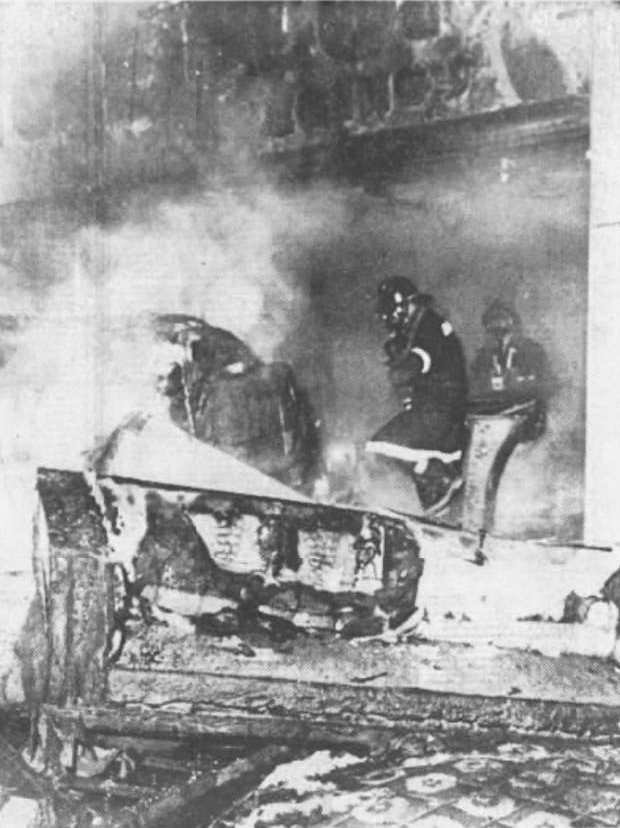
Photo: Firefighters encounter heavy smoke conditions as they exit the burning furniture store.

Detail from the 1950 Sanborn fire insurance map showing the configuration of the fire building (circled in red) and the surrounding exposures.


Photo taken from Side Charlie of the interior of the first floor of the fire-gutted store.


Photo of the hole in the floor of the furniture showroom near where the body of the missing fire officer was recovered.


