
Fire Lieutenant Killed and Firefighter Fatally Injured During Two-Alarm Fire in Pork Packing Plant Icehouse – Cambridge, Massachusetts – November 10, 1898
Submitted by Rick DeGroot
On November 10, 1898, Cambridge Fire Lieutenant James Dalton of Truck Company No. 2 was killed while operating during a two-alarm fire in a former icehouse of a meat packing plant. Lieutenant Dalton had climbed a ladder placed against the exterior of the burning icehouse and attempted to open a window. As he opened the window a blast of fire knocked him from the tip of the ladder to the pavement, where he died 15 minutes later. Another member of Truck Company 2, Fireman Matthew L. Fairbairn was later caught in the collapse of an exterior masonry wall and died on November 23 as a result of his head injuries. The fire originated in a large storeroom on the second floor of the former icehouse that was packed with sawdust, tan bark, and wood shavings and had been tightly sealed prior to the fire. The cause of the blaze was never determined.
The structure involved in the incident was a two-story Type III Ordinary construction building that was formerly used as a meat packing icehouse that was part of the plant occupied by the John P. Squire Pork Packing Company at 169 Gore Street in East Cambridge. All the windows on the second level of the building were tightly sealed with boards. An archway separated the icehouse from a stable. Adjoining the building on the other side was a cooper shop, the plant offices and the main building of the plant. The sprawling plant complex occupied a 22-acre site that bordered the cities of Cambridge and Somerville. Parts of the main plant complex were covered by automatic fire sprinkler systems but the former icehouse which was used for storage was not. The plant maintained their own fire brigade; however, alarms received at the plant were transmitted to both Cambridge and Somerville due to the size of the plant and hazards in the complex.
Cambridge is a city in Middlesex County, Massachusetts, located directly across the Charles River from Boston. The 7.10 square mile city’s population as of the 2020 U.S. census was 118,403, making it the most populous city in the county, the fourth most populous city in the state, behind Boston, Worcester, and Springfield, and ninth most populous city in New England. It was named in honor of the University of Cambridge in England, which was an important center of the Puritan theology that was embraced by the town’s founders. Cambridge is known globally as home to two of the world’s most prestigious universities. Harvard University, an Ivy League university founded in Cambridge in 1636, is the oldest institution of higher learning in the United States and has routinely been ranked as one of the best universities in the world. The Massachusetts Institute of Technology (MIT), founded in 1861, is also located in Cambridge and has been similarly ranked highly among the world’s best universities.
Founded in December 1630, the site of present-day Cambridge was chosen for settlement because it was safely upriver from Boston Harbor, making it easily defendable from attacks by enemy ships. Between 1790 and 1840, Cambridge grew rapidly with the construction of the West Boston Bridge in 1792 connecting Cambridge directly to Boston, making it no longer necessary to travel eight miles through the Boston Neck, Roxbury, and Brookline to cross the Charles River. A second bridge, the Canal Bridge, opened in 1809 alongside the new Middlesex Canal. The new bridges and roads made what were formerly estates and marshland into prime industrial and residential districts. Between 1850 and 1900, Cambridge took on much of its present character, featuring streetcar suburban development along the turnpikes and working class and industrial neighborhoods focused on East Cambridge.
The Cambridge Fire Department was established by an act of the state legislature on March 17, 1832, with a volunteer suppression force of six engines and one ladder truck. At the time of the 1989 fire, the Department consisted of 125 men, 57 fully paid and 68 partly paid (callmen), 37 horses, 7 steam fire engines, 1 reserve steam engine, 2 hook and ladder trucks, 1 aerial ladder truck, 8 hose wagons, and 7 supply wagons. The city of 95,000 residents was covered by a Gamewell telegraph fire alarm system with 123 street fire boxes. Water service included 945 fire hydrants fed from a system of reservoirs and pump houses.
Today the ISO Class 1 Department is a 21st Century “All Hazards Department” which provides not only fire protection, fire prevention and education, emergency medical advanced life support, heavy rescue service, and protection to the environment – but all technical rescue skills as well, including hazardous materials, high-angle, collapse, trench, confined space rescue, and water/ice rescue, both surface and underwater. The Department is staffed by 270 sworn members and 6 civilian members operating from 8 firehouses strategically located throughout the city deploying 8 engines, 4 ladders, 2 BLS rescue/ambulances, 1 Hazardous Materials/Special Operations unit and 1 Special Services Heavy Rescue. In 2025, Cambridge fire companies responded to 16,636 emergency incidents which generated 36,711 responses including 45 building fires, 959 inside fires, 1109 fires of all categories, 7885 EMS calls, and 235 elevator rescues. Cambridge fire companies also responded to their mutual aid partner communities 248 times in 2025.
Early on the morning of Thursday, November 10, 1898, a fire was discovered on the second floor of a two-story former icehouse at the Squire Pork Packing Company at 169 Gore Street in East Cambridge. The fire originated in a large room that was being used as storage for sawdust, tan bark, and wood shavings. As far as is known, no one had been in the room that morning. A worker in an area directly below smelled smoke and called the plant fire brigade. At 6:55 a.m., Box 114 was transmitted summoning Cambridge firefighters. At the same time Box 112 was transmitted calling units from the Somerville Fire Department to the scene.
When the fire departments from Cambridge and Somerville arrived on the scene, the entire icehouse was now involved in flames. A large crowd had gathered and police officers from both cities were summoned to control the sightseers. The response of both departments to the first alarm was immediate, yet the danger to the main buildings was so great that a second alarm was sounded.
The plant fire brigade quickly attacked the fire, which had burned two small holes in the ceiling of the first floor, under the direction of plant Fire Chief Boyer. It was at this time that Lieutenant James Dalton, who worked as a foreman in the yard at the plant and was also a call member of Cambridge Truck Company No. 2, led the brigade in fighting the blaze. The room in which the fire originated was hard to get at, the windows being battened up, necessitating considered effort to get at the seat of the blaze. This room was very large and without partitions, giving the fire an immense space over which to spread.
A ground ladder was quickly placed to the rear of the building and Lieutenant Dalton ran up to a dormer window 30 feet from the ground. He had just reached the window sill and had gotten his footing when a burst of flame shot out of the window into Dalton’s face as he attempted to open the window. He lost his balance and fell to the pavement below, landing sideways with great force. Rescuers quickly picked the unconscious Lieutenant up and carried him into the plant office and summoned medical assistance.
Lieutenant Dalton lived for 15 minutes before expiring from his injuries. His body was carried across the street to his home on Squire Court. The medical examiner found that the Lieutenant’s death was due to a fractured pelvis, fractured ribs, and internal injuries. He also suffered a fractured elbow.
Later in the incident, another member of Cambridge Truck Company No. 2, Fireman Matthew L. Fairbairn, received severe head injuries when he was caught under a collapsing masonry wall. He was taken to Massachusetts General Hospital and later died on November 23 from his injuries. Several other members also received injuries in the wall collapse. An employee of the company who worked in the building was also killed during the fire.
The area on the second floor where the fire originated was hard to reach due to the windows being battened up, necessitating considerable chopping to get at the seat of the fire. The room was very large and without partitions, giving the blaze an immense space over which to spread. The adjoining cooper shop was in great danger. Had the fire not been effectively handled by the combined firefighting forces, the entire plant with its highly flammable products would have been in danger.
The men of both departments deserved great praise for their work at the incident. The opportunity to work from the fire hydrants in the immense plant yard allowed the departments to surround the burning structure and by 11:15 a.m. the fire was practically under control. The fire loss to the building was thought to not exceed $5,000, however water damage to the main building was considerable as a 300-foot portion of the first floor along Gore Street was flooded due to the thousands of gallons poured onto the plant to protect it from the burning icehouse.
Members of the Cambridge Fire Department fatally injured in the line of duty at the John P. Squire Pork Packing Company Fire on November 10, 1898:
- Lieutenant James “Jim” F. Dalton, age 61, was a call member of the Cambridge Fire Department assigned to Ladder 2. He was also a yard foreman employed at the Squire meat packing plant for more than forty years. He was a member of Post 57, Grand Army of the Republic and served in the American Civil War as a member of the Ninth Massachusetts Battery. He left behind a wife and a family of grown children; six daughters and a son. His brother was an inspector with the Cambridge Police Department. The funeral for Lieutenant James F. Dalton was held on November 13, 1898, at the late fireman’s residence at 17 Squire Court. The large attendance included Cambridge and Somerville firemen including chief officers of both departments, and several city officials. The Old 9th Battery, of which Dalton was a member, was also represented. The body was escorted by 50 men of Post 57, Grand Army of the Republic, and by 75 men of the fire department in full uniform. As the body was borne from the house, the bell on the Squire establishment, just opposite, was tolled. Ladder Truck 2 was drawn from its house and brought to the corner of Cambridge and Portland Streets, and as the funeral cortege passed the gong on the apparatus was struck. At Inman Square the bell of Engine 5 was tolled. The procession then proceeded to Cambridge Cemetery for interment.
- Fireman Matthew L. Fairbairn, age 29, was a two-year member of the Cambridge Fire Department assigned to Ladder Company No. 2. His survivors and funeral details are unknown.
The names of Lieutenant James F. Dalton and Fireman Matthew L. Fairbairn have been honored at the Massachusetts Fallen Firefighters Memorial located on the grounds of the State Capitol in Boston. The memorial features a larger-than-life bronze statue of three firefighters in search and rescue mode, weighing approximately 3,000 pounds and standing 10 feet tall. The statue is mounted on a marble Maltese cross and is surrounded by the Ring of Honor, where fire departments, associations, and families can honor deceased firefighters. The memorial also includes granite pavers engraved with the names of fallen firefighters, walkways, gardens, a water feature engraved with the Firefighter’s Prayer, and a ceremonial bell.
The site of the pork packing plant is now occupied by a large shopping center. There is no memorial marker at the site.
Commentary:
While more complete information is unavailable regarding the blast that caused the death of Lieutenant Dalton, it is likely that a smoke explosion occurred in the burning building due to a smoldering fire involving the contents of sawdust, tan bark, and wood shavings in a large room on the second floor of the former icehouse. News accounts of the incident mention that the building had been tightly sealed with the windows battened over. It is likely that a smoke explosion was triggered from a sudden introduction of an ignition source in the building just as the Lieutenant reached the second-floor window. The force of the blast venting out of the window opening caused Dalton to fall from the ladder to the street resulting in fatal impact injuries to the fire officer.
A smoke explosion involves a contained layer of flammable smoke existing within its temperature limits of flammability coming in contact with a source of ignition. Smoke explosions usually occur with a smoke/gas/air pre-mix below 1200 degree F. A smoke explosion produces pressure waves, which usually cause structural damage, with no flames involved. It is very difficult to predict a smoke explosion. However, the following indicators point to the potential for this phenomenon to occur:
- Ventilation-controlled fire (inefficient combustion producing substantial amounts of unburned pyrolysis products and flammable products of incomplete combustion).
- Relatively cool (generally less than 600 degrees C or 1,112 degrees F) smoke.
- Presence of void spaces, particularly if they are interconnected and have combustible structural elements.
- Infiltration of significant amounts of smoke into uninvolved exposures.
A smoke explosion is a relatively cold-smoke environment in which flammable vapors (smoke) have collected significantly in voids or an adjacent compartment from the fire area. A smoke explosion does not require us to make an opening on the perimeter to create ventilation; it gets its air through leaking air that seeps into the space or is readily available in the compartment and void spaces.
A smoke explosion is more difficult to predict than a backdraft. However, by following the modern firefighting principles identified through scientific studies provided by NIST and Underwriters Laboratories, we can reduce the likelihood of smoke explosions by effectively cooling the environment with a sufficient volume of water as quickly as possible, followed by effective and cautious ventilation to clear accumulated smoke and flammable vapors.
Unfortunately, there are no photos or illustrations from the incident. We have attached a detail from the 1900 Sanborn fire insurance map of the area showing the configuration of the meat packing plant and the surrounding exposures.
We have attached the link to an article published in Firehouse magazine on smoke explosions: https://www.firehouse.com/operations-training/article/10500576/extreme-fire-behavior-smoke-explosion?fbclid=IwAR0ALDx-mvzOG7Jb8EXzVF5QXYfDaxDr_TsTQzpyaQxaQ7jCtjs1FKyHwow
We also have attached the link to a news video of a fire in a strip mall in Westfield, New Jersey in 2014 with a smoke explosion captured on camera: https://youtu.be/lp31OAtVOew
Thanks to multiple media sources for the content of this article.
Honor the service of Lieutenant James Dalton and Fireman Matthew Fairbairn by studying the warning signs of smoke explosions and backdrafts with your crew members today.
Remember Fallen Brothers.
Get Out There And Know The History of Your Local!!!
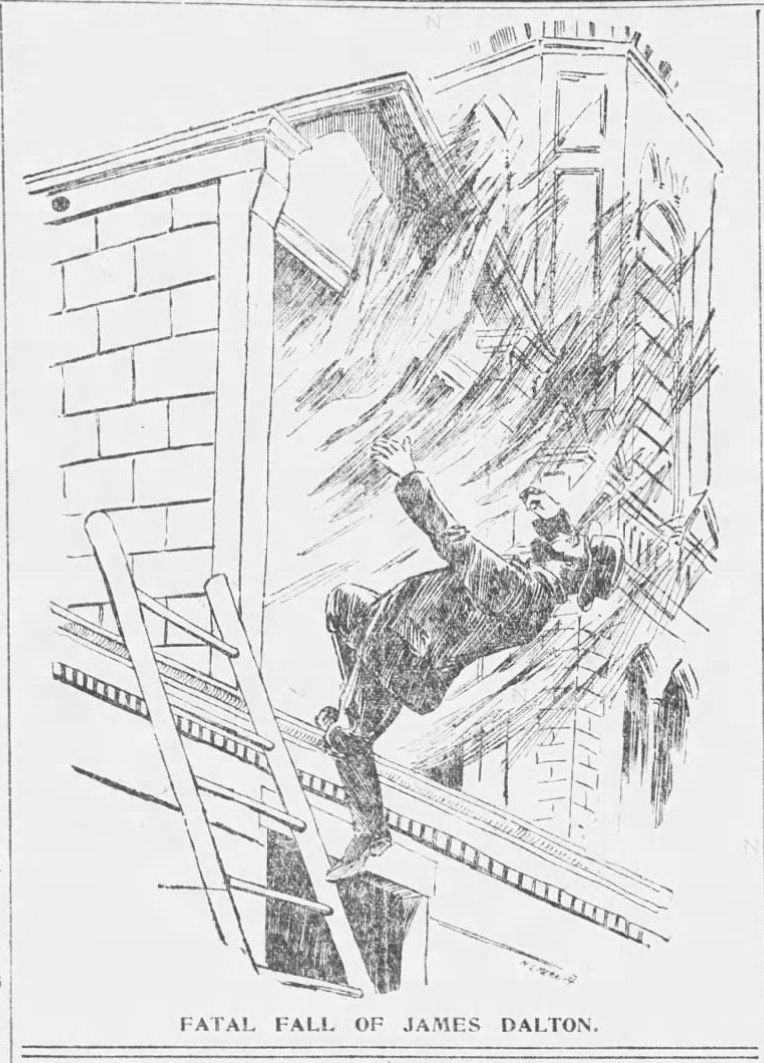
Newspaper illustration of the fall of Lieutenant Dalton.


Detail from the 1900 Sanborn fire insurance map of the area showing the configuration of the meat packing plant and the surrounding exposures. The location of the icehouse is circled in red.

The funeral for Lieutenant James F. Dalton was held on November 13, 1898, at the late fireman’s residence at 17 Squire Court. The large attendance included Cambridge and Somerville firemen including chief officers of both departments, and several city officials. The Old 9th Battery, of which Dalton was a member, was also represented. The body was escorted by 50 men of Post 57, Grand Army of the Republic, and by 75 men of the fire department in full uniform. As the body was borne from the house, the bell on the Squire establishment, just opposite, was tolled. Ladder truck 2 was drawn from its house and brought to the corner of Cambridge and Portland Streets, and as the funeral cortege passed the gong on the apparatus was struck. At Inman Square the bell of Engine 5 was tolled. The procession then proceeded to Cambridge Cemetery for interment.


