Firefighter Killed by Truss Roof and Wall Collapse During Auto Dealership Fire – Eugene, Oregon – October 11, 1966
On October 11, 1966, Eugene Oregon Engineer Harold Stinson was killed while fighting a general alarm fire at the Kendall Ford auto dealership in the downtown section of the city. Stinson was manning the nozzle of an exterior hoseline with three other firefighters when the timber truss roof assembly collapsed toppling a concrete sidewall. Stinson was unable get out of the way before the wall came crashing down burying him in the rubble. He was removed from the debris but expired from his injuries. Another Eugene firefighter, Captain Leland Christensen also died from a heart attack while working at the scene of the blaze. Captain Christensen was working on the south side of the building on 13th Avenue when he collapsed on the pavement. Firefighters rushed to his aid, but he could not be resuscitated. Another firefighter was seriously injured when a hoseline separated from a pumper connection and struck him in the chest. The cause of the fire which started in the new car preparation area of the dealership was undetermined. The deaths were the first line of duty deaths suffered by Eugene firefighters in 43 years.
The structure involved in the incident was a one-story commercial building occupied by an automobile dealership and service facility that was built in 1940. The Kendall Ford Agency at the northwest corner of West 13th and Olive Streets occupied a full block in the downtown business district of the city. The building measured about 180 feet wide, 200 feet deep and 18 feet high and had a timber truss roof supported by 6 by 12-inch wood posts with concrete block curtain walls on a concrete floor. A portion of the building at the Alpha/Delta corner was walled off as a new car showroom and offices while a 25-foot-wide fire-resistive concrete one-story addition on Side Bravo ran the length of the building. New and used car parking lots were located on Sides Bravo and Charlie while Side Alpha fronted on 66-foot-wide West 13th Street and Side Delta fronted on 66-foot-wide Olive Street. The dealership was not equipped with a fire alarm system or an automatic fire sprinkler system. A fire hydrant fed from a 6-inch water main was located in front of the building. A fire alarm call box was located across the street from the dealership. The Eugene Public Library, a two-story Type I Fire Resistive construction structure built in 1958, was opposite the dealership across West 13th Street.
Eugene is the second largest city in the state of Oregon after Portland and the seat of Lane County. It is located at the southern end of the Willamette Valley, near the confluence of the McKenzie and Willamette rivers, about 50 miles east of the Oregon Coast and 100 miles south of Portland. As of the 2020 U.S. census, Eugene had a population of 176,654 and covers an area of 44.21 square miles. Today the city is protected by the Eugene/Springfield Fire Department, which is the result of a merger of the former fire departments from both cities in 2010. The combined department operates from 16 fire stations divided into 3 battalions deploying 12 engines, 5 ladder trucks, 7 ALS ambulances, 5 BLS ambulances, 1 heavy rescue unit, 1 wildland engines, 2 ARFF airport crash units, 1 rescue boat, and 3 reserve tenders. Specialty units include a confined space rescue unit, a water rescue unit, and a HazMat unit. The combined department has 308 employees that provide fire, rescue and emergency medical services to 94.3 square miles for fire and rescue coverage and 1,625 square miles for ambulance coverage. During 2024 department fire suppression units made over 96,000 unit responses. This is an aggregate total of all responses per individual unit. There were approximately 296 structure fire responses, with several of these becoming greater alarm responses, meaning second or greater alarm response.
Area weather conditions on the evening of the fire included an air temperature of 46 degrees F and a relative humidity of 89% with calm winds under partly cloudy skies (Weather Underground). The weather conditions did not appear to be a significant factor in fire development or the outcome of the incident.
Eugene firefighters were called to the block-long Kendall Ford Agency at 7:45 p.m. on Tuesday, October 11, 1966, on a report of a fire in the building. The fire was reported to have started in the central portion of the building that housed the new car preparation area. One of the firm’s salesmen, John Brown, was outside in the new car lot when he saw flames pouring from the building. He said that by the time he ran across the street to call for help, the building was engulfed in flames.
Eugene firefighters soon arrived on the scene to find the flames shooting 50 to 100 feet into the air. By 8:01 p.m., the building was fully involved and with the flames spreading rapidly, a general alarm was sounded. Fed by exploding gasoline tanks and oil supplies in the building, a towering column of smoke drew thousands of spectators to the scene as police struggled to keep the crowd back.
Eleven Eugene fire companies and over 75 firemen battled the blaze. All off-duty Eugene firefighters were called back to duty to help fight the fire. Firefighters from nearby Springfield provided standby coverage in empty city fire stations.
Four firefighters including Engineer Harold Stinson were operating a hoseline outside the building battling the flames when the timber truss roof suddenly collapsed pushing out an exterior masonry wall that fell on the hose crew. As soon as the wall crumbled, a dozen or more firefighters, several spectators, and some newsmen rushed to the collapsed rubble in an attempt to get Stinson out. He was pulled from the wreckage within a few seconds. The other three firefighters were able to escape with minor injuries however Stinson was crushed under the weight of the debris and rushed to Sacred Heart Hospital where he was pronounced dead from his injuries. Eugene Fire Chief E.L. Smith said that Stinson had died instantly.
James Hausler, a witness to the crumbling wall that killed Stinson was watching the fire from the library on the second floor of the Bible Standard College across the street from the dealership. “There were four men on the hose and one of them went back into the street to pull more hose—the other three remained right up close to the wall,” Hausler said. “Then the fourth man began hollering to the other three men when the wall began to crack. They all turned and two of them started running back, but the man holding the nozzle couldn’t get out in time—he threw his hands up like he was trying to stop the wall just as the wall hit him.”
Eugene Fire Captain Leland Christensen apparently suffered a heart attack while battling the blaze. Christensen was working with a group of firefighters on the south side of the building on West 13th Street when he collapsed on the pavement. Firefighters rushed to his aid and Robert Jackson, manager of the Lane County chapter of the American Red Cross, quickly arrived with a resuscitator but they were unable to revive the unresponsive Captain. He was rushed to Sacred Heart Hospital where he was pronounced dead on arrival.
Another firefighter, George A. Nohrenberg was injured after being struck in the chest by a hose coupling that had separated from a pumper connection. He was admitted to Sacred Heart Hospital and was reported in good condition the next morning.
Richard Rementeria, general manager of the business, said at least 40 cars, 15 of them new, were destroyed. He estimated that the total loss at between $300,000 and $400,000. The fire was brought under control in about two hours. The blaze never threatened nearby buildings because there was little wind. The radiated heat, however, broke windows at the eight-year-old public library across the street. The cause of the fire which apparently started in the new car preparation area of the dealership was undetermined.
About 40 off-duty city firefighters called in to fight the blaze pledged overtime money earned fighting the fire to a special relief fund for the families of the fallen firefighters. The overtime was expected to amount to about $1000 and was added to other funds that had been raised for the families.
Chief Smith said of the two fallen firefighters, “They were both fine men and dedicated firemen and their deaths will place a loss on the department that will be difficult to overcome for many years. They were honestly and sincerely that good.”
Members of the Eugene Fire Department killed in the line of duty during the Kendall Ford Fire on October 10, 1966:
- Engineer Harold “Bucky” Stinson, age 33, was a 10-year veteran of the Eugene Fire Department. He was also a US Army veteran of the Korean War. Stinson was survived by his wife, Constance; his daughter, Katherine; his son, George Scott; and his parents, Mr. and Mrs. George Scott. His wife was also expecting their third child in February. His funeral service was conducted on the morning of October 14 at the Westside Church of Christ followed by a private interment service for the family at Sunset Hills Memorial Gardens in Eugene.
- Captain Leland Neil Christensen, age 41, was an 11-year veteran of the Eugene Fire Department and was assigned to the Fire Prevention Bureau. He was survived by his wife, Loma; his son, Michael; and daughter, Laurie Jeanette; his brother, Richard; and his sister, Elizabeth Carrie; his father, Mr. Neil Christensen; and his mother, Mrs. Nellie Clark. His funeral service was conducted on the afternoon of October 14 at the Wesley United Methodist Church with interment services following at Rest-Haven Memorial Park in Eugene. The fallen Captain received a military burial as a rifle squad fired the traditional three volleys into the air while a bugler played “Taps.”
Firefighters from several area fire departments formed two lines outside both of the churches as the casket of each fallen firefighter was borne slowly to the hearse following each service.
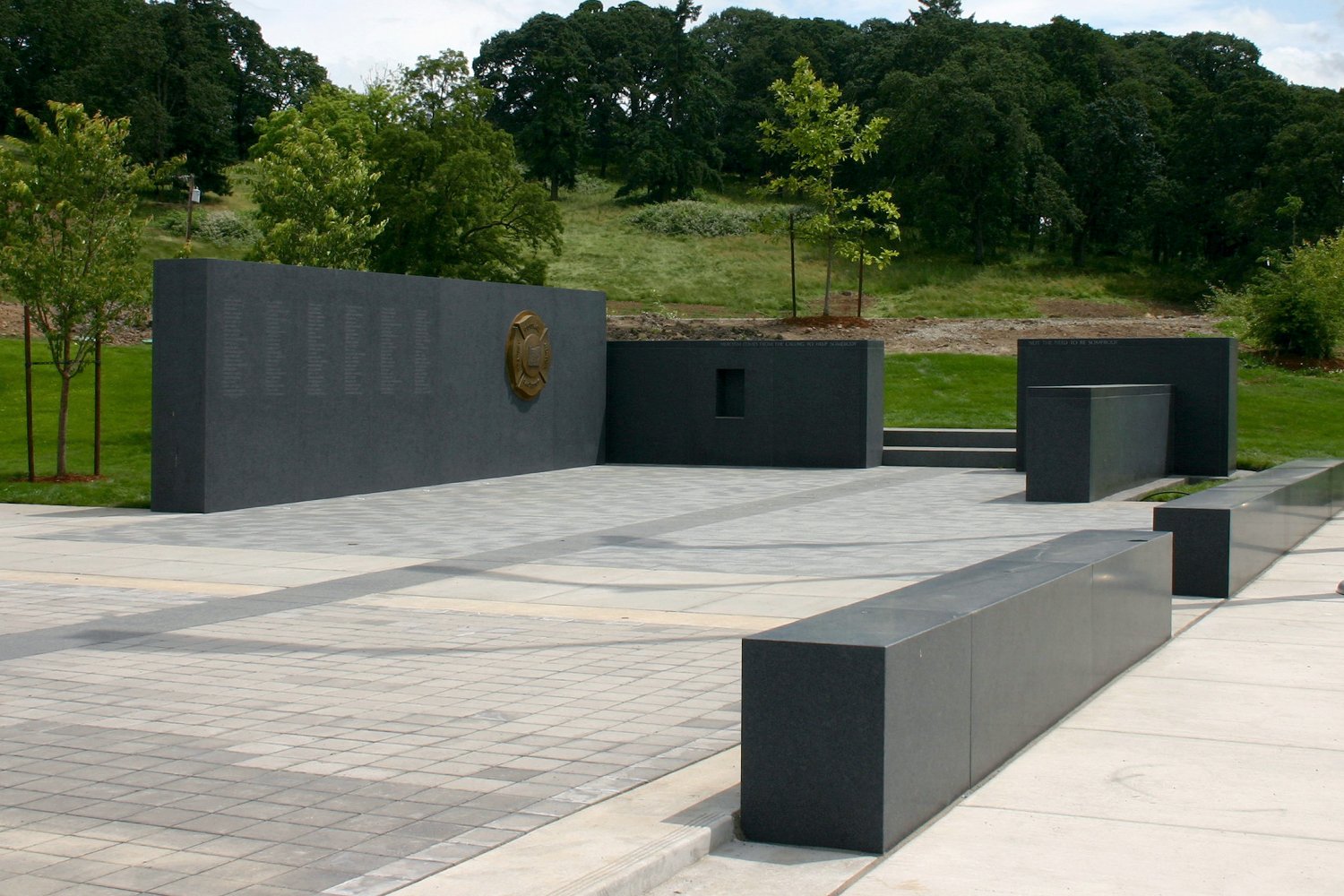
The names of Engineer Harold “Bucky” Stinson and Captain Leland Neil Christensen have been inscribed on the Memorial Wall at the Oregon Fallen Firefighters Memorial on the grounds of the Oregon Public Safety Academy located in the state capitol of Salem. The Memorial features a dark granite wall engraved with the names of career, volunteer, wildland, and structural firefighters including chief officers, company officers, engineers, and firefighters who have died in the line of duty in the state. A large bronze Maltese Cross medallion affixed to the wall flanks the names of the fallen. The Memorial is set on a plaza paved with gray bricks with granite benches that provides a quiet space to honor the fallen. To date, 182 line-of-duty deaths since 1881 have been approved for the Memorial Wall. Every June, an annual remembrance ceremony is held at the Memorial.
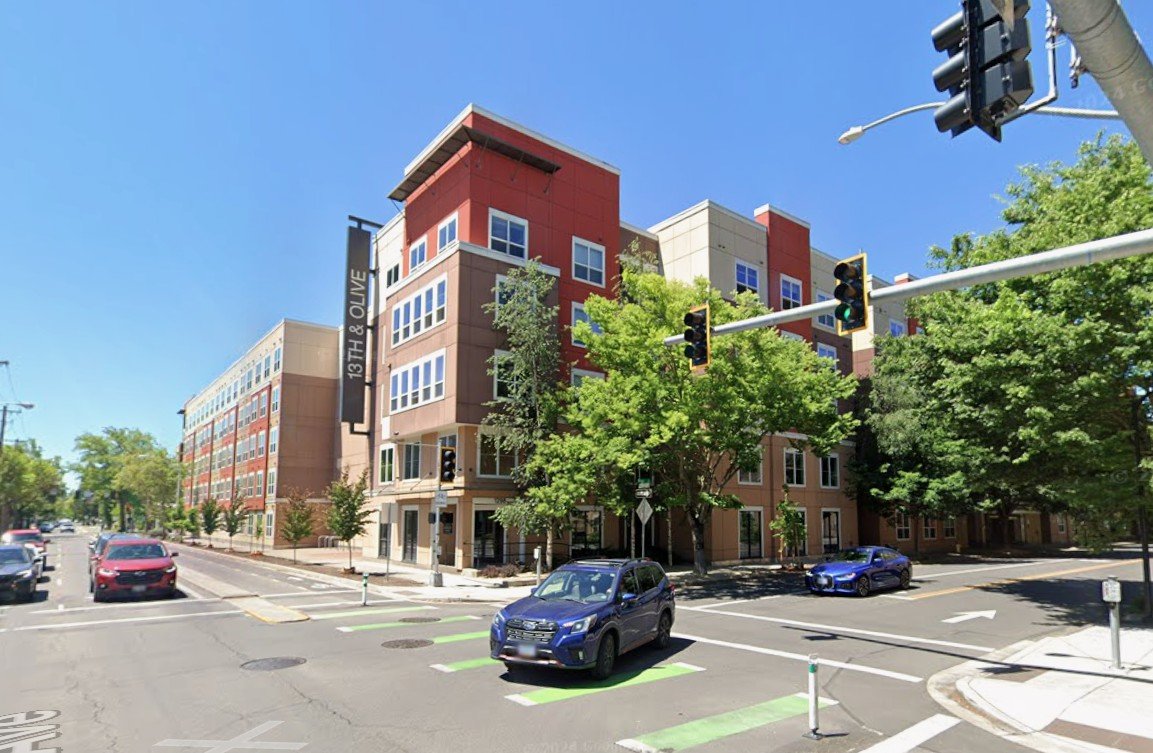
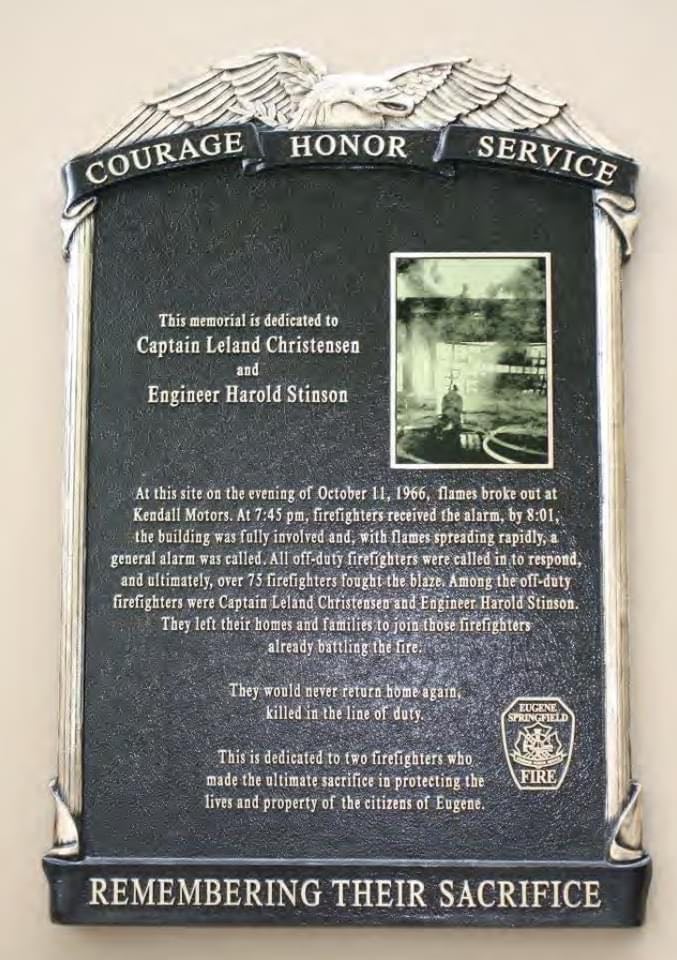
The site of the former auto dealership is now occupied by a five-story high-density residential housing complex for students attending the nearby University of Oregon campus. A memorial marker honoring the two fallen firefighters has been affixed to the southeast corner of the building.
Commentary:
While further information on the exact type of timber truss construction of the roof of automobile dealership building involved in this incident was unavailable for this article, we suspect that the sudden collapse of a masonry sidewall of the building while it was heavily involved in fire may have been the result of a truss failure that pushed the sidewall out leading to the wall collapse that took the life of Firefighter Stinson. A photo of the ruins of the building taken the morning after the fire clearly shows the remains of at least one timber truss assembly. Many automobile dealership occupancies were constructed during the mid-1900s that often used heavy timber and steel roof trusses that tend to push out the sidewalls when they fail during a fire. While we do not know specifically that a failure of the roof truss assembly directly caused the collapse in this incident, firefighters must be aware of the possible presence of truss roof assemblies in occupancies that require large open areas inside the building such as automobile dealerships, vehicle service garages, bowling alleys, supermarkets, sports arenas, and houses of worship. When firefighters have shifted fire attack operations to the exterior, the sidewalls must be monitored for stability and firefighters should be positioned outside of the collapse zone and take advantage of the reach of large caliber streams to battle the fire. This incident is hauntingly familiar of an incident in Cliffside Park, New Jersey in 1967 where five firefighters were killed in the collapse of a cinder block sidewall of a burning bowling alley on October 15, 1967. The building was equipped with a heavy timber arched truss roof assembly that failed and pushed the sidewall out when the roof collapsed after a smoke explosion in the trussloft:
https://www.facebook.com/groups/192218352449074/permalink/1352617726409125/
Retired FDNY Deputy Chief Vincent Dunn has said it best, “There is nothing new in the way firefighters are killed and injured year after year. The only new factor in the equation of death and injury is the new firefighter.” Besides the Cliffside Park incident, some additional truss roof failures that have resulted in firefighter fatalities and serious injuries include:
Thirteen firefighters killed in the collapse of an unprotected steel truss roof during a theater fire in Brockton, Massachusetts on March 10, 1941: https://www.facebook.com/groups/192218352449074/permalink/1177018427302390/
Three Chicago firefighters killed in the collapse of a heavy timber truss roof during a fire in an automobile dealership on March 27, 1958:
https://www.facebook.com/groups/192218352449074/permalink/1189612206043012/
Two firemen killed in collapse of a heavy timber bowstring truss roof at an auto dealership fire in Highland Park, New Jersey on May 26, 1958:
https://www.facebook.com/groups/192218352449074/permalink/1235343258136573/
Firefighter killed in collapse of a steel truss roof while operating at an automobile repair garage fire in Shakopee, Minnesota on September 30, 1959:
https://www.facebook.com/groups/192218352449074/permalink/1338469947823903/
Firefighter killed and assistant fire chief severely Injured in timber truss roof and wall collapse during six alarm auto dealership fire in Little Rock, Arkansas on September 28, 1963: https://www.facebook.com/groups/192218352449074/permalink/1336876534649911/
Four firefighters killed in collapse of steel truss roof during a fire in an automobile dealership in Wichita, Kansas on November 21, 1968:
https://www.facebook.com/groups/192218352449074/permalink/866984498305786/
Six FDNY firefighters were killed in a supermarket fire when a timber truss roof failed plunging twelve firefighters operating on the roof into the burning interior of the store in Brooklyn, New York on August 2, 1978: https://www.facebook.com/groups/192218352449074/permalink/1019427343061500/
Two firefighters killed by the collapse of a timber truss roof assembly of a burning synagogue in Valley Stream, Long Island, New York on November 22, 1979:
https://www.facebook.com/groups/192218352449074/permalink/1288866216117610/
Five Hackensack, New Jersey firefighters were killed when a burning arched timber truss roof collapsed during a fire in an automobile dealership service garage on July 1, 1988:
https://www.facebook.com/groups/192218352449074/permalink/1262764488727783/
An Omaha, Nebraska fire captain was killed in a steel truss roof collapse during four alarm arson fire in discount store on April 23, 1996:
https://www.facebook.com/groups/192218352449074/permalink/1212055240465375/
Two Chicago firefighters were killed, and 19 firefighters injured in the fire collapse of a timber truss roof in an abandoned former commercial laundry building on December 22, 2010:
https://www.facebook.com/groups/192218352449074/permalink/1120764389594461/
One Colby fire officer was killed, and several other firefighters injured when a timber truss roof collapsed on top of firefighters operating in the interior of a theater during a fire in Abbotsford, Wisconsin on March 4, 2012:
https://www.facebook.com/groups/192218352449074/permalink/1173059114364988/
The best protection from firefighter injury and death while operating at fires in these types of occupancies is to identify the location of buildings equipped with truss roof assemblies in your local response area prior to fires occurring these dangerous structures.
We have attached several photos from the incident. We have also attached a detail from the 1926 Sanborn fire insurance map of the block showing the configuration of the building and the surrounding exposures.
We have attached a link to an article published in Fire Engineering magazine by group member Sal Ancona on bowstring/arched rib timber truss roofs: https://www.fireengineering.com/fire-prevention-protection/firefighters-and-construction-bowstring-arched-rib-truss-roof-systems/
We have also attached the link to a recent BCFS Question of the Week article on long span timber truss supported roof assemblies: https://www.facebook.com/groups/192218352449074/permalink/1540727084264854/
Honor the service of Firefighter Harold “Bucky” Stinson by identifying and conducting pre-incident planning of occupancies within your local response area that are equipped with truss roof assemblies with your crew members today.
Remember Fallen Brothers.
Get Out There And Know Your Local!!!
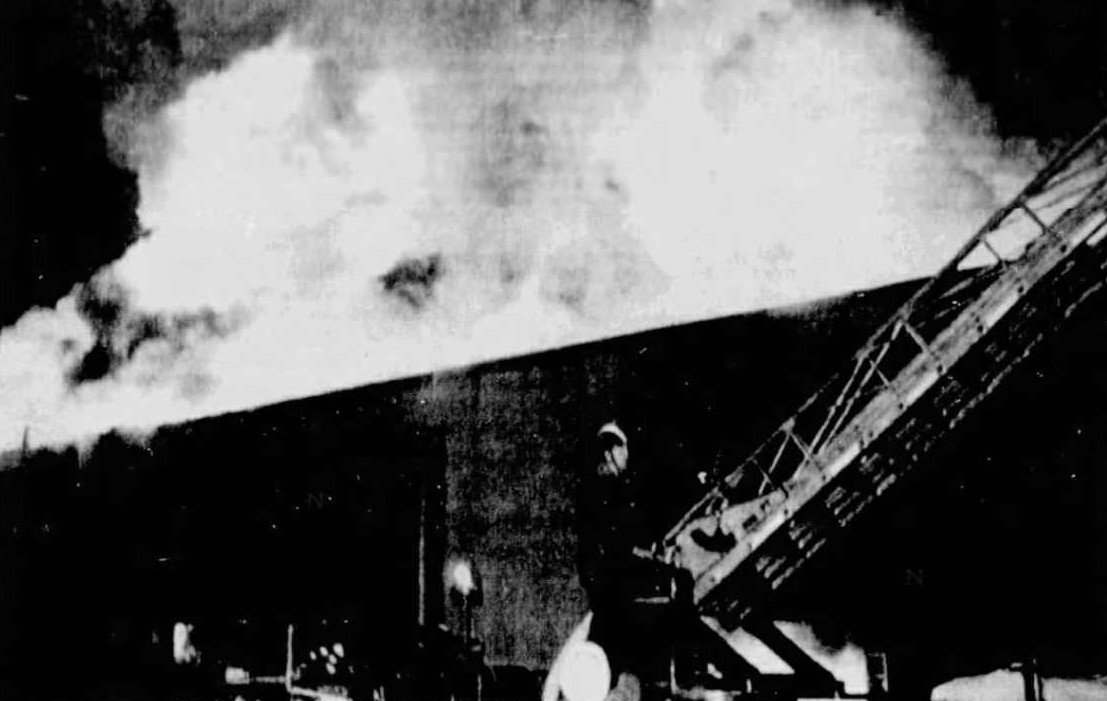
Photo of the fire overtaking the roof shortly before the roof collapsed pushing out a sidewall that killed Firefighter Harold Stinson.
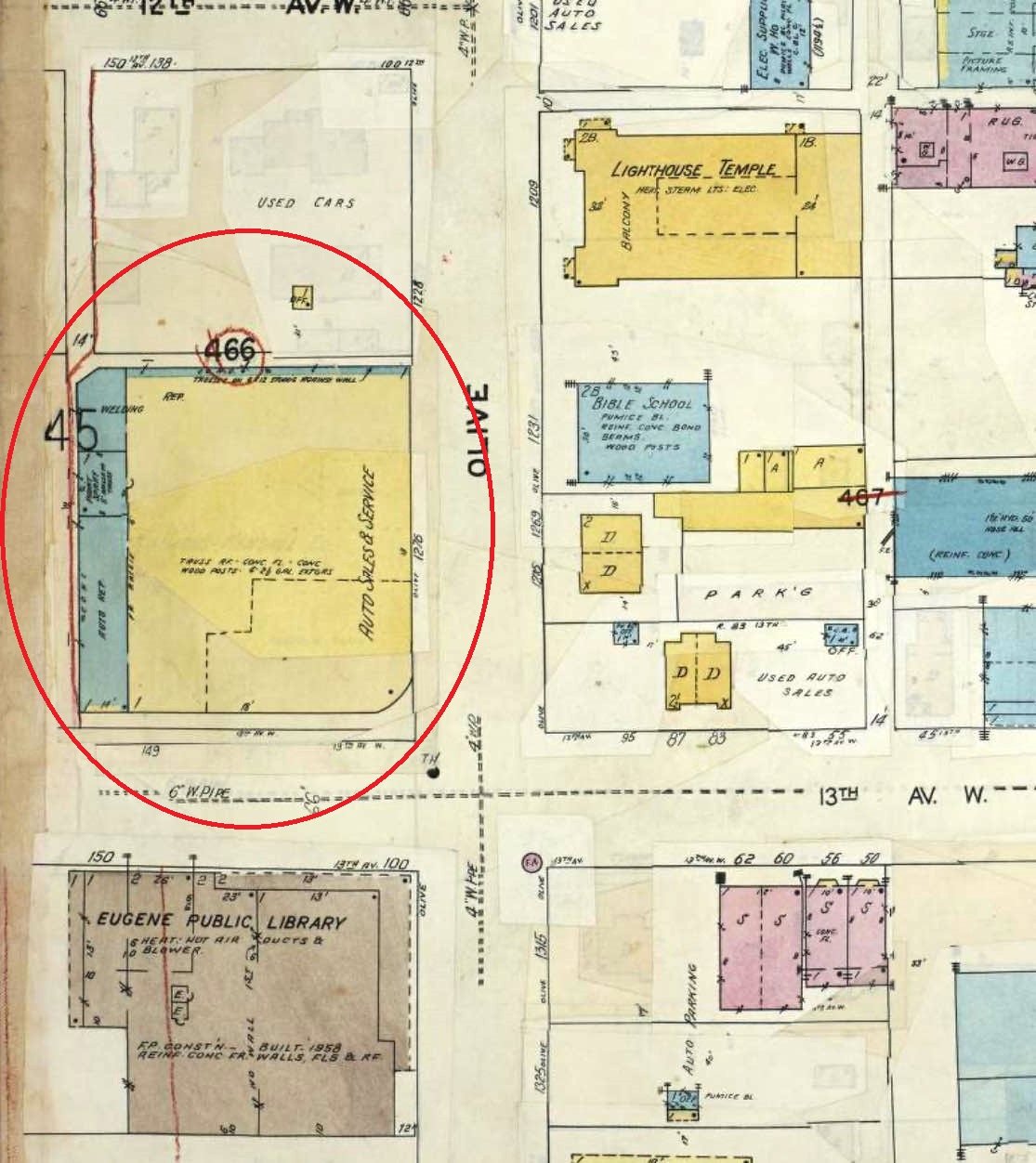
Detail from the 1926 Sanborn fire insurance map of the block showing the configuration of the fire building (circled in red) and the surrounding exposures.
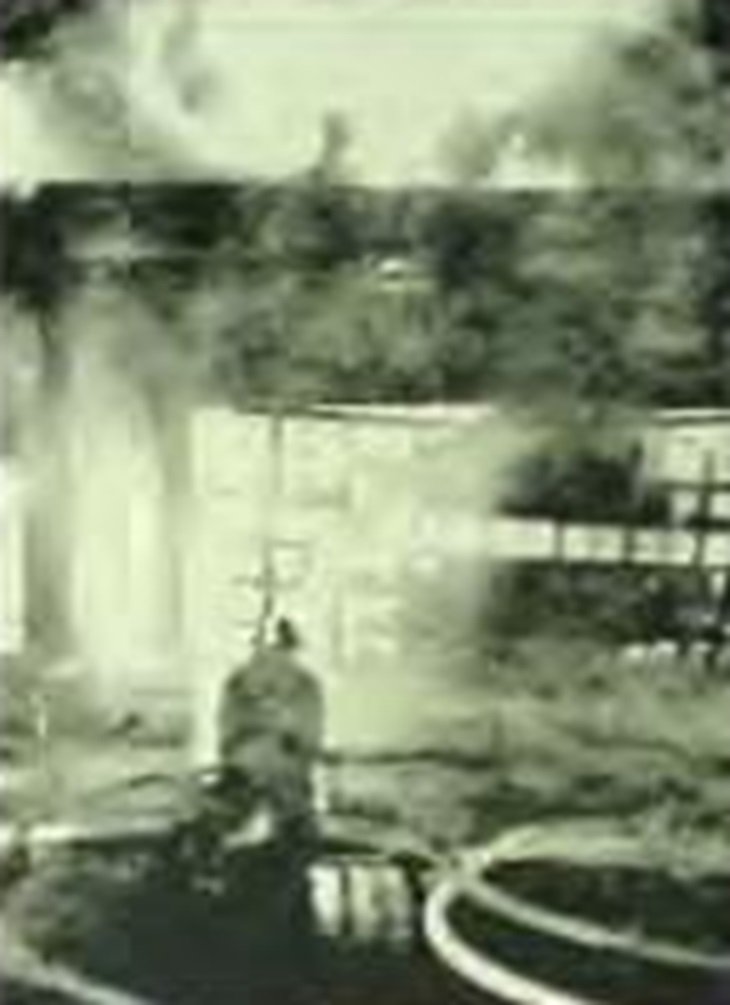
Eugene firefighters arrived on the scene to find the flames shooting 50-100 feet into the air. By 8:01 p.m., the building was fully involved and with the flames spreading rapidly, a general alarm was sounded. Fed by exploding gasoline tanks and oil supplies in the building, a towering column of smoke drew thousands of spectators to the scene as police struggled to keep the crowd back.
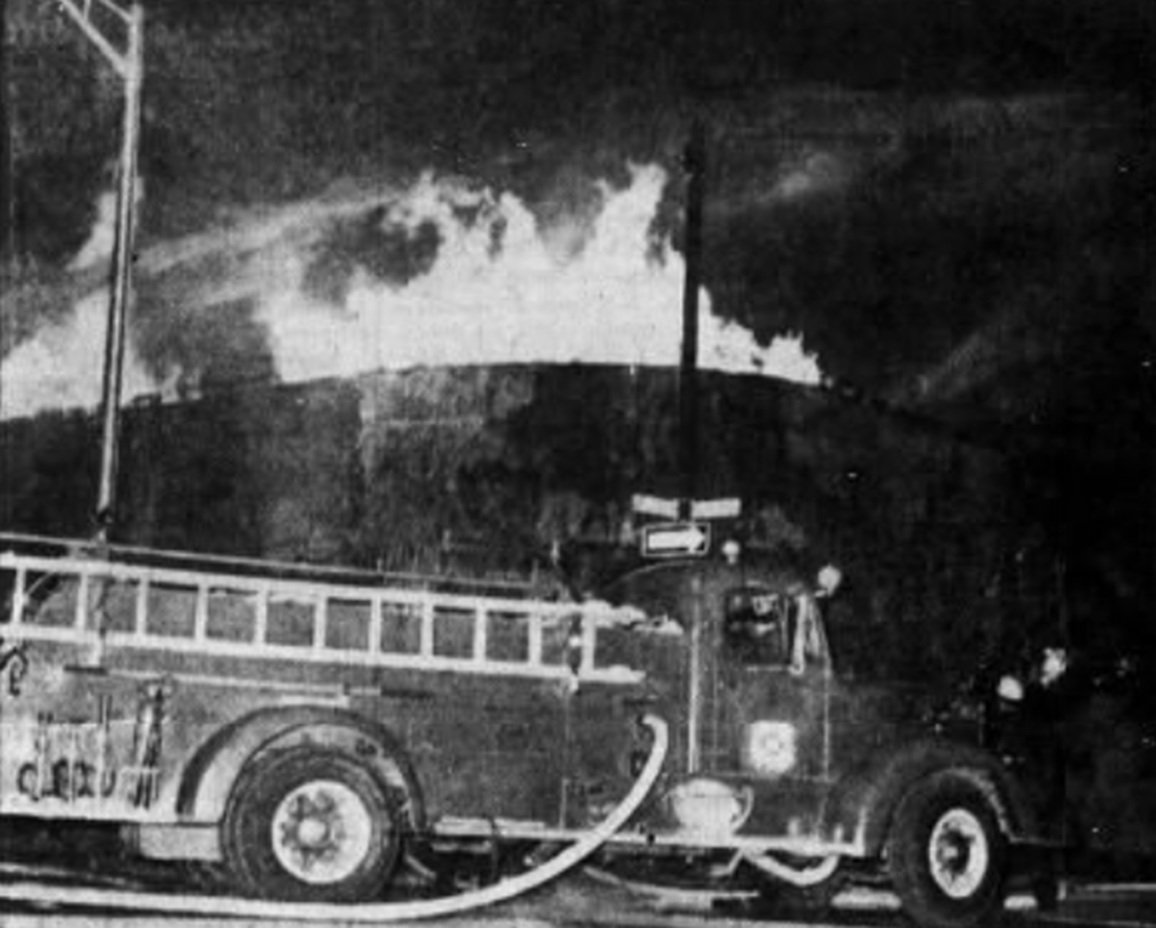
Photo showimg the roof overtaken by fire just prior to the collapse of the side wall.
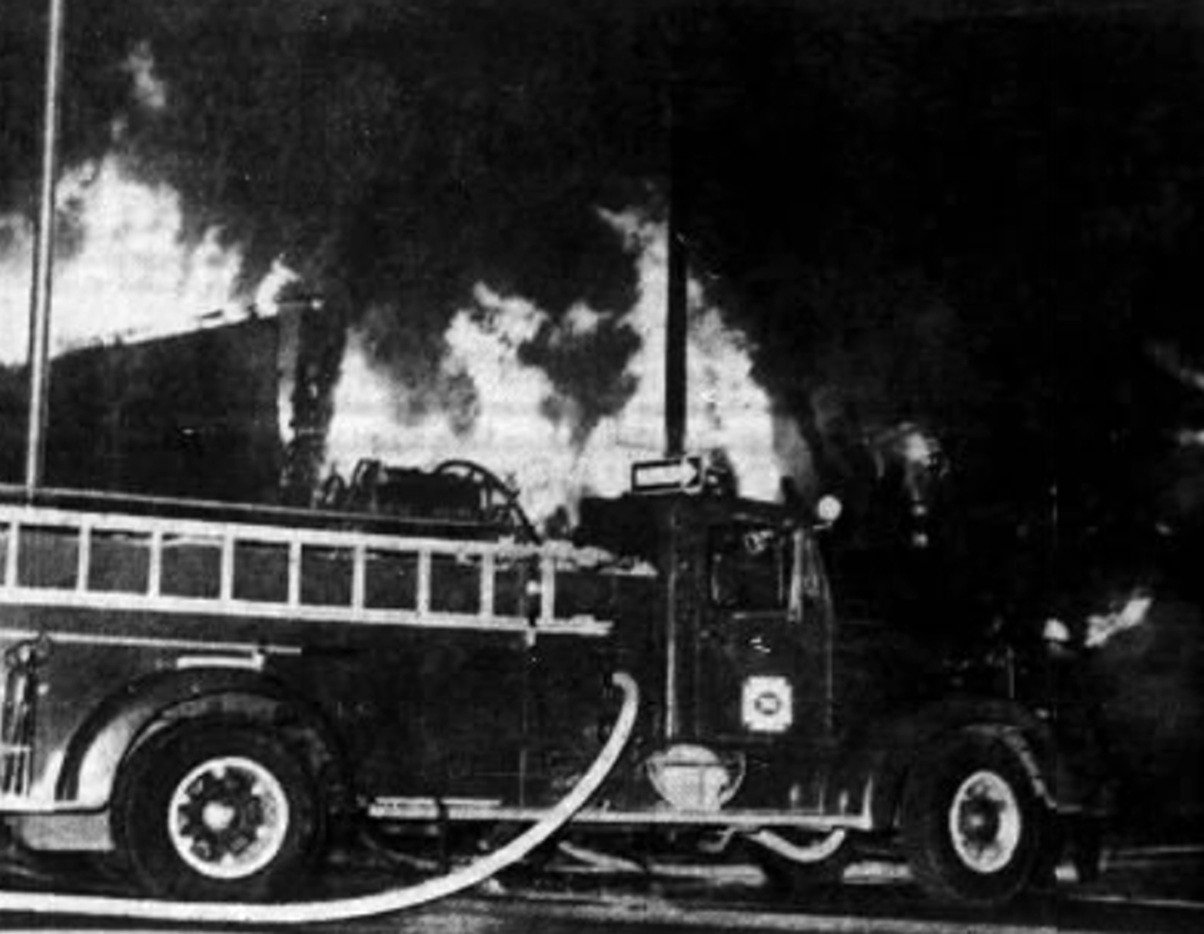
Photo taken just after the collapse of the side wall that killed Engineer Stinson.
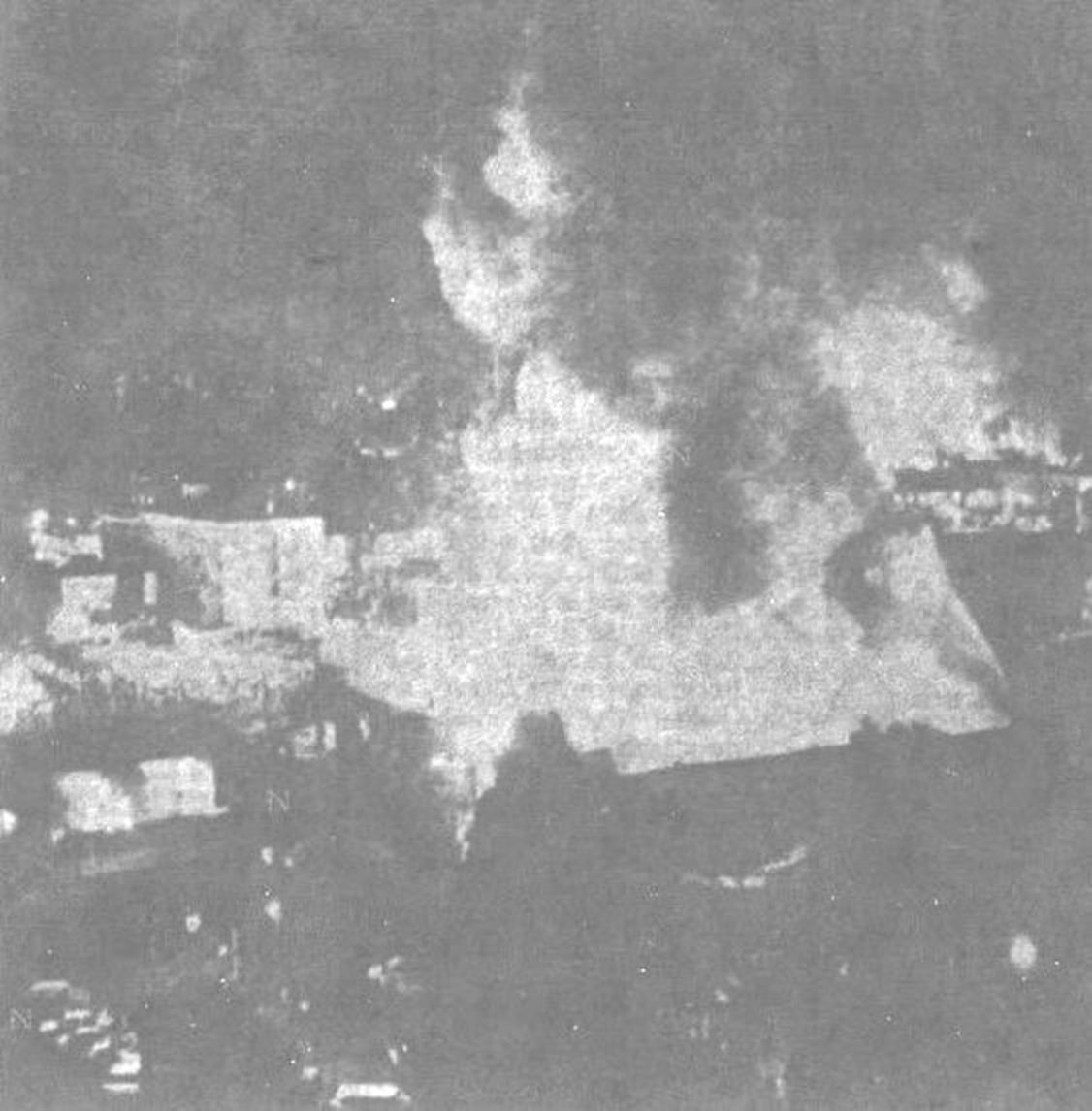
Photo: Heavy fire vents from the collapsed roof of the dealership.
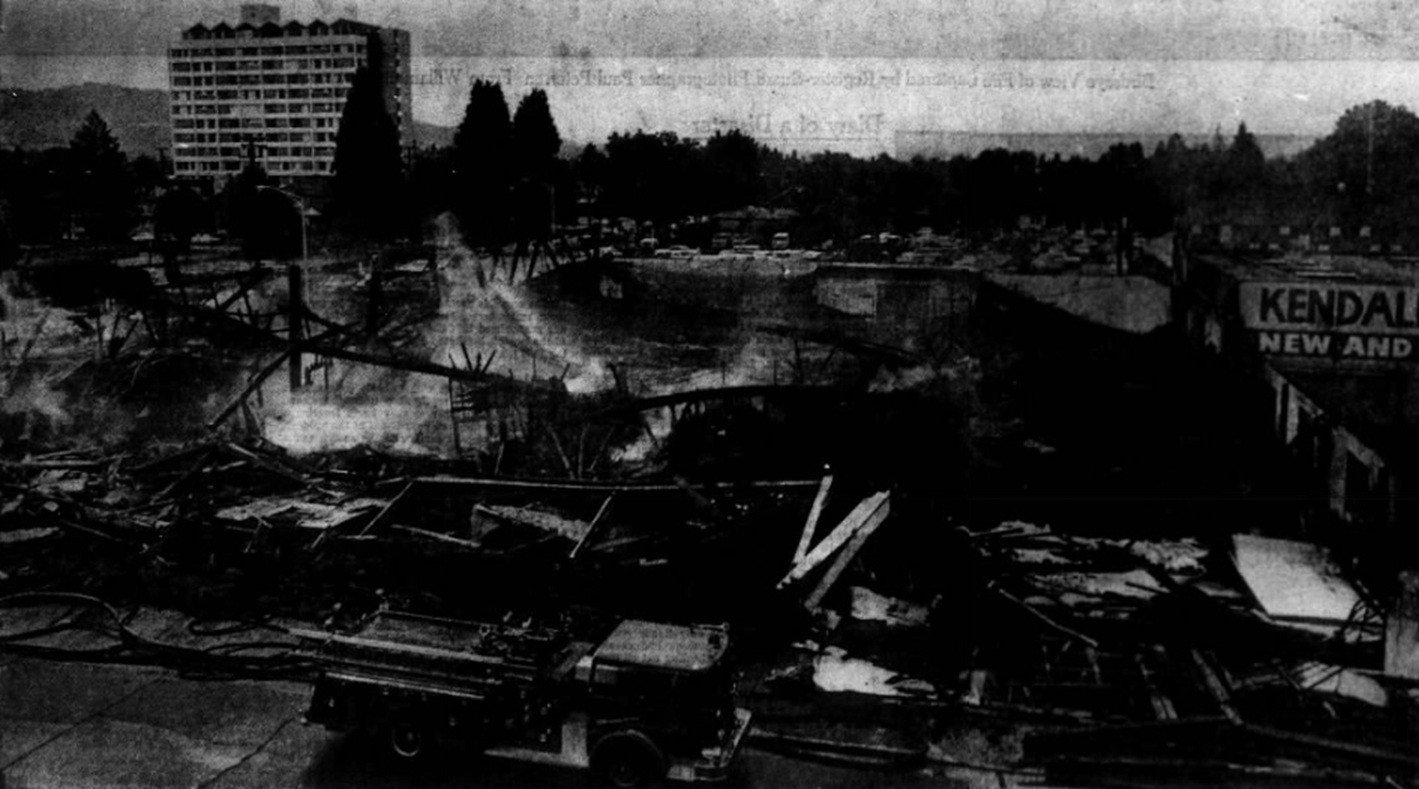
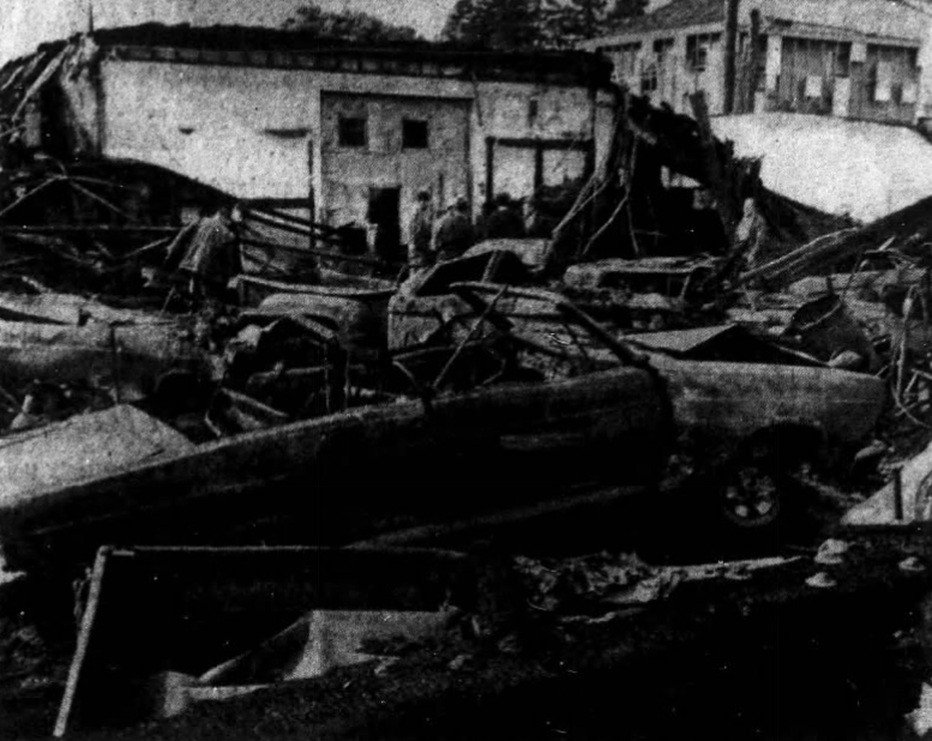
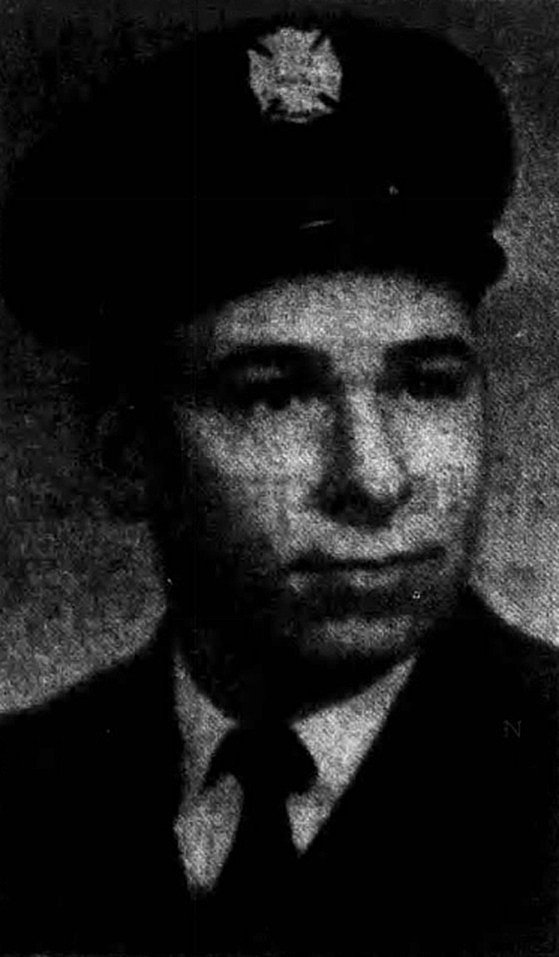
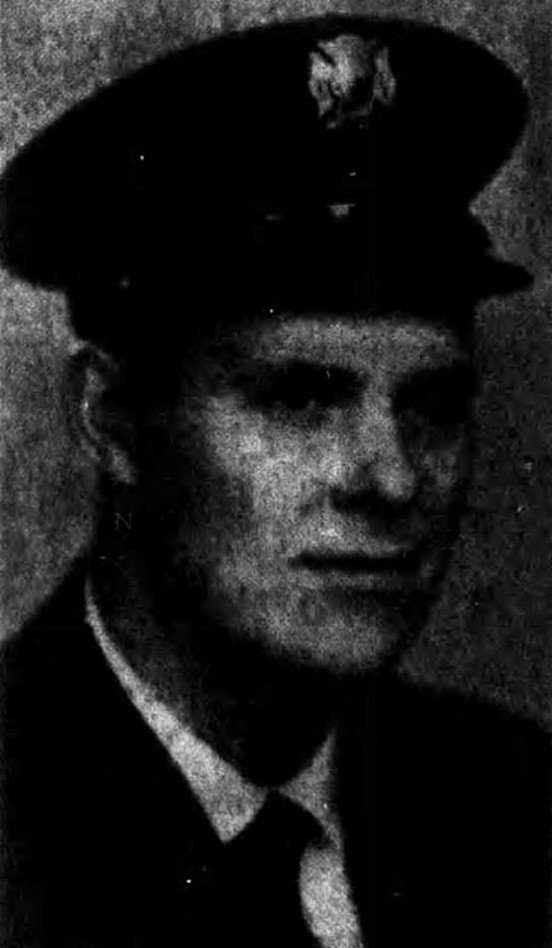
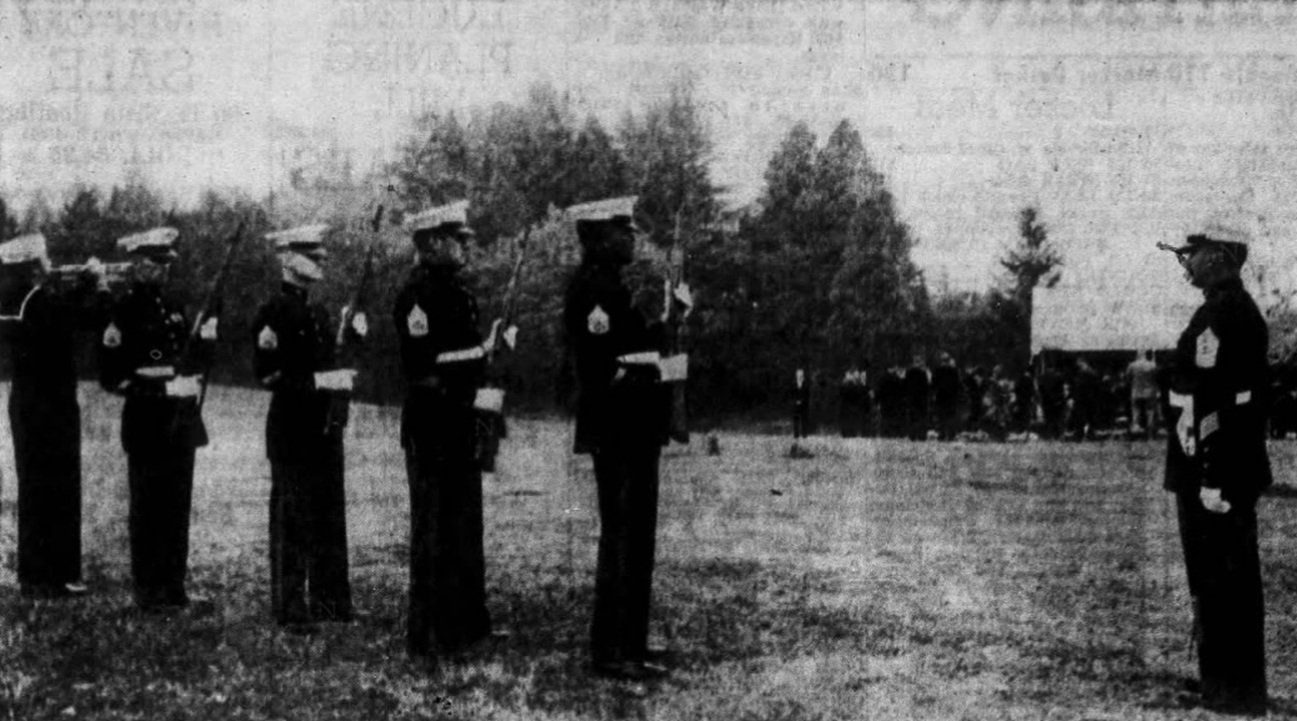
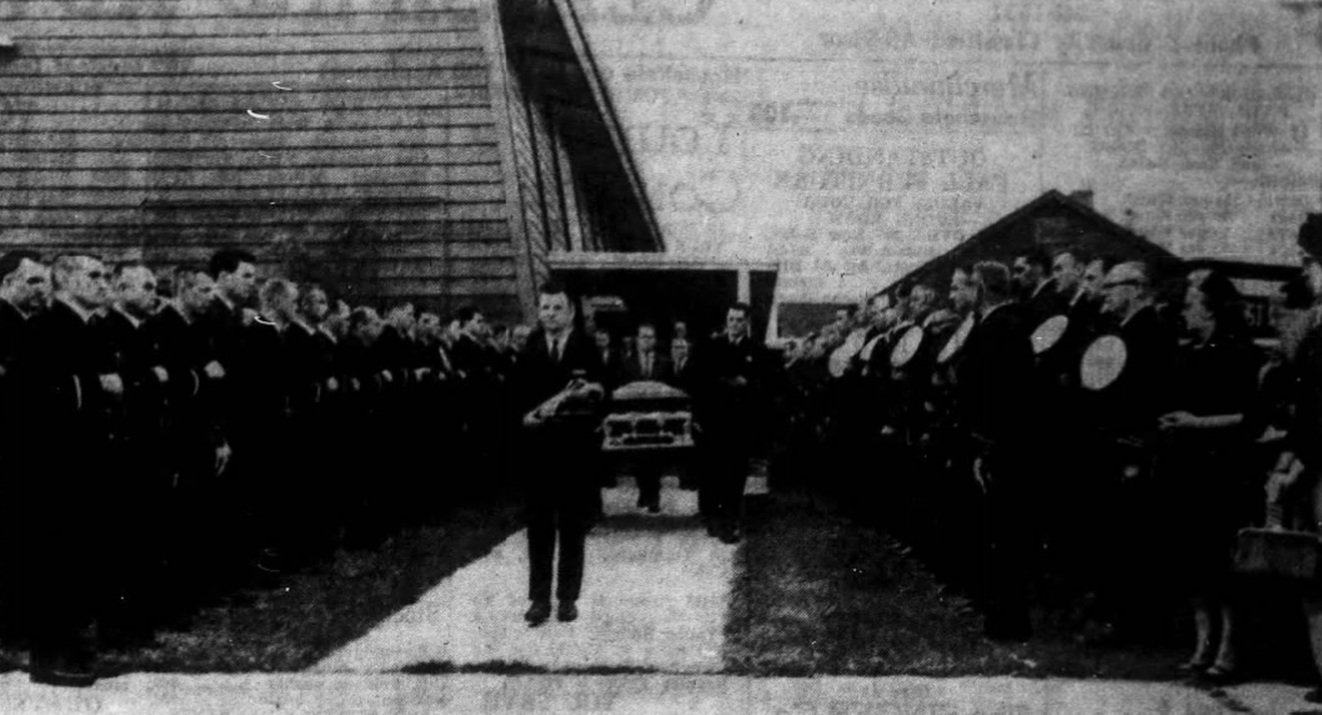
Photo of the funeral of Engineer Harold Stinson.