
Two Firefighters Fatally Injured by Collapse of Burning Synagogue Timber Truss Roof – Gates of Zion Temple – Valley Stream, Long Island, New York – November 22, 1979
Submitted by Rick DeGroot
In the early morning hours of Thanksgiving Day, November 22, 1979, Valley Stream Long Island Fire Captain John Joseph Tate, Jr. and Fire Captain Michael Moran were fatally injured while battling a suspicious fire in the Temple Gates of Zion Synagogue at 322 North Corona Avenue. After knocking down a fire in a small room next to the main altar, heat and flame were quickly reduced and firefighters assumed the blaze was extinguished. But unnoticed in the smoke, flame had spread up to the attic space through a small spiral staircase leading to the attic. In the attic, concealed by a recently installed ceiling, truss roof supports were burning. As firefighters continued to work in the sanctuary, the ceiling and the triangular timber truss roof collapsed. The collapse and ensuing fire trapped and severely burned several firefighters. Two members were fatally burned. Captain Tate died eight days after the fire from his burn injuries. Captain Moran survived for 16 days following the blaze before he too died from his burn injuries. A total of 14 firefighters received burns and other injuries during the fire. The cause of the blaze, which destroyed the synagogue’s sanctuary and social hall, was declared suspicious as the synagogue had been the target of repeated attacks by vandals but no one was ever charged with a crime in connection with the fire.
The structure involved in the incident was a two-story Type III Ordinary construction brick and wood frame synagogue built in 1926. The building had several sections including a social hall, offices, classrooms, and a sanctuary with a high ceiling. The roof over the sanctuary portion of the building was supported by an inclined plane (triangular) timber truss assembly that was located in a low attic that was accessed by a narrow spiral staircase behind the altar. The synagogue was not equipped with a fire alarm system or an automatic fire sprinkler system. Fire hydrants were located about 150 feet away in both directions on North Corona Avenue.
Valley Stream is a village in Nassau County on Long Island in the State of New York. The 3.5 square mile community borders the New York City Borough of Queens and is part of the Town of Hempstead. The population of Valley Stream was 40,634 residents at the 2020 U.S. census. In the early 20th century, the village developed as a mostly residential suburb as transportation access to areas of New York City to the west improved. The community is protected by the more than 250 volunteer members of the Valley Stream Fire Department operating from six fire stations deploying four engines, two ladders, and a rescue.
Area weather conditions on the night of the fire included an air temperature of 40 degrees F and a relative humidity of 100% with light east-northeast winds at 5 mph under cloudy skies (Weather Underground). The weather conditions did not appear to be a significant factor in fire development or the outcome of the incident.
On Thursday, November 22, 1979, while most Valley Streamers were still asleep – before a day that would be spent bonding with family and eating turkey, stuffing, pies and more – the high-pitched, piercing trill of the Plectron radios of dozens of Valley Stream firefighters roused them from their sleep at about 3:30 a.m., and they headed out.
Former Chief Robert James Boyce, whose home, at the time, was directly behind the temple recalled that when the call came in, he rushed to get dressed and was the first at the scene, where he donned his firefighting turnout gear he typically carried in his car trunk. Boyce had spent the previous night with family at a New York Rangers hockey game, and when he arrived, the temple doors were open, with “a good amount of smoke coming from the building.”
Soon, Valley Stream Engine 1 arrived with his fellow firefighters. He grabbed the nozzle of a 2.5-inch hoseline, and together they extended the hoseline into the building. The path to the temple sanctuary, where the fire was believed to have started, was long for the heavy hoseline, Boyce recounted, but backing him up was Captain Michael Moran, “my best friend,” he said. They were battling the fire above the temple altar, but “something told me we were moving in too deep, too fast,” Boyce said.
As firefighters knocked down the flames in the altar area, unknown to them, the fire had entered the attic area via a small spiral staircase behind the altar and was devouring the timber trusses that supported the roof. Firefighters thought they had the fire under control as they began removing valuable religious artifacts. As smoke continued to build, Boyce went to retrieve air masks for himself and Moran, but before he could return, he heard what he described as a loud whooshing sound. He returned to find the temple roof had collapsed on his fellow members.
“There was no warning at all,” said William Youngson, one of the firefighters caught inside the sanctuary. “It was clear. There was no smoke and you could see where the fire was. Just all of a sudden, the whole ceiling let loose.” About a dozen firefighters were inside. Some managed to escape unharmed, while others needed to be pulled from the rubble. He saw them crawling out of the rubble, some badly burned. Fourteen firefighters went to the hospital that night. Seven had serious injuries, and five needed weeks or months of treatment to recover. According to fire officials, the wooden pews in the sanctuary broke the fall of the ceiling’s heavy beams probably saving several lives.
Boyce found Moran still in the sanctuary, burned and gravely injured. He called for a stretcher, and Moran was rushed to Nassau County Medical Center. Boyce recalled Moran telling him that he thought he would die in that temple, and how painful the treatment for his burns was. Sixteen days later he succumbed to his injuries. He was 23 years old. John Tate died eight days after the fire at age 28 due to his burns. Tate and Moran were among the 14 firefighters injured in the blaze, five required extended stays for treatment of their burns. Captain Tate and Captain Moran are among the five Valley Stream firefighters in the department’s history who were killed in the line of duty.
The 12 other firefighters who were in the building when the ceiling collapsed suffered injuries that still affect many of them today. Brian Ferrucci, a 50-year member of Rescue Company No. 1, said he suffered second- and third-degree burns to the back of his head, his right ear and his right hand. During the incident, his right glove came off, and his hand caught fire. When he was pulled out of the rubble after the roof collapse, other firefighters used their hoseline to stop him from burning alive. “That was one of the scariest experiences of my life,” he said. “I didn’t think I would make it out of the hospital.” Although Ferrucci had to endure four months of physical therapy to heal after the fire, he said, the hardest part about the temple fire was dealing with the death of his two school friends: Moran and Tate. “While I was in the hospital, I couldn’t even get out in time to attend their funerals,” Ferrucci said. “Moran and Tate were two great guys … This was one of the biggest tragedies in Valley Stream Fire Department history.”
The death of Moran and Tate came as a shock to many in fire departments across Nassau County. According to 54-year firefighter and former chief Ron Garofalo, also from Rescue Company No. 1, ever since the temple fire, departments across the county have developed new ways to protect those in the fire services.
At the time of the temple fire, rubber gloves were used to help protect firefighters’ hands. When the rubber was exposed to heat, however, it would become sticky, making it harder to hold items and perform rescues during a fire. Now, departments use special fire retardant materials for their gloves, Garofalo said. Additionally, the boots the firefighters used proved inadequate during the temple fire. They only reached up to their knees, Garofalo said, and were too low to protect a firefighter’s legs. Now fire departments use turnout pants that protect a firefighters’ legs. Area departments have also incorporated fire retardant hoods into their gear, which help protect the face and ears during rescues. “So many injuries in the temple fire could have been prevented if we had those things,” Garofalo said.
For Garofalo, the hardest part about the immediate aftermath of the temple fire, he said, were those critical moments after the collapse, worrying if everyone had gotten out. The biggest long-term effect, though, was dealing with the death of his captain, Tate. “He was a smart man, who was very knowledgeable about fires . . . He was the type of person who would give you the shirt off his back,” Garofalo said with emotion in his voice. “This was one of the worst fires that I’ve ever seen, and the deaths really affected me.”
The fire was discovered by Bruce and Karen Respler who were married at the synagogue earlier in the evening. Respler’s parents lived next to the synagogue. “We don’t know how the fire started,” said Rabbi Simon Resnikoff, who added that he had no reason to believe the fire was set deliberately. Religious artifacts were recovered from the wreckage, but some were irreparably damaged. He said the synagogue, built in 1926, would be rebuilt. Services and religious instruction for the 500 families who used the synagogue would be held in adjoining buildings.
The synagogue was severely damaged with the sanctuary and social hall destroyed. Valley Stream’s Fire Chief, Denis Caulfield, asked fire marshals to investigate, saying there was no immediate indication of what had started the blaze. The fire was one of a string of suspicious fires in synagogues that occurred on Long Island at the time. One fire official said the synagogue had been under siege by gangs of hoods who congregate in nearby Valley Stream State Park. A suspicious fire several years prior caused damage to several rooms in the rear of the synagogue and vandals recently painted a swastika on the outside of the building.
A spokesman for the Nassau County police said it was believed that the fire had been burning inside the building for a while and then erupted suddenly in a blaze that engulfed the entire building. Demolition equipment was brought in later that day to knock down the remaining walls. County fire marshals were still investigating but the fire was declared suspicious. No one was ever charged with a crime in connection with the fire.
Rabbi Yechiel Buchband recalled the community’s extraordinary effort after the fire to rebuild the temple, which was rededicated in 1981. A plaque in memory of the two firefighters hangs above the entrance to the sanctuary. He said that the temple holds services four times a year for congregants to remember loved ones who have died, and Tate and Moran are always included. “No words can fully express the awe we feel for their sacrifice,” Buchband said.
Sunday, November 22, 2019, was a day of remembrance for the Valley Stream Fire Department, as its members commemorated the 40th anniversary of the Temple Gates of Zion synagogue fire, which claimed the lives of two of their own — Michael Moran and John Tate Jr. — in one of worst tragedies in the department’s history. About three dozen firefighters, Valley Streamers and officials from neighboring communities crowded in front of the temple to pay their respects to Tate and Moran, who, after battling the Thanksgiving-morning blaze in 1979, later died from their injuries they suffered when the building’s ceiling collapsed on them. A prayer was also read in recognition of the 12 other firefighters who were injured in the fire.
“It was a big loss for the department,” Valley Stream Fire Chief Jason Croak said, and acknowledged that while he was not alive to experience the tragedy firsthand, many of the department’s older members had related stories about the two men to him. On Sunday he posthumously promoted Tate and Moran to the rank of chief. “A lot of the guys were very close with Chief Tate and Chief Moran,” he said. “Some almost familywise, and from what I hear we lost two great firefighters.”
Members of the Valley Stream Long Island Fire Department fatally injured in the line of duty during the Gates of Zion Temple fire on November 22, 1979:
- Captain John Joseph Tate Jr., age 28, was a nine-year volunteer member of the Valley Stream Fire Department. He died of his injuries on November 30, 1979, eight days following the fire. He was promoted to captain on April 5, 1979. More than 1,000 uniformed firefighters stood at attention as the flag-draped coffin of the fallen captain was loaded onto the back of an engine following a private service at the Moore Funeral Home. A procession of almost 100 fire apparatus escorted the engine to Greenfield Cemetery in Uniondale, Long Island for burial where an arch formed by two ladder trucks with a large American flag between the two raised aerial ladders marked the entrance. Tate was survived by his wife, Mary Sue; his parents, John Sr. and Gertrude; and his sister, Joyce English.
- Captain Michael J. Moran, age 23, was a five-year volunteer member of the Valley Stream Fire Department. He died of his injuries on December 8, 1979, 16 days following the fire. He was promoted to captain on April 3, 1979. More than 500 firefighters from Nassau and Suffolk turned out for his funeral mass at the Blessed Sacrament Church in Valley Stream. An engine from Valley Stream Hose Company No. 1 bore his flag-draped casket to Holy Rood Cemetery in Westbury, Long Island for burial. Moran was survived by his father, Philip Moran Sr.; his brother, Philip Jr.; and two sisters, Ann and Mary.
In 2023, the members of the Valley Stream Fire Department dedicated their new fire training center to Captain John Joseph Tate Jr. and Captain Michael J. Moran. A bronze plaque bearing their names has been affixed to the building.
The names of Captain John Joseph Tate Jr. and Captain Michael J. Moran have been inscribed at the New York State Fallen Firefighters Memorial on the grounds of the New York State Capitol in Albany. The memorial honors the men and women of the fire service who have perished in the line of duty in the Empire State. The memorial is located between the Justice Building and The Egg in a park-like area bordered by Norway maple trees. Dedicated in 1998, it consists of a ten-foot-high bronze statue of two firefighters rescuing an injured comrade backed by a granite wall fifty-four feet long and fifteen feet high inscribed with the names of New York state firefighters who gave their lives to save others. The memorial is placed on a plaza of charcoal and red brick pavers forming a Maltese Cross. As of October 2025, there are 2,818 names on the wall. The earliest name on the wall is from the year 1811.
Commentary:
Timber truss roof assemblies have a long and tragic history of killing and injuring firefighters in North America. Numerous line-of-duty death incidents have occurred where collapsing heavy timber truss roofs have taken the lives of firefighters operating both on the interior and on the exterior of fire-involved buildings. Firefighter fatality and injury incidents involving the fire collapse of heavy timber truss roof assemblies include:
- 1947, Oakland, California: collapse of timber truss roof of a storage warehouse,
one firefighter killed and five firefighters and one civilian injured.
- 1958, Chicago, Illinois: collapse of timber truss roof of an automobile dealership roof, two firefighters killed and seven firefighters injured.
- 1958, Highland Park, New Jersey: collapse of timber truss roof of an automobile dealership, two firefighters killed and one firefighter injured.
- 1960, Louisville, Kentucky: collapse of timber truss roof of a bowling alley, three firefighters killed and six firefighters injured.
- 1963, Little Rock, Arkansas: collapse of a timber truss roof of an automobile dealership, one firefighter killed and one firefighter seriously injured.
- 1966, Eugene, Oregon: collapse of a timber truss roof and exterior wall of an automobile dealership, one firefighter killed.
- 1967, Cliffside Park, New Jersey: collapse of timber truss roof causes failure of an exterior wall of a bowling alley, five firefighters killed and ten firefighters and one civilian injured.
- 1973, Chicago, Illinois: collapse of a timber truss roof of a cafeteria restaurant, three firefighters killed and 28 firefighters injured.
- 1974, Somerville, Massachusetts: collapse of a timber truss roof of a warehouse, two firefighters killed and eight firefighters injured.
- 1975, Chicago, Illinois: collapse of a timber truss roof causes exterior wall to collapse, one firefighter killed and two firefighters injured.
- 1976, Lockport, Illinois: collapse of a timber truss roof of a bowling alley, one firefighter killed and two firefighters injured.
- 1978, Brooklyn, New York: collapse of a timber truss roof of a supermarket, six firefighters killed, 34 firefighters, one emergency medical technician, and one police officer injured.
- 1979, Valley Stream, Long Island, New York: collapse of a timber truss roof of a synagogue, two firefighters killed and 12 firefighters injured.
- 1984, Yonkers, New York: collapse of a timber truss roof of a warehouse, one firefighter killed.
- 1988, Hackensack, New Jersey: collapse a timber truss roof of an automobile dealership, five firefighters killed.
- 1995, Baltimore, Maryland: collapse of a timber truss roof of a foundry building converted to an artist studio, one firefighter killed and 17 firefighters injured.
- 1998, Los Angeles, California: collapse of timber truss roof of commercial building, one firefighter killed.
- 1998, Lyndonville, Vermont: collapse of a timber truss roof and parapet wall of a storage warehouse roof, one firefighter killed.
- 1998, Chicago, Illinois: backdraft and roof collapse of a timber truss roof of an automobile tire shop, two firefighters killed and three firefighters injured.
- 2010, Chicago, Illinois: collapse of a timber truss roof of an abandoned commercial laundry, two firefighters killed and 19 firefighters injured.
- 2012, Abbotsford, Wisconsin: collapse of a timber truss roof of a theater, one firefighter killed and two firefighters injured.
There have also been numerous firefighter injury and near-miss incidents involving the collapse of timber truss roof buildings. And there have likely been many others that have gone unreported.
Timber truss roof systems may suffer from a little-known phenomenon related to inaccuracies in early industry-accepted truss design assumptions. One significant design deficiency involves the tensile strength of the bottom chord. Early truss designs assumed wood tensile strength could be defined by bending tests of small, straight-grained wood samples free of common wood defects. Prior to the 1960s, large-scale test facilities were uncommon, so full-size lumber tests were rarely conducted. During the 1960s, full-size lumber tests revealed that construction grade lumber with natural imperfections such as knots, checks and irregular grain provides in-service tensile strength significantly less than predicted by the earlier small scale, clear wood tests. By 1968, lumber industry standards established a reduction factor of 0.55 to relate tensile strength to bending strength. Current building codes have increased this factor to 0.60, meaning the allowable tensile strength design values are only about 40% of those listed in the early codes. Thus, all timber trusses constructed prior to the late 1960s have a common code deficiency: the bottom chord members may have inadequate tensile strength to support code-prescribed roof loads. (NIOSH Firefighter Fatality Investigation Report #F2010-38, Page 18)
Arched, triangular, and parallel-chord timber truss roofs provide an ample area for high heat and unburned products of combustion to accumulate over the heads of unsuspecting firefighters who enter the structure seeking the seat of the fire. As firefighters probe deeper into the structure, the combustible roof elements are being devoured by fire even as the heat generated may remain undetected by firefighters operating below this gathering heat sink above their heads. The often-tenable conditions with a lack of heat and good visibility at floor level can draw unwary firefighters deep into the structure. These buildings are also usually large in area, which places firefighters at greater distances from exits should the need for an emergency evacuation arise. Timber truss roofs have a history of sudden and catastrophic failure. Firefighters who have survived these devastating collapses have reported that there were virtually no warning signs that the roof was about to fall.
Timber truss roof assemblies tend to topple the masonry walls that they are supported on and may cause the collapse of parapet and perimeter walls during a fire. Some configurations of timber truss roofs that feature purlins that span the distance from the end trusses to the front and rear walls of the structure tend to lever and topple the end walls when the timber trusses fail. In many cases, the failure of one timber truss may precipitate the failure and collapse of multiple adjacent trusses as the assemblies are usually connected by roof joists or purlins spanning the distance between trusses.
Fire departments must prioritize the early identification of such roof assemblies, and strategy and tactics at fires in such buildings must be adjusted to account for the sudden and catastrophic collapse that often occurs in these occupancies should fire enter the truss loft space. Fire agencies should conduct building surveys in their local response districts to determine where timber truss roof structures are located and develop methods and systems where this information and other building hazards are readily available to firefighters in the field. Retired FDNY Deputy Chief Vincent Dunn has said it best, “There is nothing new in the way firefighters are killed and injured year after year. The only new factor in the equation of death and injury is the new firefighter.”
Honor the service of the dozens of firefighters killed and injured in the fire collapse of heavy timber truss roof assemblies by surveying your local response district to identify the presence of these potentially dangerous roof structures with your crew members today. As the philosopher George Santayana noted, “Those who do not learn from history are doomed to repeat it.”
We have attached photos from the incident. We also have attached a link to a short video on the dangers of bowstring truss roofs produced by Fire Engineering featured group members Paul T. Dansbach and Steve Kalman: https://youtu.be/4dpou439s0g
We have also attached a link to an article published in Fire Engineering magazine by group member Sal Ancona on bowstring/arched rib timber truss roofs: https://www.fireengineering.com/fire-prevention-protection/firefighters-and-construction-bowstring-arched-rib-truss-roof-systems/
Honor the service of Captain John Joseph Tate Jr. and Captain Michael J. Moran by identifying occupancies in your local response district that are equipped with timber truss roof assemblies and tour one of these locations with your crew members today.
Thanks to several media sources for the content of this article.
Remember Fallen Brothers.
Get Out There And Know Your Local!!!
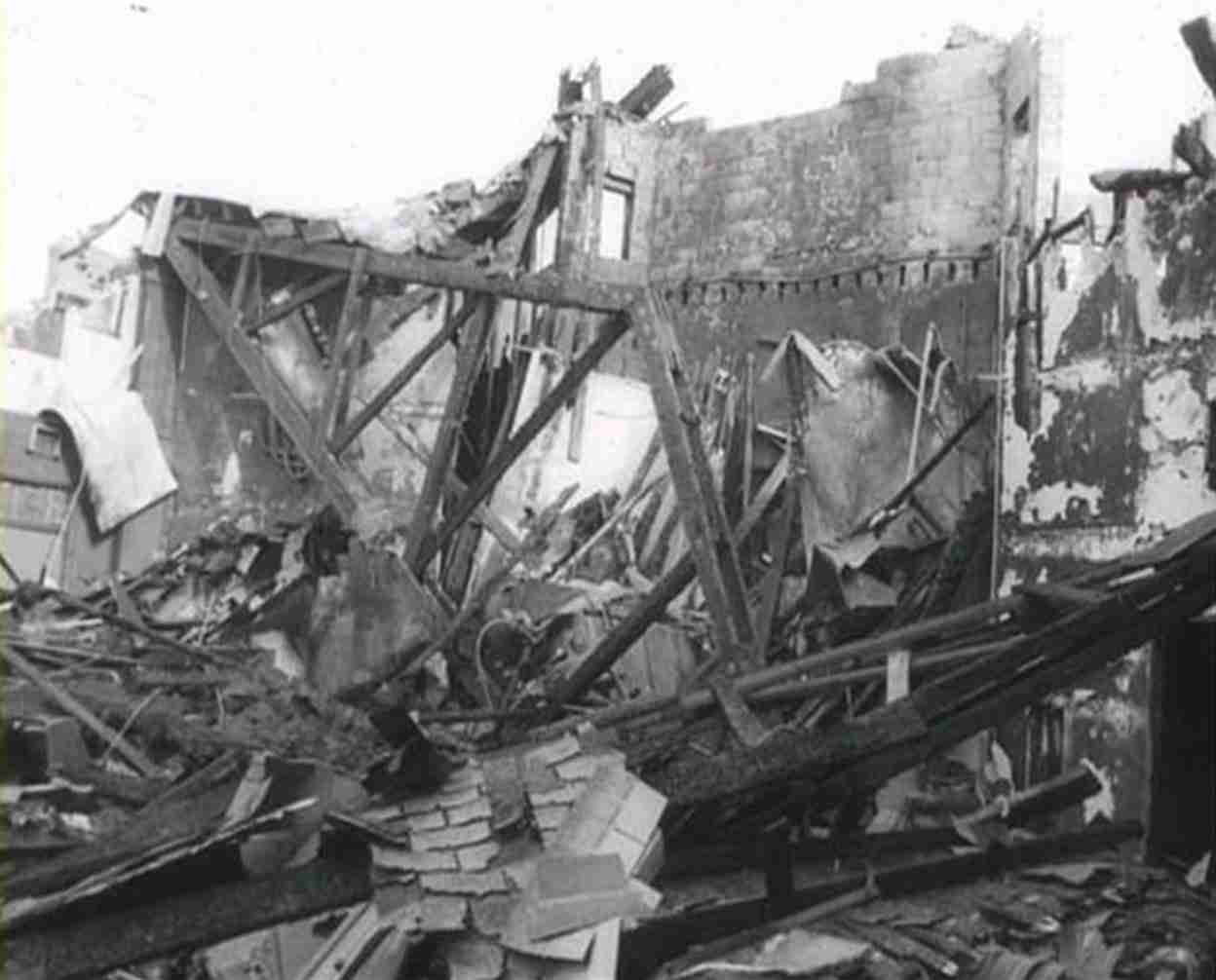
Note the remains of the failed incline plane (triangular) timber trusses in the gutted shell of the synagogue.


View of the rebuilt synagogue as it appears today.
