Six Firefighters Killed by Collapsing Walls During Furniture Store Fire – Keenan and Jahn’s Furniture Store Fire – Detroit, Michigan – October 5, 1894
On October 5, 1894, Detroit Fire Lieutenant Michael Donaghue, Ladderman Julius Cummings, Pipemen Martin Ball, Joseph Dely, and John Pagel, and Volunteer Fireman Fred Bussey were killed by collapsing walls as fire gutted a five-story brick and wood joist building occupied by a furniture store and factory. As firefighters were working to bring the blaze under control, the front and rear walls suddenly fell, killing the six men. Ten other firefighters were injured in the collapse. The fire was discovered in the shipping room in the basement at the back of the furniture store by a shipping clerk. An alarm was promptly turned in, but by the time the engines arrived the fire had gained considerable headway, having run up the elevator shaft, and the entire upper floor was a mass of smoke and flame when the first stream was thrown. Firefighters working in a narrow alley in the rear of the store were crushed when the rear wall collapsed. Firefighters in the front of the store were also crushed when the front wall of the building crashed into the street. The tragedy remains the largest loss of firefighters’ lives in a single incident in the history of the Detroit Fire Department.
The furniture store and factory were located at 213-217 Woodward Avenue in the downtown area of Detroit. The five-story Type III Ordinary construction brick and wood joist structure was built in 1873 and was occupied by the Keenan and Jahn’s Furniture Store and was located midblock between Clifford Street and Grand River Avenue in a congested area of mercantile shops in the main shopping district. The double mercantile loft building measured 60 feet wide by 100 feet deep with a flat roof. A one-foot-high parapet wall topped by a wooden cornice was on Side Alpha which fronted on 120-foot-wide Woodward Avenue. On Exposure Bravo was a four-story mercantile building of similar construction. Side Charlie was a 20-foot-wide alley with numerous commercial structure lining the passageway. On Exposure Delta was a four-story upholstery shop with a bakery on the ground floor in the rear. The store had furniture showrooms on the first, second, third, and fourth floors. Workshops for manufacturing furniture occupied the fifth floor. The building had a passenger elevator and a freight elevator, each elevator shaft being clad with tin. A wooden bridge crossed the rear alley, connecting the furniture building’s second floor to a storage and workshop building opposite. A small skylight was on the roof and a single stairway on the Delta sidewall near the rear served all floors. An elevated water tank was mounted on the roof. A masonry party wall ran through the center of the building on the upper floors that was supported by cast iron columns in the basement and on the first floor. The business was not equipped with a fire alarm system or an automatic fire sprinkler system. There was a fire hydrant fed from an eight-inch water main a short distance from the building at the corner of Woodward and Grand River Avenues. A 7,000-gallon cistern was in the street at the opposite corner at Clifford Street. Note: The building had a history of structural defects and had once been deemed unsafe by city officials. The 12-inch thick brick walls of the five-story building had been filled with rubble.
The City of Detroit is the largest city in Michigan and the seat of Wayne County. The city had a population of 639,111 at the 2020 U.S. census, making it the 27th-most populous city in the United States. Detroit is a port on the Detroit River, one of the four major straits that connect the Great Lakes system to the Saint Lawrence Seaway. The metropolitan area, known as Metro Detroit, is home to 4.3 million people, making it the second largest in the Midwest after the Chicago metropolitan area, and the 14th largest in the United States. At the time of the incident in 1894, Detroit was a fast-growing industrial city with a population of about 295,000.
The Detroit Fire Department was established as a paid department in 1860. By 1896, the department had grown to 413 paid men operating 21 steam engines, 6 chemical engines, 9 ladder trucks, 21 hose carriages, 1 65-foot water tower and 1 fireboat. The city was equipped with a fire alarm telegraph system with 374 fire alarm boxes. The water system was supplied from the Detroit River with a pumping station with a capacity of 25 million gallons per day. 2950 fire hydrants were distributed around the developed areas of the city with 490 miles of water mains ranging from 43-inches to 3-inches in diameter. There were also 581 water cisterns placed at strategic intersections around the city.
Today the city is protected by the more than 1,200 members of the Detroit Fire Department operating from 36 fire stations organized into 8 battalions and deploying 27 engines, 13 trucks, 6 squads, 27 ambulances, 2 HazMat units, 2 airport ARFF units, and 2 fireboats. In 2022, the department responded to 200,643 total calls for service including 146,551 (73.04%) EMS calls, 23,184 (11.55%) fire calls and 30,908 (15.40%) medical first responder calls in 2022.
At around 7:30 a.m. on Friday morning, October 5, 1894, a fire of unknown cause began in the basement of Keenan and Jahn’s Furniture Store at 213-127 Woodward Avenue in downtown Detroit. Building occupants discovered the blaze and four companies of firefighters arrived quickly to find the flames had made rapid headway. The engineer of the building said that there was a lot of excelsior, in which iron beds were packed ready for shipment, standing near the elevator shaft in the basement. He said the fire started in this flammable material, and that the draft from the elevator shaft carried the flames through the entire building and up to the fifth floor. By the time the fire department arrived, the entire building was engulfed in flames.
Sixty persons were in the building at the time with most in the manufacturing area on the building’s upper floors. The fire spread so quickly that many had difficulties escaping the building. While none were killed, more than a dozen were severely injured. Before the front wall fell, the avenue was crowded with spectators. Fred J. Cozzens called Assistant Fire Chief Elliott’s attention to the fact that the walls were considered very dangerous, the building being generally considered a veritable shell. In the past, there had been much comment upon the fact that the structure was a constant menace to public safety and should not have been permitted to stand. Elliott, however, paid no attention to this warning, but proceeded to carry out his method of attack.
By 8:30 a.m., there were five streams of water playing on the building, but they seemed to have little effect, the water supply seeming to be rather inadequate. There were two streams playing on the lower floor and two in the rear. The firemen of Engine 9 were playing their stream from a bridge that spanned the alley trying to get water into the second floor in the rear by smashing the windows with their stream, but the force of the water did not seem strong enough. Five men were ordered up a short ladder to break the windows with axes. Three men went up on the cornice of the second floor and two more were on the ladder with their hose. The fire seemed to cling to the center of the building, the furniture in the lower floor was all ablaze, but from the front there seemed to be very little flame above.
By 9 a.m., an immense crowd of spectators had gathered about the scene of the fire, and it was necessary to draw ropes around to keep them back. Even at a distance, however, some of the spectators say they saw that the walls were weakening. Still no high ladders were ordered up, and all the men were on the ground except those in the alley, who stood on a platform running from the furniture store to a small building on Griswold Street used as a storage room.
About an hour after they began fighting the fire, firemen from Engine 8, Truck 2, and Truck 6 were working in the rear alley. The men from Engine 1, Chemical 1 and Truck 2 were working in the doors and windows of the ground floor in front. They had stretched their hoseline a short distance inside the doorway. It was found impossible to get water for their stream, however, and they were ordered out of the building. They had barely reached the pavement 20 feet away from the building when, without warning, the elevated water tank on the roof fell through all the floors of the building and the exterior walls collapsed.
The long, heavy wooden joists that had run through the building had been burned through, and when these supports gave way, the walls, too weak to stand of their own strength, had gone down. The rear wall went into the alley at almost the same time that the front wall fell, and the firemen, most of them from Engine 8, went down into the alley with the wall on top of them. Every man in the company except the captain was injured.
When the walls collapsed, the air was filled with smoke and dust, and it was difficult for a time to tell how many men were beneath the ruins. The uninjured firemen did not wait for the smoke and dust to clear away but jumped at the ruins and began to dig at the debris. With their eyes blinded in the smoke and the fine plaster dust, they dug at the hot bricks with their hands in hope of saving the lives of the unfortunate fellows under the walls, and their labors quickly brought results. Within 15 minutes the men who had been working in the rear alley were taken out.
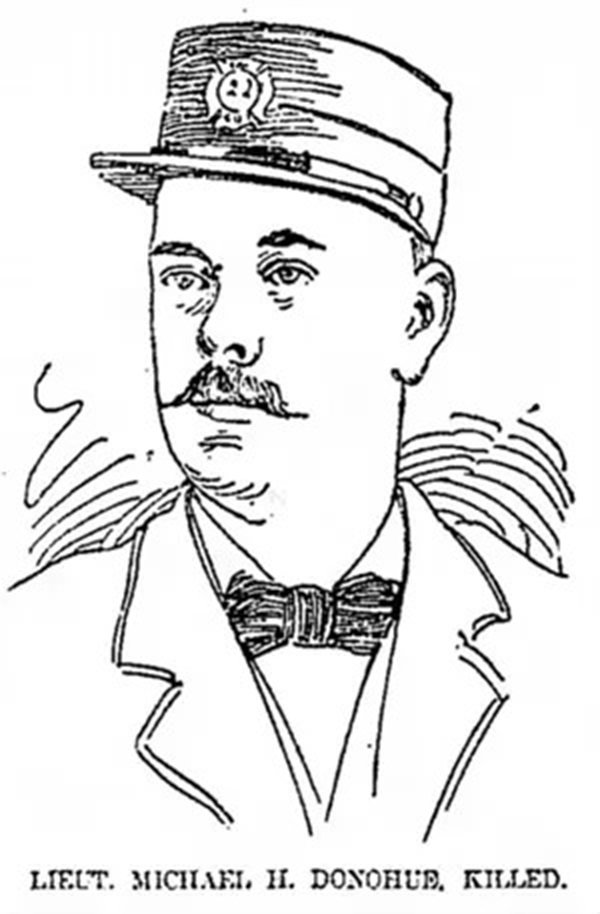
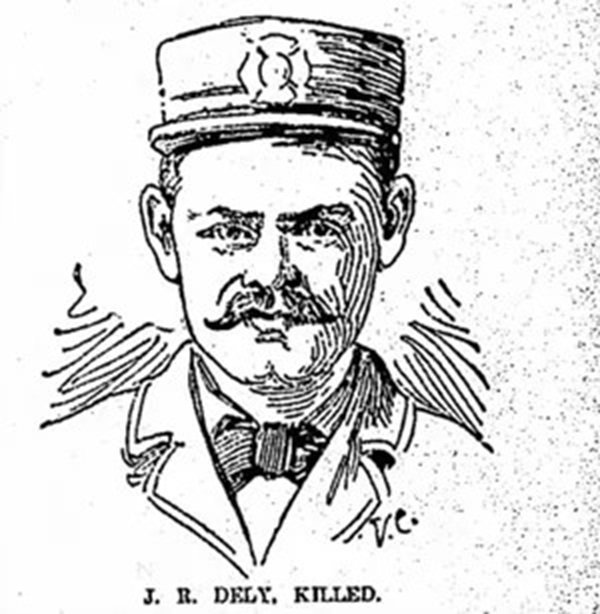
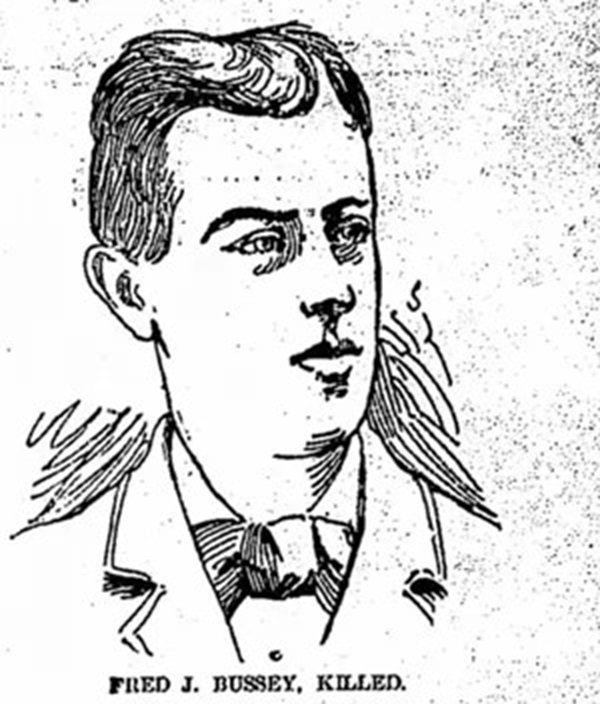
Lieutenant Michael H. Donahue, of Chemical 1, was the first one found. He was still breathing when taken out, but terribly cut about the head and torso, and died within a few minutes in the arms of some of his comrades. Pipeman Richard Dely of Engine 9 was the next one found. He was taken up from the Woodward Avenue sidewalk, where he lay under the hot brick. He, too, was still breathing, but soon died. Engineer Stocks, Pipeman B. Cronin, and Lieutenant O’Rourke, all from Engine 8, were taken out alive. Then came Thomas C. Gursey, a substitute. They were at once removed to the different hospitals. Volunteer Fireman Fred Bussey, who was standing under the bridge in the rear alley was also killed. It was known that there were at least two others under the ruins, Cummings in the rear, and Ball last seen near the front corner of the store.
About 11 a.m., the board of public works sent to Assistant Chief Elliott a note offering the services of a number of their laborers for the work of recovering the bodies of those who might still be under the debris. In a few minutes, the board’s experienced shovelers were delving into the masses of brick and mortar on Woodward Avenue and in the rear alley. The diggers were soon rewarded by getting a glimpse of a rubber coat, and then about a dozen men got down on their knees and began digging with their hands.
“It is Cummings,” was the word that was passed along. The firemen and laborers dug with all their might, brick and pieces of wood being thrown right and left as soon as they had been carefully lifted from over the form of the unfortunate under the pile of debris.
About 11:30 a.m., enough of the rubbish had been cleared away to permit the men to lift the form of the fireman out of the heap. He was dead, beyond doubt. His head was bloody and discolored, and his limbs hung limp, as half a dozen men hurried his body to an ambulance. Ball’s body was recovered at 1:30 p.m. and was removed to the morgue.
At about this time Mayor Hazen S. Pingree arrived on the scene and his honor at once expressed his disgust that there was not a larger force of them to throw aside the rubbish.
“What can that handful of men do here?” said the mayor indignantly. “They ought to put on all the workmen they can find. There may be some people under there.”
“We’ve taken them all out except one,” remarked Assistant Chief Elliott.
“It’s a terrible thing this should have been permitted to happen,” continued the mayor. “Everyone knew what that building was and the idea of sending those firemen to a post of danger when there was nothing to gain was wrong, all wrong.”
“Were you warned, Mr. Elliott, that this building was unsafe?” was asked of the assistant chief.
“I guess that someone may have spoken to me to that effect.”
“But you paid no attention to the warning?”
“I did not. At every fire someone comes up with that same story. If we paid attention to all that was told us we would never accomplish anything in the way of putting out a fire.”
“You considered the building safe enough.”
“I knew no reason to think otherwise.”
“You were not posted in regard to the building inspector’s estimate of the safety of the walls?”
“I didn’t know anything especially wrong with this structure.”
“You consider it an error of judgment to have sent the men where you did?”
“I consider it a misfortune, indeed. I had a narrow escape myself and only got under the pipe line in time to get away from the falling bricks. I was hurt in the back, but not badly, I guess.”
Fire Commissioner Carson was asked if there would be any special meeting to consider any matter in connection with the fire, and he said he thought not. “There is some criticism of Chief Elliott, I know,” said he, “and if public sentiment demands an investigation I shall be perfectly willing to have the matter looked into, so far as I am concerned. Mr. Elliott has had thirty years’ experience in the department, and while it is easy to make a mistake it is also easy to criticize. I called at the hospitals this evening and talked with those of the injured men who were able to talk without injury, and they said they had no idea they were in any special danger when the walls fell. Not one of them had any word of criticism or complaint to offer, and I am disposed to think the trouble was in the building and not in the manner in which in the men were handled.”
Members of the Detroit Fire Department killed in the Keenan and Jahn’s Furniture Store Fire on October 5, 1894:
- Lieutenant Michael H. Donaghue, age 30, was an eight-year member of the Detroit Fire Department assigned to Chemical 1. He was appointed to the department on May 3, 1886, and was assigned as a ladderman on Truck 4. He was transferred on October 21, 1889, to be a steersman on Truck 1. On July 1, 1893, he was promoted to lieutenant of the water tower, and on November 15, 1893, was transferred to Chemical 1. Donaghue was married. His funeral service was held on October 8 at the Holy Trinity Church. Following the service a detail of 50 city firefighters, headed by Chiefs Elliott and Kendall and marshalled by Chief Broderick marched after the hearse as the procession proceeded to the Church of Saints Peter and Paul to await the conclusion of the funeral service of Pipeman Joseph Richard Dely. From there the combined funeral procession made its way to Mount Elliott Cemetery in Detroit for a dual interment service. The two men were buried side-by-side in the Firemen’s lot in the cemetery.
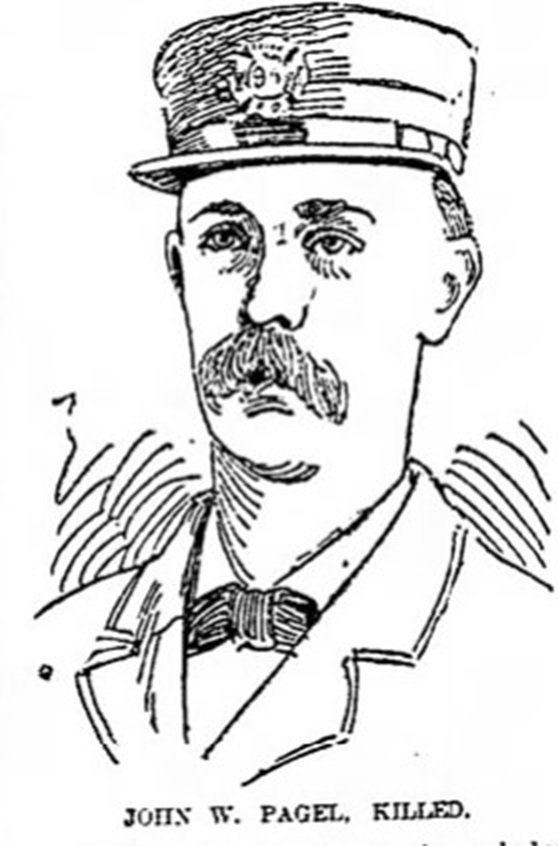
- Pipeman John W. Pagel, age 33, was a six-year member of the Detroit Fire Department assigned to Engine 9. He joined the department on November 12, 1888. Pagel was survived by his wife, Marie and his son, Benjamin. His funeral service was held at his residence at 332 Champlain Street on October 7 followed by interment at Evergreen Cemetery in Detroit. A large contingent of Detroit firefighters and firefighter from other nearby cities attended the services.
- Ladderman Julius G. Cummings, age 29, was a ten-month member of the Detroit Fire Department assigned to Truck 2. He was appointed to the department on January 1, 1894. He was unmarried and his relatives resided in Grand Rapids, Michigan. Lieutenant Atwood accompanied the shipment of the body for interment in that city.
- Pipeman Martin W. Ball, age 26, was a new member of the Detroit Fire Department assigned to Engine 9. He was appointed on August 15, 1894. Ball was survived by his wife, Dora and two small children, Ina, age 4, and Martin W. Jr., born after his death. He resided in the same house with his brother-in-law, Henry Kemberling, a fireman who was also at the fire. Ball was on his day off on the morning of the fire and was acting as a substitute for a brother fireman. He was buried at Rollin Center Cemetery in Rollin, Michigan.
- Pipeman Joseph Richard Dely, age 23, was a new member of the Detroit Fire Department assigned to Engine 9. He joined the department on January 1, 1894, and had been married only three months prior to his death to his wife, Rose. Their son, William, was born a few months after his death. His funeral service was held on October 8 at Saints Peter and Paul Church. Following the service a detail of 50 city firefighters, headed by Chiefs Elliott and Kendall and marshalled by Chief Broderick marched from the funeral service for Lieutenant Michael H. Donaghue and the combined funeral procession made its way to Mount Elliott Cemetery in Detroit for a dual interment service. The two men were buried side-by-side in the Firemen’s lot in the cemetery.
- Volunteer Fireman Frederick A. Bussey had recently been employed by the Detroit Fire Department as a substitute fireman. He lived with his wife, Carrie, his widowed mother and two younger sisters. His funeral service took place on October 8 at Saint Peters and Paul’s Church in Detroit with a large crowd of firemen and the public attending. Interment followed at Mount Elliott Cemetery in Detroit.
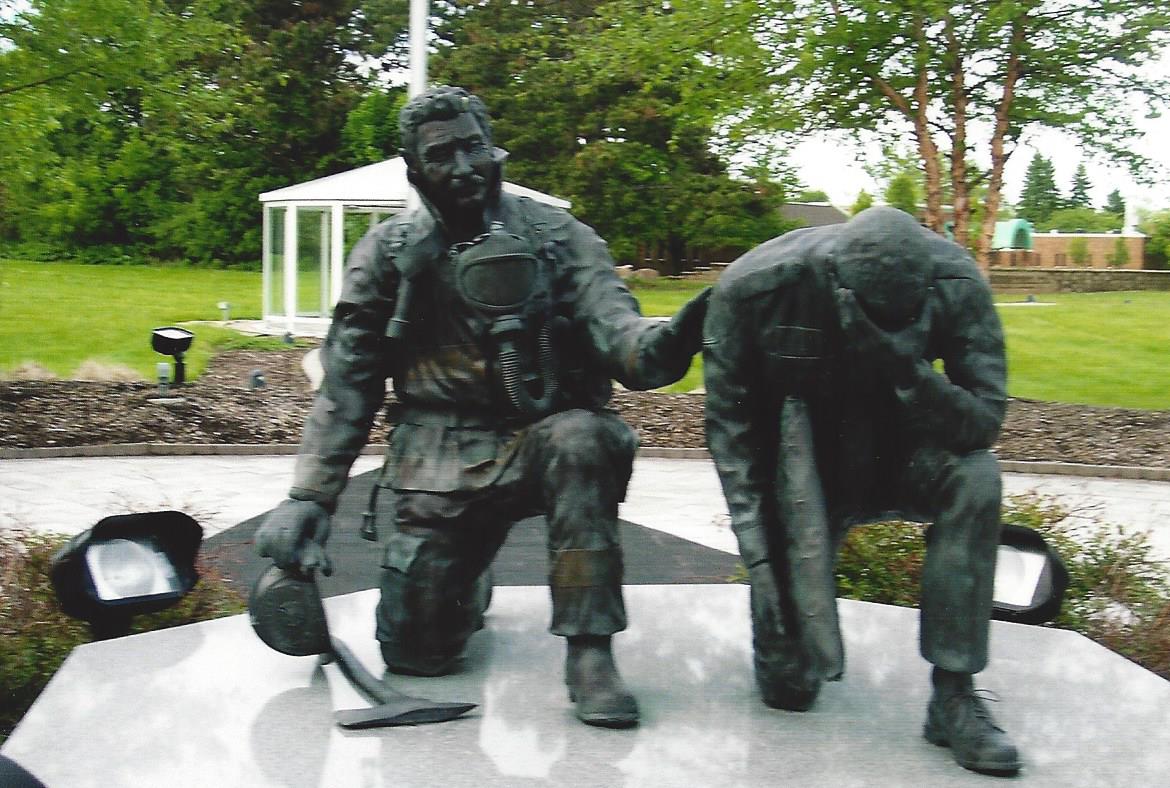
The names of the six fallen Detroit firefighters have been inscribed on the Michigan Fallen Heroes Memorial Monument in the Oakland County complex in Pontiac. The memorial features a bronze statue of two kneeling firefighters, one consoling the other, and a granite wall engraved with the names of more than 900 Michigan firefighters who have died in the line of duty since 1864, honoring their courage and sacrifice.
Ten persons were injured at the fire including:
- Pipeman Bartholomew Cronin of Engine 8.
- Pipeman Patrick J. Rourke of Engine 8.
- Pipeman Fred Draheim of Engine 8, badly hurt.
- Pipeman F.E. Stocks of Engine 8.
- Fireman Michael C. Gray, badly hurt.
- Fireman Thomas C. Gursey.
- Fireman Leslie E. McElmurray.
- Ladderman John B. Newell of Truck 2.
- Fireman E.E. Stevens of Chemical 1, badly hurt.
- Spectator Henry Herring.
The property loss was set at $10,000 for the building and $50,000 for the contents.
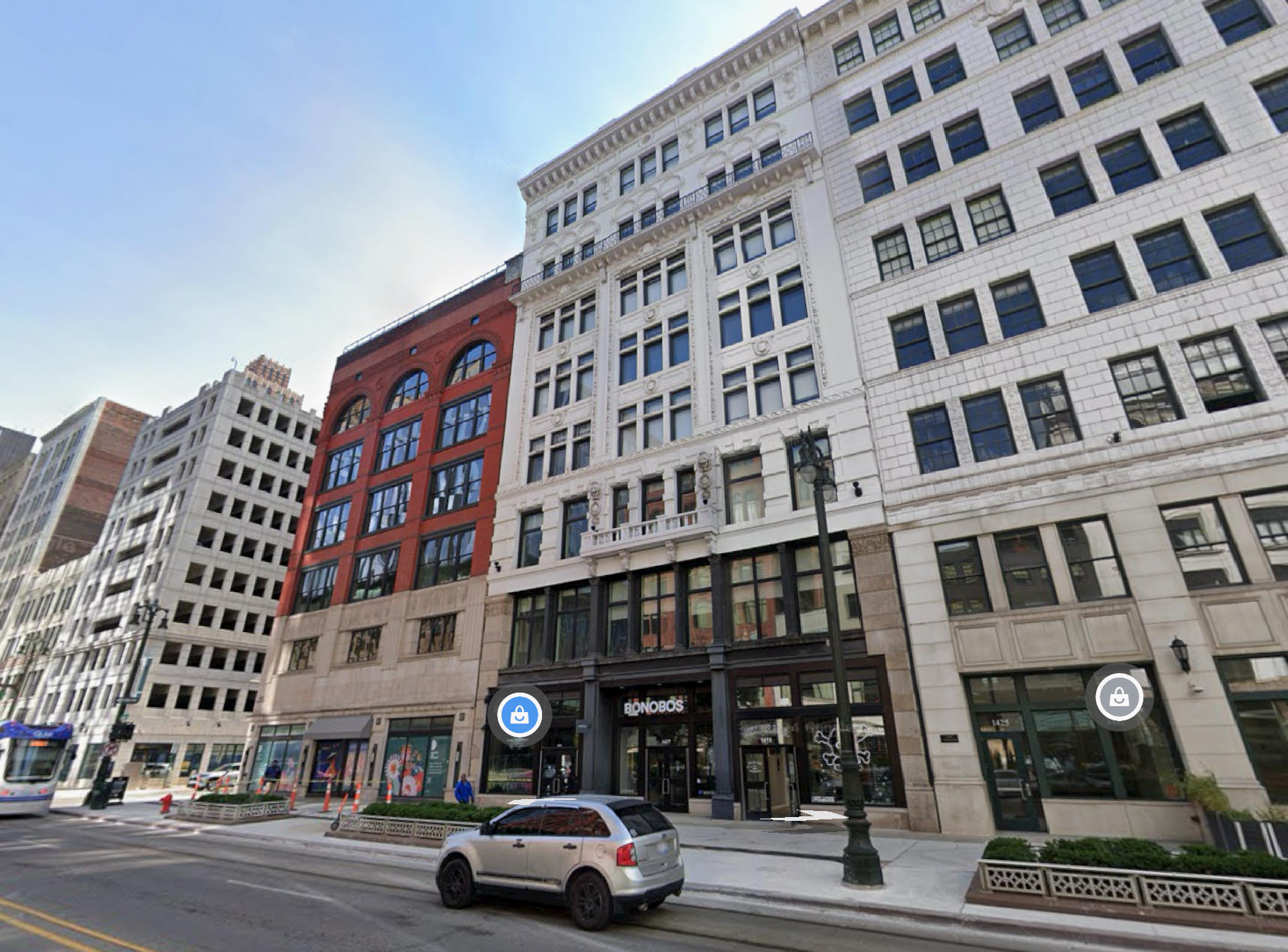
The site of the fatal fire is now occupied by the Valpey Building, an eight-story residential over commercial building with retail space on the first floor and 42 residential units on the upper floors. There is no memorial marker at the site.
Commentary:
Masonry structures built before 1933 typically have unreinforced brick, stone, terra cotta block, or concrete walls that are subject to collapse. Generally, the front and rear walls of a legacy Type III Ordinary construction building are non-load bearing and are only lightly adhered to the load bearing sidewalls that usually run perpendicular to the street. Shifting of wood floor joists or steel and cast iron support columns and beams from increased dynamic loading or fire exposure may cause the unreinforced front and rear walls to collapse outward. Unreinforced masonry structures that have been exposed to significant fire load and have had the wooden, steel or cast iron interior supporting structures destroyed by fire have a poor fire performance record and have been responsible for causing numerous deaths and serious injuries to firefighters.
In this incident, fire officers failed to heed early reports that the building was showing signs of structural weakness which resulted in the deaths and injuries to firefighters. There was also evidence that the building had structural defects that had been documented by city building officials, but it was unclear if this information was effectively conveyed to the fire department. Firefighters must be trained to recognize the warning signs of impending collapse in fire damaged legacy masonry structures and effectively communicate these conditions to command officers. Command personnel should also consider assigning a safety officer with the sole responsibility of monitoring the stability of any structure that has suffered significant fire involvement and convey any collapse indicators to command for consideration for evacuating the building and setting up appropriate collapse zones while shifting fire control operations to a defensive attack mode.
We have attached newspaper illustrations from the incident. We have also included a detail from the 1884 Sanborn fire insurance map of the block showing the configuration of the fire building and the surrounding exposures.
We have also included the links to a two-part article on recognizing building collapse indicators that was published in Firehouse magazine by the late Deputy Chief James P. Smith: https://www.firehouse.com/operations-training/article/10544968/building-collapse-indicators
Thanks to multiple media sources for the content of this article.
Honor the service of Detroit Fire Lieutenant Michael Donaghue, Ladderman Julius Cummings, Pipemen Martin Ball, Joseph Dely, and John Pagel, and Volunteer Fireman Fred Bussey by studying collapse indicators in masonry structures and by visiting a legacy masonry mercantile or manufacturing building in your local response district with your crew members today.
Remember Fallen Brothers.
Get Out There And Know Your Local!!!
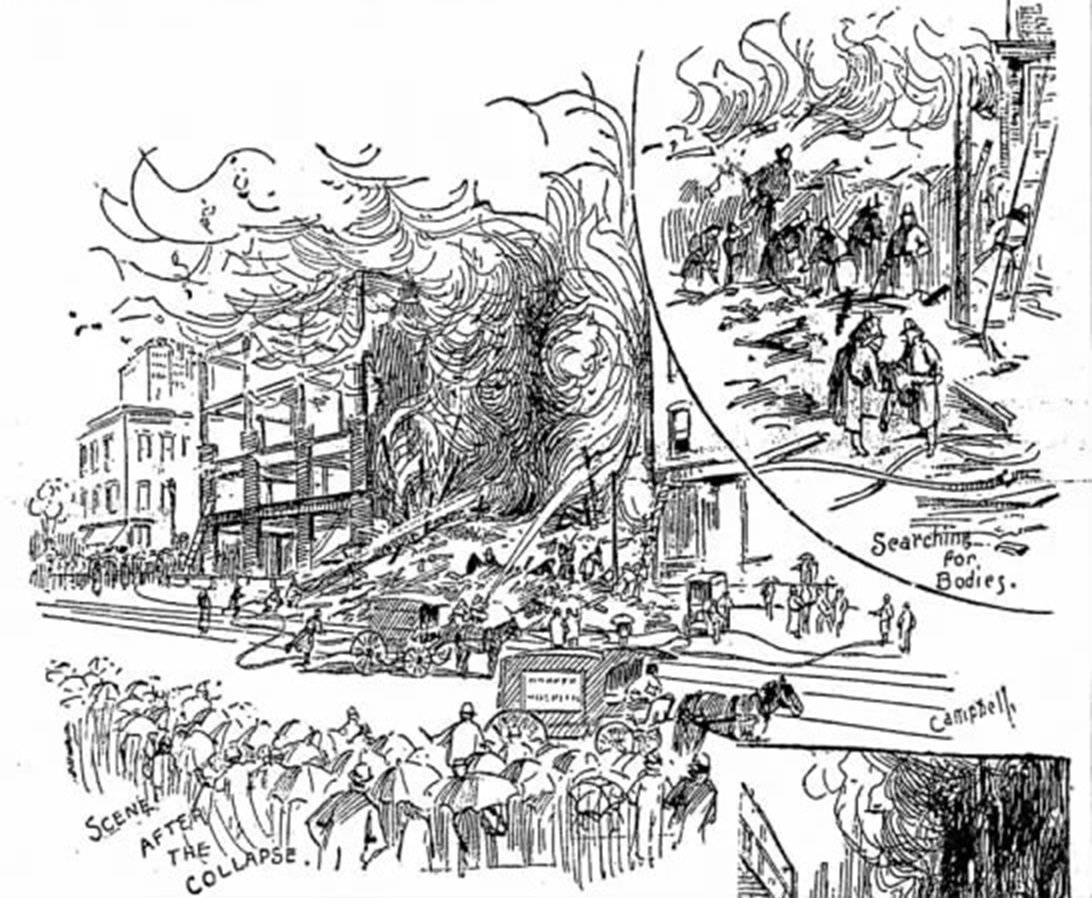
Newspaper illustration of the fire and collapse scene.
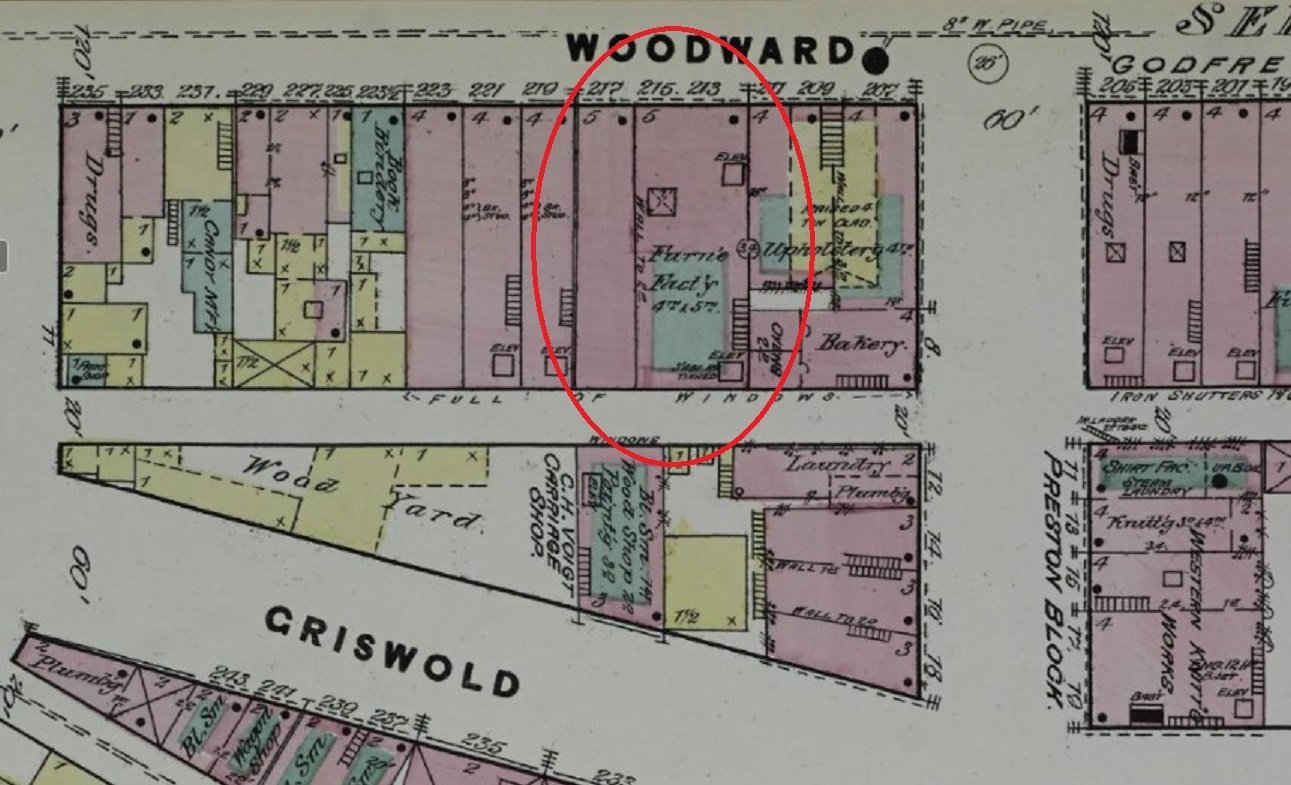
Detail from the 1884 Sanborn fire insurance map of the block showing the configuration of the fire building (circled in red) and the surrounding exposures.
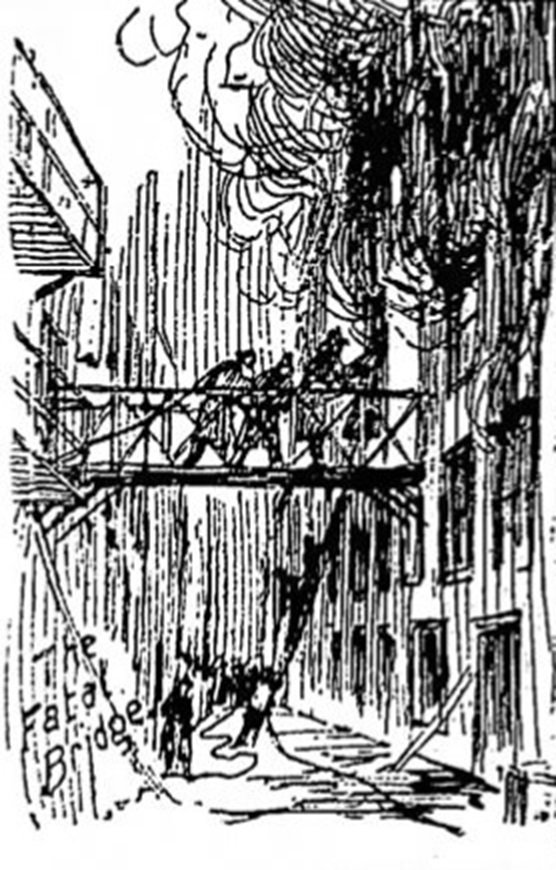
Newspaper illustration of the members of Engine 9 attacking the fire from the bridge in the rear alley.