
One Firefighter Killed and Dozens of Others Injured During Multiple Alarm Fire in Wholesale Grocers Building – Janney and Andrews Wholesale Grocery Fire – Philadelphia, Pennsylvania – November 24, 1889
Submitted by Rick DeGroot
On November 24, 1889, Philadelphia Assistant Foreman James McCuen of Engine Company 4 was killed when a wall collapsed during in six-alarm fire in a wholesale grocery building in the Old City business district. McCuen and other firemen were operating a hoseline from a rear courtyard of an adjacent building when the walls of the burning gr
ocery building bulged at the rear. The several members of Engine Company 4 saw the signs of the imminent collapse and ran inside the adjoining building for protection but Assistant Foreman McCuen was caught in the avalanche of steaming brick and burning timbers. He was quickly dug out of the wreckage but suffered severe injuries and soon died from his wounds. Three other firemen were seriously hurt in the collapse and twenty-two firemen were overcome by irritating fumes from a stock of burning ground pepper in the store. The cause of the fire which appeared to have started on the third floor was undetermined. The grocery building was entirely destroyed, and several adjoining buildings were badly damaged. The loss to the grocery building and contents was placed at more than a quarter of a million dollars.
The structure involved in the fire incident was a six-story Type III Ordinary construction mercantile loft building used by the Janney and Andrews Company wholesale grocery warehouse located at 121-123 Market Street in the Old City business district of the city. The three-year-old building was located midblock between North Front and North 2nd Street in a congested area of mercantile shops and small factories. The structure measured 75 feet wide, 160 feet deep and 72 feet high stretching back to Church Street. The first and second floors were occupied as a salesroom with 200 barrels of sugar, 100 barrels of molasses, and 200 bags of coffee. In the cellar there was also a large quantity of sugar and molasses. Many cases of matches were stored in a concrete vault in the cellar. A stock of 75,000 cases of canned goods were stored on the third, fourth, fifth and a portion of the sixth floors. At the rear of the sixth floor was a coffee roasting room with two large ovens that had a concrete-covered floor and iron-clad walls. On the fifth floor were a number of barrels filled with ground pepper. Ceilings heights ranged from 20 feet on the first through fourth floors to 16 feet on the fifth floor and 12 feet on the sixth floor. The building had three unenclosed hoist shafts, two near the front of the building, one each on Sides Bravo and Delta, and one that served the coffee roasting room on Side Charlie. The iron and brick facade of the building faced 100-foot-wide Market Street. On Exposure Bravo was a five-story mercantile building of similar construction that housed with a drug store. Church Street, a narrow 25-foot-wide lane, was on Side Charlie. The windows facing Church Street were equipped with heavy iron fire shutters. On Exposure Delta was a four-story mercantile building of similar construction occupied by David Scull & Company, a woolen goods merchant with a small, enclosed courtyard at the rear. The first floor was used as salesroom and the upper floors were used for storage of light wood and willow ware. The grocery building was not equipped with a fire alarm system or an automatic fire sprinkler system. There were numerous fire hydrants including one directly across the street fed by 8- and 16-inch water mains. The nearest fire alarm call box was one half block west at North 2nd and Market Streets.
Note: A mercantile loft-style building is a structure that was originally built for commercial purposes such as warehouses, garment factories and other manufacturing uses. The first floor was usually occupied by a mercantile use while the upper floors contained manufacturing and light industrial uses. They were often built using cast iron structural elements including cast iron columns to support the upper floors and cast iron decorative front facades that provided large arched windows to display merchandise at street level. Built with high ceilings and supported by large wooden beams with cast iron columns, loft buildings provided ample floor space for machinery and materials in manufacturing occupancies, and the display of merchandise in mercantile shops. In recent years, many loft buildings have been repurposed into residential apartments and condominiums. They are usually renovated leaving much of the interior brick walls exposed, and the cast iron columns, cast iron facades, and high ceilings retained for aesthetic purposes.
Philadelphia is the most populous city in the Commonwealth of Pennsylvania and the second-most populous city in both the Northeast megalopolis and Mid-Atlantic regions after New York City. The city covers more than 142 square miles and has a resident population of 1,603,797 according to the 2020 U.S. census. It is one of the most historically significant cities in the United States and served as the nation’s capital until 1800. Founded in 1682 by William Penn, by the time of the fire incident, the city had grown to 1,293,687 residents according to the 1900 U.S. census. The original city was only about 2.5 square miles stretching east to west between the banks of the Delaware River and the Schuylkill River and bounded north to south by the present-day Vine Street and South Street. By the time of the fire the city had expanded north, south and west to accommodate the rapidly growing community that had become a center for trade and manufacturing.
The Old City neighborhood of Philadelphia is a historic district of about one square mile that stretches from Front to Sixth Streets between Walnut and Vine Street along the Delaware River waterfront. Along with part of Society Hill, Old City is one of the city’s oldest neighborhoods and part of the area where William Penn and the Quakers settled in the late 1600s. It is home to Independence National Historic Park, a dense section of historic landmarks including Independence Hall, the Liberty Bell, and Elfreth’s Alley; a historic residential street dating back to 1703. Old City borders Northern Liberties to the north, Penn’s Landing to the east, Society Hill to the south, and Chinatown and Market East to the west. It hosted the governments of Pennsylvania and the United States of America for most of the period from 1776–1800 and was North America’s most important financial center through the 1830s. As Philadelphia’s central business district gradually moved west, it became a warehouse and light industrial district. Many historical sites in the district were restored or reconstructed in the twentieth century. In the 1980s, the warehouse area north of Chestnut and especially Market Street became popular for art galleries and artist’s studios (the latter mostly displaced by gentrification in the 1990s) as well as bars, restaurants, and nightclubs.
One of the oldest established fire departments in the United States, the Philadelphia Fire Department traces its origins back to early volunteer companies, specifically the Union Fire Company, co-founded by Benjamin Franklin and several other prominent citizens who saw the need for an organized approach to fire protection. Volunteer fire companies served the city until the paid municipal fire department was established in 1871. An ordinance on December 29, 1870, established Philadelphia’s first fully paid and municipally controlled fire department, administered by seven commissioners chosen by the City Council. The Philadelphia Fire Department officially entered into service on March 15, 1871. At 10:00 a.m., 355 men gathered at Spring Garden Hall, 13th and Spring Garden Streets, to be sworn in as members of the newly organized paid fire department in Philadelphia. They were assigned to 22 engine and 5 hook and ladder companies under the supervision of 5 Assistant Chief Engineers. Chief Engineer William H. Johnson commanded the department.
Today the city is protected by the Philadelphia Fire Department, which provides fire protection and emergency medical services (EMS) to the residents and visitors to the city. About 2700 career firefighters and EMS professionals operate from 63 fire stations with 58 engine companies, 27 ladder companies, and 60 ambulances, as well as specialty and support units that are deployed throughout the city. Specialized firefighting units are stationed at Philadelphia International Airport and three marine units protect the Port of Philadelphia and the riverfronts. In fiscal year 2024, the department responded to 55,526 fire service calls of which 2,880 were classified as structures fires, and 277,195 EMS runs.
The Old City business district of Philadelphia is protected by fire and EMS units quartered at:
- Engine 8, Ladder 2, Medics 44 & 63 – 101-15 North 4th Street – 0.4 miles from the fire building.
- Engine 11, Medic 21 – 601-09 South Street – 1 mile from the fire building.
- Engine 20, Ladder 23, Medic 1 –133 North 10th Street – 1.1 miles from the fire building.
- Engine 29, Rescue 1, Medic 15 – 400-08 West Girard Avenue – 1.6 miles from the fire building.
- Engine 1, Ladder 5, Medic 35, Battalion 1 – 711-23 South Broad Street – 1.8 miles from the fire building.
On Sunday, November 24, 1889, at 3:36 a.m., an alarm was sounded on Box 91, 2nd and Market Streets for a fire at Janney and Andrews’ Wholesale Grocery, a six-story brick building located at 121 – 123 Market Street. The fire was discovered by a passerby who notice a burning smell on the block on his way to the Camden Ferry. At Front Street he met Policeman Bonsall and notified him of his suspicions that something was burning nearby. Bonsall took a half dozen whiffs and, remembering the big fire on Church Street the previous February, ran north to Church Street where he saw smoke issuing from the crevices in the windows of the upper stories of the Janney and Andrews building. The patrolman then ran to Box 91 to turn in the alarm.
When the alarm was sounded, weary Philadelphia fire units had just returned from fighting a large fire at the Sharpless Brothers warehouse at North 8th and Market Streets. Fire apparatus from the downtown district raced to the scene to find the upper floors of the grocery building on the Church Street side well involved in fire which was threatening the surrounding exposure buildings. They had difficulty prying open the heavy iron fire shutters that covered the windows on Side Charlie.
As firemen forced their way into the store, dense volumes of smoke laden with the fumes of burning pepper and spices filled the air. Working in near-zero visibility, they were unable to locate the seat of the fire. Suddenly, the flames, which had been hidden in the smoky veil, burst through, revealing the huge building cloaked in flames as fire shot from nearly every window. The fire burned so rapidly that the firemen were at a loss to where to attack the flames first.
Fire Chief John R. Caitlin soon arrived and brought order to the chaos as he ordered six powerful streams of water directed at the blazing structure. The heavy streams were unsuccessful in reaching the seat of the fire and Chief Caitlin ordered a second alarm to be transmitted at 5:12 a.m. for additional companies to respond to the scene as the flames menaced the neighboring mercantile buildings.
Engine Company 4 under the command of Assistant Foreman James McCuen was the first engine to arrive and was assigned to attack the fire from Church Street in the rear. Telegraph and telephone wires rendered the work of the department difficult and the darkness of Church Street, which was only an alley above Market Street prevented the firemen from moving quickly. There was a three-foot alley that ran alongside the woolen warehouse of the David Scull & Company which backed up to 114 Church Street. It was through this opening that District Engineer Smith led the men of Engine Company 4. Groping along in the darkness they reached an open courtyard, fifty feet square, which was in back of the warehouse of the Janney and Andrews building. From there they hoisted a hoseline to the roof of a one-story office setback at the rear of 117 Market Street. Their stream was the first one that proved effective at hitting the fire in the rear of the grocery warehouse.
Hosemen from three other companies soon reached the roof of a wholesale hardware store at 113-115 Market Street and were successful in holding back the fire from spreading to the exposures on the west side of the street. When the fire reached the front portion of the fifth floor, where the firm’s stock of pepper was stored, there was a new danger the firemen had never previously encountered. As the flames began to devour the stores of pepper and spices on the fifth floor, dense irritating smoke and fumes from the roasting pepper filled the air. Dozens of firemen were overcome by the acrid suffocating fumes and several had to be carried from the building by their comrades. Until all of the pepper was consumed by the flames, the firemen could not advance their hoselines into the building.
Once the dense veil of smoke was relieved from the building as the pepper and spices were spent by the blaze, the engines were pumped at full capacity as multiple fire streams were turned on the building from all sides. As the blaze began to darken down, several of the fire companies were relieved from the scene to return to their quarters for much needed rest. Smoke continued to rise from the gutted building but did not seriously interfere with the operations. Chief Cantlin left the scene in charge of Assistant Chief Pullinger.
At about 6 a.m. as the members of Engine Company 4 and another engine crew continued to play their streams into the upper floor window of the smoldering building, Assistant Foreman McCuen was directing the operation while standing in the courtyard in the rear of the building. The fury of the flames had already been spent when a member of the hose crew saw the wall of the building in front of them bulge out in the dim light of dawn. He shouted a warning, “Run for your lives!” Every member of the two companies turned and ran for the shelter of the nearby building. All the members were successful in reaching the windows in time to escape except McCuen who was closest to the falling wall. The Assistant Foremen was caught in an avalanche of steaming brick and burning timbers.
The members quickly jumped into the heat and smoke to rescue of the injured officer. Despite the threat of additional collapses from the unstable walls overhead, the rescuers found McCuen on his back buried in a mass of brick and mortar. He was soon uncovered and found to be horribly mangled. He was removed from the courtyard and taken by ambulance to Pennsylvania Hospital where he was examined by doctors who said his injuries were beyond human intervention. His skull was badly crushed, his right leg was broken in two places and he received internal injuries. Within two hours James McCue was dead.
Three other firemen were seriously injured during fire and were taken to Pennsylvania Hospital. Hoseman Frank De Haven of Engine Company 1 was the most critically hurt also by the falling wall. His injuries included contusions to the back and abdomen, a fractured elbow, and lacerations about his face and neck. He was treated and admitted to the hospital but was expected to recover. Two other members were treated for non-life-threatening injuries. Fireman William Ludwick of Engine Company 8 narrowly escape death during the fire. He was standing on the roof of the building adjoining the burning grocery when the wall fell. As he turned to run, he stepped off the roof and fell to the ground below. When he was taken to the hospital it was found that his arm had been broken and he received other injuries. Twenty-two firemen were overcome by irritating fumes from the stock of burning ground pepper in the store but all soon recovered and did not require hospital treatment.
The cause of the fire remains a mystery. No fire was used in the building except for a small engine in the basement but the fire in the boiler had been allowed to burn out before 6 p.m. on the previous Saturday night. The coffee roasting operation on the sixth floor was initially suspected as the possible cause but firemen who forced their way into the roasting house early in the incident found no evidence of fire in that area. Investigators believed that the fire started on the third floor which was filled with groceries and extended to the upper floors via the hoist shafts. The fire loss was set at $250,000 for the grocery building. Several of the exposure buildings suffered smoke and water damage.
Assistant Foreman James McCuen, age 46, was an 11-year member of the Philadelphia Fire Department. He was a veteran of the American Civil War having served with the 23rd Regiment Pennsylvania Volunteers. McCuen was appointed to the Fire Department on October 9, 1878, and assigned as a hoseman to Engine Company 27. He was transferred to Engine Company 4 on October 1, 1881, and was soon promoted to Assistant Foreman. McCuen was a widower and left five children. His wife had died five months prior to his death.
The funeral for Assistant Foreman James McCuen was held on November 27 at the residence of his brother, Alexander McCuen at 1631 Columbia Avenue. Several large floral arrangements were featured in the parlor of the home. Following the service, pallbearers from Engine Company No. 4 and the Pennsylvania Volunteers carried the American flag-covered casket to the hearse as hundreds of city firefighters and military veterans lined the street in salute to their fallen comrade. The cortege then made its way to the receiving vault at Monument Cemetery where it remained for a few days before interment in the McCuen family burial plot at Fernwood Cemetery in Lansdowne, Delaware County, Pennsylvania.
The name of Assistant Foreman James McCuen has been inscribed on the Philadelphia Fire Department’s Memorial Wall located on the second floor of Firemen’s Hall Museum housed in a 1902 firehouse at 147 North Second Street in Old City Philadelphia. The names of 75 volunteer firemen and 304 career firefighters of the Philadelphia Fire Department who made the ultimate sacrifice in the line of duty are engraved on tiles that comprise the wall. Above the wall is a stained-glass window dedicated to the memory of these brave and dedicated firefighters. At the base of the wall are display cases with brass plates with name, rank, company, and date of death hand stamped into the plate. The brass plates are made from the brass ring from the coupling of the hose used by the firefighter at the time he was killed. The rings are flattened to allow the information to be stamped by hand on the memorial plates. The earliest line of duty deaths on the wall date back to May 9, 1791, when twelve unnamed volunteer firemen lost their lives battling a fire on Dock Street near Third Street. The fire destroyed nearly two dozen homes and businesses.
The Janney and Andrews Wholesale Grocery building was rebuilt at the same spot on Market Street. It is interesting to note that the rebuilt building was covered by a monitored automatic fire alarm system. The site is now occupied by a SEPTA mass transit bus stop for Penns Landing. There is no memorial marker at the site.
Commentary:
Legacy Type III Ordinary construction buildings suffer from a common flaw as the front and rear walls (Sides Alpha and Charlie) of these structures are typically non-loading walls and are only lightly adhered to the sidewalls of the structure at the corners. The sidewalls (Sides Bravo and Delta) generally run perpendicular to the street and bear the load of the floors and roof. During a serious fire in this type of structure, stresses placed on the floors and roof tend to push out the front and rear walls, especially if the structure is loaded with heavy stock such as the cases of canned goods on the upper floors of the grocery warehouse involved in this incident. Some mercantile buildings may also have fire cut floor joists that will weaken and separate from their joist pockets during an advanced fire. Incident commanders must monitor the condition of the building especially if interior operations are not making progress and a switch to defensive exterior streams may be warranted. Firefighters should be aware of the potential for the front and rear walls of masonry buildings that have sustained heavy fire may become weakened and prone to sudden collapse. Firefighters making an exterior defensive fire attack should be positioned outside the collapse zone defined as one and one-half of the height of the building to avoid being injured or killed by the falling walls. Fire apparatus such as aerial and tower ladders can be placed in a flanking position at the corners which will allow for ladder coverage of two sides of the building while being positioned in a protected zone.
We have attached photos from the incident. We have also included a detail from the 1901 Sanborn fire insurance map showing the configuration of the rebuilt warehouse and the surrounding exposures.
We have also attached a link to an article on fire operations in legacy Type III Ordinary Construction buildings by group member Chief Joe Pronesti that was published in Fire Engineering magazine: https://www.fireengineering.com/fire-prevention-protection/lessons-from-downtown-fire-in-a-challenging-legacy-building/
Thanks to multiple fire service media sources for much of the content of this article.
Honor the service of Philadelphia Assistant Foreman James McCuen by studying the fire spread and structural stability characteristics of legacy Type III Ordinary Construction buildings and by touring such an occupancy in your local response district with your crew members today.
Remember Fallen Brothers.
Get Out There And Know Your Local!!!
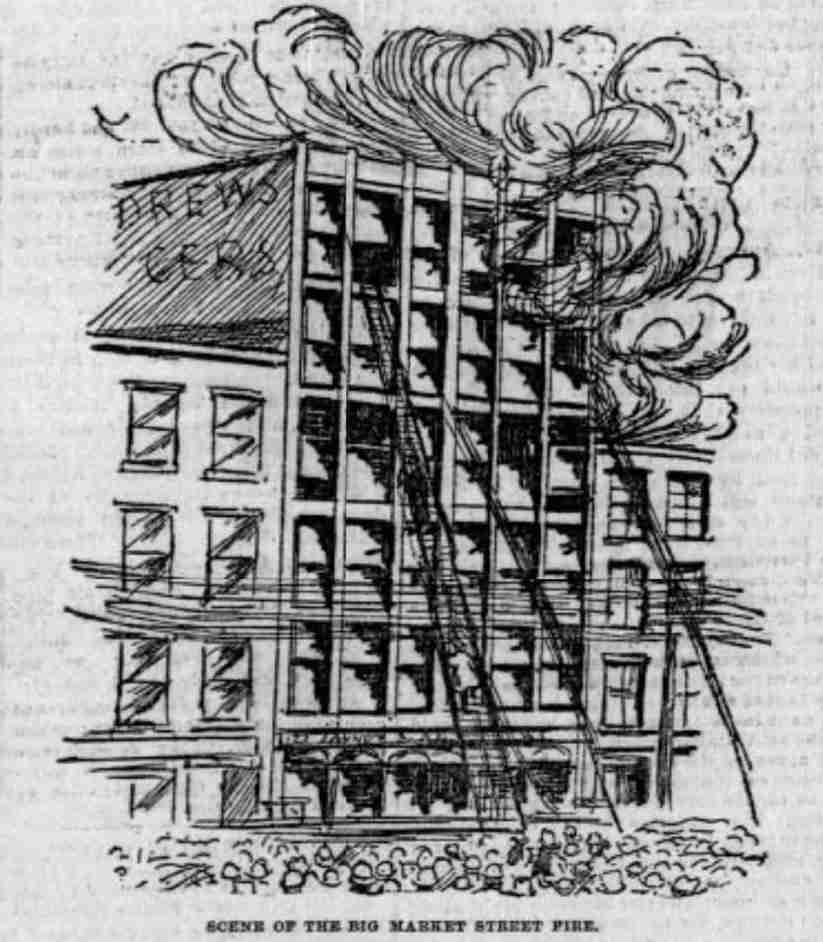
Newspaper illustration of the fire scene.

Note: A mercantile loft-style building is a structure that was originally built for commercial purposes such as warehouses, garment factories and other manufacturing uses. The first floor was usually occupied by a mercantile use while the upper floors contained manufacturing and light industrial uses. They were often built using cast iron structural elements including cast iron columns to support the upper floors and cast iron decorative front facades that provided large arched windows to display merchandise at street level. Built with high ceilings and supported by large wooden beams with cast iron columns, loft buildings provided ample floor space for machinery and materials in manufacturing occupancies, and the display of merchandise in mercantile shops. In recent years, many loft buildings have been repurposed into residential apartments and condominiums. They are usually renovated leaving much of the interior brick walls exposed, and the cast iron columns, cast iron facades, and high ceilings retained for aesthetic purposes.
Detail from the 1901 Sanborn fire insurance map of the rebuilt building. Note the small interior courtyard adjacent to the fire building and to the rear of Exposure Delta where Assistant Foreman McCuen was fatally injured by the collapsing wall. Also note that the rebuilt structure was covered by a monitored (A.F.A.) automatic fire sprinkler system.

The funeral for Assistant Foreman James McCuen was held on November 27 at the residence of his brother, Alexander McCuen at 1631 Columbia Avenue. Several large floral arrangements were featured in the parlor of the home. Following the service, pallbearers from Engine Company No. 4 and the Pennsylvania Volunteers carried the American flag-covered casket to the hearse as hundreds of city firefighters and military veterans lined the street in salute to their fallen comrade. The cortege then made its way to the receiving vault at Monument Cemetery where it remained for a few days before interment in the McCuen family burial plot at Fernwood Cemetery in Lansdowne, Delaware County, Pennsylvania.


