
Pump Operator Crushed by Falling Wall at Furniture Factory Fire – Berkey & Gay Furniture Company Fire – Grand Rapids, Michigan – November 24, 1943
Submitted by Rick DeGroot
On November 24, 1943, Grand Rapids Fireman Louis Coleman of Engine 12 died from the injuries he sustained when a section of a brick wall collapsed on him as he was operating the pumper truck during a fire at the Berkey & Gay Furniture Company on Monroe Avenue N.W. When the first fire apparatus arrived at the scene, the old factory building was a seething mass of flames. Additional alarms were sounded for more resources as firefighters attempted to confine the fire and protect adjoining exposures including the Rowe Hotel to the south. As Engine 12 was laying out hoselines alongside the east side of the building, an explosion blew out a six-story brick wall which fell and crushed the apparatus driver, Fireman Coleman. Unstable walls and uncontrolled fire hindered rescuers from immediately rescuing the seriously injured fireman. After the flames were subdued, firemen were able to retrieve Coleman from his debris-covered engine, and he was rushed to Butterworth Hospital by police ambulance where he was pronounced dead. Firefighters were able to keep the fire from spreading to the adjacent nine-story Rowe Hotel, but the massive fire required multiple apparatus and dozens of firefighters to control the blaze which took more than three days to completely extinguish. The cause of the fire was never determined but investigators had received reports of children running from the vacant structure the previous afternoon and guests at the nearby hotel had noticed an odor of wood smoke in the area later that evening.
The structure involved in the incident was a six-story Type IV Heavy Timber Mill brick and timber frame construction furniture factory occupied by the Berkey & Gay Furniture Company. The fire building, known as Plant No. 2, was part of a complex of industrial buildings located at 425 Monroe Avenue N.W. north of Michigan Street N.W. The large complex covered almost an entire city block on a plot of land adjacent to the Grand River just north of the downtown Grand Rapids business district. The Berkey & Gay Furniture Company was established at the site more than 60 years preceding the fire. Plant No. 2 was originally the main plant of the company until a new plant was built to the north at 900 Monroe Avenue N.W. A five-story industrial building of similar construction was on Side Alpha of the main plant building separated by a 20-foot-wide alley. Two wood frame elevated passageways connected the two brick and timber frame buildings that contained more than 250,000 square feet of floor space and were reportedly vacant and unused at the time of the fire. Adjacent on Side Bravo was the nine-story 300-room Rowe Hotel. On Side Charlie were several railroad sidings on the banks of the river. On Side Delta was a one-story brick and wood joist machine shop. Sections of the plant were equipped with dry and wet automatic fire sprinkler systems. It is unknown if the sprinkler system in the vacant portions of the plant were operational at the time of the fire. There were several fire hydrants located nearby on Monroe Avenue N.W. fed by eight- and 20-inch water mains. The nearest fire alarm call box was located one half block south at Michigan Street N.W.
The city of Grand Rapids is the county seat of Kent County, Michigan. It is the second-most populous city in Michigan, with a population of 198,917 at the 2020 census. It is the anchor city of the Grand Rapids metropolitan area with over 1.18 million residents and is the economic and cultural hub of West Michigan. Situated along the Grand River, the 45.63 square mile city is about 25 miles east of Lake Michigan and about 70 miles west of the state capital of Lansing. Settled in the 1820s as a fur trading post, the city grew rapidly and was incorporated in 1850. During the second half of the nineteenth century, the city became a major lumbering center, processing timber harvested in the region. Logs were floated down the Grand River to be milled in the city and shipped via the Great Lakes. The city became a center of fine wood products as well. By the end of the century, it was established as the premier furniture-manufacturing city of the United States. By 1870 there were eight factories employing 280 workers and by 1911 about 8,500 were employed by forty-seven factories. At least a third of the workers in Grand Rapids were employed by furniture companies that provided jobs for many new immigrants from Europe in the late 19th and early 20th century.
In 1940, the population of the city was 166,000. At the time of the fire, the Grand Rapids Fire Department had 1 fire marshal, 1 assistant fire marshal, 3 battalion chiefs, and 221 paid firemen working under a two-platoon system operating from 11 fire stations. Apparatus included 14 engines, 3 aerial ladders, 4 combination hose and chemical trucks, 2 hose trucks, 1 chemical truck, 1 smoke sucker, 4 chiefs cars, and 3ew steam engines with motorized tractors held in reserve. The city was protected by a Gamewell telegraph fire alarm system with 330 fire alarm call boxes connected to a central fire alarm office at fire headquarters. The municipal water system had its source at Lake Michigan with a system of pumps, elevated water tanks, reservoirs and water mains connected to 3,662 fire hydrants distributed around the developed areas of the city.
Today, the city is protected by the 234 career members of the Grand Rapids Fire Department operating from 12 fire stations deploying 10 engine companies, 4 aerial platform companies, 1 aerial ladder company, and 2 rescue companies. Each company is staffed by 3 personnel. There are several specialized units including a HazMat unit, dive rescue unit, and technical rescue unit. The ISO Class 1 and CFAI internationally accredited agency responded to 25,301 calls for fires, emergency medical services, hazardous materials responses, and technical rescue services in 2024.
Area weather conditions on the night of the fire included air temperatures in the mid-20s F under partly cloudy skies (US Weather Bureau, 1943). The weather conditions did not appear to have been a significant factor in fire development or the outcome of the incident.
On Wednesday, November 24, 1943, at about 12:30 a.m., a fire of unknown origin was discovered in a six-story section in the rear of the Berkey & Gay furniture factory at 425 Monroe Avenue N.W. Arriving firefighters found the fire was spreading so quickly that the flames crossed a passageway into a five-story warehouse that fronted on Monroe Avenue. Additional help was summoned immediately, and Fire Marshal Edward C. Palmer was on the scene within a few minutes. Marshal Palmer said the blaze spread almost immediately to the entire six stories in the rear building following an explosion just after the first firefighting equipment arrived. The blast, Palmer said, was likely due to intense heat buildup inside the building.
Fireman Louis A. Coleman had just driven the pumper of Engine 12 into the alley between the two involved buildings at the rear of the adjacent Rowe Hotel off Michigan Street N.W. Coleman was seated in the driver position on the pumper and had shifted gears to back the vehicle to the hydrant when suddenly without warning the top portion of the six-story brick wall of the fire building collapsed outward and toppled onto the pumper. Fireman Coleman was crushed under the tremendous weight of the masonry.
Marshal Palmer and a dozen firemen were within a few feet of the pumper when the wall fell. One fireman saw the structure start to topple and shouted a warning. The weight of the brick and debris crushed the heavy pumper and broke the front axle. Soon after, the walls and interiors of the building at other points started to collapse and the firemen were forced back. Also hindering the firefighting efforts was the loss of another pumper crushed in the collapse in addition to Engine 12. As the flames were being beaten back, the mangled body of Firemen Coleman was extricated from the ruins and rushed by police ambulance to Butterworth Hospital where he was pronounced dead.
Soon after the fire was discovered and it was feared the flames might spread to the adjacent nine-story Rowe Hotel, employees awakened several hundred guests who were evacuated from the building. Their luggage was piled in the lobby until the flames were brought under control about 3 a.m. and the guests were allowed to return to their rooms.
The massive fire required multiple apparatus and dozens of firefighters to control the blaze which took more than three days to completely extinguish. Both buildings were reported to be vacant and contained no materials at the time of the fire according to a company manager. Several company trucks in the buildings were also destroyed. It had been planned to equip the plants with machinery for war production within 90 days of the incident. A private automobile parked in the alleyway was also destroyed by the collapsing walls. The weakened outer walls of the two buildings were razed on the morning following the fire.
An investigation into the tragic fire was led by Inspector Albert F. Scheiern, chief of detectives, and Deputy State Fire Marshal Arnold C. Renner, who arrived in Grand Rapids from Lansing early Wednesday morning. The investigators were told that a group of children was seen running from the building about 4 p.m. on Tuesday. Renner was also informed that guests at the Rowe Hotel smelled “wood smoke” at about 8 p.m. the previous evening.
A company spokesperson said the loss of the No. 2 plant at the Berkey & Gay company would not affect war production in the large nearby No. 1 plant at 900 Monroe Avenue N.W. The company had been manufacturing prefabricated barracks, cargo trailers and shelving bins for the armed services for the past several months.
Fireman Louis A. Coleman, age 41, was a 20-year member of the Grand Rapids Fire Department assigned as a driver with Engine 12. He began his service on December 3, 1923. He was survived by his wife, Helen; a son, Private Louis A. Coleman Jr., stationed with the US Army at Barstow, California; a daughter, Mrs. Virginia Dood; four brothers, Ralph, John, Karl, and George Coleman; three sisters, Mrs. Hazel Rodenburg, Mrs. Florence Kinsman, and Mrs. Lorine Copeland. His funeral was held on November 27 at the Joldersma mortuary with interment following at Greenwood Cemetery in Grand Rapids.
Grand Rapids Fireman Louis A. Coleman has been honored at the Michigan Fallen Heroes Memorial Monument in the Oakland County complex in Pontiac. The memorial honors police officers and firefighters who died in the line of duty and features bronze statues of a police officer and firefighter kneeling in reflection before a granite wall engraved with the names of the fallen. The earliest honoree listed on the wall dates to 1864. Today, more than 900 names are etched into the granite wall.
The site of the fatal incident is now occupied by a large mail processing facility of the US Postal Service. There is no memorial marker at the site. The Rowe Hotel remains at the site and recently reopened after an extensive renovation.
Commentary:
Type IV Heavy Timber/Mill construction buildings in the United States have their origin in New England with the rise of the large industrial manufacturing firms at the dawn of the American Industrial Revolution in the late 18th century and accelerating in the 19th century. This era was defined by the rise of machine-aided factory production. In order to support the heavy machinery often needed to produce textiles, wood products, and other manufactured goods of the period, large, sturdily-built structures were erected to house this type of industry. Heavy Timber/Mill construction buildings featured robust wooden interior structural members and masonry exterior walls to support the heavy floor loads that industrial machinery placed on the structure. This type of construction also reduced the risk of fire destroying the entire building when smaller fires occurred in the structures. The masonry exterior walls also provided a measure of protection from exposure fires from nearby structures. Often these buildings would suffer only light fire damage to the interior and business could resume fairly quickly after clean-up. However, if the fire could not be controlled in its incipient stage by fire brigades or local fire companies, or later by automatic fire sprinkler systems, the large dimension wooden structural members would burn long and furiously, sometimes becoming a conflagration hazard to adjacent structures by generating tremendous amounts of radiant heat.
The term “slow burning” often has been associated with heavy timber/mill construction; this description refers to a mill’s relative resistance to ignition. Starting a fire in a mill’s massive wood members is fairly difficult. Using the term slow burning, however, can be misleading. Once a serious fire has taken hold in a mill, it will spread very rapidly. Extreme radiant heat, flying brands, and falling walls are characteristic fire conditions of a fully involved mill. Typically, the masonry exterior walls of a Type IV Heavy Timber/ Mill construction structure are meant to enclose the large diameter wooden interior framework of the structure that provides most of the structure’s load bearing capacity. When the interior wooden framework is consumed during a serious fire in this type of construction, the exterior masonry walls are left with minimal lateral support and can become a serous collapse hazard to firefighters working on the exterior of the burning structure.
The collapse of exterior masonry walls of fire-damaged Type IV Heavy Timber/Mill construction buildings have caused serious injuries and deaths to dozens of firefighters. Two recent examples include:
On April 9, 2012, Philadelphia Fire Lieutenant Robert Neary and Firefighter Daniel Sweeney of Ladder 10 died when a wall collapsed during firefighting operations at a vacant commercial structure fire. One engine company was initially dispatched to a report of smoke in the area at 0313 hours. Upon arrival at 0317 hours, Engine 2 radioed that the fire was spreading throughout the structure and called for a second alarm response and to prepare for a third alarm. The vacant and abandoned warehouse covered more than half a city block. This incident would eventually grow to five alarms as the fire would extend to an adjacent occupied furniture store. Ladder 10 was dispatched on the second alarm and assigned to deploy an elevated master stream. The fire originated in Building 1 on Side Charlie and rapidly extended to the other structures within the vicinity. Building 2 located east of the building of origin and situated on Side Alpha sustained the structural and wall collapse that resulted in the firefighter fatalities and injuries. Ladder 10 set up ladder pipe operations on Side Alpha of the fire building. The collapse occurred at 0555 hours after the lieutenant and three firefighters from Ladder 10 were sent inside the furniture store to operate a hoseline to stop the fire extension. Two firefighters were trapped by the collapse and were injured. Lieutenant Neary and Firefighter Sweeney were buried by the collapse and died as a result. The cause of the fire in the dilapidated building was undetermined:
https://www.facebook.com/groups/192218352449074/permalink/1500640808273482/
On March 22, 2018, York Pennsylvania Firefighters Ivan Flanscha and Zachary Anthony died following a structural collapse while working to extinguish hot spots following a structure fire in a 140-year-old mill building being renovated into residential apartments. The previous day, March 21, 2018, the local fire department was dispatched at 1616 hours, for a report of a structure fire with possible entrapment. Firefighters mounted an interior attack on the fire but were later withdrawn from the building due to deteriorating conditions. A large section of the rear of the building later collapsed during defensive operations. The next day an overhaul crew was working to extinguish a deep-seated smoldering fire in roofing materials and debris on the upper floors when the building suffered another partial collapse that took the lives of two firefighters and seriously injured two others. The secondary collapse occurred almost 20 hours after the fire had been placed under control. The deaths of the two firefighters were the first firefighter line of duty deaths in almost fifty years in the city. Fire investigators determined that the fire originated on the first floor but the cause of the fire was undetermined.
https://www.facebook.com/groups/192218352449074/permalink/1484389289898634/
The risk assessment of a building during firefighting operations must be continuous with building intelligence and reconnaissance communicated on degrading conditions, fire extension and compromise, building integrity considerations, the effects of fire spread and suppression on the interior compartment, and the structural system and building envelope. Often during long duration incidents, firefighters tend to suffer from “mission creep” and begin to push the limits of established collapse zones in an effort to complete the extinguishment process as quickly as possible. This loss of situational awareness may lead to placing firefighters in compromising positions. Incident commanders should consider rotating companies at long duration incidents so that fresh firefighters are assigned to areas adjacent to collapse zones. Additional safety officers should also be assigned to maintain a full-time vigilance over the established collapse areas. Some departments are also employing specialized equipment such as surveyor transits to monitor building stability at fires that have seriously compromised involved structures.
We have attached photos from the Grand Rapids incident. We have also attached a copy of the 1912 Sanborn fire insurance map of the area showing the configuration of the furniture factory and the surrounding exposures.
We have also included the link to a two-part article on recognizing building collapse indicators that was published in Firehouse magazine by the late Philadelphia Deputy Chief James P. Smith:
https://www.firehouse.com/operations-training/article/10544968/building-collapse-indicators
We have also included the link to a BCFS Question of the Week article on Type IV Heavy Timber/Mill construction: https://www.facebook.com/groups/192218352449074/permalink/1666007241736837/
Thanks to multiple media sources for the content of this article.
Remember the service of Grand Rapids Fireman Louis A. Coleman by studying the construction features of Type IV Heavy Timber/Mill construction buildings and by touring a Type IV building in your local response district while reviewing the indicators of building collapse with your crew members today.
Remember Fallen Brothers.
Get Out There And Know Your Local!!!
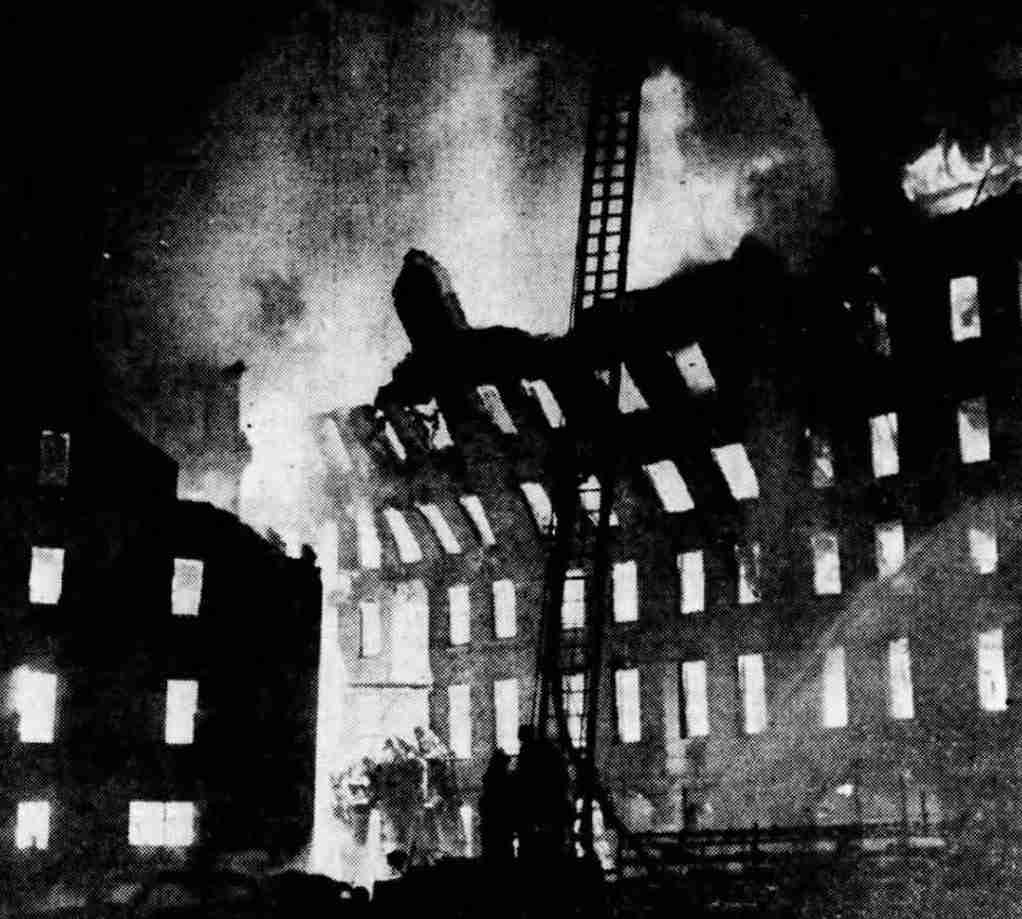
Newspaper photo of the collapsing walls on Side Alpha of the burning factory building. The photo was taken just after a portion of the top of the wall initially collapsed striking Fireman Coleman who was laying hoselines with Engine 12 in the alley between the buildings

Detail from the 1912 Sanborn fire insurance map showing the configuration of the furniture factory and the surrounding exposures. The area where the fatal collapse occurred is circled in red.

The massive fire required multiple apparatus and dozens of firefighters to control the blaze which took more than three days to completely extinguish. Both buildings were reported to be vacant and contained no materials at the time of the fire according to a company manager.


