
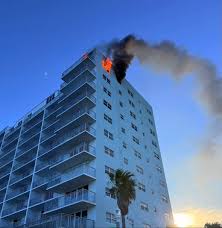
This near-miss event occurred during a high-rise fire attack operation. While ascending to the fire floor, crews encountered severe delays connecting to the standpipe due to a corroded reducer. Conditions rapidly deteriorated when a propped-open stairwell door compromised smoke control. The most critical event involved the Company Officer from Engine 40 advancing into the fire area and experiencing sudden, catastrophic air depletion, where the user alleges the SCBA Heads-Up Display (HUD) and low air alarm reportedly failed to activate. The officer was briefly out of air and unable to immediately access the RIT/Buddy breathing system due to the inverted placement of the pouch. A Mayday was not called by any crew member during or immediately after the event. The situation was resolved only by the swift, unassisted action of the partner connecting the emergency air supply.
Detailed Narrative
Hollywood Fire Rescue was dispatched to a reported apartment fire with multiple confirming 911 calls. EMS 31 established Command, assigning Engine 40 and Rescue 40 to Fire Attack.
1. High-Rise Evolution Delay: E-40 and R-40 crews ascended to the 11th floor (floor below the fire) and began the high-rise evolution. Crews successfully removed the residential hose from the standpipe cabinet but encountered a severely corroded reducer on the connection. Significant time and effort were expended to remove the reducer before the high-rise pack could be connected.
2. Stairwell Compromise: During the high-rise pack deployment & setup, crews opened the stairwell door and were instantly overcome with heavy smoke and zero visibility. The E-40 Company Officer and Firefighter proceeded up to the 12th floor and discovered the stairwell door to the fire floor was propped open with an unknown object, compromising the entire stairwell’s tenability. The E-40 Officer had to forcefully attempt to close the door to gain control before retreating to the 11th floor to finalize the high-rise connection.
3. SCBA Failure and Disorientation: Once the hose was charged, the crew advanced back to the 12th floor and into the hallway. For an unknown reason, the E-40 Officer advanced to the right, away from the fire apartment, causing brief disorientation.
4. Catastrophic Air Depletion: A few minutes into this advance, the Officer experienced their mask sucking to their face upon inhalation. A second breath provided air, but the third resulted in the mask sucking to the face again, indicating zero available air.
5. Emergency Actions: The E-40 Officer advised their partner of the air emergency. While attempting to access the buddy breathing hose, the Officer noted the pouch was inverted, preventing immediate access. Seeing daylight through accordion shutters nearby, the Officer recognized a pathway to fresh air, removed their mask, and took a breath. Simultaneously, the partner recognized the severity of the emergency, immediately deployed their buddy breathing hose, and connected it to the Officer’s pack, restoring air supply.
6. Withdrawal and PAR: Once air was flowing in his mask, the Officer immediately donned their mask, advised Command of the emergency, and advised a PAR 3 for exiting the structure. Upon exiting, the E-40 crew was sent to Rehab for evaluation.
7. Post-Incident SCBA Status: The Officer reported checking the SCBA at the beginning of the shift, noting only a half battery status. The Officer does not recall seeing any low-air lights on the HUD or hearing the low air alarm activate prior to complete air depletion.
Contributing Factors and Lessons Learned
1. Equipment Readiness (SCBA): The reported failure of the HUD and low air alarm systems to indicate low air is a critical factor. While a less than full battery was noted at the beginning of the shift, it is unclear if this contributed to the failure of the low-air warning systems. The lack of warning forced the Officer into a surprise, life-threatening situation.
2. Infrastructure Failure: The severely corroded standpipe reducer significantly delayed a critical phase of fire attack, extending the time crews were in a hazardous environment.
3. Building Occupant Action: The stairwell door being propped open compromised the critical fire safety barrier, allowing heavy smoke conditions to migrate instantly into the dedicated means of egress, and complicating fire attack operations.
4. Operational Disorientation: The Officer’s unexplained advancement away from the fire apartment increased the time exposed to IDLH conditions. However, this unintentional deviation ultimately proved beneficial, as it moved the crew away from the immediate fire area, allowing the Officer access to daylight and a safer path for immediate self-rescue; had the SCBA failure occurred inside or immediately adjacent to the fire apartment, the exposure to superheated gases would have created a significantly greater problem.
5. Buddy Breathing Accessibility: The inverted placement of the buddy breathing pouch due to the waist strap being twisted, delayed the Officer’s own attempt to secure buddy breathing with his partner.
6. Mayday Failure (Cultural/Training): Despite facing zero air and survival conditions, a Mayday was not called by the Officer or any crew members on scene, either during the emergency or immediately following stabilization. This is a critical training deficiency requiring immediate remediation.
Recommendations
1. SCBA Maintenance and Checks: Conduct an immediate, detailed investigation into the SCBA unit involved, the manufactures representative was contacted and th pack has been secured. Review department policy for what constitutes a serviceable SCBA when a low battery is noted and reinforce the importance of confirming the functionality of all low-air warning systems (HUD, low air alarm) during the daily check. Contact the manufacture to provide analyze all department packs to insure safety and operation across the entire organization.
2. Mayday Training Reinforcement: Implement mandatory, high-frequency training scenarios focusing solely on calling a Mayday under stress, emphasizing that any member can and must call the Mayday for themselves or their partner when a life-threatening emergency occurs, regardless of rank.
3. Buddy Breathing Standardization: Review the deployment and placement of RIT/Buddy Breathing connections on all packs to ensure universal, non-inverted, and immediate accessibility.
4. High-Rise Equipment Review: Notify building management and code enforcement regarding the corrosive conditions found on the standpipe connections. The department should carry tools specifically designed to assist with corroded or stuck components during high-rise evolutions.
