
Hoarding Conditions in Residential House Fire Claims Life of Firefighter – Pensacola, Florida – November 25, 2000 – NIOSH Firefighter Fatality Report F2000-44
Submitted by Rick DeGroot
On November 25, 2000, Pensacola Florida Firefighter Marvin Maurice Bartholemew died in a late-night residential house fire. At 0135 hours, firefighters received a call of a reported structure fire. Three engines, one ladder and a rescue company responded and found a one-story residence well involved in fire. A search team including Firefighter Bartholemew, a captain and a lieutenant entered the structure because it was unclear if the occupants had exited. The team advanced a hoseline through the front door while a positive pressure ventilation (PPV) fan was placed at the front door. Another crew advanced a hoseline to the rear of the structure.
Bartholemew and the search crew advanced their hoseline down a hallway and into a bedroom when the crew captain noticed heavy fire in an adjacent room. The crew became disoriented and could not find the nozzle due to a large amount of accumulated possessions and trash in the residence. The captain ordered the crew members to evacuate the building as fire extended into the hallway. The captain and the lieutenant were able to escape the building, but Firefighter Bartholemew became lost in the structure and did not exit. Command immediately ordered exterior crews to enter the structure and search for the missing firefighter. 56 minutes later Firefighter Bartholemew was located, removed from the residence and pronounced dead at the scene. Unknown to the firefighters, the elderly residents had self-evacuated the structure prior to the arrival of fire units. Fire investigators determined the fire’s origin was in the kitchen and was declared accidental due to cooking.
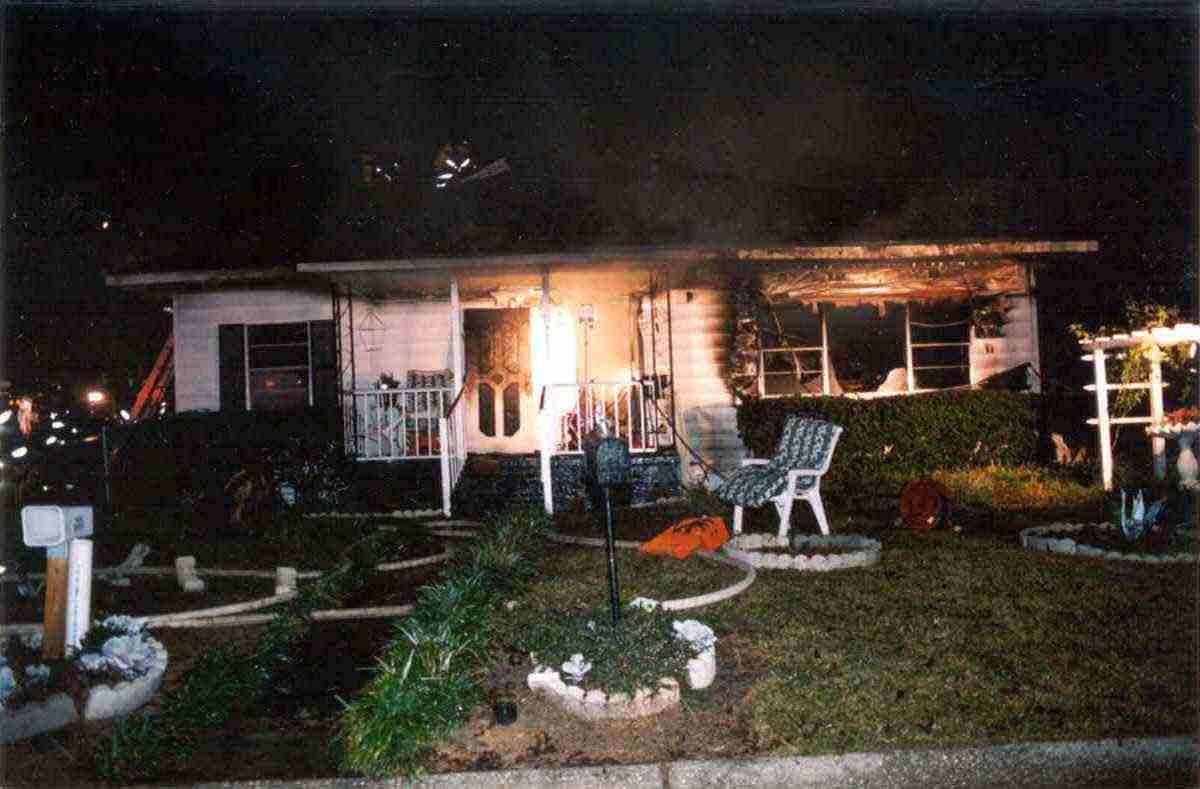
The structure involved in the incident was a one-story Type V Wood Frame single-family dwelling that measured approximately 52 feet by 59 feet. The structure had an attached roof on Side Charlie measuring approximately 19 feet by 21 feet, which served as a carport. The home had a central hallway with two bedrooms on Side Bravo and a living room, another room, and a kitchen on Side Delta. A small bathroom was located at the end of the hallway in the center of the home. The home had a large accumulation of possessions, furniture and rubbish stored in piles throughout the residence. A small storage shed was attached on the exterior of Side Charlie near the carport. A trailer with lawn equipment stored inside was parked on Side Bravo near the carport. A fire hydrant was located about 150 feet east of the fire building at the corner of North 9th Street.
Pensacola is the westernmost city in the Florida Panhandle, and the county seat and only incorporated city of Escambia County. As of the 2020 U.S. census, the population was 54,312. Located on the north side of Pensacola Bay, the city is 60 miles east of Mobile, Alabama, and 200 miles west of Tallahassee, the state capital of Florida. Tourism is an important part of the local economy with some two million tourists having visited the area in 2016.
At the time of the incident, the Pensacola Fire Department was comprised of 137 uniformed personnel. The department served a population of approximately 60,000 residents in an area of 25.9 square miles. The department required all new firefighters to complete a city orientation program, Fire Fighter Level I and II (in accordance with NFPA standards), and a physical agility exam. Refresher training was provided periodically. The refresher training consisted of courses such as search and rescue, blueprint reading, high angle and confined space rescue, and fire origin and cause. The training records of Firefighter Bartholemew were reviewed by NIOSH investigators and appeared to be sufficient. Bartholemew had approximately four years of experience as a firefighter.
Area weather conditions on the night of the fire included an air temperature of 56 degrees F and a relative humidity of 93% with a southwest wind of 7 mph under fair skies (Weather Underground). The weather conditions did not appear to have a significant effect on fire development or the outcome of the incident.
On Saturday, November 25, 2000, at 0135 hours, city firefighters received a call for a reported structure fire at 800 East Hatton Street in a residential area north of downtown Pensacola. Engine 5, Engine 2, Engine 1, Ladder 11 and Rescue 32 responded to the call. At 0141 hours, Engine 5 with a captain, a lieutenant, and Firefighter Marvin Bartholemew arrived on the scene and the captain assumed Command reporting a well-involved, one-story house fire. The majority of the firefighters interviewed stated that they recalled seeing heavy smoke and fire extension from Side Charlie of the structure, indicating that the fire was self-venting through the rear of the structure. Command ordered dispatch to get the power company in route and ordered all other responding companies to stand by for their assignments. Within the next 1 ½ minutes, all first-alarm companies arrived on the scene. Command ordered Firefighter Bartholemew to pull a
1.75-inch hoseline off their engine and stretch it to the front door. He then radioed the captain and lieutenant from Rescue 32 to team up with Bartholemew to make entry through the front door, and search for possible occupants. Note: Due to the time of the call, Command was concerned that the structure might be occupied.
Command then attempted to complete a 360-degree walk-around size-up of the structure before ordering the captain and lieutenant from Ladder 11 to set up their positive pressure ventilation (PPV) fan in the front door. Note: Command could only complete a partial 360 size-up because of a fence which cut off access to a portion of the rear. After setting up the PPV fan, the captain and lieutenant were ordered to enter the structure, follow the hoseline taken in by the search crew, and assist in the search for occupants. Command then ordered dispatch to strike a second alarm and Engine 3 and Ladder 16 were dispatched to the scene at 0143 hours.
Command then ordered Engine 1 to pull a second 1.75-inch hoseline off of Engine 5 and advance it through the front door for fire attack, and to back up the search crew. Unclear of the order, the captain from Engine 1 ordered his firefighter to stretch the hoseline to the Bravo/Charlie corner of the structure for fire attack. The lieutenant from Engine 1 met up with the firefighter and assisted in advancing the hoseline to the rear of the structure. The crew from Engine 2 was ordered to pull a 5-inch main supply line from Engine 5 and hook it into a nearby fire hydrant. After making their hookup, the Command ordered them to pull a 1.75-inch hoseline off their engine, hook it up to Engine 5, and protect the Delta exposure.
The search crew advanced their hoseline through the front door and down the cluttered hallway toward the rear of the structure. Note: Firefighters stated that there was debris and furniture throughout the hallway. The captain and lieutenant from Ladder 11 positioned the PPV fan in front of the front door and fed additional hoseline to the search crew. The interior crews stated that there was no visible fire, but heavy smoke when they entered the structure.
The lieutenant and the firefighter from Engine 1 opened their line up on a trailer with lawn equipment, which was burning near the rear. After knocking down most of the lawn equipment fire, they opened up a straight stream and applied it to the heavy fire emitting from the eaves of the partially collapsed carport on the Bravo/Charlie corner. Note: The lieutenant stated that he never received a direct order of operation and was unaware that any firefighters were inside the structure at this time. Shortly thereafter, the lieutenant and the firefighter from Engine 1 turned their hoseline to a small, burning shed, to the left of the covered carport. The captain and lieutenant from Rescue 32 stated that Firefighter Bartholemew, who was on the nozzle, entered a bedroom near the rear of the structure. The lieutenant stood at the door of the room as the captain remained in the hallway. The captain and the lieutenant stated that at this time the PPV fan was clearing up the heavy smoke conditions.
The captain from Rescue 32 with the search crew stated that he looked into a room toward the Delta side of the structure (a room in front of the kitchen where the fire started) and saw a large amount of fire through the kitchen doorway. He yelled at the lieutenant from Rescue 32, requesting the nozzle in fear that the room would flashover. The lieutenant responded to the captain’s request stating that they could not locate the nozzle. With the heat intensifying, the captain ordered Bartholemew and the lieutenant to exit the structure immediately. At this point, the lieutenant and firefighter from Engine 1, who were on the Bravo/Charlie corner, recalled seeing the roof over the kitchen begin to collapse. The captain from Rescue 32 stated that the lieutenant turned and went in front of him toward the front door and Bartholemew turned and was face to face with him. The captain then turned with Bartholemew behind him and attempted to exit. The lieutenant stood and began to run toward the exit before falling over heavy debris (clothing, furniture, and paper products). At approximately 0147 hours, the captain stated that heavy fire filled the hallway and he also fell to the floor. He then told the lieutenant that they had to go through the fire to exit the structure. The captain then proceeded to pass the lieutenant and exit the structure. The lieutenant exited the structure shortly after. The captain did not see Firefighter Bartholemew exit but assumed he was right behind him. He asked the lieutenant if Bartholemew had exited, and the lieutenant could not recall if he did.
At this point, the captain and the lieutenant from Ladder 11 recalled seeing fire emitting from the front door and the captain then shut down the PPV fan. Command reported seeing a civilian in the road, just in front of the house, stating that her husband was going to need an ambulance for smoke inhalation. Command radioed dispatch for an ambulance at 0149 hours. The captain from Rescue 32 approached Command reporting that Firefighter Bartholemew did not exit the structure. The lieutenant from Engine 1, who was still on the Bravo/Charlie corner, broke out the rear window on the Side Bravo. He recalled being able to see fire on the interior Side Delta wall. Command ordered the captain and lieutenant from Ladder 11 to enter the structure with the hoseline that the crew from Engine 2 was using for exposure control, and search for Bartholemew. The captain from Rescue 32 told Command that the missing firefighter should be in the rear of the structure, in a room on the left.
The captain and lieutenant from Ladder 11 advanced the hoseline down the hallway. As they advanced their line, they stated that the hoseline taken inside by the search crew was damaged and water was free flowing. The captain and lieutenant reported that they encountered fire in a room near the kitchen. They hit the fire three times with a fog stream and stated that the fire was quickly knocked down but not completely extinguished. Given the information that Bartholemew was in a room off to their left, they retreated and entered the doorway of the room on their left and recalled seeing a small fire. They opened their hoseline on this fire as the lieutenant’s low-air alarm sounded. Noticing that all firefighters on the scene were occupied, Command radioed dispatch at 0150 hours requesting a second ambulance, Engine 6, and Rescue 36. Engine 3 arrived on the scene at 0152 hours and was ordered to pull a hoseline from their engine and protect the Delta exposure.
Over the next 40 minutes, several firefighters took part in the search, which consisted of following the initial hoseline taken inside by the search crew. The firefighters stated that they had reached the nozzle and Bartholemew was not near it. The firefighters stated that the search was hampered by a large amount of debris, clothing, and furniture, which was throughout the structure. The firefighters continued the search for the missing firefighter, thinking that he could have been under some of the debris. At 0234 hours, the crew from Engine 1, along with a captain reported to be in the rear on Side Charlie, stated that a section of the roof near the kitchen was down, and they were attempting to knock down some hot spots and search that area. As the crew from Engine 1 hit the hot spots, the captain searched through the burned-out debris. At 0245 hours, the captain was searching in the kitchen, near the doorway which led into the room off of the kitchen and located Firefighter Bartholemew. He was found in his full array of personal protective equipment, lying on his left side with his head toward the doorway and his feet toward Side Charlie. Note: His personal alert safety system (PASS) was severely damaged in the fire and was not sounding. The captain radioed Command reporting that the missing firefighter was found, and they would need a paramedic in the rear. Soon after, a paramedic arrived at the rear of the structure and pronounced Bartholemew dead at 0250 hours.
The medical examiner listed the cause of death as asphyxia due to smoke inhalation and carbon monoxide poisoning. A positive carbon monoxide reading of 69.5 percent was recorded.
Fire investigators determined the fire’s origin was in the kitchen and was declared accidental due to cooking.
NIOSH investigators concluded that, to minimize the risk of similar occurrences, fire departments should ensure that the department’s standard operating procedures (SOPs) are followed:
- ensure that when entering or exiting a smoke-filled structure, firefighters follow a hoseline, rope, or some other type of guide and refresher training is provided to reinforce the procedures.
- ensure that a rapid intervention team(s) (RIT) is established when firefighters enter an immediately dangerous to life and health atmosphere, and the RITs be properly trained and equipped.
- consider providing all firefighters with a personal alert safety system (PASS) integrated into their self-contained breathing apparatus.
- consider increasing the number of firefighters on engine companies to perform in accordance with NFPA standards.
- consider providing all firefighters with portable radios or radios integrated into their facepieces.
Additionally, dispatchers and emergency call takers should:
- obtain as much information as possible from the caller and report it to the responding companies.
Firefighter Marvin Maurice Bartholemew, age 30, was a four-year member of the Pensacola Fire Department. He was survived by his fiancée, Janie Powers, his son Caled, age 7 and his daughter, Tiffany, age 2-1/2-months, and his mother, Velma Jones. His funeral was held on December 1, 2000, at Sacred Heart Cathedral. His coffin was placed on the back of Pensacola Engine 5 for the 1.1-mile journey from the cathedral to his gravesite at Holy Cross Catholic Cemetery in Pensacola. More than fifty fire apparatus along with hundreds of firefighters from around the region lined the street as the procession of 200 Pensacola firefighters accompanied by a bagpipe and drum band marched along 12th Avenue enroute to the gravesite.
The name of Firefighter Marvin Maurice Bartholemew has been inscribed at the Florida Fallen Firefighter Memorial on the campus of the Florida State Fire Collage in Ocala. The centerpiece of the Memorial is a life-size bronze statue of a firefighter that does not depict the typical heroic pose we often see but is instead modeled in a pose keeping with the purpose of the Memorial, that being a “Firefighter at Rest”.
In 2019, Florida dedicated a Firefighter Memorial Monument on the grounds of the State Capitol in Tallahassee. The monument pays tribute to firefighters who have given their heroic efforts to protect life and property and is constructed primarily of bronze. The sculpture shows three firefighters in a dignified and majestic pose.
Firefighter Marvin Maurice Bartholemew’s name has been inscribed on the 2000 plaque displayed at the National Fallen Firefighters Memorial on the campus of the National Fire Academy in Emmitsburg, Maryland.
Commentary:
The Fire Service has recently seen an alarming increase in fires and other emergencies in dwellings with hoarding conditions. The excessive accumulation of possessions, furniture and trash poses a significant increase in the fire load of a residence and can lead to rapid fire spread in the event of a fire occurring in the structure. When such conditions are encountered, especially during EMS and other non-fire related calls, fire departments must have a policy for partnering with local social service agencies to assist the occupants with rectifying the situation. Fire agencies must also have a method for identifying these dangerous conditions in the response system data base so that firefighters are alerted in advance of an emergency run at the location.
We have attached photos from the incident. The link to the NIOSH report is here: https://stacks.cdc.gov/view/cdc/163783
We have also attached the link to a BCFS Question of the Week article on hoarding conditions: https://www.facebook.com/groups/192218352449074/permalink/1569059674764928/
We have also attached the link to an article on fighting fires in hoarding conditions by Ryan Pennington published in Firehouse magazine:
Remember Firefighter Maurice Bartholemew by discussing your department’s policy for dealing with hoarding conditions and identifying such conditions in your response data with your crew members today.
Remember Fallen Brothers.
Get Out There And Know Your Local!!!
Bartholemew and the search crew advanced their hoseline down a hallway and into a bedroom when the crew captain noticed heavy fire in an adjacent room. The crew became disoriented and could not find the nozzle due to a large amount of accumulated possessions and trash in the residence. The captain ordered the crew members to evacuate the building as fire extended into the hallway. The captain and the lieutenant were able to escape the building, but Firefighter Bartholemew became lost in the structure and did not exit. Command immediately ordered exterior crews to enter the structure and search for the missing firefighter. 56 minutes later Firefighter Bartholemew was located, removed from the residence and pronounced dead at the scene. Unknown to the firefighters, the elderly residents had self-evacuated the structure prior to the arrival of fire units.
Fire investigators determined the fire’s origin was in the kitchen and was declared accidental due to cooking.
View of Side Alpha of the dwelling.


