
Structural Collapse During Auto Parts Store Fire Claims Lives of Three Firefighters – Coos Bay, Oregon – November 25, 2002 – NIOSH Firefighter Fatality Report F2002-50
Submitted by Rick DeGroot
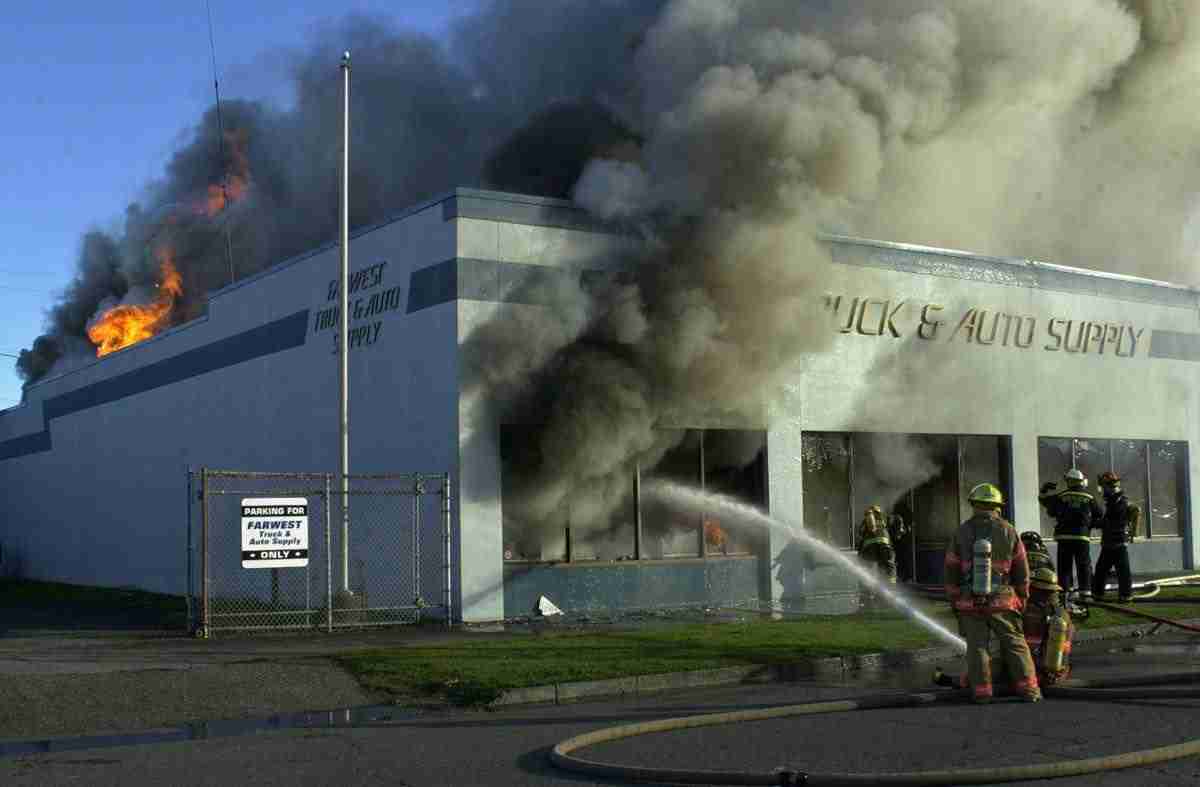
On November 25, 2002, Coos Bay Oregon Fire Lieutenant Randall Carpenter, Firefighter Robert Hanners, and Firefighter Jeffery Common died while battling a fire in the Farwest Truck & Auto Supply store. Employees returning from lunch discovered a light haze in the air and the smell of something burning in the structure. They searched for the source of the haze and burning smell and discovered what appeared to be the source of a fire. At 1351 hours they called 911. Local fire units were immediately dispatched to the auto parts store with reports of smoke in the building. Firefighters advanced attack lines into the store and began their interior attack. At approximately 1420 hours, crews began opening up the ceiling and wall on the mezzanine level where they found fire in the roof rafters.
Three of the eight firefighters operating on the mezzanine began running low on air. As they were exiting the building, the ventilation crews on the roof began opening the skylights and cutting holes in the roof. The stability of the roof was rapidly deteriorating forcing everyone off the roof. Command called for an evacuation of the building. Five firefighters were still operating in the building when the ceiling collapsed. Two firefighters escaped. Attempts were made to rescue the three other firefighters as conditions quickly deteriorated. Numerous firefighters entered the building and removed Firefighter Hanners. He was transported to the area hospital and later pronounced dead. Approximately two hours later, conditions improved for crews to enter, and Lieutenant Carpenter and Firefighter Common were later found on the mezzanine. Both firefighters were pronounced dead about an hour later by the Deputy Medical Examiner. Fire investigators later determined that grease being incinerated in a furnace in a parts-cleaning operation in the adjacent machine shop in a separate part of the building caused a chimney flue to overheat which in turn ignited roofing materials that burst into flames when they came in contact with a supply of oxygen. A subsequent backdraft or smoke explosion in the cockloft was suspected to have caused the collapse of the roof.
The Farwest Auto Parts store, located at 340 South Second Street in Coos Bay, was built in approximately 1938 and was of Type IV Heavy Timber construction. The building had numerous modifications which included the addition of a warehouse and a mezzanine. The non-sprinklered building encompassed approximately 13,520 square feet of floor space. The ceiling was comprised of 8-inch wide by ¾-inch thick old-growth fir ship lap boards with 3/8-inch Furtex ceiling tiles glued to the surface. The ceiling was attached to 2-inch by 10-inch wood ceiling joists. The height of the ceiling in the sales area was approximately 14 feet and at the mezzanine was 7 feet. The roof was constructed of the same material and in the same manner as the ceiling. The roof was supported by 2-inch by 13-inch wood roof rafters and 9-inch by 9-inch wooden posts supporting 9-inch by 13-inch wooden beams. A tapered cockloft ran the width of the building from Side Bravo to Side Delta. An automotive machine shop operating as a separate occupancy was located in the Bravo/Charlie corner of the building. A fire hydrant was located directly across South Second Street from the fire building.
Coos Bay is a city located in Coos County, Oregon, along the Pacific Coast where the Coos River enters Coos Bay on the Pacific Ocean. The city borders the city of North Bend, and together they are often referred to as one entity called either Coos Bay-North Bend or Oregon’s Bay Area. The 10.5 square mile city as of the 2020 U.S. census had a population of 15,985 residents, making it the most populous city on the Oregon Coast. In the 1800s, Coos Bay served as an important commercial passage to the sea. Today it is still the largest bay between San Francisco and Seattle. Ship building, shipping, and wood products trading were popular in the late 19th century when transportation developments were being made. Today, the area is the center of trade and commerce for the entire southwestern Oregon coastal region.
At the time of the incident the city was protected by the Coos Bay Fire Department, a combination fire department comprised of 19 career firefighters and 25 volunteer firefighters staffing two stations.
Lieutenant Randall Carpenter was a career lieutenant who had approximately 14 years of experience with the Coos Bay Fire Department and had a total of 23 years of experience as a firefighter. He was a certified NFPA Fire Fighter Level I & II, as a Driver/Operator, and as a Fire Service Instructor. Additional training included Tactical Operations for Company Officers I & II, Firefighting Tactics and Strategy, Building Construction, and Firefighter Safety and Survival.
Firefighter Jeffrey Common was a volunteer member who had approximately three years of experience with Coos Bay Fire Department and had a total of 10 years of experience as a firefighter. He was certified NFPA Fire Fighter Level I & II, as a Driver/Operator, and as a Fire Service Instructor.
Firefighter Robert Hanners was a volunteer member who had approximately eight years of experience with Coos Bay Fire Department and a total of 15 years of experience as a firefighter. He was certified NFPA Fire Fighter Level I & II and as a Driver/Operator.
Area weather conditions at the time of the incident included an air temperature of 61 degrees F and a relative humidity of 39% with east-northeast winds at 12 mph under fair skies (Weather Underground). Note: Research by the National Institute of Standards and Technology (NIST) has shown wind speeds on the order of 10 to 20 mph are sufficient to create wind-driven fire conditions in a structure with an uncontrolled flow path (Madrzykowski and Kerber 2009). The breezy weather conditions on the afternoon of the incident likely had a significant impact on fire development and the outcome of the incident.
On Monday, November 25, 2002, at approximately 1320 hours, employees of the Farwest Truck & Auto Supply store returned from lunch and discovered a light haze in the air and could smell something burning. They searched the store but could not find the source of the haze or smell. One of the employees went outside and on the north side of the building, Side Bravo, put a ladder up to the roof. He went to the roof but was unable to find anything. After exiting the roof, he met the occupant from the attached automotive machine shop. They discussed the haze and smell of something burning. Together they returned to the roof where they found the chimney to be hot to the touch. They exited the roof, entered the auto parts store, and noticed a red glow in the bathroom area on the mezzanine. Note: The red glow was caused by the fire above the ceiling and behind the wall. They attempted to extinguish the red glow with a portable fire extinguisher. Their attempts to extinguish the red glow were unsuccessful so the occupants called 911 at 1351 hours.
At 1351 hours, fire units were dispatched to the auto parts store with reports of fire in the ceiling of the bathroom. Initial dispatch response included Ladder 8151, Engine 8132, Rescue 8171, Engine 8131, Staff 8101, and Battalion 8111. Battalion 8111 arrived on the scene, assumed Command, and reported “nothing showing” to Central Dispatch. The property owner approached Command and informed him that the fire was near the chimney in the bathroom on the mezzanine and that all of the occupants had exited the building. Command could see a light haze of smoke at the drop ceiling level. Ladder 8151 arrived on the scene and Command informed one of the firefighters as to the location of the fire.
At 1356 hours, the Fire Chief arrived on the scene and Battalion Chief 8111 transferred Command to the Chief. Brown smoke was now visible at the roof level near the chimney with no visible fire. Command then radioed responding units to advise them that it was a working fire in a commercial structure. The property owner, standing near the front door on Side Alpha with Command, pointed toward the mezzanine and said that the fire was in the bathroom up on the mezzanine.
Firefighter #1 and Firefighter #2 from Ladder 8151 advanced a 1.75-inch hoseline through the front door. The two firefighters advanced the line toward the north end of the sales counter. They saw fire at the ceiling level approximately 20 to 25 feet from the front wall in the northwest corner of the building. Note: It is believed that the fire was coming from a scuttle/vent space. The crew then applied water and knocked the fire down. The two firefighters repositioned the hoseline to the center of the sales counter before proceeding down the center aisle leading to the stairs of the mezzanine. The two firefighters could hear crackling as they reached the stairs.
Battalion Chief 8111 assisted in establishing a water supply to Ladder 8151. He was ordered by Command to do a walk-around of the building as part of the size-up of the incident. Command requested mutual-aid units from Central Dispatch. Coos Bay Engine 8132 arrived on the scene and firefighters pulled a 1.75-inch backup hoseline off Ladder 8151.
Firefighter #1 and Firefighter #2 advanced the attack line to the top of the stairs and onto the mezzanine. They advanced to the back wall of the mezzanine where they saw, to their left, the fully involved bathroom (Side Bravo of the building). Note: The two firefighters reported to NIOSH investigators that at this point, they encountered a light haze of smoke and very little heat on the mezzanine. They began their attack on the bathroom area and knocked the fire down. They opened up the ceiling near the bathroom and found fire in the rafters which they quickly knocked down. Three firefighters, Firefighter Robert Hanners, Firefighter #3 and Firefighter #4, advanced two hoselines from Ladder 8151 to the counter and continued with one hoseline to the mezzanine. Note: Firefighters reported to NIOSH investigators that the lights in the building were still on and that there was a grayish/brownish colored smoke at what they believed to be the ceiling level. The actual ceiling height was deceiving because of the drop ceiling and suspended lights above the sales counter and shelving.
The hose team encountered heavy smoke conditions with no visible fire upon reaching the top of the mezzanine. They met up with the two firefighters on the initial attack hoseline and assisted them with pulling ceiling material. The crews then began pulling wall material and attacking the fire between the rafters of the automotive machine shop. Firefighter #5 and Firefighter Common entered the front of the building and followed the hoselines to the mezzanine. Lieutenant Randall Carpenter entered the building and proceeded to the mezzanine. In an attempt to clear smoke from the mezzanine, Firefighter #5 searched for windows to open along the back wall and in the office. There were now eight firefighters (Lieutenant Carpenter, Firefighter Jeffrey Common, Firefighter Hanners and Firefighter’s #1- #5) operating with two hoselines along the back wall of the mezzanine. Lieutenant Carpenter radioed Command requesting roof ventilation and for a positive pressure ventilation (PPV) fan to be set up on Side Alpha of the building.
At approximately 1408 hours, mutual-aid units began arriving on the scene. North Bend Engine 8306 was ordered to the rear of the building to protect the exposure and the five firefighters were assigned by Command to the roof to perform vertical ventilation. Staff 8301 (North Bend Fire Chief) became the Division Charlie officer and Staff 8302 (North Bend Assistant Chief) was assigned as the Incident Safety Officer (ISO). Coos Bay Engine 8131 also arrived on the scene.
Five firefighters from North Bend Engine 8306 and a firefighter from Coos Bay Engine 8131 were now on the roof and radioed Command that they were ready to begin ventilating the roof. A small flame could be seen near the chimney on Side Bravo of the building. This area later was determined by the State Fire Marshal to be the point of fire origin.
Firefighters on Side Charlie of the building were now pulling hoselines off Engine 8306 and advancing them into the automotive machine shop. The Division Charlie officer entered the shipping and receiving area from Side Charlie and proceeded to a man-door that led to the auto parts store (the door was located directly below the mezzanine). He opened the door and heard crews operating on the mezzanine above him. Crews on Side Charlie were now in the automotive machine shop attacking the fire near the point of origin. Note: There was little to no fire damage in the automotive machine shop and shipping and receiving area portions of the building.
As the interior attack crews continued pulling wall and ceiling material on the mezzanine, they experienced a momentary loss of water pressure. Note: There were delays in establishing a water supply to Ladder 8151 as personnel were having difficulty with the Storz coupling. Ladder 8151 had a 375-gallon tank that was initially utilized until they were successful in hooking up to a hydrant. Firefighters #1, #2, and #4 were now low on air and proceeded to exit. Firefighter #3 radioed Command and requested additional manpower. Firefighter #4 passed the nozzle to Firefighter Hanners who was still working near the bathroom. As Firefighter #4 was exiting, he ran into Lieutenant Carpenter near the corner of the break room where he provided details of what they had encountered and accomplished. Visibility was now reduced to zero but the heat was still relatively mild. As the three firefighters proceeded toward the top of the stairs they passed two more firefighters believed to be Firefighter Common and Firefighter #5. Note: At this time five firefighters were operating on the mezzanine (Lieutenant Carpenter, Firefighter Common, Firefighter Hanners, Firefighter #3 and Firefighter #5). Common and Hanners each had a nozzle and were hitting fire between the rafters of the automotive machine shop while Lieutenant Carpenter (working with Firefighter Hanners near the bathroom) and Firefighter #5 (working with Firefighter Common along the back wall of the mezzanine) continued pulling ceiling and wall material.
As the three exiting firefighters followed the hoseline down the stairs, they heard the skylights on the roof being broken out. Four firefighters on the roof were breaking out the skylights as two others began cutting a 6-foot by 8-foot hole, to the east, approximately 15 feet from the chimney (point of origin). Initially, no smoke was coming from the first skylight but then it began emitting a heavy dark gray smoke. Crews proceeded to break out the second skylight where heavy smoke began billowing out.
Firefighters #1, #2, and #4 exited the building and approached Command to inform him of what they had completed and the location of the fire. The Chief passed Command to Battalion 8111 so that he could go to the roof to check on roof operations. The crew on the roof requested a hoseline. The senior firefighter in charge of the ventilation crew noticed that the roof began to feel “spongy,” told his crew members that the roof was getting weak and ordered the crew off the roof. After the Chief reached the roof he could see the roof tar bubbling, smoke along the wall near the Alpha/Bravo corner, and heavy smoke pushing out of the skylights. He also noticed that the roof felt “soft” and “spongy” near the Side Alpha wall.
Firefighter #3 was now low on air and proceeded to leave the mezzanine. Firefighter #5 passed his flashlight to Firefighter Common when his low-air alarm began sounding. He followed the hoseline to the top of the stairs. As he reached the top of the stairs he was knocked to the bottom of the stairs by falling debris as the ceiling collapsed. Firefighter #3 was near the bottom of the stairs and was knocked to the floor. Note: It is believed that Firefighter Hanners was directly behind Firefighter #5 when the ceiling collapsed. Lieutenant Carpenter and Firefighter Common were behind Hanners. As Firefighter #5 was knocked to the bottom of the stairs, Hanners was either partially trapped at the top of the stairs or was knocked over the stair railing. Lieutenant Carpenter and Firefighter Common received the full force of the ceiling collapse and were covered in debris near the corner of the break room. Firefighter #3 was out of air and forced to exit the building. As Firefighter #5 gained his bearings he could see that the mezzanine area was now fully involved with fire. He yelled for the other firefighters on the mezzanine but did not receive a response. In an attempt to get their attention, he began pulling on the hoseline but did not get a response. He then ran out of air and was forced to exit the building.
As the ventilation crew was exiting the roof, the Chief ordered an evacuation of the building. Battalion 8111, who was still acting as Command, radioed for crews to evacuate the building. Drivers and firefighters began blowing the air horns on the apparatus on Side Alpha of the building. Note: The department’s evacuation procedure was for an announcement over the radio by Command and for apparatus air horns to be blown. Central Dispatch does not make a simultaneous evacuation notice. The Chief was the last to leave the roof. As he was climbing onto the ladder, he could see one of the skylights drop into the building. A deep red flame and heavy smoke began blowing out of the hole. Firefighter #5 now exited the building, ran into the ISO and told him to radio the firefighters that were still inside. The ISO, along with other officers and firefighters, attempted to radio the three firefighters still inside. They did not receive a response.
As the Chief got off the ladder, he heard Firefighter #5 report that there were firefighters still in the building and that there was some kind of an explosion. The Chief (now acting as Command) ordered the ventilation crew to become the Rapid Intervention Team (RIT). Additional hoselines were pulled from the various apparatus to protect the egress on Side Alpha of the building. Division Charlie proceeded through the automotive machine shop to the man-door below the mezzanine after being informed of the missing firefighters. He opened the door and could hear personal alert safety systems (PASS) sounding overhead on the mezzanine. A personnel accountability report (PAR) was conducted. Note: Lieutenant Carpenter, Firefighter Common, and Firefighter Hanners were noted as still missing in the building. The identity of Firefighter Common was not known until a firefighter reported his identity to Command. The RIT entered Side Alpha in an attempt to locate the three missing firefighters. The fire began to intensify rapidly as the front windows began to break. Fire was now visibly rolling along the ceiling from the back toward the front of the auto parts store. The RIT had made two separate attempts to enter and search the building before they were forced to exit the building.
Approximately five minutes later, Firefighter #1, operating a 2.5-inch hoseline near the front of the building, reported to Command that he could hear a PASS sounding. Firefighter #1 and Firefighter #5, who had replenished his air supply, entered the building and approached the sales counter. Firefighter #5 climbed over the counter and found Firefighter Hanners. Note: Hanners was found face down with his face mask on and all of his protective gear in place. Apparently, he was able to find the hoselines leading from the mezzanine stairs to the front of the building. Firefighter #1 exited and asked crews to assist in retrieving Hanners. Numerous firefighters entered and were able to remove Firefighter Hanners. He was provided advanced life support measures by the Medic 5 crew before being transported to the area hospital where he was later pronounced dead.
An additional mutual-aid department arrived on the scene and a second attempt was made to enter and search the building for Lieutenant Carpenter and Firefighter Common. The crews on Side Charlie attempted to perform a rescue operation but were unsuccessful. A second evacuation was ordered as conditions still remained too dangerous for crews to operate on the interior of the building.
Operations went defensive until, approximately two hours later, conditions improved for crews to enter and locate Lieutenant Carpenter and Firefighter Common on the mezzanine. Crews left the fallen firefighters in place for further examination by the State Fire Marshal and the Deputy Medical Examiner. Both firefighters were pronounced dead about an hour later by the Deputy Medical Examiner. The cause of death as recorded on the death certificates for all three victims was asphyxiation.
Fire investigators later determined that grease being incinerated in a furnace in a parts-cleaning operation in the adjacent machine shop in a separate part of the building caused a chimney flue to overheat which in turn ignited roofing materials that burst into flames when they came in contact with a supply of oxygen. A subsequent backdraft or smoke explosion in the cockloft was suspected to have caused the collapse of the roof.
The Coos County Grand Jury later indicted Jonathan Inskeep, the owner of the machine shop and Verlin Villines, a contractor who installed the furnace without the necessary permits or inspections on three counts of criminally negligent homicide. Both men faced up to 15 years in prison. The men later reached a plea deal with the District Attorney where they were qualified for work release and each were sentenced to 300 hours of community service, 36 months of court probation and fined $1,695.
NIOSH investigators concluded that, to minimize the risk of similar occurrences, fire departments should:
- ensure that firefighters provide the Incident Commander with interior size-up reports.
- ensure that firefighters open concealed spaces to determine whether the fire is in these areas.
- ensure that pre-emergency planning is completed for mercantile and business occupancies.
- ensure that a Rapid Intervention Team (RIT) is established and in position.
- consider using a thermal imaging camera as a part of the interior size-up operation to aid in locating fires in concealed areas.
- ensure that local citizens are provided with information on fire prevention and the need to report emergency situations as soon as possible to the proper authorities.
- ensure that self-contained breathing apparatus (SCBAs) and equipment are properly inspected, used, and maintained to ensure they function properly when needed.
- ensure that fire command always maintains close accountability for all personnel operating on the fireground.
Additionally,
- building owners should ensure that building permits are obtained, and local building codes are followed when additions or modifications are made.
Members of the Coos Bay Fire Department killed in the line of duty during the Farwest Auto Supply fire on November 25, 2002:
- Lieutenant Randall Earl “Randy” Carpenter, age 45, was a career fire officer who had approximately 14 years of experience with the Coos Bay Fire Department and had a total of 23 years of experience as a firefighter. Beginning his career as a volunteer‚ then full-time with the Baker City Fire Department‚ before moving to a position with the Coos Bay Fire Department in February 1989, Randy followed in his father’s footsteps who was a 46-year volunteer member in Baker City. He is survived by his two daughters‚ Sarah and Stephanie; his parents‚ Wayne and Dru; three brothers‚ Kerry‚ Brad‚ and Jeff‚ their spouses and families; and his companion‚ Christine Farmer-Benson. A memorial service for Carpenter was held on December 7, 2002, at the First Nazarene Church in Baker City with interment following at Mount Hope Cemetery in Baker City, Oregon.
- Firefighter Robert Charles “Chuck” Hanners, age 33, was eight-year volunteer member with Coos Bay Fire Department and had a total of 15 years of experience as a firefighter. He worked full-time as a store manager for Walmart. Chuck’s 12-year-old son‚ Ryan shared these words of the legacy left behind by his dad: ‘My dad has done too many things to count – he has taught us how to have respect for others and to have manners; to have a kind heart and to love one another.’ He is survived by his wife, Kristin; his six children, Zachary, Steven, Ryan, Joshua, Ashley and Daniel Hanners; his parents, Chuck and Carol Hanners; his siblings, Nevada Hanners, Craig Hanners and Patrick Hanners; as well as his extended family and friends. A funeral service for Hanners was held on November 30 at Bay Area Church of the Nazarene in North Bend. Private interment followed at Ocean View Memory Gardens in Coos Bay.
- Firefighter Jeffrey Edward Common, age 30, was three-year volunteer member of the Coos Bay Fire Department and had a total of 10 years of experience as a firefighter having previously served as a volunteer member in North Bend and North Bay. He served as a volunteer captain at North Bend before moving to Coos Bay. He worked full time as a tugboat captain and had his Master Mariner’s license. He also followed in his father’s footsteps who was a 20-year volunteer member in North Bend. He is survived by his three children‚ daughter Taylor‚ age 3‚ and twin sons Brycen and Bailey‚ age 2. A memorial service for Common was held on November 30, 2002, at North Bend High School in North Bend. He was buried at Sunset Memorial Park in Coos Bay.
A memorial service for the three fallen firefighters was held on December 7 and was attended by hundreds of local firefighters.
The City of Coos Bay has installed a memorial to the fallen firefighters in a small park in the downtown district directly in front of City Hall. The memorial includes a bronze sculpture of the three firefighters crouched while battling the flames and features personalized memorial bricks.
A sculpture designed to commemorate the sacrifice of the firefighters featuring three soaring bronze columns has also been placed at the site of the tragedy which is now occupied by a dental office.
The names of Lieutenant Randall E. Carpenter, Firefighter Chuck Hanners, and Firefighter Jeffrey E. Common have been inscribed on the 2002 plaque displayed at the National Fallen Firefighters Memorial on the campus of the National Fire Academy in Emmitsburg, Maryland.
Commentary:
Firefighters are four times more likely to be killed or injured in fires involving commercial properties than in residential occupancies. Incident commanders must consider several factors including type of construction, size and configuration of the structure, type of fire load, location of the fire, available staffing, available water supply, current weather conditions, exposures and life hazards in their decision-making process while formulating an attack strategy for an incident. Fires in commercial structures also are responsible for far more multiple firefighter death incidents than residential occupancies. The best defense for firefighters while dealing with fires and other emergencies in commercial properties is to maintain an active fire preplanning program accomplished at the fire company level so that members will have firsthand familiarity of the commercial target hazards in their locals.
We have attached photos from the incident. The link to the NIOSH report is here: https://stacks.cdc.gov/view/cdc/163796
We have also attached an article on fire preplanning published in Fire Rescue magazine by Michael Lee: https://www.firerescue1.com/fire-attack/articles/fireground-tactics-pre-fire-planning-sR3xcM8bClBCFaKG/
Thanks to multiple media sources for additional content for this article.
Honor the service of Coos Bay Lieutenant Randall E. Carpenter, Firefighter Chuck Hanners, and Firefighter Jeffrey E. Common by conducting fire preplanning activities in commercial structures in your local response district with your crew members today.
Remember Fallen Brothers.
Get Out There And Know Your Local!!!
Three of the eight firefighters operating on the mezzanine began running low on air. As they were exiting the building, the ventilation crews on the roof began opening the skylights and cutting holes in the roof. The stability of the roof was rapidly deteriorating forcing everyone off the roof. Command called for an evacuation of the building. Five firefighters were still operating in the building when the ceiling collapsed. Two firefighters escaped. Attempts were made to rescue the three other firefighters as conditions quickly deteriorated. Numerous firefighters entered the building and removed Firefighter Hanners. He was transported to the area hospital and later pronounced dead. Approximately two hours later, conditions improved for crews to enter, and Lieutenant Carpenter and Firefighter Common were later found on the mezzanine. Both firefighters were pronounced dead about an hour later by the Deputy Medical Examiner. Fire investigators later determined that grease being incinerated in a furnace in a parts-cleaning operation in the adjacent machine shop in a separate part of the building caused a chimney flue to overheat which in turn ignited roofing materials that burst into flames when they came in contact with a supply of oxygen. A subsequent backdraft or smoke explosion in the cockloft was suspected to have caused the collapse of the roof.
View of Side Alpha of the fire building following the ceiling collapse.

NIOSH diagram of the fire building.


