
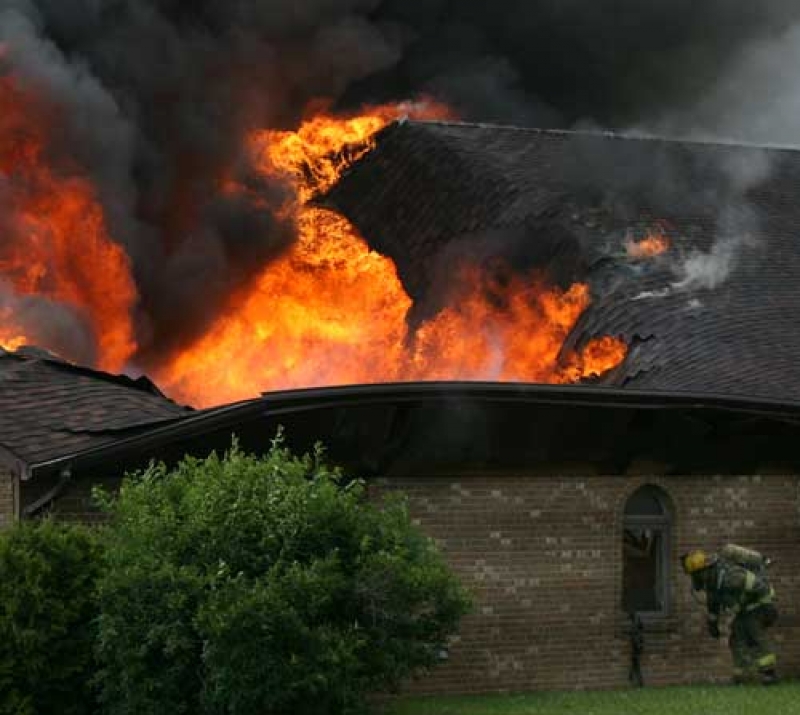
in a church fire. Tragically, there is a history of church and related houses of
worship fires resulting in the death of Firefighters-see numerous links below.
Of the factors identified in the new NIOSH report (link below), the investigation shows
that the initial SIZE-UP did not fully consider the impact of
limited water supply, available staffing, the occupancy type, and lightweight
roof truss system. On June 15, 2011, Firefighter Scott Davis, 40, was at that
fire conducting interior firefighting efforts inside the Muncie church when the
steeple collapsed onto the sanctuary portion of the structure. Other
firefighters escaped with minor injuries and attempted to rescue Firefighter
Davis, who died in that fire.
IT SHOULD BE NOTED THAT upon arrival, units had visible
fire and heavy smoke coming from the roof of the church and a second alarm was
immediately requested due to the lack of hydrants in this area.
HOWEVER-the interior crew was initially met with visible
conditions, light smoke, and no visible fire INSIDE the church. Conditions
quickly changed after walls and areas of the ceiling were opened up, exposing a
fire engulfed attic space. A decision was then made to evacuate the building due
to the amount of fire burning above the Firefighters. At this same moment
(around 1610 hours), the roof began to collapse into the church where the
Firefighters were working, trapping the victim and injuring others as they
exited out of windows or ran from the collapse. Due to the magnitude of the
fire, the fire department was unable to return to the collapsed area to rescue
the victim. The victim’s body was later recovered after the fire was
extinguished.
At this fire, the incident commander’s size-up did not
identify proper strategy and tactics for the church, the location and size of
the fire hidden in the attic, a practical water supply for suppression (no water
hydrants were near the church, and a lake from which to pull water was only
identified later) and hazards associated with the lightweight roof truss systems
used in the church.
The incident commander also placed his command post so
that he could not see conditions on the opposite side.
“When the acting BC
arrived on scene, he began a walk around of the structure where he discovered
that the steeple had toppled over, indicating the potential for further collapse
of the roof structure,” the report says.
“The volume of fire discovered in
the attic was too large for the initial 1 3/4-inch hoseline and not easily
accessible by the firefighters,” the report says. “Also, the fire department did
not have sufficient water and significant fire flow to extinguish a fire in a
nonresidential structure and of the volume of fire encountered.”
The report
points out the importance of BEFORE THE FIRE pre-incident planning inspections of buildings
within their response areas so that they can develop safe fireground tactics and
not have to guess when arriving on the scene.
In the fire that took
Firefighter Davis’s life, the firefighters involved knew that the area did not
have an immediate water supply, but the church had no pre-incident plan.
MUNCIE FIRE
REPORT: http://www.cdc.gov/niosh/fire/reports/face201114.html
PITTSBURGH CHURCH FIRE REPORT: http://www.cdc.gov/niosh/fire/reports/face200417.html
TENNESSEE CHURCH FIRE REPORT: http://www.cdc.gov/niosh/fire/reports/face200437.html
ARKANSAS CHURCH FIRE REPORT: http://www.cdc.gov/niosh/fire/reports/face200103.html
GEORGIA CHURCH FIRE REPORT: http://www.cdc.gov/niosh/fire/reports/face9904.html
TEXAS CHURCH FIRE REPORT: http://writer-tech.com/pages/articles/texas.htm
