
Firefighter Killed and Six Others Seriously Injured During Four Alarm Fire in Commercial Laundry – Plymouth Steam Laundry Fire – Third Street, Brooklyn, New York – November 4, 1906
Submitted by Rick DeGroot
On November 4, 1906, FDNY Fireman James McCusker of Engine 103 was killed, and six other firefighters were seriously injured after being were buried in a wall collapse during a four-alarm fire in a commercial laundry building on Third Street in Brooklyn, New York. The fire was well underway when the first firefighters arrived, and it was not long after that the interior became fully involved, and the floors started to collapse carrying down heavy commercial laundry machinery on every story with the rapid progression of flames. The members of Engine 103 had mounted the roof of a one-story brick extension to the laundry plant and had been working there less than an hour when the rear wall began to bulge from the intense heat. The wall started to topple outward, and several tons of debris fell onto the extension. The weight of the load sent the firefighters through the roof and down into the cellar of the structure. Fireman McCusker’s body was crushed into an almost unrecognizable mass. The fire went to four alarms as at least a ton of bricks and iron had to be removed before his body could be reached by rescuers. Six of his comrades miraculously survived the collapse but suffered serious injuries. Fire officials believed that heat from a tile making operation on a lower floor caused the dried out wooden interior framing of the old building to ignite.
The structure involved in the incident was two-, three-, and four-story Type III Ordinary construction brick and wood joist commercial building with a basement that housed the New York Vitrified Tile Works on the first floor and the Plymouth Steam Laundry on the upper floors at 86-92 Third Street in the Williamsburg section of Brooklyn near the Gowanus Canal. The building had a masonry cornice on Side Alpha facing 80-foot-wide Third Street. Exposure Bravo had several attached wood frame brick-lined stores and dwellings separated by a narrow alley. Several attached wood frame storage sheds were on Exposure Charlie. Exposure Delta was an attached one-story brick and wood joist commercial building that housed the water tanks for the laundry. The building was not equipped with a fire alarm system or an automatic fire sprinkler system. A fire hydrant was in front of the building as well as several others on the block fed by a six-inch water main. Street fire alarm call boxes were located at each end of the block.
Brooklyn is one of five boroughs that make up the City of New York. With a population of 2,736,074 residents according to the 2020 U.S. census, if Brooklyn were ranked as a city, the borough would rank as the third-most populous in the country, behind Los Angeles and Chicago. The area where the incident occurred is in an industrial area along the Gowanus Canal. At the time of the fire, the area was a neighborhood of factories, manufacturing lofts, and warehouses amid streets lined with brick row houses. Brooklyn was a rapidly growing borough at the turn of the 20th century with an expanding population fueled by the arrival of thousands of European immigrants. In the twenty years between 1890 and 1910, the population of the borough doubled from 838,547 to 1,634,351 residents. Many of the new arrivals worked in the factories, warehouses, and on the docks along the canal.
At the time of the fire the neighborhood was protected by the members of Engine 103 located at 533 Hicks Street about one mile from the fire building. Engine 103 was redesignated as Engine 203 in 1913. The fire company was disbanded in 1974. Today the area is protected by FDNY fire units from the 32nd Battalion:
- Engine 204 – 299 Degraw Street – 0.6 miles from the fire building.
- Engine 239 – 395 4th Avenue – 0.6 miles from the fire building.
- Engine 279, Ladder 131 – 252 Lorraine Street – 0.8 miles from the fire building.
- Engine 202, Ladder 101, Battalion 32 – 31 Richards Street – 1.4 miles from the fire building.
On Sunday, November 4, 1906, a passerby discovered a fire in the washing room of the Plymouth Steam Laundry plant on Third Street in Brooklyn at about 6 a.m. First arriving fire units found a fast-moving fire devouring the old pine interior of the brick and wood joist plant. The blaze spread so rapidly that four alarms were soon sounded. Two wood frame tenements separated only by a narrow alleyway were on Exposure Bravo of the fire building and were threatened by the flames. By now the fire had overtaken much of the old building and was eating through the dried wooden interior structural members.
Ten members of Engine 103 including Fireman James McCusker, led by their officer, Lieutenant John B. Donovan, stretched several hoselines to the roof of a shed attached to a one-story brick extension portion at the rear of the fire building. This seemed like an ideal spot from which to fight the flames.
The men of Engine 103 had been working their stream for less than an hour when the rear wall of the brick plant began to bulge from the intense heat. Fire Chief Edward F. Croker arrived at the fire with the third alarm companies and saw the danger the men were in on the roof. He was on his way to get the men off the roof when the back wall fell. The wall started to topple outward, and several tons of debris including heavy commercial laundry machinery fell onto the extension shed. The weight of the load sent the firefighters crashing through the roof and down into the cellar of the structure.
The ten members had fallen into the basement and were buried amid the wreckage. The members of Engine 104, who had also been ordered to the roof but were halted when the wall feel, immediately began the rescue work. Only two were able to crawl out from beneath the debris. Deputy Chief Thomas Lally, who had been directing the work of the men in another quarter, hearing the crashing of the falling wall, hurried to the rear of the plant, just as the two who had escaped came out crying that the rest were all buried.
The work of fighting the flames ceased for a moment as everyone dropped their hoselines and hurried into the alley leading to where the men were buried. This became so congested that the majority of the men were ordered back to their hoselines as the remainder began to hunt for the trapped men. They did not stop to find tools to work with but dug into the smoking pile of hot brick with their bare hands. The groans and screams of the buried men indicated where they were, and the rescuers shouted words of encouragement to them.
Fireman James McCusker was one of the first to be uncovered. At least a ton of bricks and iron had to be removed before his body could be reached by rescuers. He was alive but his body was so badly crushed that it was apparent that he had been grievously injured and was not expected to live but a short time. He died shortly thereafter at the scene. His body was taken to his home where his wife and four children were waiting for him to come home from work. They had no idea of his death until the Fire Department Chaplain brought the sad news a short time before the body was delivered to the house.
Only two of the ten men operating on the extension were able to crawl out from under the debris comparatively unhurt. All of the members of Engine 103 except the company driver had been caught in the collapse with six suffering serious injuries. From a stable nearby, hay and straw were brought, upon which to lay the injured men as they were dug out. Fire Chaplain Father McGronen, who was present, administered the last rites of the church to McCusker. Firemen James Finley and Owen Ward were the most seriously injured, as they were severely crushed about the head and there was slight hope for either. A call for ambulances was sent and the injured men were all attended to.
Among the most seriously injured were Fireman James W. Finley, who suffered both legs broken and crush injuries to his head and body and was not expected to live. Fireman Owen J. Ward was in very serious condition at Long Island College Hospital with crush injuries to the head and body. Other injured firemen included John Kelly, who suffered a dislocated shoulder, Joseph F. Fitzpatrick, who had a leg broken and crush injuries to his head, and John Black, whose two ankles were broken, a piece of his nose removed, and crush injuries to his head. Lieutenant Donovan received a laceration to his head but refused to leave the scene for treatment.
The building was one of the flimsiest the firefighters had to tackle in a long while. A ladder placed against what appeared to be a substantial wall poked a hole in it. It was apparent that either mud had been used instead of mortar in laying the bricks, or that it had become so dried that it no longer had any adhesive quality.
Chief Croker was joined by at the scene by Deputy Fire Commissioner Charles C. Wise, and later Fire Commissioner Francis J. Lantry. They decided that the walls must come down and notified the Building Department, which soon had men at work. The walls were pulled down while the fire was still smoldering within. The firefighters kept the flames confined to the laundry and to the vitrified tile firm which occupied part of the building. The loss of the building was estimated at $100,000. The fire was extinguished and nearly all of the walls were down by 4 p.m. that afternoon.
The death Fireman McCusker broke Deputy Chief Lally’s record of thirty-six years. In that time, he had not lost a single man at a fire, and he was very much broken up over the death of the young firefighter.
Fireman James W. McCusker, age 27, had been a member of the FDNY for almost four years. He was assigned to Engine 103 at the time of his death. McCusker had a splendid record and was a well-respected member of the fire company. He left behind a wife and four children, the youngest being only a week old. He was buried at Calvary Cemetery in Woodside, Queens, New York.
Fireman James W. McCusker has been honored at the New York Firemen’s Memorial on Riverside Drive at 100th Street in Manhattan, New York. The memorial honors the almost 1,200 members of the FDNY and volunteer members of the NYFD who have made the ultimate sacrifice in the line of duty. Built in 1913 on a hillside facing the Hudson River, the memorial comprises a grand staircase, a balustraded plaza, a fountain basin, and the central monument. Made of Knoxville marble, the monument is a sarcophagus-like structure with a massive bronze bas-relief of horses drawing an engine to a fire. To the south and north are allegorical sculpture groups representing “Duty” and “Sacrifice.” The inscription on the reverse side of the monument reads: “To the men of the fire department of the City of New York who died at the call of duty, soldiers in a war that never ends. This memorial is dedicated by the people of a grateful city.” Every September, the FDNY holds an annual remembrance ceremony at the monument.
The name of Fireman James W. McCusker has been inscribed at the New York State Fallen Firefighters Memorial on the grounds of the New York State Capitol in Albany. The memorial features a 54-foot by 15-foot gray granite wall with 2,692 names of New York State fallen firefighters permanently etched into the stone. In front of the wall stands a 10-foot-high dark bronze sculpture of two firefighters rescuing an injured colleague created by New York sculptor Robert Eccleston. The sculpture rests on a paved plaza with charcoal and red bricks forming a Maltese Cross. As of October 2026, there are 2,871 names on the wall. The earliest name on the wall is from the year 1811.
The site of the fatal fire is now occupied by a large four-story mixed use repurposed loft building. There is no memorial marker at the site.
Commentary:
Once again, we witness death and serious injuries to firefighters who are caught in the collapse of an exterior wall while operating fire streams from a defensive position outside a building heavily involved in fire. Firefighters must be aware of the collapse hazards of masonry walls during fire control and overhaul operations. Unreinforced brick, stone, block and terra cotta tile walls that were constructed in the era before 1933 are prone to collapse during heavy fire events. The year 1933 has a significant meaning to the Fire Service in North America. On March 10th of that year, a 6.4 magnitude earthquake hit the Long Beach, California area with damage measured in the millions of dollars and killing over one hundred people. Damage to buildings mostly consisting of unreinforced masonry construction was extensive and led to changes in building construction materials and methods which in turn we as firefighters can utilize to our advantage when sizing up Type III Ordinary construction structures, especially buildings that proudly display the year of construction on a cornerstone or center parapet.
The use of sand lime mortar to bond masonry together was the standard prior to 1933. This type of mortar does not bond as well to brick or stone as today’s Portland cement mortar. Its major issue is that the sand lime mortar can be washed and flaked away by years of weather and in particular water such as from leaking pipes or hose streams. As far as floor and roof beams are concerned in buildings built prior to 1933, a firefighter can also expect to find fire cut beams. These beams are supports cut on an angle so under fire conditions they pull out of the wall leaving it intact. It was a simple way to rebuild when a Type III Ordinary construction building surrendered to the effects of fire.
One of the responsibilities of the incident commander at a well-involved structure fire is to monitor the structural stability of the building. Current best practice is to appoint a deputy safety officer or another experienced individual whose specific role should be to keep constant watch on the fire building for any collapse indicators. Some progressive fire agencies have begun to employ transit level equipment to detect movement of the outer walls of a building under heavy fire attack.
There are no photos or illustrations available from the incident. We have attached a detail from the 1904 Sanborn fire insurance map showing the configuration of the fire building and the surrounding exposures.
We have attached the link to an article on Type III Ordinary construction hazards published by Robert Moran and John Lewis in Firehouse magazine: https://www.firehouse.com/operations-training/article/53057112/how-buildings-of-type-iii-construction-threaten-firefighter-safety
We have also attached the links to a two-part article on building collapse indicators by the late Philadelphia Deputy Chief James P. Smith published in Firehouse magazine: https://www.firehouse.com/operations-training/article/10544968/building-collapse-indicators
Thanks to multiple media sources for the content of this article.
Honor the service of Fireman James McCusker by reviewing Type III Ordinary construction building features and building collapse indicators in these types of structures and by touring a legacy Type III building in your local response district with your crew members today.
Remember Fallen Brothers.
Get Out There And Know Your Local!!!
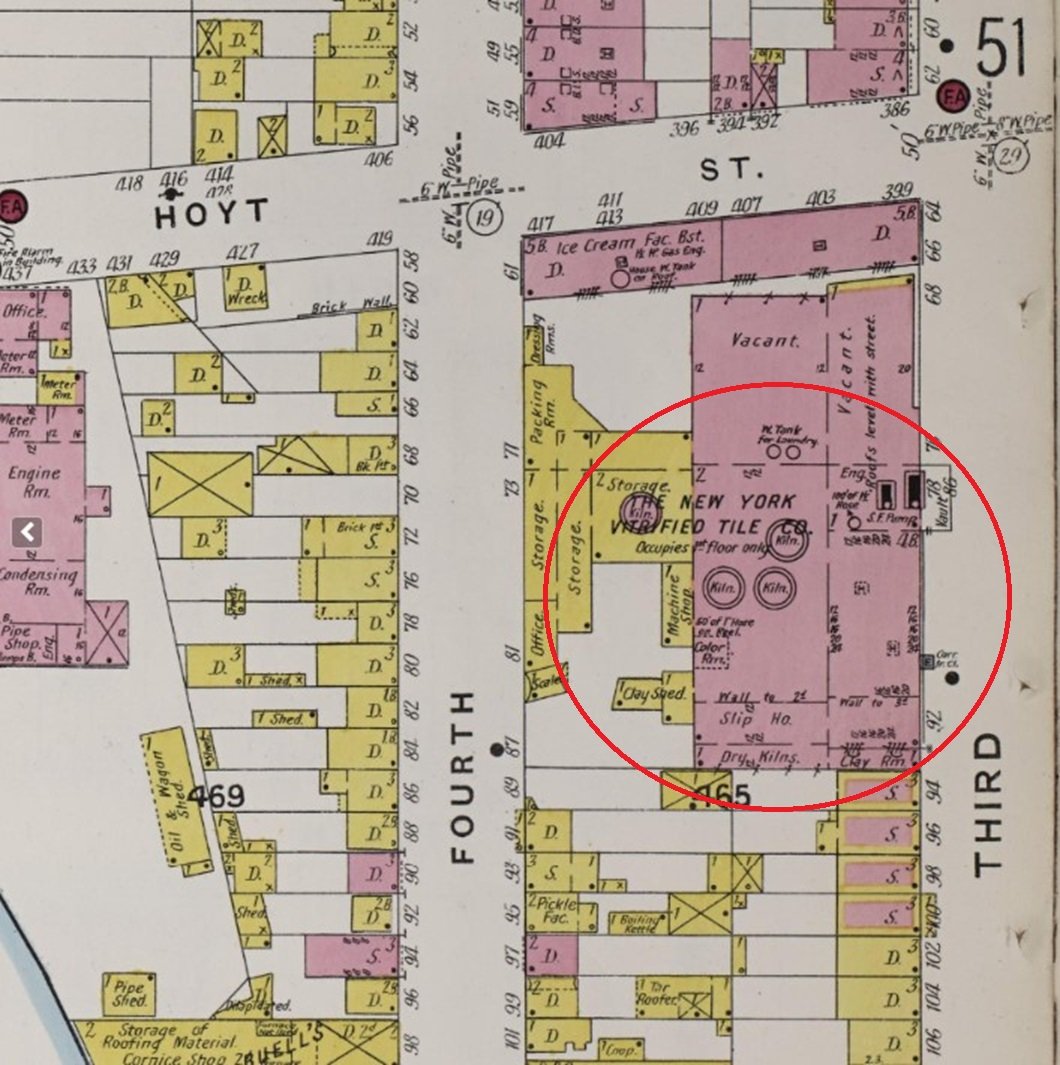
The structure involved in the incident was two-, three-, and four-story Type III Ordinary construction brick and wood joist commercial building with a basement that housed the New York Vitrified Tile Works on the first floor and the Plymouth Steam Laundry on the upper floors at 86-92 Third Street in the Williamsburg section of Brooklyn near the Gowanus Canal. The building had a masonry cornice on Side Alpha facing 80-foot-wide Third Street. Exposure Bravo had several attached wood frame brick-lined stores and dwellings separated by a narrow alley. Several attached wood frame storage sheds were on Exposure Charlie. Exposure Delta was an attached one-story brick and wood joist commercial building that housed the water tanks for the laundry. The building was not equipped with a fire alarm system or an automatic fire sprinkler system. A fire hydrant was in front of the building as well as several others on the block fed by a six-inch water main. Street fire alarm call boxes were located at each end of the block.
Detail from the 1904 Sanborn fire insurance map showing the configuration of the fire building (circled in red) and the surrounding exposures.


