
Firefighter Dies in Fall from Roof at Apartment Building Fire – Brooklyn, New York – June 21, 2007 – NIOSH Firefighter Fatality Report F2007-19
On June 21, 2007, FDNY Firefighter Daniel F. Pujdak of Ladder 146 died after falling from the roof while operating at a four-story apartment building fire in the Williamsburg section of Brooklyn. When firefighters arrived on scene, light smoke and fire were showing from a fourth-floor window. The firefighter had just climbed an aerial ladder to the roof bulkhead and was attempting to lower himself to the main roof when he fell. The roof saw (slung on the firefighter’s back) shifted causing him to lose his balance and fall sixty feet to the ground. Firefighters had been on scene less than three minutes when the firefighter fell. The gravely injured firefighter was transported to the hospital where Firefighter Pujdak succumbed to his injuries. The cause and origin of the fire was an unattended cigarette left on a fourth-floor windowsill that ignited the wooden window frame. The fire was confined to the windowsill and adjacent interior furnishings, but the plumes of smoke made the blaze appear larger than it actually was.
The structure involved in this incident was a four-story with basement Type III Ordinary construction brick building originally built in the 1920s. The building was originally a sewing machine factory and had been illegally converted into residential loft apartments in 2000. The building was 75 feet wide by 100 feet long and was equipped with fire sprinklers, some of which were blocked because of the illegal conversions. Each floor had four apartments and interior construction was drywall over metal studs. Exterior construction was solid brick with a flat tar and asphalt roof with three large wired-glass skylights. The building had two internal stairwells, one of which was blocked on every floor, with bulkheads on the roof at diagonal corners. Side Alpha faced 60-foot-wide Meserole Street with an eight-foot-high masonry parapet wall along the roof edge. Side Bravo fronted on 60-foot-wide Leonard Street. Both streets had curbside parking and a wide sidewalk. Exposure Charlie was a one-story commercial building with a flat roof used as a warehouse. Exposure Delta was a one-story commercial building. The block was served by several fire hydrants, one of which was at the Alpha/Bravo corner of the building, supplied by a six-inch water main. The nearest fire alarm call box was located one block west on Meserole Street at Lorimer Street.
This incident occurred in the New York City Borough of Brooklyn, the most populous of the five boroughs within the city. Brooklyn had a population of 2,736,074 residents in 2020. If each borough were ranked as a city, Brooklyn would rank as the third-most populous in the country, after Los Angeles and Chicago. At the time of the incident, the Fire Department of New York (FDNY) consisted of approximately 11,500 career firefighters operating from 230 firehouses that served a population of over eight million residents in a geographic area of approximately 322 square miles.
Williamsburg is a neighborhood in Brooklyn bordered by Greenpoint to the north; Bedford–Stuyvesant to the south; Bushwick and East Williamsburg to the east; and the East River to the west. The population of the area according to the 2010 U.S. census was 151,308. Williamsburg, especially near the waterfront, was a vital industrial district until the mid-20th century. After deindustrialization of the area in the 1970s, many of the former factories and commercial buildings were left vacant or underutilized. By the early 21st century, the area began to revitalize with many of the former commercial properties converted for residential and mixed uses.
The New York City Fire Department (FDNY) operates five fire stations serving the Williamsburg area:
- Engine 216/Ladder 108/Battalion 35 – 187 Union Avenue – 0.5 miles from the fire building.
- Engine 229/Ladder 146 – 75 Richardson Street – 1 mile from the fire building.
- Engine 209/Ladder 102/Battalion 34 – 850 Bedford Avenue – 1.4 miles from the fire building.
- Engine 211/Ladder 119 – 26 Hooper Street – 1.5 miles from the fire building.
- Engine 221/Ladder 104 – 161 South 2nd Street – 1.6 miles from the fire building.
The fire department required all firefighters to complete a 23-week training program at the department’s fire academy. (Note: At the time Firefighter Pujdak graduated from the academy the program was 13 weeks). Firefighter recruits are instructed in the basics of fire suppression systems and firefighting tactics. After graduating from the fire academy, the recruits go through a one-year probationary period. Firefighter Pujdak graduated from the department’s fire academy in September 2005 and had almost two years of firefighting experience with a truck company.
Weather conditions on the afternoon of the incident included an air temperature of 84 degrees F with a relative humidity of 32% with strong westerly winds at 16 mph gusting to 24 mph under fair skies (Weather Underground). Note: Research by the National Institute of Standards and Technology (NIST) has shown wind speeds on the order of 10 to 20 mph are sufficient to create wind-driven fire conditions in a structure with an uncontrolled flow path (Madrzykowski and Kerber 2009). The NIOSH report states that the weather was not a factor in this incident.
On Thursday, June 21, 2007, at approximately 1654 hours, a fire was reported on the fourth floor of a four-story apartment building located on 83 Meserole Street in the Williamsburg section of Brooklyn, New York. Engines 216, 229, & 230, Ladders 108 & 146, and Battalion 35 were dispatched. On arrival, firefighters saw fire and moderate white smoke in a window on the top floor of the apartment building.
Ladder 108, the first-due ladder company, arrived at 1657 hours. After positioning in front of the building, the roof firefighter from the ladder company raised and placed the aerial ladder to the roof at the center of the rooftop bulkhead. In this type of legacy Type III construction, a rooftop bulkhead is a small, enclosed structure located on the roof of a building that usually covers the top of a stairwell, elevator, dumbwaiter, or air shaft. They are often equipped with a skylight to provide light and ventilation to the stairwell or shaft way below. Note: In standard FDNY ladder company position assignments, a roof firefighter is responsible for ventilating the roof if necessary and checking all sides of a building for trapped residents. Firefighter Daniel Pujdak, also assigned as the roof firefighter with his ladder company, arrived on scene in Ladder 146 at 1658 hours. He dismounted the apparatus, grabbed his tools and went to Ladder 108 to access the roof.
The Ladder 108 roof firefighter climbed the ladder to the roof with Firefighter Pujdak climbing about 20 feet behind. The Ladder 108 roof firefighter threw his Halligan bar and hook to the roof when he reached the level of the roof while still on the aerial ladder. The Ladder 108 roof firefighter then dismounted the aerial ladder onto the top of the bulkhead; he squatted between the bulkhead parapet and the skylight and vented some of the glass panes in the bulkhead skylight and observed very light smoke. He maneuvered to a safe area and lowered himself onto the roof by hanging and dropping. Note: From the top of the bulkhead to the roof was approximately 9 feet. He called to Firefighter Pujdak, still climbing up the ladder, that he may need to bring the folding scissor ladder on the tip of the aerial to access the roof from the bulkhead. He then proceeded to the opposite side of the roof to provide vertical ventilation, looked over, opened a second bulkhead door, and then heard a scream followed by a Mayday radio transmission.
At 1701 hours, Firefighter Pujdak fell approximately sixty feet to the ground while attempting to maneuver down from the top of the bulkhead to the top of the main roof parapet wall. He continued to hold a hand tool in each hand. Note: It was 5’6” feet from the top of the bulkhead coping to the top of the roof parapet wall. The chauffeur of Ladder 108 observed that the roof saw, which was slung over Firefighter Pujdak’s shoulder with a sling, shifted during the climb down from the bulkhead and the victim lost his balance. The firefighter fell sixty feet to the ground and landed on his side and upper torso and sustained massive trauma to his head, torso, and extremities. Note: Besides the weight shift from the saw, a loss of grip or footing could have contributed to the fall.
During this time, firefighters from first due Engine 216 were stretching a 2½ inch hoseline to the fourth-floor fire apartment. Firefighters from second due Engine 229 were assisting with the hoseline stretch. Note: Since this was formerly an industrial building, departmental SOPs mandate a 2½-inch hoseline be stretched into the building for all fires. Firefighters from third-due Engine 230 also assisted with the stretch from Engine 216. The building’s sprinkler system was containing the spread of the fire and the hoseline was not charged until after the fatal event.
Immediately after the firefighter fell, a firefighter from Ladder 108 radioed a Mayday and rushed to aid the injured firefighter. Most of the members of Engine 230 saw Firefighter Pujdak fall. Firefighters on the ground immediately administered first aid, CPR, and stabilization and rushed the injured firefighter to an awaiting ambulance. He was transported to a hospital where he succumbed to his injuries.
According to the medical examiner’s findings, the cause of death was “blunt impact of head, torso and extremity with fractures and visceral injuries.”
According to the fire department, the cause and origin of the fire was an unattended cigarette left on a fourth-floor windowsill that ignited the wooden window frame. The fire was confined to the windowsill and adjacent interior furnishings, but the plumes of smoke made the blaze appear larger than it actually was. Some of the occupants of the apartment building had already evacuated as fire department apparatus arrived on scene.
NIOSH investigators identified several key contributing factors to this incident including:
- Judgment of the firefighter in deciding on a riskier means of moving from the roof bulkhead to the main roof.
- Placement of the ladder against the roof bulkhead rather than the main roof which introduced additional fall risks for firefighters.
- Hazardous task of climbing a ladder while laden with tools and equipment.
- Method in which the saw was carried which allowed the shifting saw to put the firefighter off balance.
NIOSH investigators made several recommendations including:
- Fire departments should stress to firefighters the importance of exercising caution when working at elevation.
- Fire departments should consider location and placement of aerial ladders to prevent firefighters from climbing from different elevations during fireground operations.
- Fire departments should consider the use of portable scissor ladders to facilitate access from an aerial ladder to a roof.
- Fire departments should ensure that firefighters communicate any potential hazards to one another and ensure that team continuity is maintained during roof operations.
- Fire departments should evaluate the manner in which equipment is harnessed or carried by firefighters to prevent loss of balance.
- Fire departments should consider reducing the amount of equipment that firefighters must carry while climbing ladders.
- Manufacturers of fire service saws should consider ergonomic design principles to reduce the weight of ventilation saws.
- Manufacturers of fire service saws should consider developing improved carrying slings.
As a result of this tragedy, FDNY Books – Ladders 3 – was amended to include the following under Roof Position:
- Never attempt to climb onto or off a bulkhead or similar type structure at a spot near or next to an open shaft or near a building wall that faces on a shaft, areaway, courtyard or street.
- It is safer to access a building’s roof with an aerial ladder and then position a scissor ladder to access the top of the bulkhead when venting the skylight.
- If the decision is made to climb to the top of a bulkhead, be sure to come down the same way you went up.
- Firefighters wearing bunker gear, PSS, SCBA and carrying tools/equipment may be loaded with more than 100 lbs. of additional weight. This added weight reduces the agility of a firefighter and can cause a firefighter to be off balance.
Firefighter Daniel F. Pujdak, age 23, was a 19-month member of the FDNY having graduated from the fire academy and assigned to Ladder Company 146 the previous year. He was a 2001 graduate of St. Francis Preparatory School in Queens where excelled as a star baseball player. Daniel attended SUNY Cortland and majored in Fitness Science with a concentration in Kinesiology. In his spare time‚ Daniel was a personal trainer at the Greenpoint YMCA. He is survived by his parents, Leo and Christina Pujdak, two brothers, David and Matthew, his girlfriend, Vanessa Pschirrer, and several relatives. Daniel’s younger brother Matthew‚ following in the footsteps of his brother as a member of the FDNY, now proudly bears Daniel’s #8655 on his helmet as his own.
On June 26, thousands of mourners including firefighters from the city and surrounding area attended the funeral for the young fallen firefighter at St. Cecilia’s Roman Catholic Church in Greenpoint, Brooklyn. A procession led by the Emerald Society bagpipe band escorted the fire engine caisson holding the flag-draped casket of Firefighter Pujdak to the church. The Requiem Mass was presided over by Pujdak’s uncle, the Reverend Steve Pujdak. Mayor Michael Bloomberg, Fire Commissioner Nicholas Scoppetta, Pujdak’s father Leo, his younger brother Matthew and his girlfriend Vanessa Pschirrer delivered moving eulogies remembering the 23-year-old as a perpetual joker, a quiet man and a hard worker. The body of the fallen firefighter was cremated, and the ashes were given to the family.
The name of Firefighter Daniel F. Pujdak has been honored at the New York Firemen’s Memorial on Riverside Drive at 100th Street in Manhattan, New York. The memorial honors all members of the FDNY who have made the ultimate sacrifice in the line of duty.
The name of Firefighter Daniel F. Pujdak has been inscribed at the New York State Fallen Firefighters Memorial on the grounds of the New York State Capitol in Albany. The memorial features a 54-foot by 15-foot gray granite wall with the names of New York State fallen firefighters permanently etched into the stone. In front of the wall stands a 10-foot-high dark bronze sculpture of two firefighters rescuing an injured colleague created by New York sculptor Robert Eccleston. The sculpture rests on a paved plaza with charcoal and red bricks forming a Maltese Cross. As of October 2024, there are 2,692 names on the wall. The earliest name on the wall is from the year 1811.
The name of Firefighter Daniel F. Pujdak has been inscribed on the 2007 plaque displayed at the National Fallen Firefighter Memorial on the campus of the National Fire Academy in Emmitsburg, Maryland.
The site of the fatal fire remains in operation as a four-story multiple dwelling. There is no memorial marker at the site.
Commentary:
Roof operations can present significant risks to firefighters. Safe roof operations start with appropriate placement of the ladder to the building. Best practice for ground and aerial ladder placement to a roof is to have the tip of the ladder extend at least six feet above the eave or parapet to allow a handhold for firefighters as they make the transition to the roof surface or parapet wall. Consideration should also be given to placing a folding ladder at the tip of an aerial device to provide safer access to the roof surface when firefighters encounter a high parapet wall when ascending to a roof.
There are often many hazards and obstacles that a firefighter must maneuver while successfully operating on a roof. Items like open shafts, skylights, satellite TV antennas, low parapet walls, steep roof pitches, slippery or unstable roof surfaces, etc., can often present hazards to firefighters. Making the transition from an aerial ladder tip or platform is also sometimes difficult and dangerous. Firefighters operating from different companies on a roof must learn to coordinate their activities so that they can safely access the roof while working as a team.
We have attached photos from the incident. We have also included a detail from the 1950 Sanborn fire insurance map showing the configuration of the fire building and the surrounding exposures.
The link to the NIOSH report is here: https://stacks.cdc.gov/view/cdc/163598
Also, a link to an excellent article on flat roof operations by Anthony Avillo: https://www.fireengineering.com/firefighting/flat-roof-operations-from-the-street-to-the-roof-and-back/
Thanks to multiple media sources for additional information for this article.
Honor the service of Firefighter Daniel F. Pujdak by reviewing and discussing your department’s roof operations access procedures and by touring some of the rooftops in your local response district to identify rooftop features and possible hazards with your crew members today.
Remember Fallen Brothers.
Get Out There And Know Your Local!!!
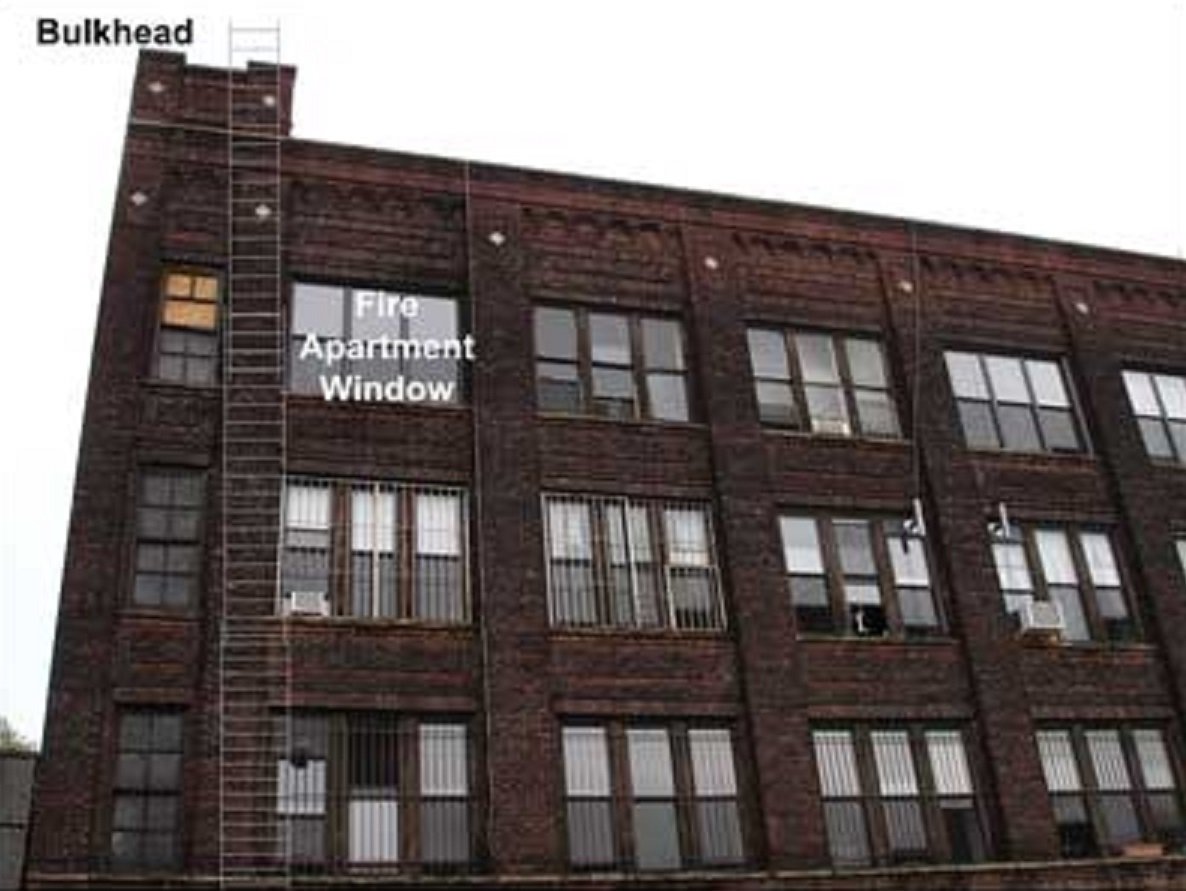
Photo of Side Bravo of the fire building. (Ladder image is for reference purposes only). NIOSH photo.

The structure involved in this incident was a four-story with basement Type III Ordinary construction brick building originally built in the 1920s. The building was originally a sewing machine factory and had been illegally converted into residential loft apartments in 2000. The building was 75 feet wide by 100 feet long and was equipped with fire sprinklers, some of which were blocked because of the illegal conversions. Each floor had four apartments and interior construction was drywall over metal studs. Exterior construction was solid brick with a flat tar and asphalt roof with three large wired-glass skylights. The building had two internal stairwells, one of which was blocked on every floor, with bulkheads on the roof at diagonal corners. Side Alpha faced 60-foot-wide Meserole Street with an eight-foot-high masonry parapet wall along the roof edge. Side Bravo fronted on 60-foot-wide Leonard Street. Both streets had curbside parking and a wide sidewalk. Exposure Charlie was a one-story commercial building with a flat roof used as a warehouse. Exposure Delta was a one-story commercial building. The block was served by several fire hydrants, one of which was at the Alpha/Bravo corner of the building, supplied by a six-inch water main. The nearest fire alarm call box was located one block west on Meserole Street at Lorimer Street.
Detail from the 1950 Sanborn fire insurance map showing the configuration of the fire building (circled in red) and the surrounding exposures.

Aerial view of incident scene showing the apparatus and aerial ladder placement to the roof of the fire building near the Bravo/Charlie corner.


Bulkhead on the roof of the incident structure.

Aerial view of the rooftop at 83 Meserole Street. The bulkhead that the firefighter fell from is on the left.


Firefighters gather near the scene after the incident.

(NIOSH Photo taken for demonstration purposes only)

Firefighter Daniel F. Pujdak, age 23, was a 19-month member of the FDNY having graduated from the fire academy and assigned to Ladder Company 146 the previous year. He was a 2001 graduate of St. Francis Preparatory School in Queens where excelled as a star baseball player. Daniel attended SUNY Cortland and majored in Fitness Science with a concentration in Kinesiology. In his spare time‚ Daniel was a personal trainer at the Greenpoint YMCA. He is survived by his parents, Leo and Christina Pujdak, two brothers, David and Matthew, his girlfriend, Vanessa Pschirrer, and several relatives. Daniel’s younger brother Matthew‚ following in the footsteps of his brother as a member of the FDNY, now proudly bears Daniel’s #8655 on his helmet as his own.

On June 26, 2007, thousands of mourners including firefighters from the city and surrounding area attended the funeral for the young fallen firefighter at St. Cecilia’s Roman Catholic Church in Greenpoint, Brooklyn. A procession led by the Emerald Society bagpipe band escorted the fire engine caisson holding the flag-draped casket of Firefighter Pujdak to the church. The Requiem Mass was presided over by Pujdak’s uncle, the Reverend Steve Pujdak. Mayor Michael Bloomburg, Fire Commissioner Nicholas Scoppetta, Pujdak’s father Leo, his younger brother Matthew and his girlfriend Vanessa Pschirrer delivered moving eulogies remembering the 23-year-old as a perpetual joker, a quiet man and a hard worker. The body of the fallen firefighter was cremated, and the ashes were given to the family.

The name of Firefighter Daniel F. Pujdak has been honored at the New York Firemen’s Memorial on Riverside Drive at 100th Street in Manhattan, New York. The memorial honors all members of the FDNY who have made the ultimate sacrifice in the line of duty.

The name of Firefighter Daniel F. Pujdak has been inscribed at the New York State Fallen Firefighters Memorial on the grounds of the New York State Capitol in Albany. The memorial features a 54-foot by 15-foot gray granite wall with the names of New York State fallen firefighters permanently etched into the stone. In front of the wall stands a 10-foot-high dark bronze sculpture of two firefighters rescuing an injured colleague created by New York sculptor Robert Eccleston. The sculpture rests on a paved plaza with charcoal and red bricks forming a Maltese Cross. As of October 2024, there are 2,692 names on the wall. The earliest name on the wall is from the year 1811.

