
Fire Lieutenant Overcome During Second-Alarm Tenement Fire – 4035 Park Avenue, Bronx, New York – November 26, 1957 – Division 7 Newsletter January 2017 Edition
Submitted by Rick DeGroot
On November 26, 1957, FDNY Lieutenant Richard MacClave of Engine 46 was overcome by smoke and carbon monoxide while searching an upper floor apartment during a second-alarm fire in a new law tenement in the New York City borough of The Bronx. Firefighters had been called to the five-story building after a young boy had accidentally set the kitchen of his third-floor apartment on fire. On arrival, firefighters were met by smoke issuing from a third-floor window of the tenement. Lieutenant MacClave had donned his canister filter mask and was searching the fire apartment while waiting for his engine company to stretch a hoseline to the fire floor. He apparently was overcome by smoke when his filter mask failed to protect him as he searched the apartment. He was found by members of his engine company unconscious on the floor. The Lieutenant still had his MSA filter-type mask facepiece on, but he wasn’t breathing. He was quickly removed to the second floor and given medical attention, but he died at the scene. The cause of the fire was due to an accidental cooking mishap involving an 11-year-old child.
The structure involved in the incident was a five-story with basement Type III Ordinary construction brick and wood joist “New Law” tenement located at 4035 Park Avenue in the Claremont neighborhood of the South Bronx. The building had a central open stairwell with apartments fronting on a public hallway. The structure measured 40 feet wide, 85 feet deep and 56 feet high with a masonry cornice atop a three-foot-high parapet wall on Side Alpha which fronted on 50-foot-wide Park Avenue. A mirror-image five-story tenement was on Side Bravo and shared an air and light shaft between the buildings. Side Charlie was a small rear yard. A five-story Type III Ordinary construction brick and wood joist tenement building located at the corner of East 174th Street was on Side Delta. The building was not equipped with a fire alarm system or an automatic fire sprinkler system. A fire hydrant fed by a 12-inch water main was in front of the building. The nearest street fire alarm call box was one block west at the corner of East 174th Street and Park Avenue. Note: Following the New York State Tenement House Act of 1901, new law tenements were required to have a number of improvements in New York. Most notably, new law tenements were required to have window access for most interior rooms. This was usually accomplished by providing an air shaft often in the center of the building that ran from the first floor to the roof and often could only be accessed from the windows at each level. They were also shared with adjoining buildings and could also be found in the public hallways. The buildings were usually four to seven stories in height and had four railroad-flat style apartments per floor. They also featured open stairwells from the first floor to the roof and were required to have fire escape access from each apartment. They were also required to have a “fireproof” layer separating the basement from the upper floors usually accomplished by a brick or concrete partially above grade basement with a separate exterior entrance.
The Bronx is one of the five boroughs that make up the City of New York. It is located south of Westchester County; north and east of the borough of Manhattan, across the Harlem River; and north of the borough of Queens, across the East River. The Bronx has a land area of 42 square miles and had a population of 1,472,654 in the 2020 U.S. census. If each borough were ranked as a city, the Bronx would rank as the ninth-most-populous city in the country.
Claremont is a primarily residential neighborhood in the southwest portion of The Bronx. Bounded by the Cross-Bronx Expressway to the north, Crotona Park and Crotona Village on the east, Concourse Village to the south, and the Grand Concourse to the west. Webster Avenue is the primary thoroughfare through the area. Like many residential areas of The Bronx, as access to the city subway and streetcar system was extended north from Manhattan in the late 19th century, the neighborhood experienced a wave of development, attracting immigrants from various backgrounds who sought employment opportunities in the growing city. Vast tracts of multiple dwellings were constructed to house the new arrivals. The vibrant and diverse neighborhood thrived during the first half of the 20th century but a period of decline that ravaged the South Bronx in the 1970s brought crime and arson to the area.
The Claremont neighborhood is protected by several FDNY fire stations:
- Engine 46, Ladder 27- 460 Cross Bronx Expressway – 0.4 miles from the fire building.
- Rescue 3, Collapse 3 – 1655 Washington Avenue – 0.4 miles from the fire building.
- Engine 42 – 1781 Monroe Avenue – 0.5 miles from the fire building.
- Engine 92, Ladder 44, Battalion 17 – 1259 Morris Avenue – 1.1 miles from fire building.
- Engine 50, Ladder 19, Battalion 26 – 1155 Washington Avenue – 1.6 miles from the fire building.
Area weather conditions on the morning of the fire included an air temperature of 36 degrees F and a relative humidity of 64% with a west wind at 10 mph under partly cloudy skies (Weather Underground). Note: Research by the National Institute of Standards and Technology (NIST) has shown wind speeds on the order of 10 to 20 mph are sufficient to create wind-driven fire conditions in a structure with an uncontrolled flow path (Madrzykowski and Kerber 2009). The windy weather conditions at the time of the fire likely was a significant factor in fire development and the outcome of the incident.
On Tuesday morning, November 26, 1957, Lieutenant Richard MacClave left his wife, Mary, his two daughters, Katherine, age 8, and Ann, age 12, and his son, Thomas, age 11, to go to work at Engine Company 46. There were reasons to be happy in the MacClave home. They had just moved into a new apartment on Bainbridge Avenue in The Bronx. Lieutenant MacClave had just celebrated his 20th Anniversary in the FDNY. And Thanksgiving was two days away. This day, however, would change the lives of the MacClave family forever.
On the third floor of 4035 Park Avenue in Apartment 3A, young Raymond Conover Jr., age 11, was home alone. His father was at work and his mother left the apartment to go to the store. Raymond was hungry and decided to make himself breakfast. After he was done, he went into the apartment living room to watch television. He was startled by the sound of breaking glass in the kitchen. He ran to see what caused the sound. He saw that the kitchen was on fire. Raymond grabbed the family dog and fled the apartment.
In the tenement next door at 4031 Park Avenue in Apartment 3B, Mr. Ernest Sulzer, age 46, was going through his morning routine. He looked out his apartment window into the air and light shaft, and he saw billowing smoke coming from the third floor of the tenement next door at 4035 Park Avenue. He quickly ran downstairs and “snapped” the fire alarm box at the corner of East 174th Street and Park Avenue. He then ran into the fire building to alert the occupants of the danger.
The day tour was about to commence at the firehouse of Engine 46 and Ladder 27 at 453 East 176th Street. Commanding Engine 46 was Lieutenant Richard MacClave, and commanding Ladder 27 was Captain Thomas F. Finnegan. Just prior to the bells sounding 11-11 signaling the start of the day tour at 0900 hours, the Bronx Fire Dispatchers tapped out a box over the telegraph system. The bells were sounded in quick succession: one two, one two three four five six seven eight nine, one, one two three four five six seven…Box 2917, Park Avenue and East 174th Street. Engine 46 and Ladder 27 were assigned first due to this box. They quickly turned out. The alarm box was only a couple blocks away.
Engine 46 arrived at the fire building near the corner of Park Avenue and East 174th Street. Lieutenant Richard MacClave donned his turnout gear and his Mine Safety Appliance (MSA) canister filter mask. He could see the smoke coming from the front windows of the third floor on the left side. He told the firefighters of Engine 46 to stretch a 2.5-inch hoseline to the fire floor. He then charged up the stairway.
Upon arrival at the third floor, he donned his facepiece and began operations in the fire apartment. Fire and thick smoke were now spreading throughout the railroad flat apartment. Ladder 27 arrived at the fire. Captain Finnegan and his forcible entry team raced up the tenement stairway to evacuate the third, fourth and fifth floors. From the outside of the building, it appeared that the fire was making its way to the upper floors.
Engine 42 arrived at the fire and stretched a back-up hoseline to the fire floor. They thenstretched this hoseline to the fourth floor. Engine 50 arrived at the fire. They were ordered to stretch a hoseline to the fifth floor.
Deputy Chief John J. Broderick of the 7th Division arrived at the fire. He saw fire extending to the upper floors of the five-story new law tenement. He transmitted a second alarm. With the fire extending to the upper floors via voids in the kitchen area, a heavy smoke condition was created. Ladder Companies 19 and 44 joined Ladder 27 in performing searches and opening up ceilings and walls. In total, 12 people were removed from the fire building.
FDNY units worked aggressively to extinguish the fire. They were getting ahead of it quickly. It looked like it was going to be a successful operation. Deputy Chief Broderick declared the fire to be “Under Control” at 0925 hours. Shortly thereafter, things went horribly wrong. As the smoke started to lift in the charred apartment on the third floor, firefighters found Lieutenant Richard MacClave unconscious on the floor. He still had his MSA filter-type mask facepiece on and he wasn’t breathing. They quickly removed him to the second floor and began artificial respirations.
Deputy Chief Broderick radioed the Bronx Fire Dispatchers and requested ambulances respond to the scene. Three ambulances arrived at the scene quickly. However, none of them had a doctor on board. Frustrated, Deputy Chief Broderick requested the New York City Police Department (NYPD) send a radio car to get a doctor. Before the radio car could return, a doctor arrived in a fourth ambulance and started working on Lieutenant MacClave on the second floor of the fire building. This doctor would later pronounce Lieutenant Richard MacClave dead. He was 46 years old.
Historical Note: In 1957 there were no EMTs or paramedics. The ambulances were mostly located at hospitals. There were times that physicians responded with the ambulances. It wasn’t until July of 1977 that the New York City Health and Hospitals Corporation established the first fully coordinated Emergency Medical Service. One of the goals was to have 40 Advanced Life Support units in service within a three-year period of time.
In addition to Lieutenant MacClave, there were four other firefighters with smoke related injuries: Captain Thomas F. Finnegan of Ladder 27, Fireman Lawrence Goldblatt of Engine 42, Fireman George Meadows of Engine 50 and Fireman George Conachia of Engine 46. Fireman Conachia was admitted to Jacobi Hospital.
The FDNY confiscated the MSA filter-type mask used by Lieutenant MacClave and three others used at the scene of this fire. These masks were to be tested in FDNY laboratories. Assistant Chief Antonio Petronelli, and Deputy Chief John Broderick supervised this confiscation. The reports in the newspapers stated that firefighters on the scene said that the filter-type masks had only limited effectiveness. However, Fire Commissioner Edward Cavanagh told the press that the confiscation was routine after a fire such as this.
Lieutenant Richard MacClave’s body was transported to the Engine 46 firehouse, which was the practice at the time. This practice was called “bringing him home”. Lieutenant MacClave’s body was later removed by the Medical Examiner.
At 1130 hours, FDNY Chaplain Reverend Leo Farley arrived at the MacClave home. He informed Mrs. Mary MacClave of her husband’s death. Mrs. Mary MacClave lived to be 100 years old. She raised her three children. She later had 13 grandchildren and 21 great grandchildren.
The mask that was used by Lieutenant Richard MacClave was the Burell Mine Safety Appliance (MSA) mask. The MSA mask was originally purchased and issued by the FDNY in 1938. They were to be used by rescue companies for gas leaks and refrigerant leaks. The limitation of the MSA mask was that the atmosphere must have at least 16 percent oxygen and it must not have more than 2 percent of carbon monoxide. In August of 1957, three months before the fire at 4035 Park Avenue, the FDNY approved the MSA filter type mask for general firefighting purposes.
Lieutenant Richard MacClave had the MSA filter-type mask facepiece donned. The autopsy of Lieutenant Richard MacClave showed that he had carboxyhemoglobin levels of 65 percent (30 percent can cause death).
Firefighter George Conachia of Engine 46 also had his mask facepiece on. He was also found unconscious but was still breathing. The fire at 4035 Park Avenue was the beginning of the end of the MSA filter-type mask for the FDNY. On May 17, 1962, the FDNY had two types of masks. They had 1,800 MSA filter-type masks. The FDNY also had 900 Scott self-contained breathing apparatus. The FDNY would eventually switch over to Scott self-contained breathing apparatus.
Mrs. MacClave sued the City of New York stating that the MSA filter-type mask that was provided was inadequate to protect her husband. She won the suit in a unanimous decision on December 21, 1965 and was awarded $200,000. The FDNY completely removed the MSA filter-type mask from service within days.
Lieutenant Richard MacClave, age 46, was a 20-year member of the FDNY assigned to Engine 46. MacClave was survived by his wife, Mary, his two daughters, Katherine, age 8 and Ann, age 12, and his son, Thomas, age 11.
Lieutenant MacClave received a deputy chief’s funeral with six lieutenants serving as pallbearers. Fire Commissioner Cavanagh lead a procession of 500 uniformed firefighters to his requiem mass at St. Brendan’s Church on Perry Avenue in The Bronx. Interment followed at Gate of Heaven Cemetery in Hawthorne, Westchester County, New York.
A memorial plaque honoring the service of the fallen Lieutenant is displayed at the quarters of Engine 46 at 460 Cross Bronx Expressway in The Bronx.
Lieutenant Richard MacClave has been honored at the New York Firemen’s Memorial on Riverside Drive at 100th Street in Manhattan, New York. The memorial honors all the members of the FDNY who have made the ultimate sacrifice in the line of duty. Built in 1913 on a hillside facing the Hudson River, the memorial comprises a grand staircase, a balustraded plaza, a fountain basin, and the central monument. Made of Knoxville marble, the monument is a sarcophagus-like structure with a massive bronze bas-relief of horses drawing an engine to a fire. To the south and north are allegorical sculpture groups representing “Duty” and “Sacrifice.” The inscription on the reverse side of the monument reads: “To the men of the fire department of the City of New York who died at the call of duty soldiers in a war that never ends this memorial is dedicated by the people of a grateful city.” Every September, the FDNY holds an annual remembrance ceremony at the monument.
The name of Lieutenant Richard MacClave has been inscribed at the New York State Fallen Firefighters Memorial on the grounds of the New York State Capitol in Albany. The memorial honors the men and women of the fire service who have perished in the line of duty in the Empire State. The memorial is located between the Justice Building and The Egg in a park-like area bordered by Norway maple trees. Dedicated in 1998, it consists of a ten-foot-high bronze statue of two firefighters rescuing an injured comrade backed by a granite wall fifty-four feet long and fifteen feet high inscribed with the names of New York state firefighters who gave their lives to save others. The memorial is placed on a plaza of charcoal and red brick pavers forming a Maltese Cross. As of October 2025, there are 2,818 names on the wall. The earliest name on the wall is from the year 1811.
The building next door on Side Delta at 4031 Park Avenue remains occupied next to the now vacant site of the fire. There is no memorial marker at the site.
Commentary:
While use of self-contained breathing apparatus (SCBA) during structural firefighting operations is now mandatory under most fire department policies and is required under federal law per OSHA regulations, at the time of this incident the use of SCBA at structure fires was not commonly practiced. The use of canister-type filter masks provided only limited protection from toxins in the atmosphere during a structure fire. Even if a department was fortunate to have SCBA, the first-due personnel at a structure fire were expected to enter a fire building without SCBA to make rapid rescues and to knockdown the fire until being backed up by later arriving firefighters equipped with breathing apparatus. Many fire departments lacked sufficient breathing apparatus to equip all firefighters working in a toxic atmosphere at a structure fire. Many departments also lacked the equipment to refill air cylinders at the scene of a fire which caused some departments to reserve their air supplies for only the most critical uses during fires. Fortunately, since this era, use of SCBA at structure fires has become a universally accepted best practice in the fire service.
We have attached photos from the incident. We have also attached a detail from the 1950 Sanborn fire insurance map showing the configuration of the fire building and the surrounding exposures.
We have also included the link to an article on essential SCBA skills by Ryan Pennington published in Fire Engineering magazine: https://www.firehouse.com/safety-health/scba-accessories/article/21095470/essential-scba-skills-every-firefighter-should-revisit
Thanks to FDNY Deputy Chief (ret.) Jay Jonas for his article in the January 2017 edition of the FDNY Division 7 newsletter on the incident for much of the content of this article.
Honor the service of Lieutenant Richard MacClave by practicing SCBA emergency self-rescue and Mayday procedures with your members today.
Remember Fallen Brothers.
Get Out There And Know Your Local!!!
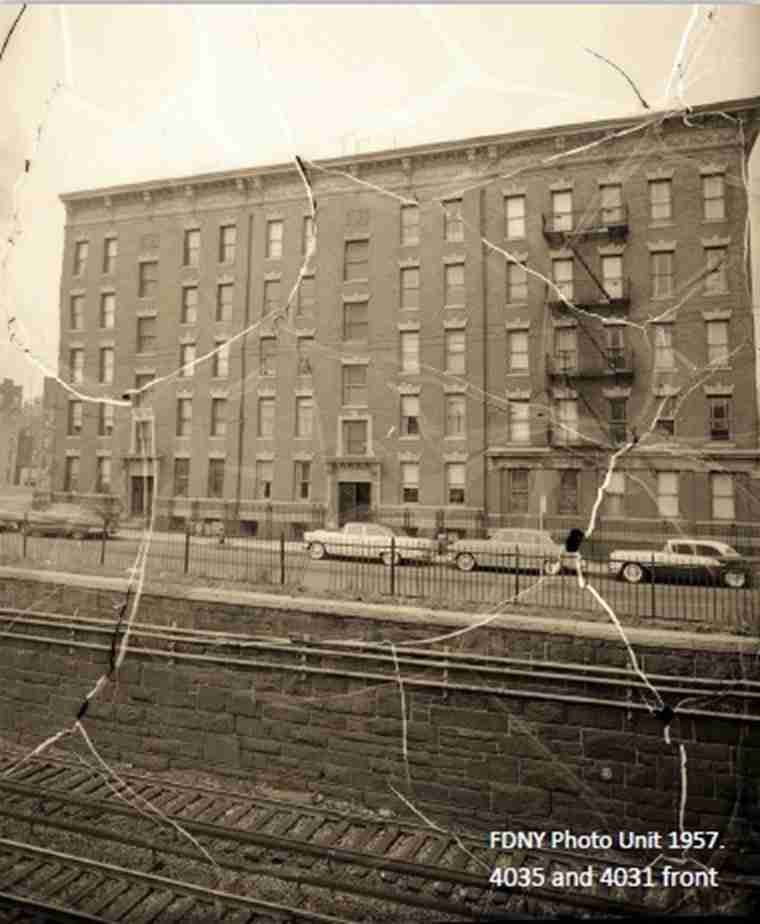
Photo of Side Alpha of the fire building (center occupancy) at the time of the fire.

Detail from the 1950 Sanborn fire insurance map showing the configuration of the fire building (circled in red) and the surrounding exposures.


Photo of a Burell MSA canister mask similar to the one worn by Lieutenant MacClave.

Lieutenant MacClave received a deputy chief’s funeral with six lieutenants serving as pallbearers. Fire Commissioner Cavanagh lead a procession of 500 uniformed firefighters to his requiem mass at St. Brendan’s Church on Perry Avenue in The Bronx. Interment followed at Gate of Heaven Cemetery in Hawthorne, Westchester County, New York.


