
Fire Lieutenant Killed in Backdraft During Row House Basement Fire – Baltimore, Maryland – November 22, 1985
Submitted by Rick DeGroot
On November 22, 1985, Baltimore Fire Lieutenant Nelson K. Taylor of Engine 8 was caught in a backdraft while battling a fire in the basement of a row house. Baltimore fire units responded to what at first appeared to be a routine fire in a two-story attached row house. On arrival, members of Engine 8 and Truck 10 observed heavy smoke pushing from around the first-floor windows and doors of the dwelling. Engine company members stretched hoselines into the structure as truck company members searched for occupants. The interior attack was soon halted as an uncommon chain of events caused the death of one fire lieutenant and burn injuries to two members of his crew after they were caught in a backdraft that blasted up the interior basement stairs. As Lieutenant Taylor and the two firefighters were advancing a hoseline into the kitchen of the dwelling, Taylor was pulled down the interior stairs into the flaming basement by the sudden fire event. The Lieutenant was knocked off balance and carried down the stairs into the developing backdraft by the inrushing air. The other two firefighters were blown backward by the blast and received burn injuries to their faces and hands. Lieutenant Taylor was rescued from the basement with serious burn injuries and head trauma from the fall down the basement stairs. He died in the burn unit twelve hours later. The fire originated in a mattress in the basement from a cause that was undetermined.
The structure involved in the incident was an occupied two-story Type III Ordinary construction brick and wood joist end-of-row attached row house. Built in 1928, the dwelling was the end unit of a row of 34 similar single-family attached row house dwellings. The single-family dwelling had 1320 square feet of living space with one bathroom and a basement that was accessed via a doorway and staircase from the kitchen near the rear of the unit. The basement also had a set of windows below the covered porch on Side Alpha and a small window on Side Bravo near the Bravo/Charlie corner. The row house measured 12 feet wide by 55 feet deep with a slightly sloped flat roof. Set on a corner lot of 1110 square feet, Side Alpha had an attached covered porch, a small front yard, and a street with curbside parking of private vehicles. Side Bravo was the corner of Ashburton Street, also with curbside parking. Side Charlie was a small rear yard and a narrow alley that ran behind the row of dwellings. A similar attached row house was on Exposure Delta. A fire hydrant was located directing across Lauretta Avenue from the fire building.
Baltimore is the largest city in the state of Maryland, fourth most populous city in the Mid-Atlantic, and the 30th most populous city in the United States with a population of 585,708 according to the 2020 U.S. census. The 92.05 square mile city is about 40 miles northeast of Washington, D.C. and is located where the Patapsco River empties into the Chesapeake Bay in central Maryland. In the thirty-year period following the close of the American Civil War, Baltimore doubled in population from 212,418 residents in 1860 to 434,439 residents according to the 1890 U.S. Census. The city bustled with commerce as new factories, foundries and mills took advantage of the transportation options that the natural harbor along the Patapsco River, the headwaters of the Chesapeake Bay, afforded. Baltimore’s position along the Mid-Atlantic coast allowed raw materials and finished products to be shipped both north and south via the waterway and several rail lines converging on the city. Vast neighborhoods of brick row houses were erected to house the workforce. Once a predominantly industrial town with an economic base focused on steel processing, shipping, auto manufacturing, and transportation, the city experienced deindustrialization starting in the 1970s which cost residents tens of thousands of low-skills, high-wage jobs. The population has declined by more than 35 percent since the 1970 population high of 905,787 residents. By 2020, the city had more than 16,000 vacant buildings and a residential vacancy rate of 7.7%. In parts of east and west Baltimore, the rate was nearly one in three houses.
Today, the Baltimore City Fire Department is an ISO Class 1 department that consists of 1800 career members responding from 38 fire stations operating 32 engine companies, 17 truck companies, 3 squad companies, 1 rescue company, 2 fireboats, 20 full-time advanced life support medic units, 7 full-time basic life support ambulances, 4 peak time basic life support ambulances, and numerous special, support, and reserve units. These companies and units are organized into 7 battalions: 6 fire and 1 EMS. The department responds to about 235,000 calls annually.
Area weather conditions on the morning of the fire incident included an air temperature of 38 degrees F and a relative humidity of 97% with a north-northeast wind at 10 mph under cloudy and rainy skies. Note: Research by the National Institute of Standards and Technology (NIST) has shown wind speeds on the order of 10 to 20 mph are sufficient to create wind-driven fire conditions in a structure with an uncontrolled flow path (Madrzykowski and Kerber 2009). The windy weather conditions likely had an impact on fire development and the outcome of the incident.
Just before 11 a.m. on Thursday, November 22, 1985, Box Alarm 36-10 was struck for a report of fire in a two-story attached row house located at 2668 Lauretta Avenue on the northeast corner of Ashburton Street in a residential area of western Baltimore. A structural response of four engines, two trucks, and a battalion chief were assigned to respond. On arrival, members of Engine 8 and Truck 10 found heavy smoke pushing from around the first-floor windows and doors of the dwelling. Engine company members stretched hoselines to the structure as truck company members began searching for occupants. Despite the heavy smoke, no fire was visible from outside.
Lieutenant Nelson Taylor and Firefighters Morris Hedges and Richard Watson of Engine 8 crawled into the kitchen through a rear door with a pre-connected hoseline in an effort to locate the fire. They had made their way approximately five feet into the smoke-filled room and found the doorway leading to an interior stairway to the basement. As Lieutenant Taylor leaned forward and opened the basement door, a backdraft occurred, causing the basement to erupt into flames. Lieutenant Taylor was pulled or “sucked” into the flaming basement by the sudden events. He was knocked off balance and was literally carried down the stairs and into the developing backdraft by the inrushing air. The firefighters following behind Taylor were blown backward into the kitchen in what might be described as the conventional effect of a backdraft.
Firefighters immediately went into the basement to retrieve Lieutenant Taylor. Several firefighters made their way down the basement stairs with the hoseline pushing back the flames as a truck company captain and his crew entered the basement from the windows below the covered front porch on Side Alpha. Lieutenant Taylor was quickly located and removed from the structure. The fire was brought under control within a half hour.
Lieutenant Taylor was severely burned over 65% of his body and suffered a head injury when he fell down the stairs. He was transported by ambulance to the shock-trauma facility at University Hospital and later transferred to the Francis Scott Key Medical Center burn unit where he succumbed to his injuries about 12 hours later.
Firefighters Morris Hedges and Richard Watson were also burned about the face and hands. Both were treated and released at the fire department’s infirmary. A resident of the fire building also received first- and second-degree burns to his hands while trying to extinguish the fire before firefighters arrived.
In a twist of fate, it could have been Firefighter Hedges lying in the basement. For it was he who was to lead the hoseline into the kitchen of the house with Lieutenant Taylor. “We got to the door and stopped to pull up our boots and put on our gloves and air mask,” Firefighter Hedges said. “I was to take the nozzle and he was supposed to back me up.” He said, ‘Jack, give me the pipe (nozzle), I’ll go on. I’ve got my gloves on,’” Hedges recalled. They then trailed each other into the kitchen on their hands and knees, barely able to squeeze by two large appliances that had been placed by the door. The building was filled with smoke, but at that point they had not pinpointed the origin of the fire – a rolled-up mattress in the basement.
“My ears were burning, I told the Lieutenant, ‘Let’s go; it’s too hot,’ but he asked for more hose,” said Hedges. As he grabbed one of the Lieutenant’s boots to persuade him to back out, the heat reached an incendiary point and caused what is known as a backdraft, one of the biggest threats firefighters face. Firefighter Hedges was blown toward the rear of the house while Lieutenant Taylor, who was near the top of the basement stairs, was literally sucked into the blazing cellar.
Other firefighters grabbed Hedges and extinguished the fire in his hair while others attempted to force their way into the building to find the Lieutenant. They were unaware he was in the basement. “I though he was right behind me,” said Hedges. “He couldn’t have been more than five feet away.”
When the firefighters reached the kitchen, they found the Lieutenant’s boot that Firefighter Hedges had grabbed, as well as his helmet. Investigators theorized that once Lieutenant Taylor was sucked into the basement he became disoriented and crawled toward a bright spot that he thought was a window—instead it was the center of the fire. “It should have been me,” Hedges said.
When Captain Steven Fugate of Truck 10 found Taylor, he was lying face down in the water about ten feet from the front of the building. His air mask was intact and still supplying air to his facepiece, the Captain said. Oblivious to the warning bell on his own air supply, Captain Fugate struggled vainly to pull his friend from the basement and finally collapsed as the final gush of air poured from his tank. Both men were then removed from the basement by two other firefighters, Firefighter Lonnie Jackson of Truck 13 and Lieutenant Vincent Green of Engine 20. Captain Fugate was treated for smoke inhalation at the scene.
The row house fire was brought under control by 11:30 a.m. and the firefighters returned to their station only to be summoned ten minutes later for another fire call. “The fact of the matter is that we have a job to do,” Captain Fugate said. “We probably will never forget about Lieutenant Taylor, but when the (fire) bell rings, we have to go out again. You don’t have a chance to vent your emotions. We grieve internally and pray.”
Lieutenant Nelson K. Taylor, age 51, was a 26-year member of the Baltimore Fire Department assigned to Engine 8. He was a native of the city and a graduate of Dunbar Senior High School in 1954. Soon after graduating he joined the U.S. Navy and served until 1959 when he joined Fire Department. Talyor was promoted to Lieutenant in 1984. He was a member of the Vulcan Blazers and the Baltimore Fire Officers, Local No. 964 I.A.F.F. He also coached Little League football in Northwood for many years. He was survived by his wife Esther; his children, Rosalind, Dwayne, Patrick and Cedrick; his mother, Mrs. Agnes L. Taylor; his sister, Mrs. Theodora F. Butler; his brother, Louis E. Taylor, and two granddaughters.
A Mass of Christian Burial was offered for Lieutenant Taylor on November 25 at St. Francis Xavier Roman Catholic Church with interment following at Arbutus Memorial Park in Arbutus, Maryland. The mile-long funeral procession, led by a motorcycle escort, rolled west on North Avenue before snaking its way several blocks south to the West Lafayette Street fire station where Lieutenant Taylor worked as the on-duty members of Engine 8 stood in salute outside the station draped in black bunting. At the cemetery, two ladder trucks created an arch under which the procession slowly passed. His casket was borne by fellow city firefighters as more than 800 mourners including several hundred city and area firefighters attended the funeral services.
The Lieutenant Nelson Taylor Award is presented in memory of Lieutenant Taylor of Engine 8, who lost his life in the line of duty while operating at the row house fire in 1985. Recipients of the award must exemplify the commitment and high ideals demonstrated by Lieutenant Taylor during his 26 years of service to the community. A medal, certificate and $500 monetary award is presented to a member(s) of the Baltimore Fire Department who performs duties above and beyond the call of duty and/or work to enhance the betterment of the African American community of Baltimore City. The award was established and is presented by the Vulcan Blazers Inc.
A memorial tribute to Lieutenant Nelson Taylor is displayed at the quarters of Engine 8 and Truck 10 on West Lafayette Street.
The name of Lieutenant Nelson K. Taylor has been honored at the Maryland Fire-Rescue Services Memorial in the state capitol of Annapolis. The memorial’s centerpiece features bronze statues of a firefighter and an EMS provider ascending from this world as they answer their call to serve with strength, determination, and sacrifice. In their final moment, they turn to say farewell to their loved ones. Below them, a kneeling mother, a child, and an elderly man represent family and community. Brick walls flank the memorial, bearing bronze plaques with the names of fallen fire and EMS members from across the state who gave their lives in service to their communities.
Lieutenant Nelson K. Taylor’s name has been inscribed on the 1985 plaque displayed at the National Fallen Firefighters Memorial on the campus of the National Fire Academy in Emmitsburg, Maryland.
Commentary:
Discussion by John E. Bowen, official spokesperson for the Baltimore Fire Department, from an article on the event, “The Backdraft, a New Look at an Old Danger,” that was published in Fire Engineering magazine in 1986:
A typical backdraft situation you’re thinking? Oh, it was most certainly a backdraft, but, no, it was definitely not the typical backdraft. The backdraft has always been a threat to firefighters working at structural fires, of course, especially in the winter months when buildings are apt to be tightly sealed against the cold weather. So, let’s take a look first at what have become known in the fire service as the “typical” conditions that lead to a backdraft. Then we will come back to the Baltimore incident.
Typical Backdraft Conditions
The normal atmospheric oxygen concentration is just under 21% at sea level and it decreases slightly with increasing elevation. You know, of course, that oxygen is necessary for and is consumed during combustion. The oxygen reacts chemically to form carbon dioxide if abundant oxygen is available, and carbon monoxide if oxygen availability is significantly below the usual 21%. A free-burning fire in a tightly closed area (a room or a basement, for example) soon lowers the ambient oxygen concentration to a level considerably less than 21%. When the oxygen level drops to about 15%, flaming combustion ceases, the fire begins to smolder, and large quantities of carbon monoxide are produced.
Carbon monoxide, you will recall, is both markedly toxic and highly flammable. For example, a concentration of 0.64% (6,400 ppm) of carbon monoxide in the air produces a blood saturation of 80% in most people within a minute or two. If the carbon monoxide content of the air doubles to 1.28%, two or three breaths will likely render a person unconscious. Death usually follows within one to three minutes under the latter conditions. The ignition temperature of carbon dioxide is 1,204°F; its lower and upper flammable limits are 12.5% and 74%, respectively.
Three factors must come together simultaneously for a backdraft to occur:
- A large amount of fuel that has already been heated to its ignition temperature (carbon monoxide that has been produced by the smoldering fire).
- A source of ignition (the smoldering fire itself).
- A suddenly increased availability of oxygen.
When these three components of a backdraft are brought together in an enclosed area, ignition of the fuel, the carbon monoxide, occurs virtually instantaneously and with explosive rapidity.
We have been taught for decades that the proper method to minimize the potential for a backdraft is to ventilate the enclosed area, be it a basement or cellar, a room or an entire building, at the highest point. This permits the upward and outward flow of smoke, carbon monoxide, and the other heated combustion products, without allowing an influx of cooler air and, specifically, oxygen. You must be certain that these combustion products are venting to the outside, that the outward flow is not being blocked, perhaps by a suspended ceiling or interior partition, for example.
There is no doubt that these superheated, explosive gases will ignite when finding their needed air supply. Fire strategy demands that we choose where the fire triangle will be completed. If the gases are channeled vertically, the oxygen will be found in free space and the energy of combustion will be unleashed rather harmlessly in air. However, it is when the necessary oxygen is “sucked” into an enclosed space that the same energy, now confined by the structure, causes the damaging backdraft phenomenon.
Narrow (30 degree) fog streams can be introduced into the fire area once effective ventilation has begun. Water application must be very carefully coordinated with ventilation though, ensuring that ventilation at the highest point has been started first. But don’t wait too long to start the water after ventilating or you will suddenly have a large free-burning fire on your hands.
At this point, let’s examine more closely the circumstances that led to the tragic event in Baltimore:
The two-story structure was a rowhouse, the end unit of a block-long series of interconnected dwellings. It was constructed of brick, but the brick had been covered with vinyl siding. The dwelling had been built on a gently sloping parcel of land so that the first floor was approximately five feet above grade in the front and at ground level in the rear. This placed the basement about one-half below grade in the front and almost fully below grade in the rear. There were very small basement windows in the west wall (Side Bravo) and a larger one in the front; the rear and east basement walls were without any windows.
Basements in dwellings frequently have a heavy fuel load because they are used for storage, and this one was no exception. In fact, this fire was found subsequently to have started in a rolled up and stored mattress. The cause of ignition was probably children playing with matches or possibly careless smoking.
A fire that originates in a basement, by virtue of its partial below-grade location in a structure and the storage function that the area often serves, can be expected to generate great quantities of smoke and carbon monoxide. After all, the below-ground and usually tightly sealed basement is poorly ventilated at best, so oxygen levels in the air are going to drop quickly once the fire starts, a condition highly conducive to carbon monoxide accumulation and to backdraft. It is imperative that such a situation be recognized by the first firefighters to reach the scene and that the proper actions be taken to minimize the risk of a backdraft.
The proper procedure for attacking a smoldering basement fire that is generating great volumes of smoke is exactly the same as that for minimizing the backdraft potential in any other type of occupancy. First, establish vertical ventilation at the highest point and then get a hoseline in position as quickly as possible to protect vertical openings—the interior stairway between the kitchen and basement, for example—to prevent upward extension of the fire. The need for self-contained breathing apparatus (SCBA) is obvious, of course.
Atypical Backdraft
This is precisely what Lieutenant Taylor and his team were trying to do, locate the fire and get a hoseline into position at the interior staircase. Here, then, is where the situation at this particular fire began to deviate from the usual events leading to a backdraft.
The firefighters in the kitchen, having determined that the seat of the fire was in the basement, approached the door to the basement stairs, fully anticipating that they would be met by heavy smoke and superheated gases venting upward toward them when the door was opened. Instead, there was an immediate flow of air from the kitchen, down the stairway, to the fire in the cellar. It seems probable that the fire had vented itself, probably through one or more of the basement windows, just as the firefighters were opening that fateful door upstairs.
An outward flow of smoke and heated gases from the windows was thus established as the door was being opened. The suddenly opened doorway in the kitchen then provided the channel for cool air to enter, and a replenishing oxygen supply, to flow into the fire area. It was this flow of cool air that knocked the firefighters off balance, causing Lieutenant Taylor to fall or to be swept into the burning basement.
In effect, then, this incident was the reverse of the “typical” backdraft. The primary ventilation was probably accomplished through a basement window, the lowest point, when the fire self-ventilated. The interior stairway from the kitchen above then became the channel for air—and oxygen—to flow into the fire.
This incident was certainly unusual in the manner in which it developed, but it does serve to underscore a very important fact in the fire service. That is, nothing can ever be interpreted as “ordinary” or “predictable” in firefighting. There is always the omnipresent exception lurking around some corner, an exception that threatens every firefighter with bodily injury and death.
We have attached photos from the incident.
We have also attached a video of a backdraft occurring in a row of stores in Queens, New York in 2018 that injured seven firefighters and at least five other civilians:
We have also included an article from the Firehouse Tribune that discusses the warning signs of backdraft and how to prevent it: http://www.thefirehousetribune.com/blog/2015/9/25/understand-a-backdraft#:~:text=With%20this%20being%20said%20there%20are%20certain%20warning,and%20smoke%20inward%20when%20an%20opening%20is%20made
Thanks to John E. Bowen for his excellent article which provided much of the content for this post.
Honor the service of Lieutenant Nelson Taylor by reviewing the fire behavior phenomenon of backdraft and measures to control and prevent it with your crew members today.
Remember Fallen Brothers.
Get Out There And Know Your Local!!!
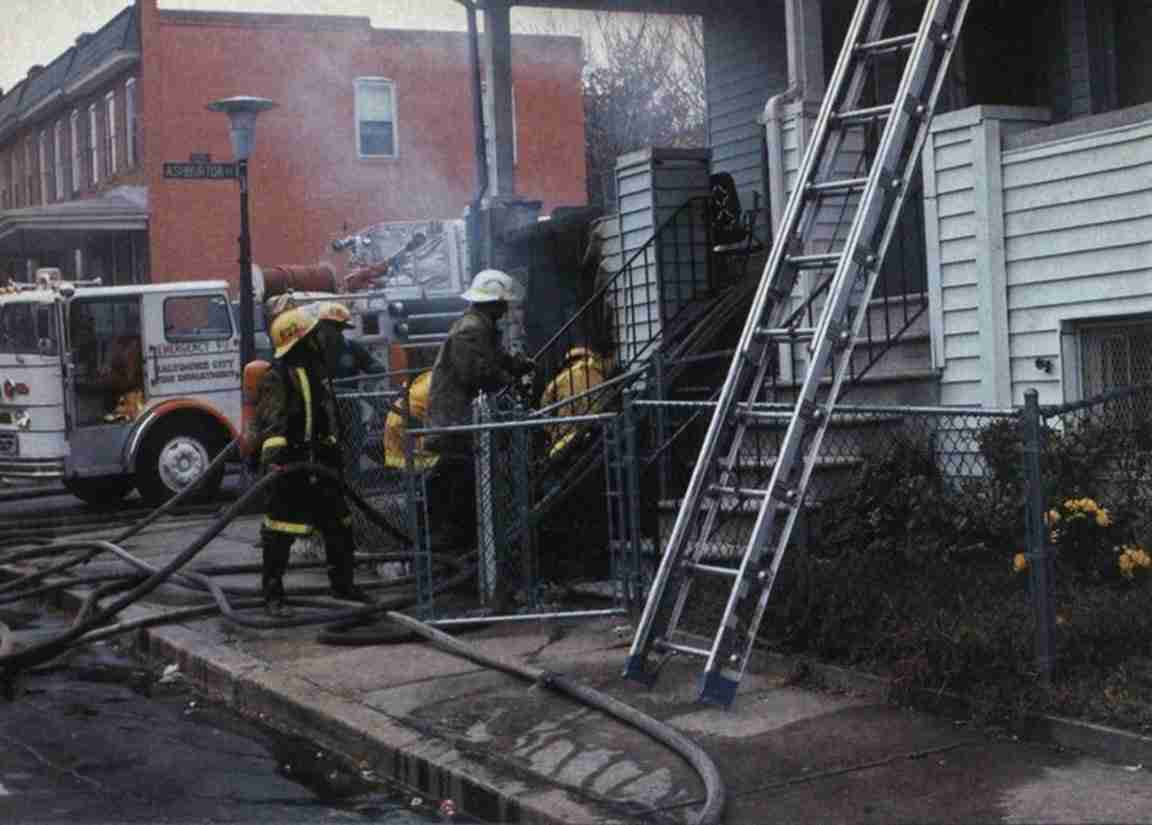
Photo of fire and rescue operations on Side Alpha via small basement window.

Photo of the row house as it appears today.

Photo of the rear of the row house as it appears today.


