Fire Chief Killed and Firefighter Seriously Injured in Wall Collapse During Department Store Fire – State Dry Goods Store Fire – Fort Collins, Colorado – June 29, 1965
On June 29, 1965, Fort Collins Colorado Fire Chief Clifford Carpenter was killed by falling bricks and mortar when a wall collapsed during a fire at the State Dry Goods department store in the downtown central business district. Chief Carpenter was directing hoselines at the building at South College Avenue and West Oak Street when an exterior wall gave way. The Chief was crushed in an avalanche of brick and stone while Firefighter James Witchel was also injured in the collapse. Firefighters immediately began rescue operations and Firefighter Witchel was found seriously injured in the rubble first, but rescuers had difficulty finding Chief Carpenter under the debris. He was located and removed from the scene via ambulance to the hospital where he was later pronounced dead from severe head trauma. The fire totally destroyed the dry goods building and damaged or destroyed several other businesses on the block. The cause of the fire was later determined to be a malfunctioning electrical timer that controlled the lights in the dry goods store front display window. The total fire loss to the dry goods building and adjacent businesses was placed at more than one million dollars. The death of Chief Clifford Carpenter marked the first line-of-duty firefighter fatality experienced by the Fort Collins Fire Department.
The structure involved in the fire was a two-story Type III Ordinary construction mercantile building built in 1906 that was located at 151 South College Avenue at the northwest corner of West Oak Street in the central business district of the city. The building measured about 100 feet wide and 100 feet deep and had a flat roof with a three-foot-high masonry parapet wall with a stone cornice at the roof edge on Sides Alpha and Bravo. The building had originally been built as a department store but was then occupied by the State Dry Goods store and several other tenants. An elevator supported by a steel framework was placed at the center of the store to serve the upper floor. The wooden interior of the second floor was supported on four rows of cast iron columns and steel beams. The lower floor was split into three separate stores with the dry goods store occupying the bulk of the floor area while the Bowen bookstore and the Collinado Drug store occupied the remainder. The main entrance to the drug store was at the Alpha/Bravo corner. Offices of several tenants occupied the second floor. Steel lintel beams supported the exterior walls on Sides Alpha and Delta with large plate glass display windows on the first floor fronting on the sidewalk. Side Alpha faced 140-foot-wide South College Avenue with a wide sidewalk and curbside parking. A one-story extension with several mercantile stores was on Side Bravo that faced 100-foot-wide West Oak Street with a sidewalk and curbside parking. A 20-foot-wide alley separated the fire building from several exposure buildings on Side Charlie. A row of two-story mercantile shops separated from the fire building by a brick firewall was attached on Exposure Delta. The fire building was not equipped with a fire alarm system or an automatic fire sprinkler system. Several fire hydrants fed by a 10-inch water main were available on the block and in front of the fire building. The nearest fire alarm call box was located at the north end of the block at West Mountain Avenue.
Fort Collins is the county seat and the most populous municipality of Larimer County, Colorado. The city population was 169,810 at the 2020 U.S. census, an increase of almost 18% since 2010. Fort Collins is the principal city of the Fort Collins Metropolitan Statistical Area and is a major city of the Front Range Urban Corridor. The city is the fourth most populous city in the state. Situated on the Cache La Poudre River along the Colorado Front Range, Fort Collins is located 56 miles north of the State Capitol in Denver. The city is a midsize college town, home to Colorado State University and Front Range Community College’s Larimer campus. At the time of the incident the city was protected by the Fort Collins Fire Department which was formed in 1888. In 1938, the Fort Collins Rural Protective Association was formed to provide fire protection to rural areas surrounding the city, before becoming the Poudre Valley Fire Protection District in 1950. In 1981, the Fort Collins Fire Department and the Poudre Valley Fire Protection District merged to form the Poudre Fire Authority. Today, the authority provides fire, rescue, and emergency medical services to more than 212,000 residents in the 230 square mile district from 14 fire stations staffed by 224 full time career members, 12 part-time members, and 25 volunteer and seasonal firefighters. The district provides daily staffing for 11 engines companies, 1 tower ladder company, 1 aerial ladder company, 1 safety officer, 1 fire prevention officer, and 2 battalion chiefs. In 2024, Fire Authority responded to 25,276 calls for service with 17,135 (67.7%) rescue and EMS calls and 8,141 (32.2%) fire and emergency calls of another nature. There were 378 fires reported in 2024.
Area weather conditions on the night of the fire included air temperatures in the 60s F and a relative humidity of 78% with winds from the north at 12 mph under fair skies (U.S. Weather Bureau). Note: Research by the National Institute of Standards and Technology (NIST) has shown wind speeds on the order of 10 to 20 mph are sufficient to create wind-driven fire conditions in a structure with an uncontrolled flow path (Madrzykowski and Kerber 2009). The wind condition likely had an impact on fire development and the outcome of the incident.
On Tuesday, June 29, 1965, at about 9:30 p.m., an electrical timer that controlled the lights in the front display window of the State Dry Goods store at College Avenue and Oak Street malfunctioned and the brief shower of sparks ignited combustible materials in the shop. The fire quickly spread but was not immediately noticed because the darkly painted walls of the display window made the interior of the store invisible from the sidewalk. The fire burned for about an hour, slowly increasing the interior pressure to the point where one of the large display windows exploded, showering shards of glass across the sidewalk and into the middle of the street. The oxygen that was sucked inside caused the interior to erupt into an inferno. The fire was first reported by an anonymous caller from the Aggie Theater across College Avenue. All city fire units including a snorkel truck responded to the scene. By the time the Fire Department arrived, the building was fully involved.
Mutual aid was requested from the LaPorte Volunteer Fire Department and the U.S. Forest Service, and all off-duty firefighters were called in as well. Fire Chief Clifford Carpenter was notified of the alarm via the telephone extension installed in his home and responded to take command. Firefighters set up heavy streams at the sides of the building and battled the flames for about one hour while attempting to prevent the fire from spreading to the attached stores on Sides Bravo and Delta. The snorkel truck was set up on College Avenue to quell the flames that were now breaking through the roof.
The wind carried glowing cinders several blocks away from the fire. Flaming debris showered Remington Street near the elementary school and were carried as far away as Elizabeth and Mathews Streets. A constant bombardment was carried in chunks and sparks across the street to lace the north face and roof of the nearby Post Office building. Precautionary measures were taken as a constant spray of water was directed on the walls of the building. An awning on an apartment half a block away was set afire by the flying embers.
Chief Carpenter was concerned that the firewall between the dry goods store and the attached exposures on Side Delta was old and may have had openings. He then called for an additional engine from the Loveland Fire Department to concentrate on the exposures on that side of the fire building. The engine from Loveland arrived eight minutes later at 11:40 p.m. By that time, flames that towered 100 feet above the building began moving west toward the rear of the structure but the northernly wind prevented the fire from leaping over the building into other businesses north on College Avenue. Throngs of spectators crowded the intersection and police had to hold back the crowd that was building in the streets. The glow from the fire was visible throughout the city and from eight miles to the south.
The fire, which apparently started near the front of the building, had completely eaten away all of the wooden window frames and had collapsed an awning along College Avenue by 11:45 p.m. Firemen in the snorkel unit were elevated to the second floor level while they poured a heavy stream through the windows near the firewall adjoining the Delta exposures. Other firemen directed a spray of water on them to cool and protect them from the towering flames.
Long, wide cracks in the stone face of the building began reaching down from the top along the Alpha/Bravo corner of the building. Heat forced the steel skeleton of the structure out of shape, bowing it out in a curve along Oak Street. The Chief noticed the bulge in the wall on Side Bravo and decided to order the men handling the hoselines to back off. Just seconds before the collapse, word was passed down the fire line that the wall was about to fall, and firemen hurriedly pulled their hoses back near the Post Office.
Chief Carpenter was standing with Fireman James Witchel checking a gas meter at the rear of the south side of the drug store when the wall suddenly crumbled shortly after midnight sending a wall of flaming debris, brick and stone onto West Oak Street. The Chief and Witchel were buried in the wreckage. Firefighters immediately began rescue operations and Fireman Witchel was found in the rubble first, but rescuers had difficulty finding Chief Carpenter under the debris. “Here he is,” someone shouted, and the workers began frantically digging through the rubble.
Chief Carpenter was found to be unconscious and was carried by four men to a waiting ambulance for the trip to Poudre Valley Hospital. Doctors there pronounced the Chief dead at 12:30 a.m., 30 minutes after the wall collapsed. Severe head trauma was listed as the cause of his death.
Fireman Witchel was also transported to the hospital with injuries to his chest. He was admitted in serious condition with several broken ribs and possible internal injuries. His condition was upgraded several days later to fair and improving.
As the night wore on stunned firemen controlled the blaze. Only the debris filling the basement continued to burn. The Side Alpha wall, along College Avenue collapsed at 12:07 a.m. Fortunately, it fell inward for the most part. Had the Side Alpha wall crumbled out into the street, the injury count could have been much higher. After the exterior walls of the fire building had collapsed, much of the fire began to darken down. The snorkel unit continued its constant sweep of what was left of the front of the building with a heavy stream. An occasional burst of orange flame from the debris filled basement was seen as grey smoke filled the streets.
By dawn, much of the dry goods store was destroyed along with the women’s shop, west of the main building, described as a total loss. The Bowen bookstore and the Collinado drug store were also a total loss. Other businesses and offices lost included Pat’ s Beauty Shop, Ed Miller Real Estate, Scott Boller Insurance, and the medical offices of several doctors. The building custodian and his wife, who lived in a second-floor apartment, were awakened by the sirens and were evacuated before the fire spread to the upper floor. The unstable remains of the masonry front wall were ordered torn down that morning. The remaining warped steel skeleton of the building and the two-story elevator framework spoke to the intensity of the blaze. The total fire loss to the dry goods building and adjacent businesses was placed at more than one million dollars.
A chief engineer for the state fire insurance rating bureau speculated that the combustible synthetics used in the manufacture of dry goods and clothing as well as the type of packaging and the open display of merchandise in the dry goods store may have accelerated the fire. The engineer said that “synthetic materials used today cause flash fires while pure cotton and wool goods burn slowly and steadily, requiring a good long start before they cause the gutting of the building.”
Fire investigators later determined that the fire was accidentally started by a malfunctioning electrical timer that controlled the lights in the dry goods store front display window. As the fire grew, the plate glass display window blew out allowing the flames to spread rapidly. Intense heat weakened the steel girders, window lintels and cast iron columns as the fire consumed the basement, main floor, and second story. The heat began to warp both the Side Alpha and Bravo walls of the structure until they collapsed completely, killing Chief Carpenter and seriously injuring Firemen Witchel.
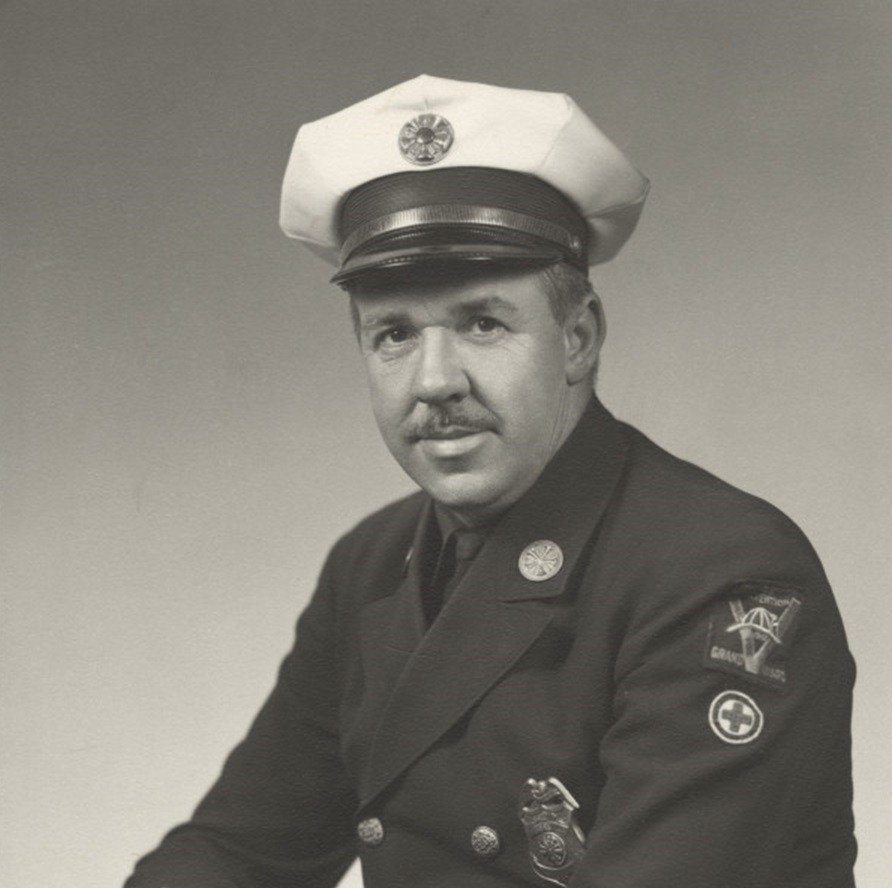
Fort Collins Fire Chief Clifford Carpenter, age 49, was born in Council Bluffs, Iowa on September 30, 1915. He moved with his family to Denver, where he graduated from East High School. The family moved to Fort Collins later and the chief’s father, R.M. Carpenter, operated a feed store. In 1941, Chief Carpenter returned to his birthplace where he worked with the Council Bluffs Fire Department for five years. He returned to Fort Collins in September 1946. He was appointed assistant chief in January of 1961. He became fire chief when his predecessor, Fire Chief T.P. Treadwell, retired on August 15, 1952. Carpenter was an accomplished musician and was the organist for the local Elks Lodge and pianist for the Kiwanis Club. He was an active member of the state, national and international fire chief’s associations, the American Red Cross, and the local Civil Defense. Carpenter was married and had three children. He and his wife had just celebrated their 25th wedding anniversary on the Sunday before the fire. Other survivors include his mother, three brothers and a sister, and four grandchildren.
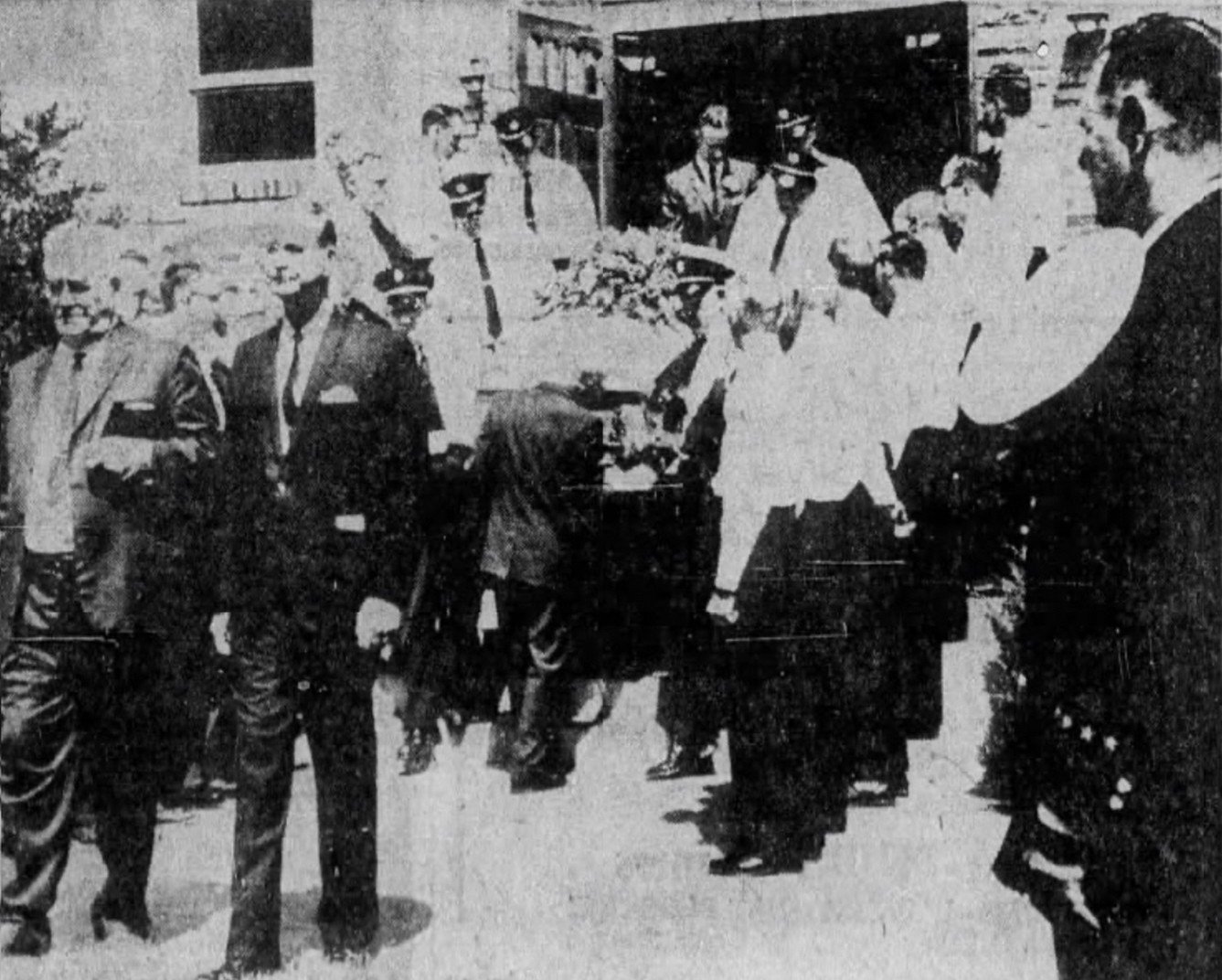
Funeral services for Chief Clifford Carpenter were held on July 1, 1965, at the First Christian Church. Following the service, the largest funeral procession the city had ever known escorted the Chief to his final resting place in Grandview Cemetery in Fort Collins.
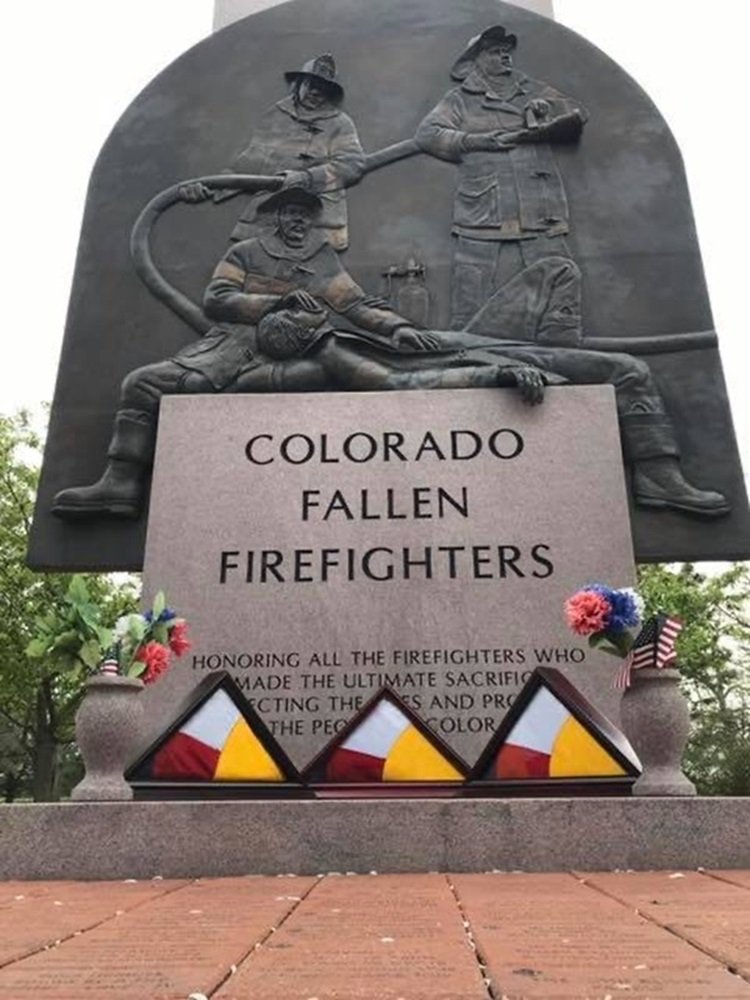
The name of Fire Chief Clifford Carpenter has been honored at the Colorado Fallen Firefighters Memorial in Lakewood. The bronze life-sized memorial on pillars of Colorado rose granite is engraved with 172 names of Colorado’s fallen firefighters. The memorial shows a firefighter rendering aid to a fallen comrade while two others continue to battle the blaze.
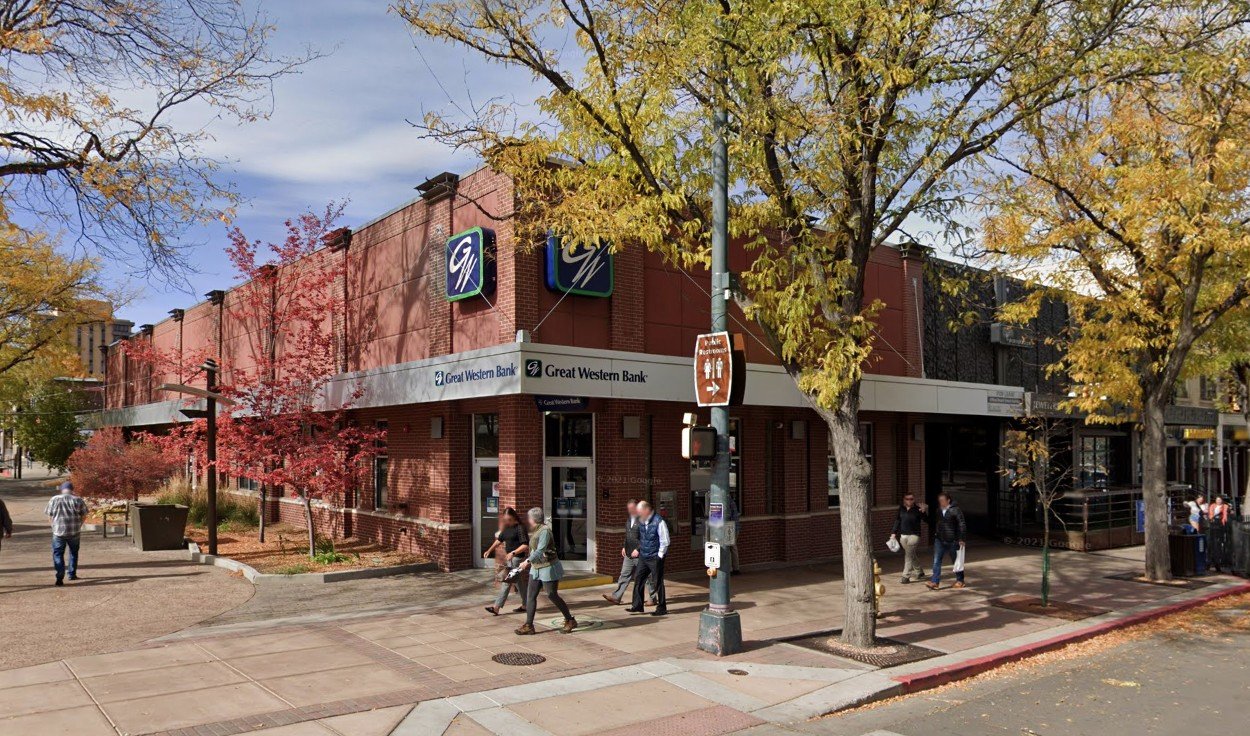
The site of the fatal fire is now occupied by two mercantile buildings. The portion of West Oak Street where the collapse occurred is now a pedestrian mall with numerous shops. There is no memorial marker at the site.
Commentary:
Many legacy Type III Ordinary construction buildings feature steel girders and cast iron columns that support the interior wood floors and roof of the structure. Structural steel is an elastic building element, meaning that when heated during a fire, the steel will deform and twist while expanding in length. According to Frank Brannigan’s Building Construction for the Fire Service, Fourth Edition: “Steel will expand from 0.06 percent to 0.07 percent in length for each 100 degree F rise in temperature. The expansion rate increases as the temperature rises. Heated to 1,000 degrees F, a steel member will expand 9½ inches over 100 feet of length. If steel beams are restrained, as by a masonry structure, and the temperature of the fire is sustained at around 1,000 degrees F, the expansion of the steel may cause the displacement of the masonry, resulting in a partial or total collapse.”
Many legacy mercantile buildings also feature large display windows along the sidewalk in the front of the structure to display merchandise (thus the term “window shopping.”) The wall openings for the large plate glass windows are usually supported by iron or steel lintel beams to carry the load of the overhead exterior wall. Should the lintel beams be exposed to heavy fire for an extended time period, they will likely deform, twist or expand, often leading to the catastrophic collapse of the exterior wall of the building. Firefighters, fire officers and safety officers should be constantly monitoring the stability of the exterior masonry walls during an advanced fire in a legacy mercantile building looking for signs of structural weaknesses such as smoke pushing through cracks in the walls, displaced or bulging walls, displaced reinforcing wall plates, out of plumb door and window openings, and leaning parapet walls. Adequate collapse zones must be maintained and enforced while firefighters use the reach of exterior fire streams to control the fire. After knocking down the main body of fire, an experienced fire officer should carefully evaluate the structural stability of the building before allowing firefighters to enter to complete extinguishment, overhaul and investigation. Should it be determined that the structure has received considerable structural damage, firefighters should continue hydraulic overhaul from the exterior of the building and demolition equipment should be brought in the remove any unstable elements in the building. We should all heed the old firefighter adage: “When the ladder pipes go up, the building comes down.”
We have attached photos of the incident and a detail from the 1917 Sanborn fire insurance map showing the configuration of the fire building and the surrounding exposures.
We have also attached the link to an article published in Firehouse magazine by Robert Moran and John Lewis on the weaknesses in legacy Type III Ordinary construction buildings:
We have also included the link to an BCFS article on Type III Ordinary construction structures: https://www.facebook.com/groups/192218352449074/permalink/1335221661482065/
Thanks to multiple media sources for the content of this article.
Honor the service of Fort Collins Fire Chief Clifford Carpenter by touring a legacy Type III Ordinary construction mercantile or commercial building in your local response district and observe the steel and cast iron building elements with your crew members today.
Remember Fallen Brothers.
Get Out There And Know Your Local!!!

Photo: Flames ravage the combustible interior of the mercantile building as viewed from the Alpha/Bravo corner. The collapse occurred on Side Bravo.
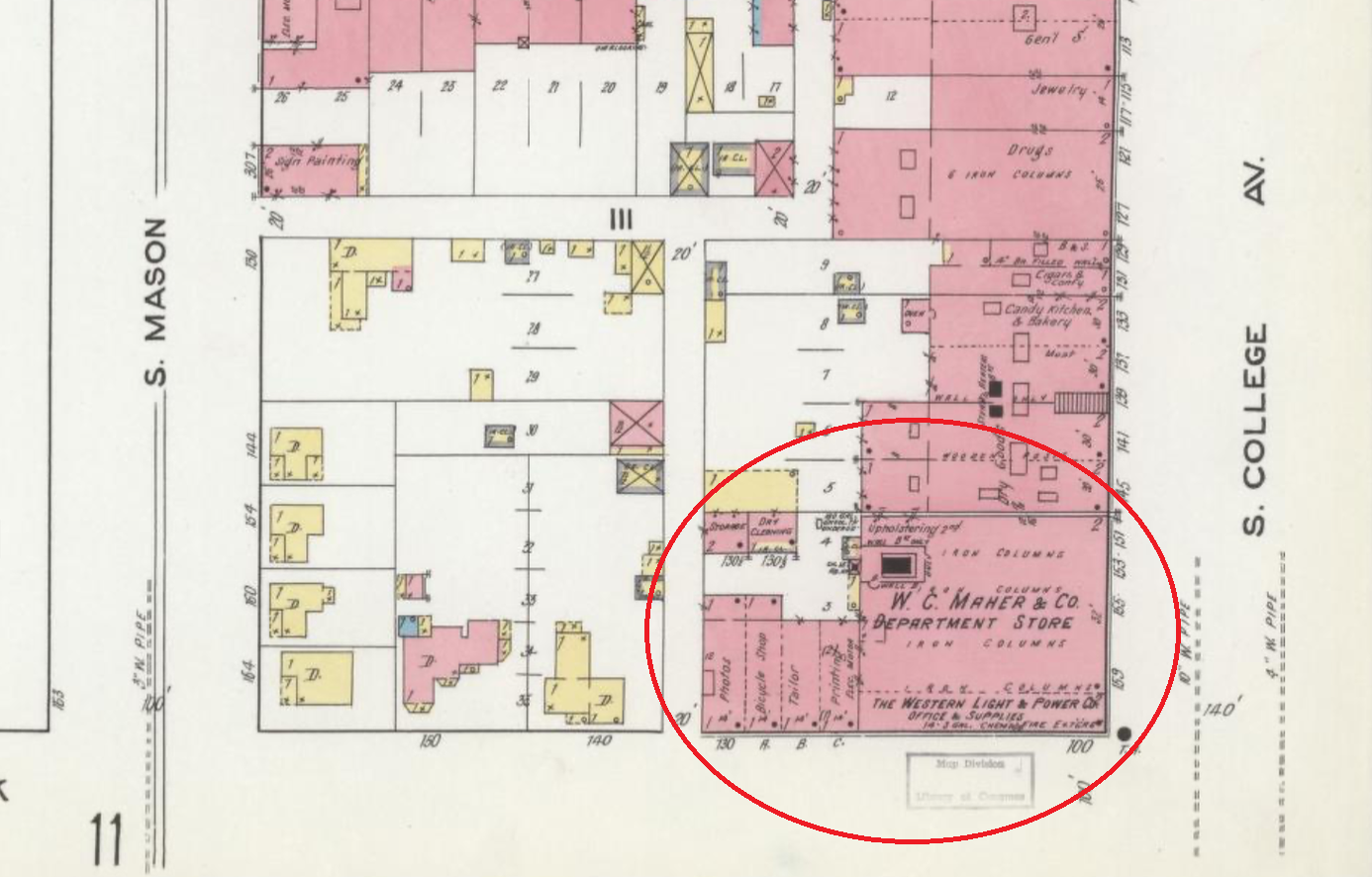
Detail from the 1917 Sanborn fire insurance map showing the configuration of the fire building (circled in red) and the surrounding exposures.
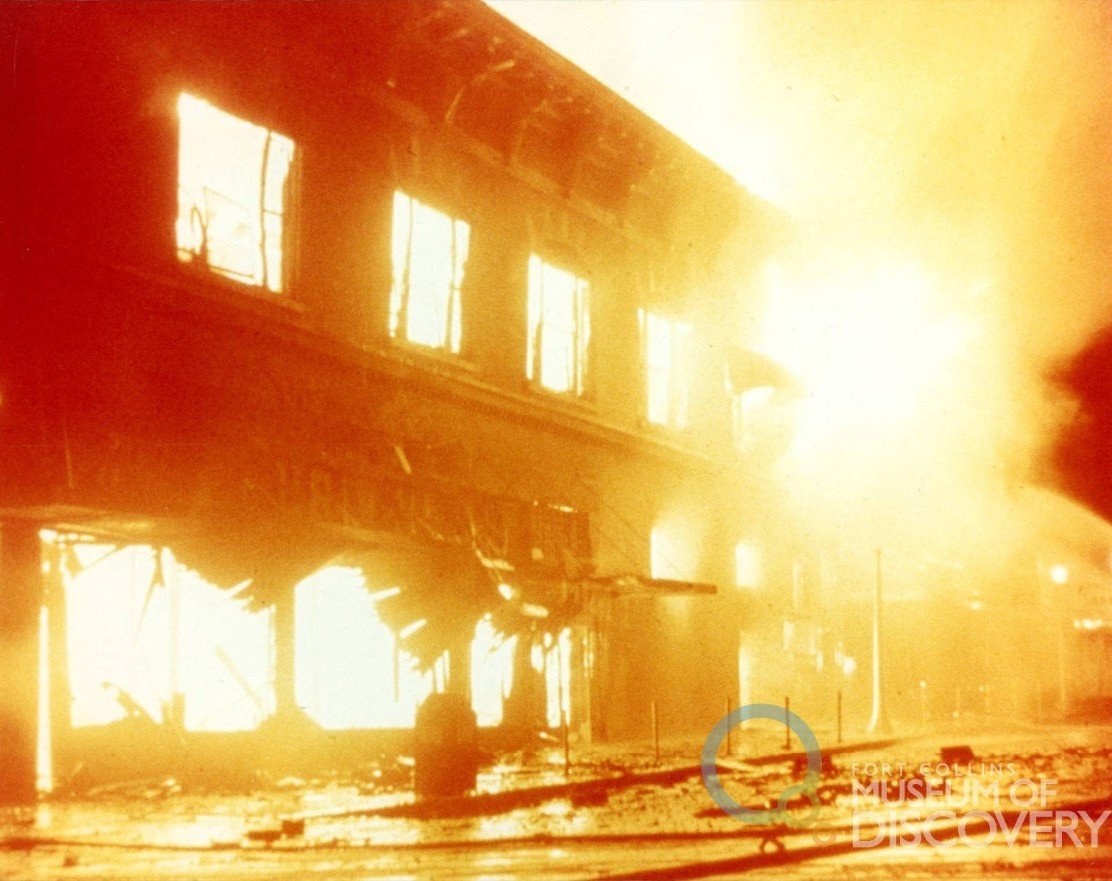
The wind carried glowing cinders several blocks away from the fire. Flaming debris showered Remington Street near the elementary school and were carried as far away as Elizabeth and Mathews Streets. A constant bombardment was carried in chunks and sparks across the street to lace the north face and roof of the nearby Post Office building. Precautionary measures were taken as a constant spray of water was directed on the walls of the building. An awning on an apartment half a block away was set afire by the flying embers.
View of Side Alpha of the fire building.
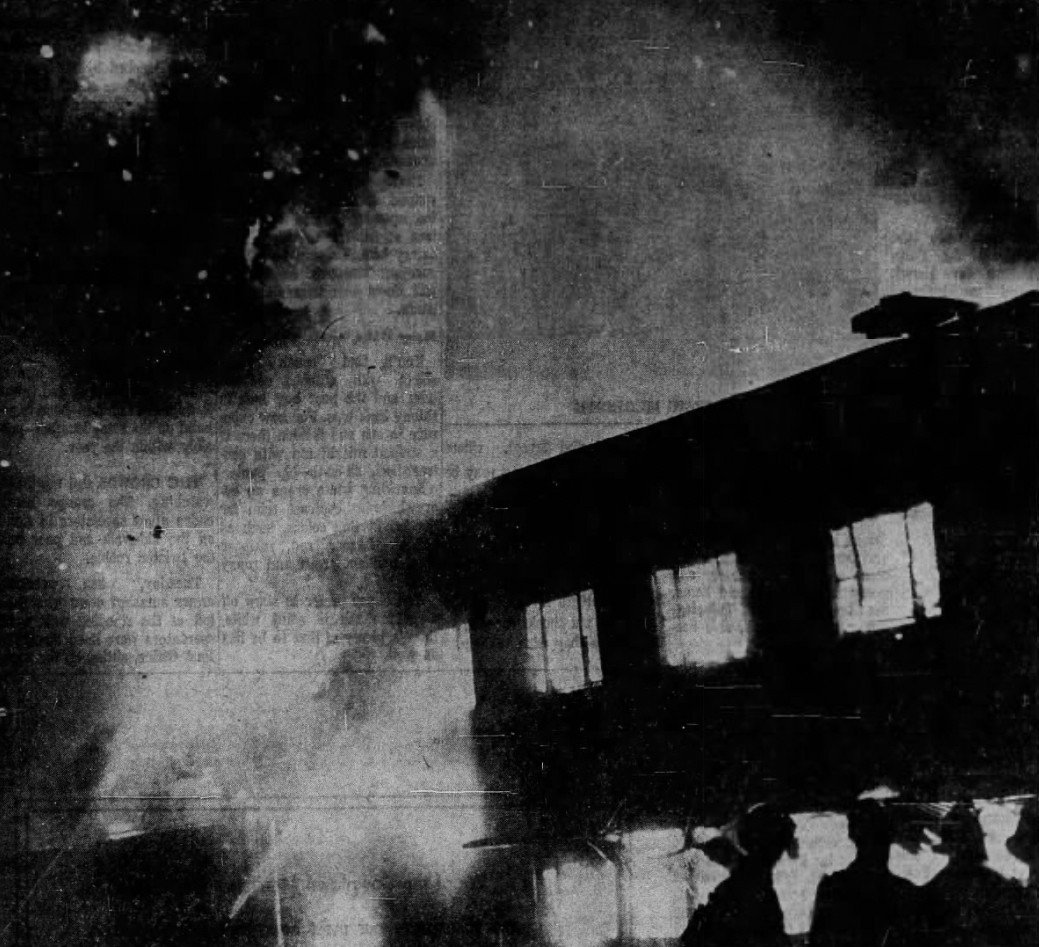
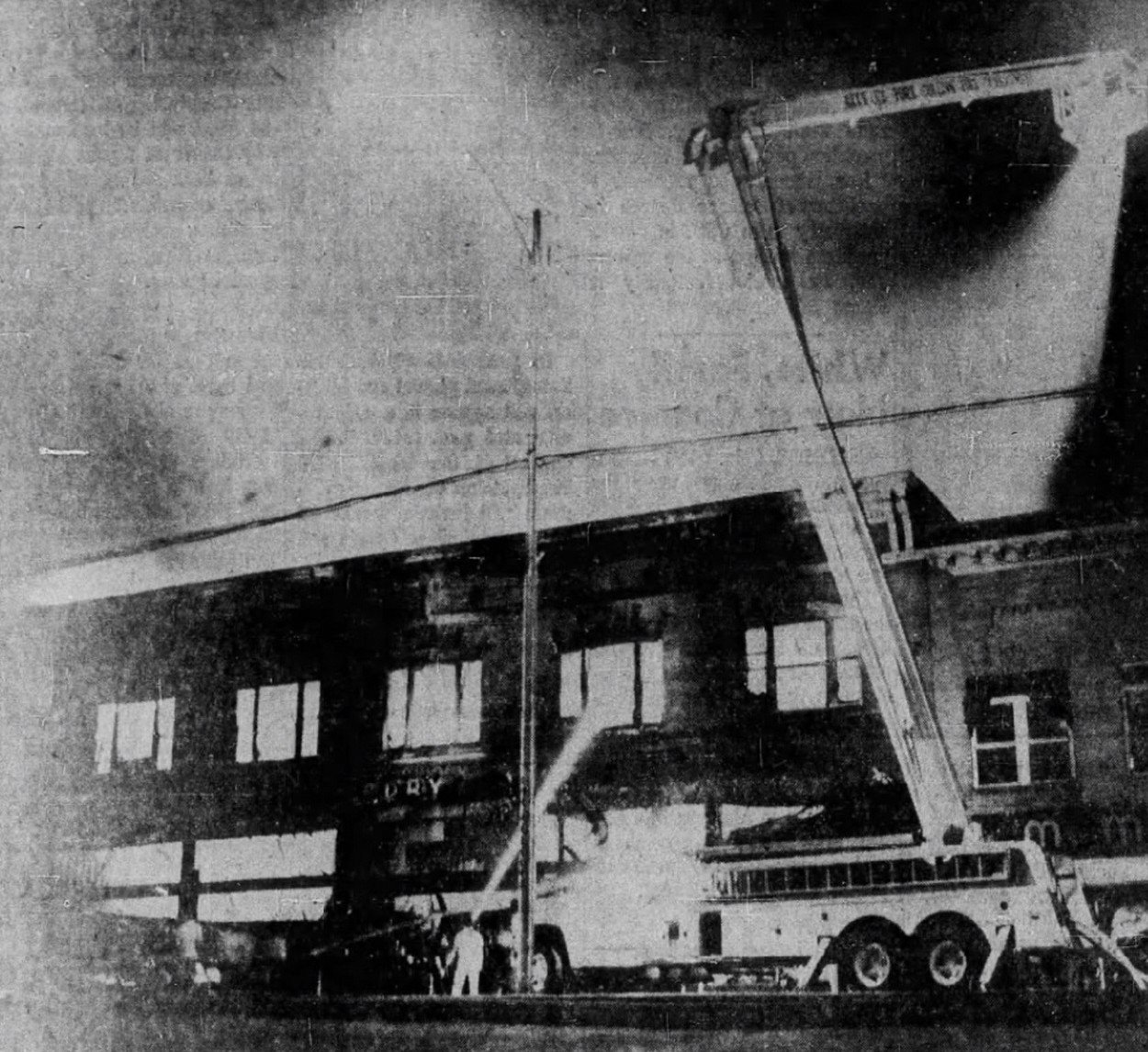
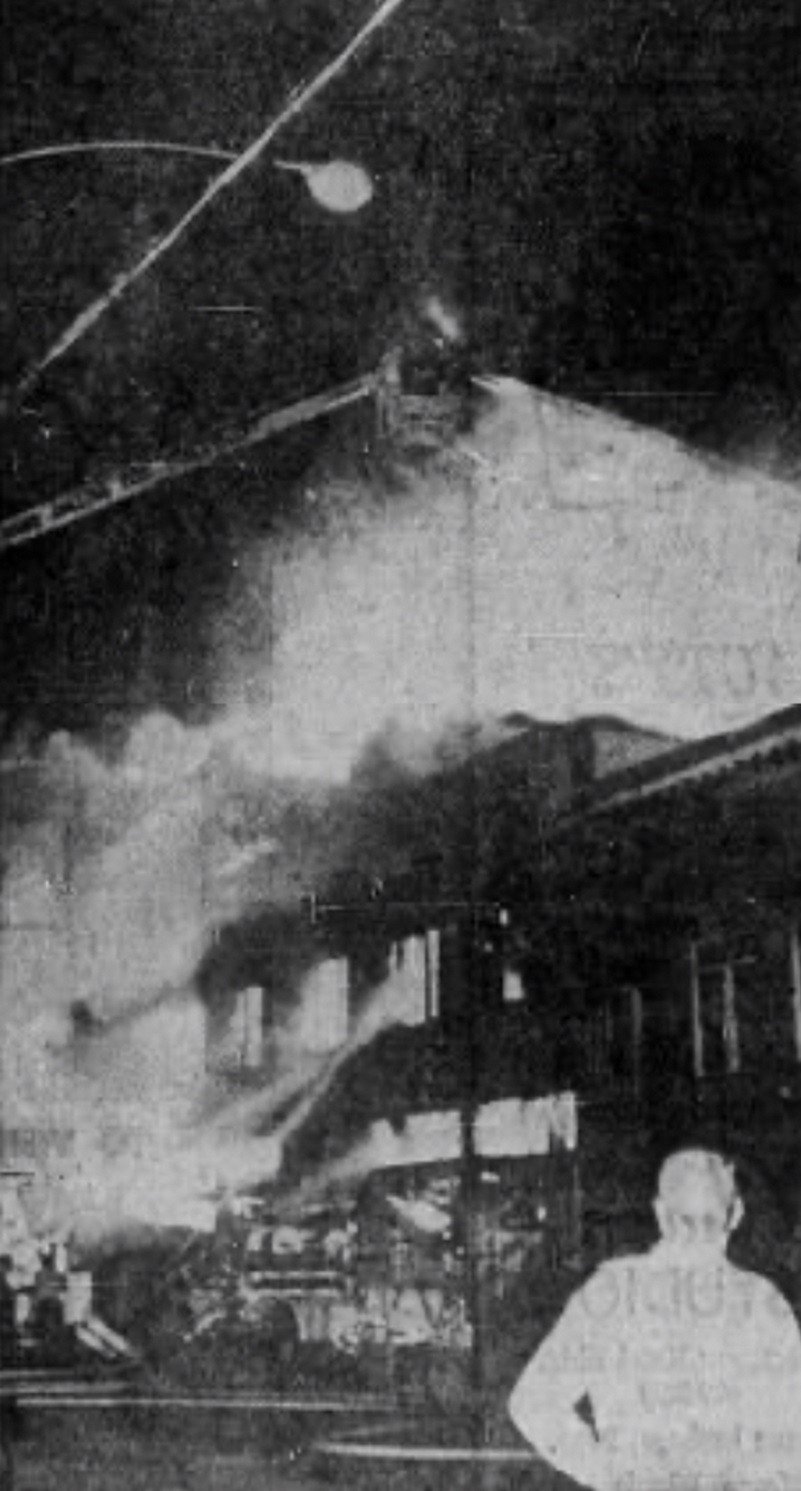
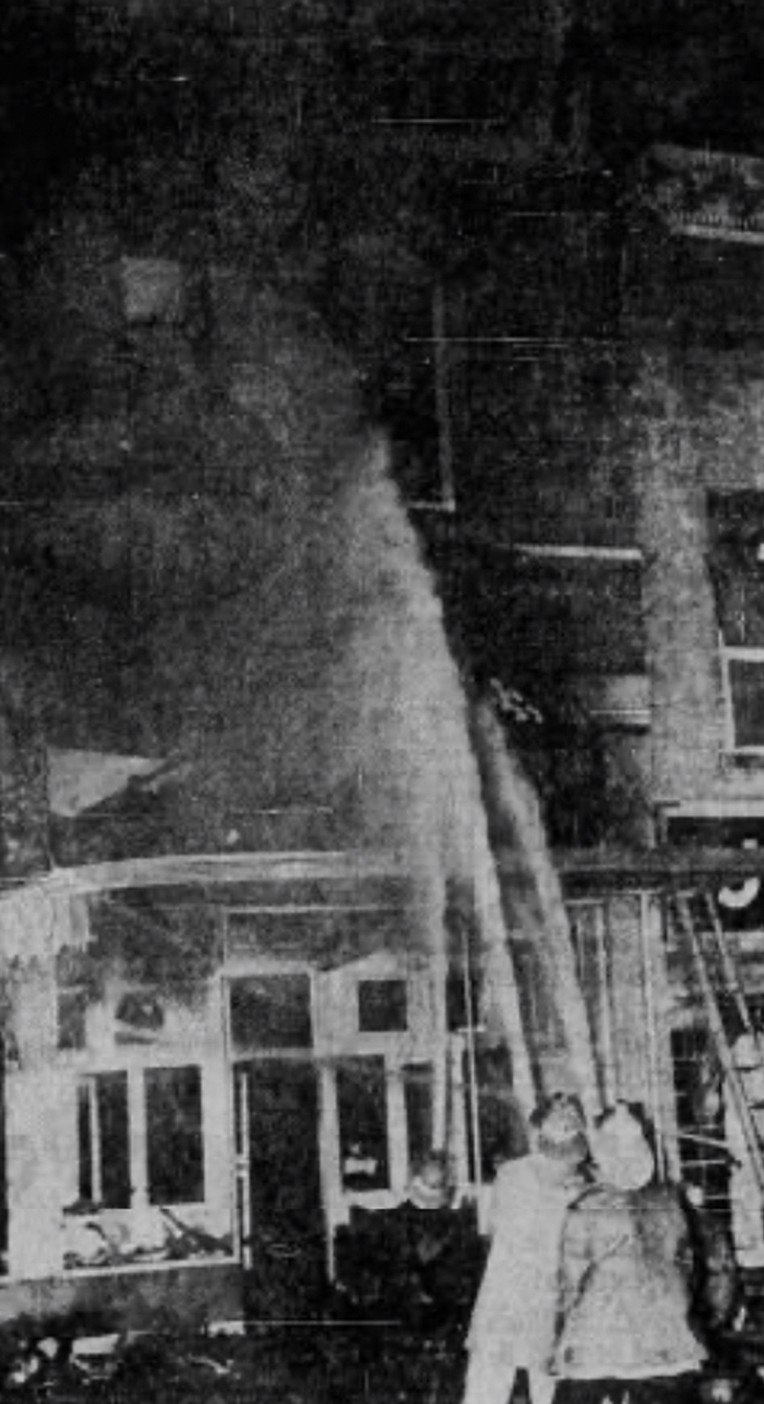
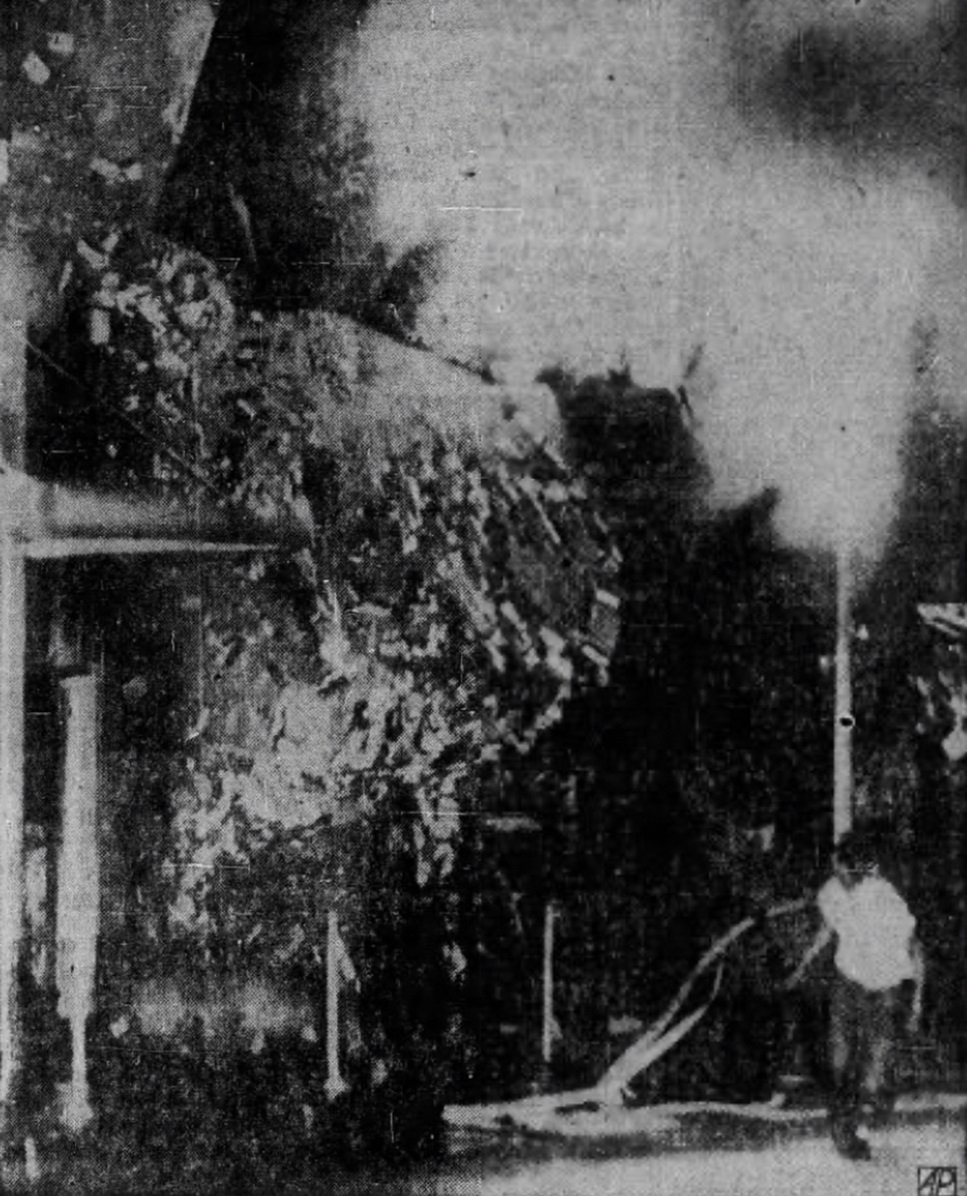
Photo of the collapse as brick and stone debris cascade into the street on Side Bravo.
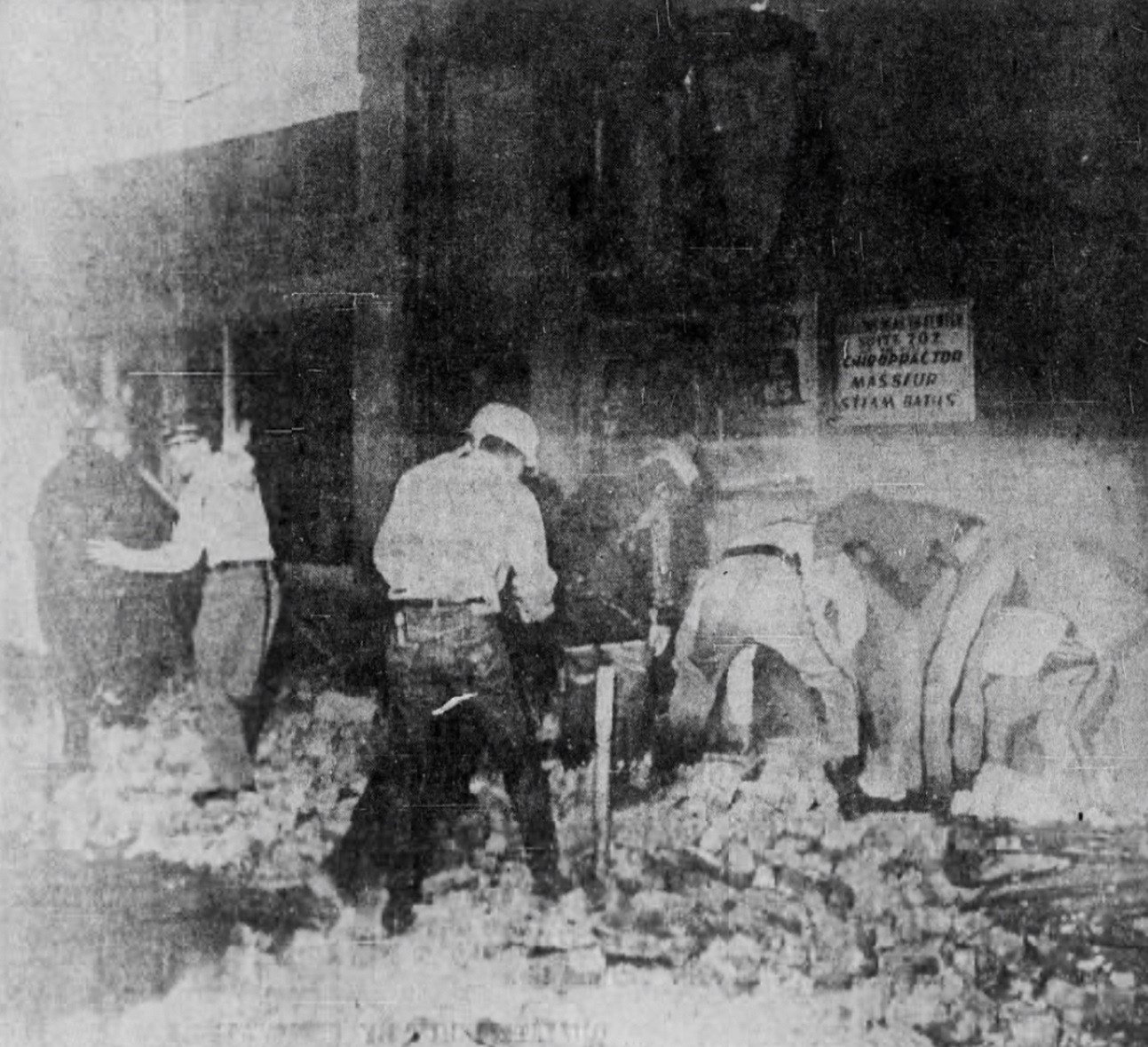
Photo: Rescuers digging in the rubble to uncover the fatally injured Chief.
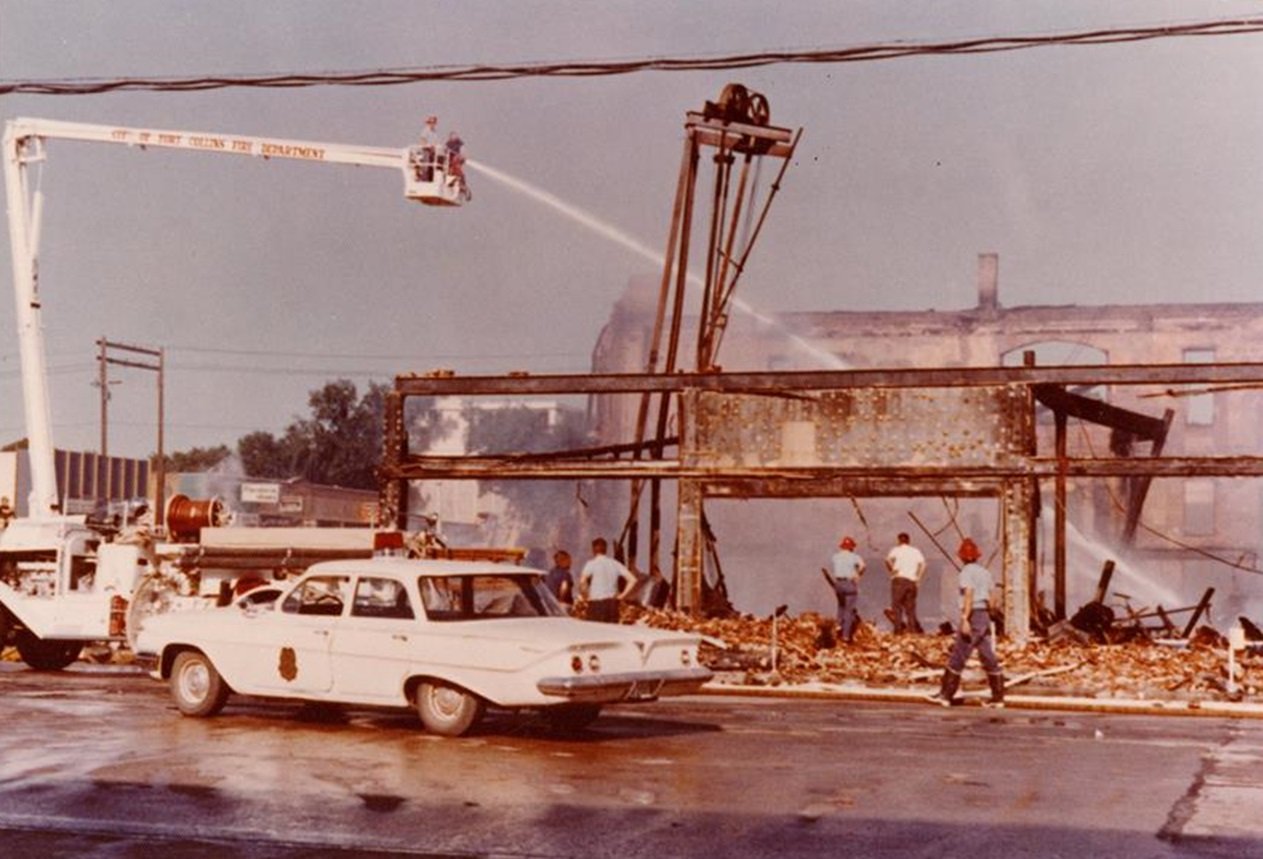
Photo of the twisted steel framework of the fire building. Note the framework of the elevator in the center of the gutted building.
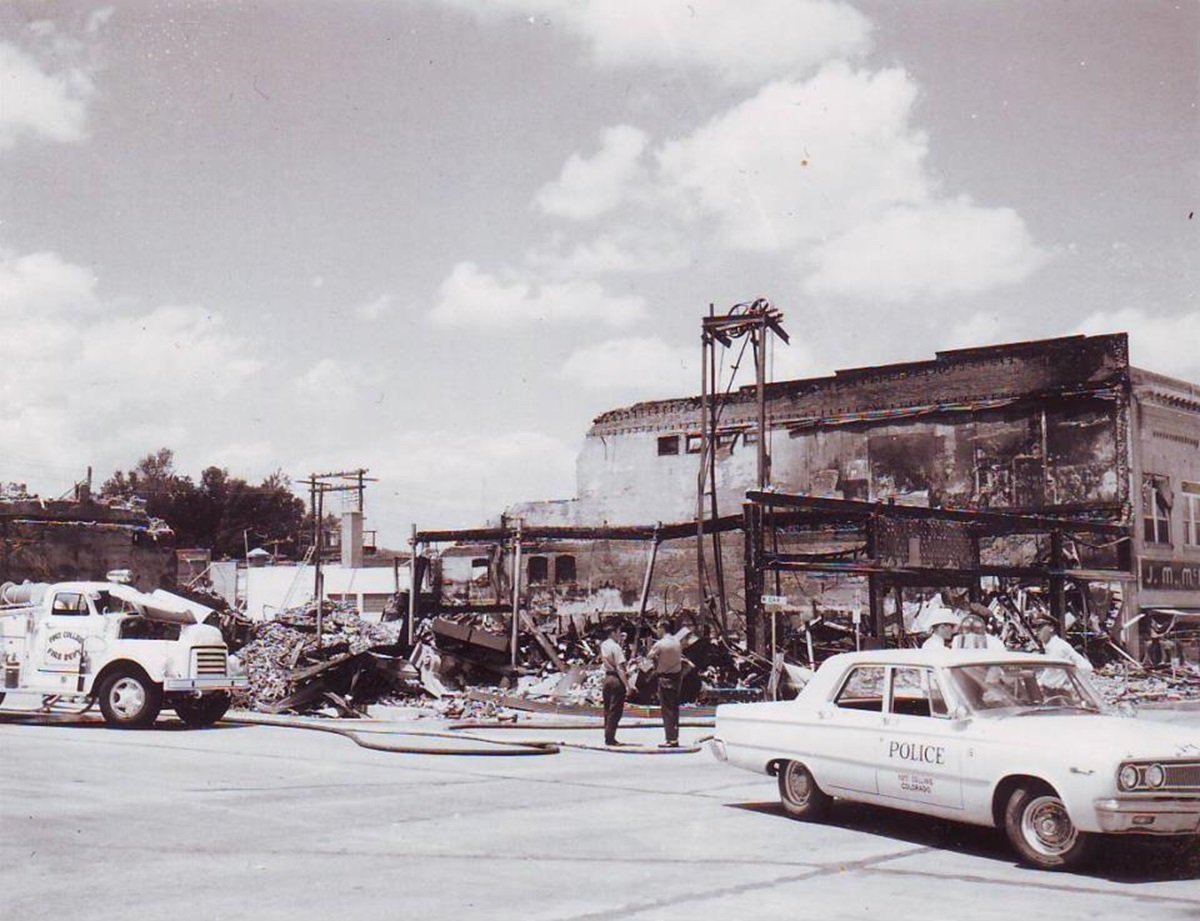
Photo of the fire scene the morning after the incident. Note the missing structural steel on Side Bravo (at center right) where the sidewall collapsed killing the fire chief and seriously injuring one firefighter. Also note the cast iron columns in the wreckage.