
Recently, an FDNY member experienced a potentially life-threatening close call while operating on the roof of a multiple dwelling fire.
After completing a roof cut, a member lifted a saw while the blade was still rotating and inadvertently swung it toward another firefighter. The rotating blade cut through the nearby member’s bunker coat at chest level, narrowly avoiding serious injury or death.
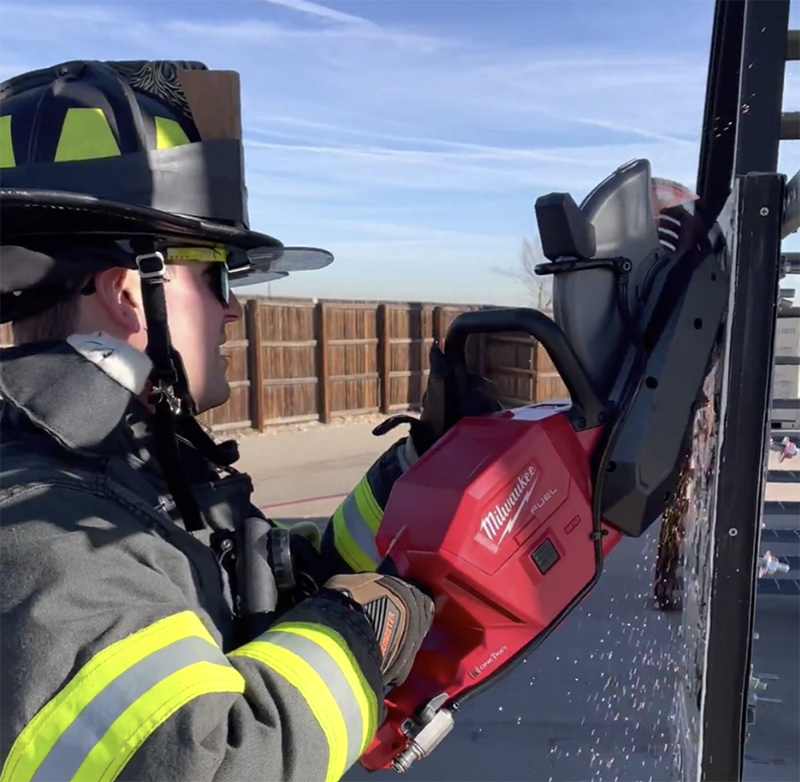
This incident serves as a critical reminder of the importance of maintaining blade awareness and following points taken from TB – Tools 9 – Portable Power Saws (PORTIONS BELOW).
• Never reposition a saw with the blade rotating. Upon completing a cut, release the trigger and place the blade on the surface being cut to stop its rotation before moving to
the next cutting position.
• Maintain the 20-foot Circle of Danger. During roof or floor cutting operations, members shall observe, as near as possible and practical, a 20-foot radius around the operating saw blade. Only the Officer, saw Operator and designated Guide may enter this area.
• Saw Operators must remain aware of the location of nearby firefighters at all times.
• Whenever possible, a two-member team shall perform cutting operations. The Guide must monitor the front, rear and sides of the Operator, provide direction and coordinate
movements to prevent accidental contact or injury.
• Gunning the saw while standing by or moving to another cutting position is prohibited. Gunning engages the centrifugal clutch, causing the blade to rotate and increasing the
possibility of injury.
• Officers must supervise saw operations whenever possible. Members awaiting completion of cuts must remain alert and warn others away from the cutting area,
particularly when multiple saws are operating.
• When an Engine Company member is detailed to a Ladder Company or a newer Ladder Company member is assigned the Roof position, officers should review proper roofcutting procedures and power saw safety. Particular emphasis should be placed on blade awareness, maintaining the 20-foot Circle of Danger, and ensuring the saw blade has
stopped rotating before repositioning.
A rotating saw blade can cause a life-altering injury in an instant. Never sacrifice saw safety for speed.
- The Circle of Danger: The operational “Circle of Danger” is strictly defined as a 20-foot radius (40-foot diameter) centered around the operating saw blade. [1, 2]
- Authorized Personnel: Only the Officer, Saw Operator, and the Guide are permitted to enter this zone during operation. [1]
- Safety Equipment: Fully compliant personal protective equipment (PPE)—including eye protection, hearing protection, and appropriate turnout gear—must be worn at all times by the team. [1, 2]
- Diamond Brazed Blades: Assigned for forcible entry operations. They are highly versatile and can cut case-hardened locks, brick, bulletproof glass, and plastic pipe.
- Bi-Directional Use: The diamond blade is bi-directional and should be flipped after each use to ensure even wear.
- Glazing Fix: If it becomes glazed over and loses cutting effectiveness, it can be cleaned by running it through an abrasive material like concrete.
- Material Restriction: While it can cut wood, doing so is not recommended. [1, 2]
- Carbide-Tipped Blades: Primarily designated for roof ventilation operations. When starting a cut, the surface should be engaged at full RPM. Lexan can be cut quickly using this blade. [1, 2]
- OOS Indicators: A saw or blade must immediately be placed out of service if:
- The saw blade continues to spin slowly when the engine is at a low idle.
- The center hole of the blade becomes out of round.
- An abrasive blade becomes contaminated with oil/gas or is deeply cracked/nicked. If an aluminum oxide blade becomes red hot during metal cutting, operations must be temporarily discontinued to let it cool. [1, 2]
- Overhauling & Inspection Preference: When examining a cockloft for extension, the order of preference dictates pulling ceilings from below rather than cutting initial inspection holes into the roof. [1]
- Horizontal Operation: The saw should typically be operated in a stable, horizontal position unless specific tactical orders dictate otherwise. [1]
