
By Myke Cole, Slate:
Last year, almost to the day, I gathered together in a sweltering high school auditorium with about 50 firefighters, EMTs, and a small cadre of cops to undergo rescue task force training, which focuses on how civilian personnel, like firefighters, can partner with armed law enforcement to render critical aid to victims in a mass-casualty incident. The training was highly effective, emphasizing command and control, triage, trauma life support, and casualty evacuation. It lasted just a few hours and was packed with critical information, so I tried to pay close attention.
I’ll admit that I did have to put in some effort. Because, for the most part, I’d already been through it when I took Tactical Combat Casualty Care training before deploying to Iraq in 2007. While tweaked somewhat to deal with a domestic incident (such as dealing with distraught parents during a school shooting), the Venn diagram for the two trainings was almost a circle. Indeed, the idea that responders to shooting incidents, whether armed or unarmed, should undergo TCCC training is an element of the 2013 Hartford Consensus. This was a kind of national throwing up of the hands that accepted that shootings could not be stopped, and shifted focus to a more effective response, recommending that responders adopt a tripartite mission when time is of the essence: 1) Stop the killing, 2) stop the dying, and 3) save as many as you can.
The Hartford Consensus contains elements of a variety of mass casualty programs, including Federal Emergency Management Agency, emergency medical services protocols, advanced trauma life support, Stop the Bleed, and Tactical Emergency Casualty Care, the civilian equivalent of TCCC. The protocols of the instruction were so eerily similar to my Iraq pre-deployment training as to evoke intense déjà vu, and not just in terms of the triage discussion—the brutal calculus wherein first responders make the impossible decision to focus overstretched resources on those who are most likely to be saved, with the tacit understanding that there are those who will have to wait, perhaps interminably, for help. I also recognized the trauma life support measures, from tourniquet application, to the instruction in how to correctly vent a sucking chest wound, to the direction to use an elbow, shoulder, or knee to apply pressure to a convex surface. We covered wound packing (stuffing the hole with the Curlex rolled gauze we habitually carried in Iraq for that purpose in the hopes of stopping bleeding), dealing with clotting powder, and stabilizing victims for transport.
But the most striking commonality was the way this training taught unarmed first responders to move with armed operators in the “warm zone,” an area where the active shooter was not immediately present but where a shooting threat could still manifest. Rescue task force guidance stridently reinforced the lesson that unarmed civilian firefighters like me would be required to move in the warm zone to assist with all of the duties required above, necessarily placing us at risk of … well … getting shot. As a hedge against this possibility, law enforcement officers would be assigned to our contact team with the duty of protecting us and engaging any suspects who opened fire. As a targeting officer (a kind of tactical intelligence analyst) in Iraq, I was armed, but using that weapon was not my job. I carried it as a last resort. Instead, I relied on the “hard operators” in my team to keep me safe, knowing that if they fell, I had at least a means of holing up and shooting it out with the enemy until the quick reaction force could extract me. Much of the training I received before deploying to Iraq centered on how I could move and integrate with hard operators in my team, staying out of their way until I was needed.
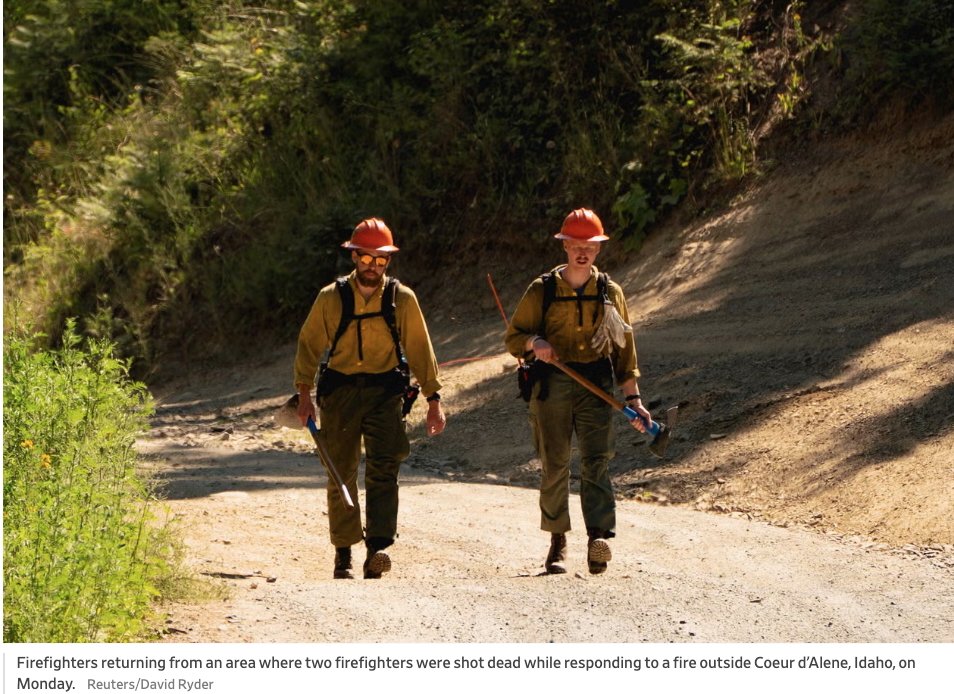
This instruction reflects the reality of rising levels of violence directed at firefighters. There are the instances when we have to respond to active shooter incidents, but also, there are the times people shoot at or assault us, as happened in Coeur d’Alene. In 2023 Drexel University’s Center for Firefighter Injury Research and Safety Trends noted a 69 percent increase in assaults on firefighters from 2021 to 2022 (from 350 to 593). Many of these incidents occur during medical calls, rather than fire responses. And this number may be an undercount, as FIRST looked only at those incidents reported in the media. I can personally attest that in the hypermasculine and stoic culture of the fire service, a minor assault that didn’t result in injury or generate media attention could easily go unremarked on. Indeed, in the District of Columbia in 2023, the firefighters union complained of an increase in assaults against firefighters, describing the attacks as occurring “fairly often.”
Read the full essay here.
