
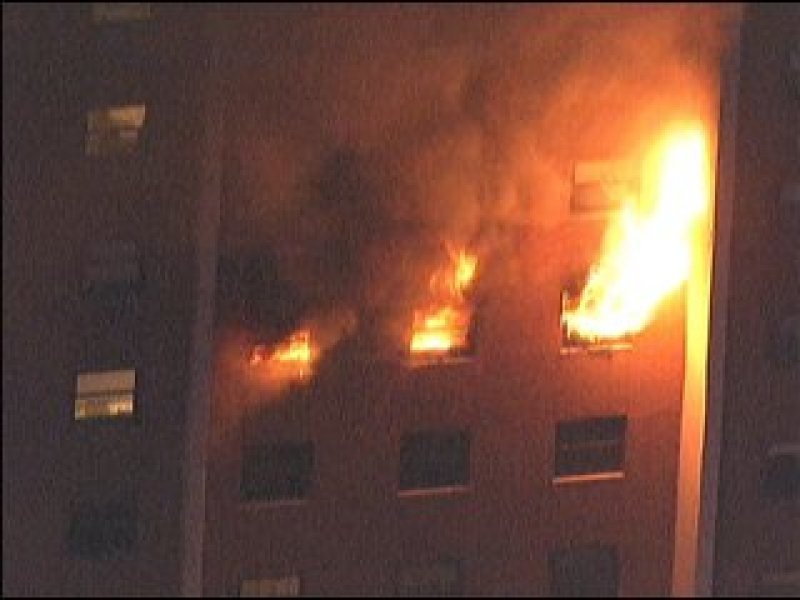
As FF McGuire continues to improve, here is an update. Just before dawn, with two hours left in his overnight shift, Michael McGuire slipped his cloth hood over his head, strapped on his plastic breathing mask and yellow helmet, and entered the burning high-rise. A dozen stories above, people trapped in their apartments were leaning out of their windows, crying for help. The elevators in the Philadelphia Housing Authority building were not working, so the 40-year-old firefighter and his lieutenant began climbing the stairs.
Fed by winds that Battalion 3 Chief Tom Gallagher estimated were blowing at 35 m.p.h., the voracious fire, which had started on the eighth floor, was spewing flames into the hallways. Clouds of dense, black smoke pressed through the cracks and crevices, filling the building and seeping into the stairwells flanking the elevator bank.
"When these housing projects burn, they’re very smoky and hot. They’re like little ovens," said Bill Gault, president of the Philadelphia firefighters union. (A high-ranking fire official, who declined to be identified, said of the building: "It’s not the worst-designed PHA high-rise we have. There’s worse.")
McGuire, who has been with Engine 27 since 2005, was relying on a tank of air that normally lasts half an hour, 45 minutes tops, Gault said. But the effort of hustling up 11 flights was depleting McGuire’s supply, and by the time he had reached the corridor and started searching for tenants, his breathing had become labored.
What happened next is unclear. By one account, McGuire, realizing he was in trouble, pressed the orange button on his radio signaling Mayday and overriding all other transmissions. By another account, his lieutenant turned to see McGuire on the ground.
"He was down," Gault said. "He had a heart rate, but he wasn’t breathing."
Fire Commissioner Lloyd Ayers said stress and exertion might have caused McGuire to run out of air. His equipment is being tested for malfunctions.
For the last 10 years, Philadelphia has followed a strict procedure in responding to serious fires, Gallagher said.
Firefighters first attempt to evacuate the people on the floor where the fire started, then the floors immediately above it, he said. A Rapid Intervention Team is put on standby in any fire with two engines and two ladders. When a Mayday signal is issued and a firefighter is trapped or "down," the team members are dispatched to find their colleague.
That team charged up to the 11th floor. The medics who intubated McGuire were heartened to see he still had a gag reflex, Gault said. Then they strapped him into a 61/2-foot-long stretcher called a "ferno basket" and carried him down the stairs to the street.
"They saved his life," Gault said Wednesday afternoon after returning from the Hospital of the University of Pennsylvania, where McGuire was being treated for severe smoke inhalation.
Gault had not been able to see his colleague, he said. But McGuire’s immediate family was allowed in the intensive care unit with him between sessions in a hyperbaric chamber, which clears the lungs of excess carbon dioxide.
McGuire and his wife, Angelique, have an 8-year-old daughter, Madison. His younger brother, John, is a lieutenant with Engine 52, and their father, John, who died in September, was a battalion commander, Gault said.
Mayor Nutter praised the firefighters’ efforts, including McGuire’s rescuers for getting him out of the building quickly. "This is a demonstration of the incredible work, training, and commitment that our firefighters make every day," he said.
While McGuire was in the hospital, a colleague returned to the fire station carrying his helmet, hood, and breathing mask – all coated with black soot and reeking of smoke.
