
Acting Battalion Chief Killed in Explosion and Parapet Collapse During Fire Operations in Apartment Building – Chicago, Illinois – November 7, 1959
Submitted by Rick DeGroot
On November 7, 1959, Chicago Fire Department Captain Thomas P. Brown of Engine 36 died in the line of duty while fighting an apartment building fire on West Jackson Boulevard. The fire started on the third floor of the four-story building and was spreading to the fourth floor when the explosion occurred, collapsing a parapet wall showering debris onto Brown and two other firefighters who were climbing to reach the roof on a ladder. The Captain was swept from the ladder by debris from the collapse and fell to the pavement below. Firefighters quickly dug him out of the wreckage And he was rushed to Presbyterian-St. Luke’s Hospital, where he died from his traumatic injuries. Captain Brown had been a member of the department for 28 years, and he was substituting for a vacationing battalion chief on the day of his death.
The structure involved in the incident was a four-story with basement Type III Ordinary construction multiple dwelling located at 2323-27 West Jackson Boulevard near the now historic West Jackson Boulevard District on the Near West Side of Chicago. The building was located midblock between South Oakley Boulevard and South Western Avenue. The four-story brick and wood joist double apartment building had a stone and terra cotta facade facing 66-foot-wide West Jackson Boulevard. The building had a flat roof with a double gabled parapet wall along the Side Apha roof edge. The apartment house had a shared front entrance on Side Alpha with an unenclosed stairway serving the upper floors. Ceiling heights were 16 feet on the first and second floors and 12 feet on the third and fourth floors. An air shaft placed in the center of the building was open to the roof. Attached on Exposure Bravo was a two-story with basement brick and wood joist dwelling. An exterior metal fire escape was attached in a narrow open ended air shaft between the buildings that discharged into a rear yard. On Side Charlie was a four-story rear extension with a passenger elevator. Attached on Exposure Delta was a similar construction four-story with basement apartment building with an open ended airshaft between the buildings that had exterior fire escapes for both structures that discharged into the rear yard. The building was not equipped with a fire alarm or an automatic fire sprinkler system. There was a fire hydrant fed by a six-inch water main a short distance away on the opposite side of the street from the fire building and additional hydrants were available at both ends of the block at South Oakley Boulevard and South Western Avenue. The nearest fire alarm call box was located one-half block west on West Jackson Boulevard at South Western Avenue.
At the time of the incident, Chicago was the second largest city in the United States with a population of 3,550,404 residents according to the 1960 U.S. census. With a population of 2,746,388 residents at the 2020 U.S. census, the city has lost more than 800,000 residents (down 22%) since 1950 and is now the third largest city in population in the country. The city is protected by the Chicago Fire Department that was founded as a paid municipal department in 1858. Today the department provides fire, rescue, and emergency medical services for the 234.53 square mile city that is divided into 5 fire districts with 25 battalions operating from 96 stations with about 5,200 employees staffing 96 engines, 50 ladders, 10 tower ladders, 1 aerial tower, 4 squads, 80 advanced life support (ALS) ambulances, 2 HazMat units, 2 USAR units, 10 Airport ARFF units, 2 helicopters, and 2 fireboats. The department responds to more than 500,000 calls for service annually.
The West Jackson Boulevard District is a historic neighborhood located in the Near West Side of Chicago about three miles west of the downtown Chicago Loop. Built between 1871 and 1900, the houses and apartment buildings in the district were in the popular architectural styles of the period—the Italianate, Queen Anne, Second Empire, and Richardsonian Romanesque—all of which are seen in the restored district today. The district is protected by the Chicago fire units:
- Engine 26, Truck 7, Ambulance 45 – 10 North Leavitt Street – 0.5 miles from the fire building.
- Engine 18, Ambulance 4, Battalion 4 – 1360 South Blue Island Avenue – 2.6 miles from the fire building.
- Engine 5, Truck 2, Ambulance 28 – 324 South Des Plains Street – 2.8 miles from the fire building.
Note – Engine 36, the fire company that Captain Brown had been attached to before his death, was one of the oldest fire companies in the city having been organized in 1858. The company was disbanded in 1970.
On Saturday, November 7, 1959, Chicago fire units in the Near West Side area responded to a report of a fire in an apartment building located at 2323-27 West Jackson Boulevard in the Near West Side of the city. Firefighters arrived to find a fire involving one of the apartments on the third floor of the multiple unit four-story apartment building. Fire Captain Thomas P. Brown was in command of the fire, acting as Chief of the 13th Battalion that day.
As hoselines were stretched into the building, a ground ladder was placed to the third-floor windowsill of the fire apartment and an aerial ladder was extended to the roof. Captain Brown and two other firemen were ascending the aerial ladder when an explosion rocked the front of the building. A section of a large masonry parapet wall on the front of the building collapsed sweeping Captain Brown from the ladder as he fell to the pavement below covered in brick debris.
The other members on the scene immediately came to his aid and began digging the injured Captain from the debris. Captain Brown was quickly removed from the rubble and transported to Presbyterian-St. Luke’s Hospital, where he was pronounced dead from his traumatic injuries.
Several other firefighters received minor injuries in the explosion and collapse. Fireman Ciro Zuccarello sustained cuts and bruises from the falling parapet while Fireman Harold Gauther received a cut foot, and Fireman John Mullen of Squad 7 received head injuries from falling masonry. All the firefighters were treated and released from Presbyterian-St. Luke’s Hospital.
Firefighters were able to contain the fire to the building of origin. Fire investigators determined that the fire started in an apartment on the third floor of the four-story building from unknow causes and was spreading to the fourth floor and cockloft when the explosion occurred.
Fire Captain Thomas P. Brown, age 57, was a 28-year member of the Chicago Fire Department assigned to Engine 36. He was survived by his wife, Mae; two daughters, Eileen and Mary Adele; and a son, Thomas Jr. The funeral service for Captain Brown was held at St. Maurice Catholic Church on November 11 with interment following at St. Mary’s Cemetery in Chicago.
The name of Captain Thomas P. Brown has been inscribed on the Chicago Firefighters Monument on West Exchange Avenue at South Peoria Street at the Union Stock Yards Gate.
The name and badge of Captain Thomas P. Brown is displayed on the Wall of Honor at the Robert J. Quinn Fire Academy of the Chicago Fire Department.
The name of Captain Thomas P. Brown has been honored at the Illinois Fallen Firefighter Memorial located on the grounds adjacent to the State Capitol Building in Springfield, Illinois. The memorial features an original bronze work of art consisting of four life-size figures of firefighters in full gear, a child, a ladder, and hose. Each adult figure is approximately 6 feet 2 inches tall if in a standing position and represents the firefighters in full protective clothing, in action.
The site of the fatal fire is now part of the Oakley Square and St. Stephens Terrace Apartments, a complex that includes three, 7-story apartment buildings and several two-story attached townhouse rental units. There is no memorial marker at the site.
Commentary:
A parapet wall is that portion of a masonry wall that rises above the roofline of a building. They can usually be found in almost all types of masonry construction and many types of occupancies such as commercial buildings, rows of stores, apartment buildings, schools, office buildings, etc. Typically, parapet walls are found in Type III Ordinary construction and are common to the largest of cities and the smallest of towns all across North America. They can also be found in Type II Noncombustible and Type IV Heavy Timber/Mill construction buildings. Some modern types of parapet walls utilizing wood and steel stud walls can be found in Type V Wood Frame structures. Their designed intent is to conceal the front edge of a building’s roofline while giving the structure a more attractive and, in some cases, imposing facade. They are often also employed to hide rooftop utilities like air handling equipment and commercial kitchen exhaust systems from view from the street.
Parapet walls and cornices pose a significant collapse hazard to firefighters operating during fire operations in Type III Ordinary construction buildings. Parapet walls are free standing and may extend three or more feet above the roof deck, and they do not withstand lateral loads very well. The taller the parapet, the more easily it may become unstable. Because these unsupported structures are exposed on three sides to the weather, they tend to become weakened over time unless properly maintained. However, because they are often located at the eave line on a structure and are difficult to access, they tend to only receive repairs when they have already presented a problem.
While exact details of the fire conditions and the cause of the explosion in this incident are limited, after examining the available photos of the fire damaged structure we suspect that the fire may have extended to the fourth floor and the cockloft above as firefighters began their fire attack on the structure. Type III Ordinary construction buildings are notorious for having multiple inherent and acquired hidden void spaces where unburned products of combustion can built up and cause a backdraft or smoke explosion condition that can injure and kill firefighters operating inside and on the perimeter of a burning structure. During a backdraft or smoke explosion, building components such as unsupported parapets walls, cornices and other building facade attachments such as signs and canopies can become weakened and in some cases be propelled with great force and fall on unsuspecting firefighters operating on the building perimeter. FDNY Deputy Chief (ret.) Vincent Dunn calls parapet walls the most dangerous walls for firefighters.
We have attached photos of the fire damaged building and we have included a detail from the 1950 Sanborn fire insurance map of the block showing the configuration of the fire building and the surrounding exposures.
We have attached the link to an excellent article by FDNY Deputy Chief Thomas Dunne on the collapse dangers of parapet walls: https://www.fireengineering.com/firefighting/parapet-collapsea-serious-danger-for-firefighters/
And we have included the link to an article by FDNY Lt. Michael N. Ciampo on fire operations and parapet walls published in Fire Engineering magazine: https://www.fireengineering.com/fire-safety/ciampo-on-fire-parapet-preparedness/
We have also attached the link to a BCFS Question of the Week article on parapets walls: https://www.facebook.com/groups/192218352449074/permalink/1481729573497939/
We have also attached example videos of parapet wall collapses:
New York: https://youtu.be/MF45e_VP0xI
Detroit: https://youtu.be/NNzMZcukvUY
Thanks to multiple media and fire service reference sources for the content of this article.
Honor the service of Captain Thomas P. Brown by studying the collapse dangers of parapet walls during fire operations with your crew members today.
Remember Fallen Brothers.
Get Out There And Know Your Local!!!
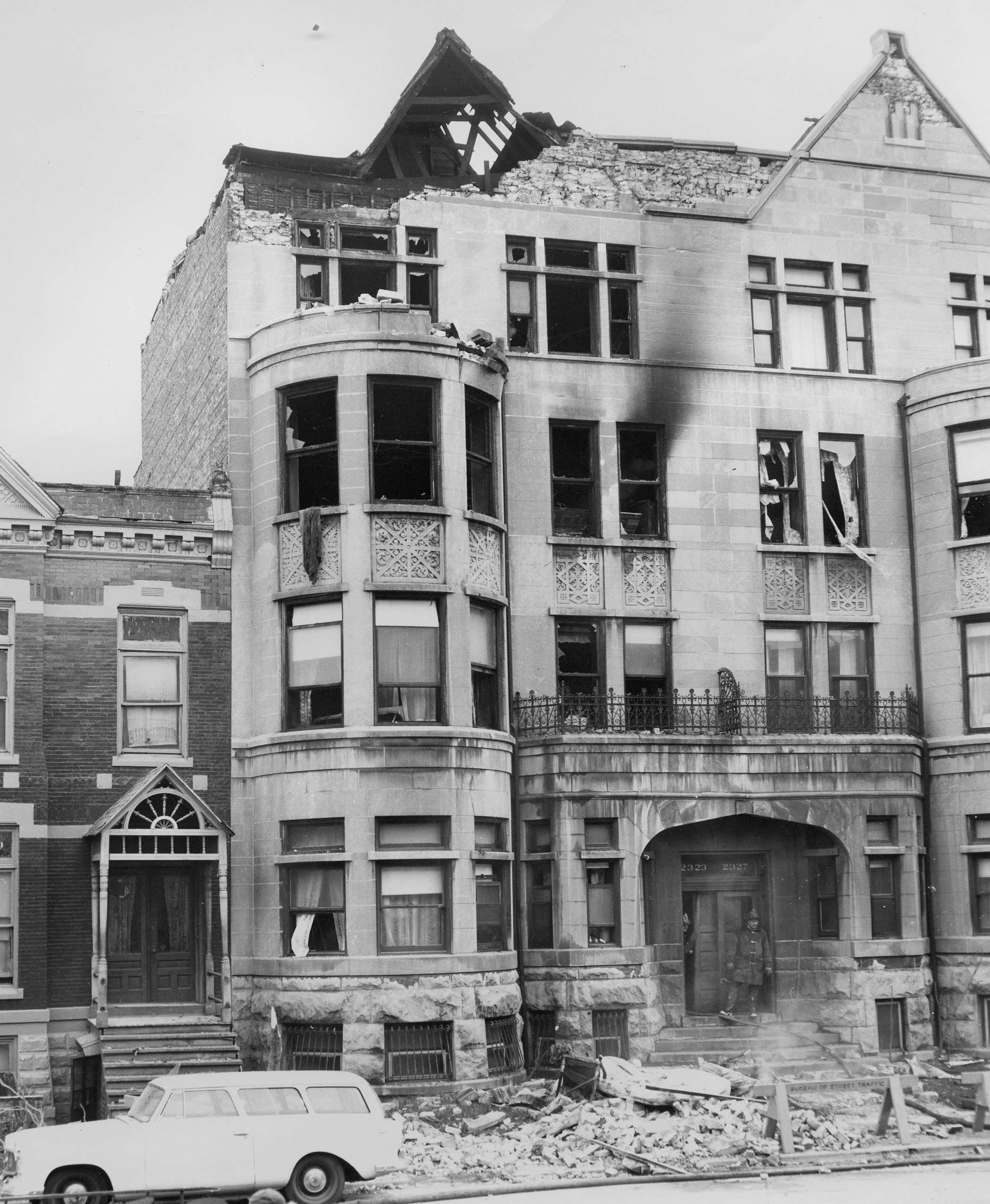
Phot of the fire building. Note the collapsed section of the double gabled parapet walls and the gutted cockloft and roof area.

Detail from the 1950 Sanborn fire insurance map showing the confuguration of the fire building (circled in red) and the surrounding exposures.


