
Four Firefighters Killed After Being Trapped in Elevator During Four-Alarm Warehouse Fire – Philadelphia. Pennsylvania – October 4, 1922
On October 4, 1922, Philadelphia Firemen Albert Fisher and Patrick Murray of Engine 21, and Thomas Gilloway, and Edward Paxson of Truck 2 were killed after becoming trapped in a stalled elevator car while battling an extremely smoky fire in a six-story warehouse in the Northern Liberties section of Philadelphia. The fire was discovered by a policeman on patrol in the area following a small explosion. Fire quickly engulfed the second floor of the warehouse that was filled with furniture and household items. First arriving firefighters from Engine 21 and Truck 2 entered the building and decided to take an elevator to the upper floors to fight the blaze. The elevator apparently jammed between the fourth and fifth floors and the men were overcome by the smoke and flames. They were later discovered huddled on the floor of the elevator. Authorities believed that the men had died from smoke inhalation. Investigators explored reports of an odor of gasoline in the building before the fire broke out but no cause for the fire was determined.
The structure involved in the incident was a six-story Type III Ordinary construction storage warehouse in a congested neighborhood at 1016-28 North American Street in the Northern Liberties section of the city. The warehouse was located midblock between West Widley Street and West George Street. The area featured a mix of industrial and commercial buildings, and row house dwellings. The flat-roofed building was S-shaped (see Sanborn map detail) with a 75-foot frontage with a wooden roof cornice on Side Alpha that faced 40-foot-wide North American Street. Side Delta stretched the full width of the 150-foot block to North Bodine Street. Side Charlie had a 40-foot wide frontage on 40-foot-wide North Bodine Street. The sixth floor of this rear portion of the warehouse was wood frame construction. On Side Bravo was an attached two-story Type IV Heavy Timber/Mill construction storage building fronting on North Bodine Street with a 15-foot by 60-foot wired-glass skylight in the center of the flat roof and a small three-story brick dwelling fronting on North American Street. A small open yard was also located on Side Bravo that could be accessed from an alley from West Widley Street to the south. A masonry roof cornice was on Side Charlie of the mill building that fronted on 40-wide North Bodine Street. The six-story warehouse building had windows on all sides of the structure and had an elevator that served all the floors. The building was not equipped with a fire alarm system or an automatic fire sprinkler system. A fire hydrant was located 50 feet away on Side Alpha and additional hydrants were located at each end of the block, all fed by six-inch water supply mains. The nearest fire alarm call box was located two block northeast at Germantown Avenue and North 2nd Street.
Philadelphia is the sixth-most-populous city in the United States and the most populous city in the Commonwealth of Pennsylvania with a 2020 U.S. census population of 1,603,797 residents. The Northern Liberties area of the city is located north of Old City and is bordered by Girard Avenue to the north; Callowhill Street to the south; North 6th Street to the west; and the Delaware River to the east. Originally a portion of Northern Liberties Township, the area became part of the consolidated City of Philadelphia in 1854. Early in its history, the location just outside Philadelphia allowed the area to thrive in manufacturing, as mills, breweries, leather tanneries, paint and chemical works, tool making factories, and iron and stove foundries once lined the neighborhood. In recent years, Northern Liberties has become a major enclave of young professionals, students, artists, and design professionals. Large improvement and revitalization projects have also been undertaken recently, causing a marked jump in property values. The neighborhood’s proximity to Center City has made it one of the city’s most desirable development districts, both for commercial and residential real estate. Like most Philadelphia residential neighborhoods, the housing stock is primarily made up of rowhouses, although new development in recent times has brought apartment and condominium complexes.
The city is protected by the 2,800 career members of the Philadelphia Fire Department which is divided into 3 operational divisions and 13 battalions. Deployed from 63 fire stations, the department operates 58 engines, 23 aerial ladders, 4 tower ladders, 2 squads, 1 rescue, 60 ambulances, 1 Hazmat unit, 1 USAR unit, 10 airport ARFF crash units, 2 wildland units, and 3 fireboats. In fiscal year 2024, the department received 387,076 calls. Of these, 277,195 were EMS incidents and 55,526 were fire incidents, 2,880 of which were working structure fires.
The Northern Liberties area is protected today by the following Philadelphia fire units:
- Engine 29/Rescue 1/Medic 15 – 400-408 West Girard Avenue – 0.7 miles from the fire building.
- Engine 8/Ladder 2/Medic 44 – 101-15 North 15th Street – 0.8 miles from the fire building.
At the time of the fire in 1922, the Philadelphia Fire Department operated from 84 fire stations with 14 chief officers, 184 captains and lieutenants, and about 1,600 firemen staffing 76 engines, 3 tractor drawn steam fire engines, 31 hook and ladder trucks, 78 combination hose and chemical trucks, 3 water towers, 5 high pressure hose trucks, and 3 fireboats. The population of the city at the 1920 U.S. census was 1,823,779.
Weather conditions in Philadelphia on the day of the fire included an unseasonably high air temperature of 87 degrees F (Philadelphia Inquirer). It is unknown if the weather conditions played a significant role in the outcome of this incident.
On Wednesday, October 4, 1922, at 11:19 p.m., an alarm was sounded on Box 523, 4th and George Streets, for a fire in Joseph Bielitsky’s six-story warehouse located at 1016-28 North American Street. According to residents in the neighborhood, a slight explosion preceded the fire, which seemed to sweep the entire second floor of the structure in minutes. The second and third floors of the building were filled with household furniture and perishable goods of all kinds. Policeman O’Keefe, who was patrolling the neighborhood, saw the flames and sent in the first alarm. Engine 21 and Truck 2 were first at the scene and a second alarm was immediately sounded. Four alarms were sounded in all.
The first firemen on the scene found the electric lights on the ground floor burning. Firemen Albert Fisher and Patrick Murray of Engine 21 and Firemen Thomas Gilloway and Edward Paxson of Truck 2 found the first floor practically free from smoke. The men apparently did not realize the extent of the fire. They carried a hoseline up an elevator, seemingly with a plan of fighting the blaze from above.
Shortly after they started up the elevator, other firemen arrived and saw the serious character of the blaze. They shouted to their companions but received no response. It was an hour later while fighting their way through the fire and smoke, that the rescuers found the bodies of the four firemen stretched out on the floor of the elevator which had jammed between the fourth and fifth floors. All four had apparently expired from smoke inhalation. The posture of the men showed that they made a heroic fight for life, but they were caged and doomed.
One newspaper article of the day describes the incident as follows: “Trapped in an elevator between the fourth and fifth floors, the men had no chance to escape. They were suffocated by the heavy clouds of smoke which engulfed them, and their bodies burned to a crisp.” Describing the recovery of the four firefighters, the article continues to say: “Huddled on the floor of the elevator they found the four men, their bodies seared and blackened. Their axe handles were charred, and hose burned through.”
The fire also spread to a two-story mill construction building occupied by P.T. Simons & Sons, Skins and Tallow at 1017-19 North Bodine Street. The fire loss was placed at $300,000.
An investigation was conducted and reports of the odor of gasoline had been detected in the warehouse at 1016-22 American Street (Side Bravo), and noises had been heard in the building preceding the fire. The building was owned by John A. Molloy and occupied by Joseph Bielitsky. Fire Marshall Elliott held a long conference with Director of Public Safety James T. Cortelyou, but neither would make any statements as to the cause and origin of the fire.
Representatives of the Fire Marshal’s office and building inspectors combed the district the following day in search of evidence of the fire cause. Important information was obtained from Frederick Dietrich, night watchman in an adjoining building, and from three boys, Joseph Attenberg, Otto Sacquis, and Fred Dietrich, son of the watchman. The boys stated that about 7 p.m. Wednesday evening they were playing marbles in Bodine Street. An agate rolled under a door of the warehouse, and they tried the door to see if they could get inside. They found the door unlocked. Inside they were met with gasoline fumes and went out hastily. Later, they reported the occurrence to Watchman Dietrich.
Dietrich tried the door by which the boys had entered but found it locked. The watchman, however, kept close watch and late in the evening heard a noise in the building. He told the Fire Marshal that he was preparing to attempt to enter the building when there was a slight explosion, and almost immediately fire appeared on the second floor.
Bielitsky had only been a tenant for six weeks. One year previous, when the building was occupied by the Oxford Knitting Mills, it was damaged by fire. Bielitsky was taken to the Fire Marshal’s office for further questioning. Coroner Knight also conducted an investigation of the incident. At the conclusion of the investigation, Knight said there appeared to be some unusual conditions regarding the fire and that he would continue his investigation. Knight added: “If the men who died in the building were ordered into the elevator, the man that gave the order is not fit to hold a position in the Fire Department. If the men went in themselves, it was foolhardy.”
It appeared that Firemen Patrick Murray, Jr., one of the four men who lost their lives in the elevator, was acting lieutenant of Engine 21, the first at the scene of the fire. During the day, Murray had been at City Hall taking a Civil Service examination to qualify as a lieutenant. His companions believed he was ambitious to make a record and attempted the impossible. “At any rate, he led his men.” was the comment of one man at the station house.
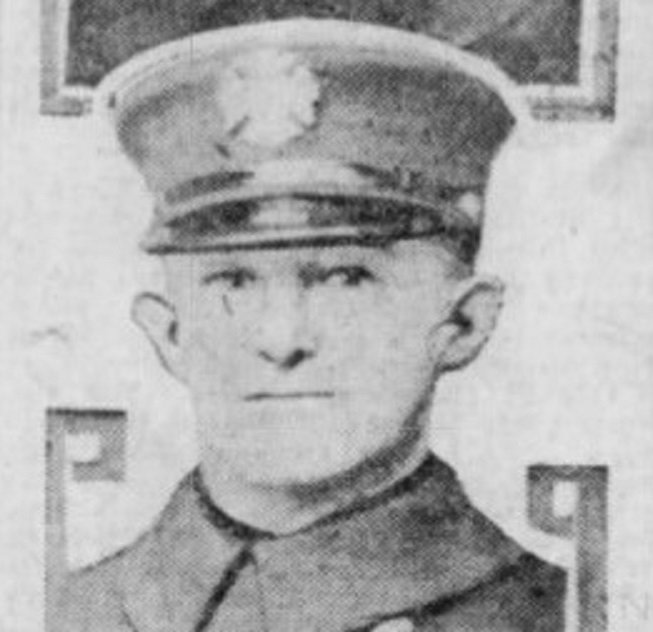
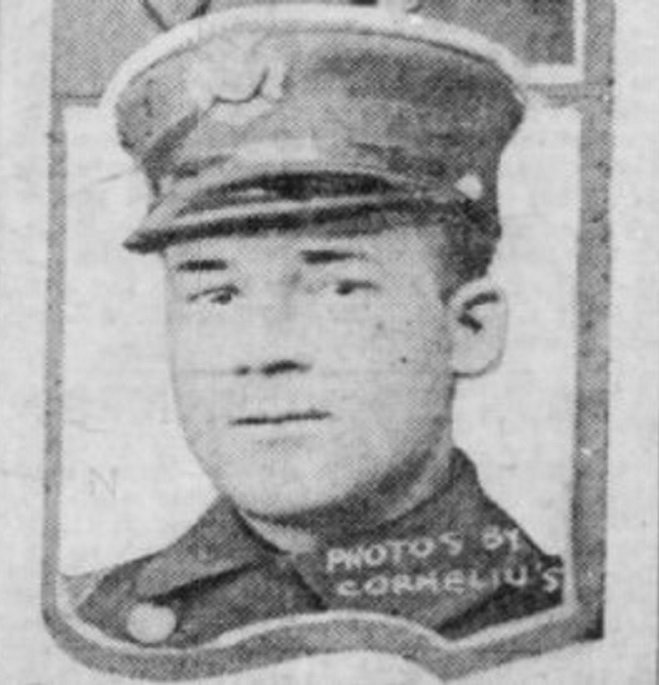
Members of the Philadelphia Fire Department who were killed in the North American Street warehouse fire on October 4, 1922:
- Fireman Patrick A. Murray Jr., age 28, was a five-year member of the Philadelphia Fire Department assigned to Engine 21. He was appointed to the department on January 16, 1917, and was a veteran of the First World War. Survived by his father, Patrick A. Murray Sr., his funeral was held at St. Malachy’s Church in Philadelphia on October 9, 1922, with interment following at Holy Cross Cemetery in Yeadon, Delaware County, Pennsylvania.
- Fireman Thomas J. Gilloway, age 26, was a four-year member of the Philadelphia Fire Department assigned to Truck 2. A native of the city, he was appointed to the department on May 4, 1918, and was a veteran of the First World War. Survived by his parents, Patrick and Ellen Gilloway, his funeral was held on October 7, 1922, at the Church of the Immaculate Conception with interment following at Holy Sepulchre Cemetery in Philadelphia.
- Fireman Edward T. Paxson, age 40, was a two-year member of the Philadelphia Fire Department assigned to Truck 2. A native of the city, he was appointed to the department on August 2, 1920, and was a veteran of the First World War. His funeral was held on October 7, 1922, at St Barnabas’ Episcopal Church with interment following at Palmer Cemetery in Philadelphia.
- Fireman Albert Fisher, age 32, was a nine-month member of the Philadelphia Fire Department assigned to Engine 21. Born in Wisconsin, he was appointed to the department on January 4, 1922, and was a veteran of the First World War. Survived by his wife, Rosie, he was buried at Most Holy Redeemer Cemetery in Philadelphia.
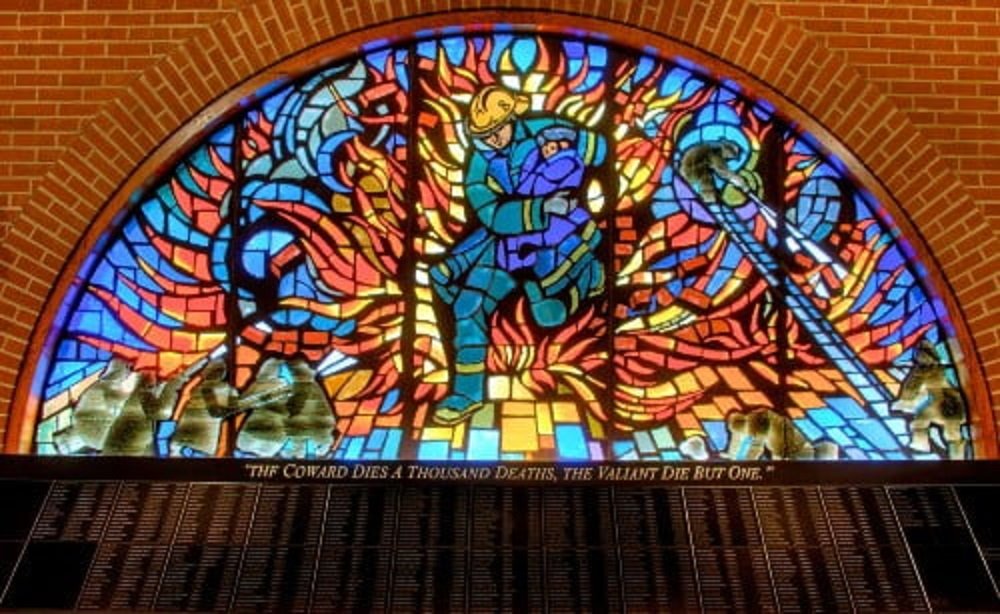
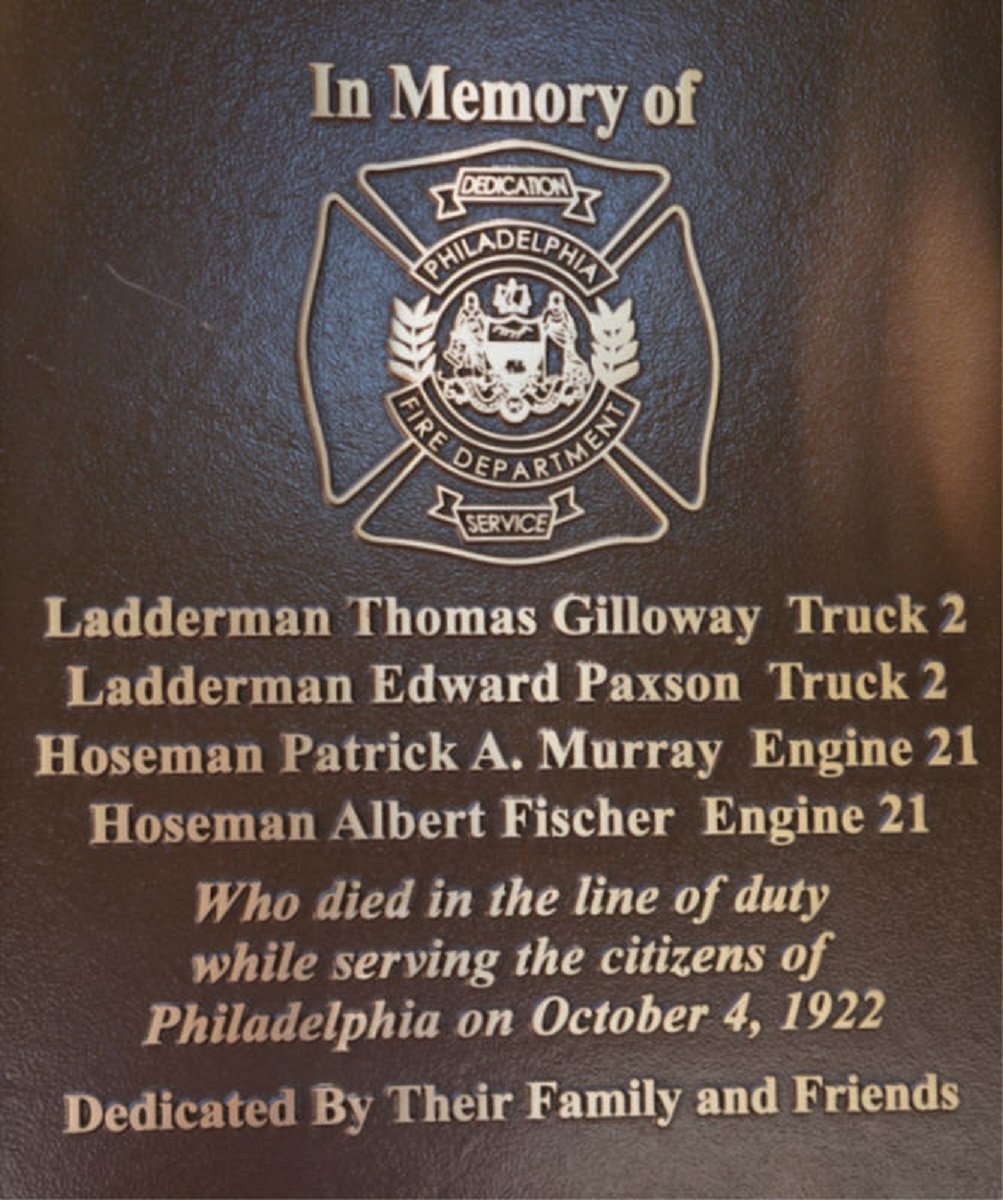
The names of Firemen Albert Fisher, Patrick Murray, Thomas Gilloway, and Edward Paxson have been added to the Memorial Wall located on the second floor of the Fireman’s Hall Museum housed in a 1902 firehouse at 147 North Second Street in Philadelphia. The names of 75 volunteer firemen and 304 career firefighters of the Philadelphia Fire Department who made the ultimate sacrifice in the line of duty are engraved on tiles that comprise the wall. Above the wall is a stained-glass window dedicated to the memory of these brave and dedicated firefighters. At the base of the wall are display cases with brass plates with name, rank, company, and date of death hand stamped into the plate. The brass plates are made from the brass ring from the coupling of the hose used by the firefighter at the time they were killed. The rings are flattened to allow the information to be stamped by hand on the memorial plates. The earliest line of duty deaths on the wall date back to May 9, 1791. Twelve unnamed volunteer firemen lost their lives battling a fire on Dock Street near Third Street. The fire destroyed nearly two dozen homes and businesses.
A memorial plaque honoring the four firefighters is mounted on the wall outside the quarters of Engine 8/Ladder 2/Battalion 4 at Arch and North 4th Streets in the Old City section of Philadelphia.
The fire occurred only five blocks north of a previous fire in 1919 that took the lives of six Philadelphia firefighters who were killed in the fire collapse of a three-story warehouse:
https://www.facebook.com/groups/192218352449074/permalink/1583750366629192/
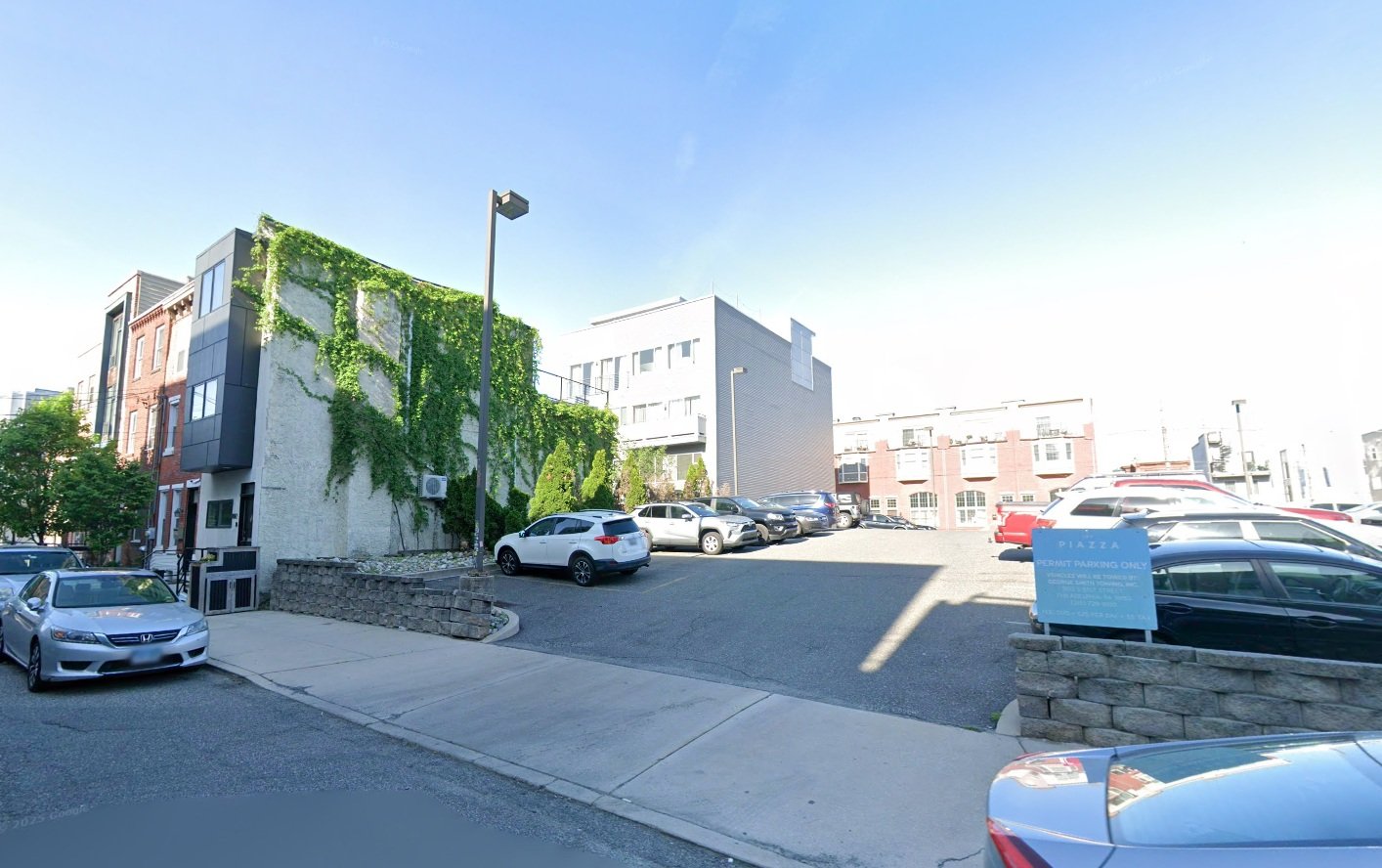
The site of the warehouse building is today a parking area. There is no memorial marker at the site.
Commentary:
The use of elevators by firefighters during a fire emergency in a building have led to several instances where firefighters have been seriously injured or killed. Elevator controls can be affected by heat and smoke during a fire which can lead to the elevator car uncontrollably stopping and opening on the fire floor. This incident shares similarities with an incident that occurred during a fire in a high-rise office building in Baltimore, Maryland in 1977 where one firefighter was lost:
On May 10, 1977, Baltimore Firefighter Joseph Bayne was trapped and fatally burned in an elevator while searching for a reported fire in a high-rise office building. Firefighters were dispatched to a telephone report of a fire at a 40-story office building in downtown Baltimore. Arriving fire crews found nothing evident from the street. Firefighters ascended to the 17th floor where the fire was reported but found no fire. Firefighter Joseph Bayne, chief’s aide to Battalion 5, entered an elevator to descend to the lobby to secure keys. The elevator stopped at the 11th floor and when the door opened Firefighter Bayne was struck with a fatal blast of smoke, fire, and searing heat. His body was later found by fellow firefighters after the three-alarm blaze had been contained. Investigators later determined that the fire was caused by faulty electrical wiring in an office on the 11th floor of the building:
https://www.facebook.com/groups/192218352449074/permalink/1224728042531428/
Firefighters should be trained to operate elevators during fires, including the proper use of fire service controls where available. Procedures advise that the elevator should not be used for direct access to the reported fire floor and should be used to deliver personnel and equipment to a floor or two below the fire area.
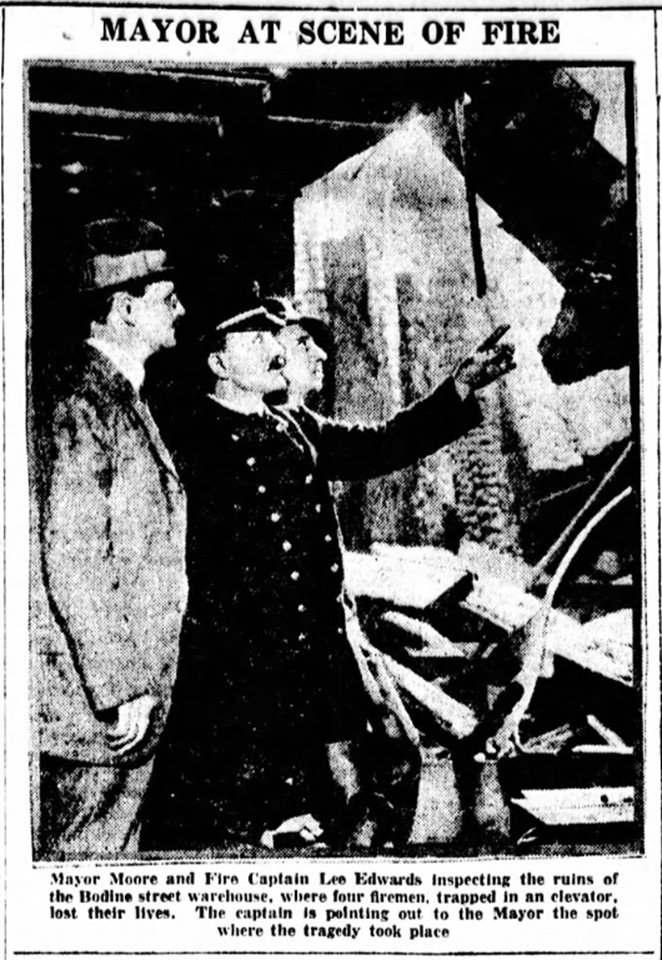
Unfortunately, there are only a few photos from the incident. We have attached a detail from the 1916 Sanborn fire insurance map that shows the configuration of the warehouse and the exposure buildings in the congested neighborhood.
We have also attached the link to an article on operating elevator cars during fire emergencies published in Fire Engineering magazine by Brian Zaitz: https://www.fireengineering.com/firefighter-training/fire-service-operations-with-elevators/
Thanks to multiple media sources for the content of this article.
Honor the service of Philadelphia Firemen Albert Fisher, Patrick Murray, Thomas Gilloway, and Edward Paxson by reviewing your departments policy on elevator use during fire operations and by touring a multi-story building equipped with an elevator and practice using the manual controls of the firefighter service functions with your crew members today.
Remember Fallen Brothers.
Get Out There And Know Your Local!!!

Newspaper photo of the base of the elevator shaft involved in the deaths of the four firemen.
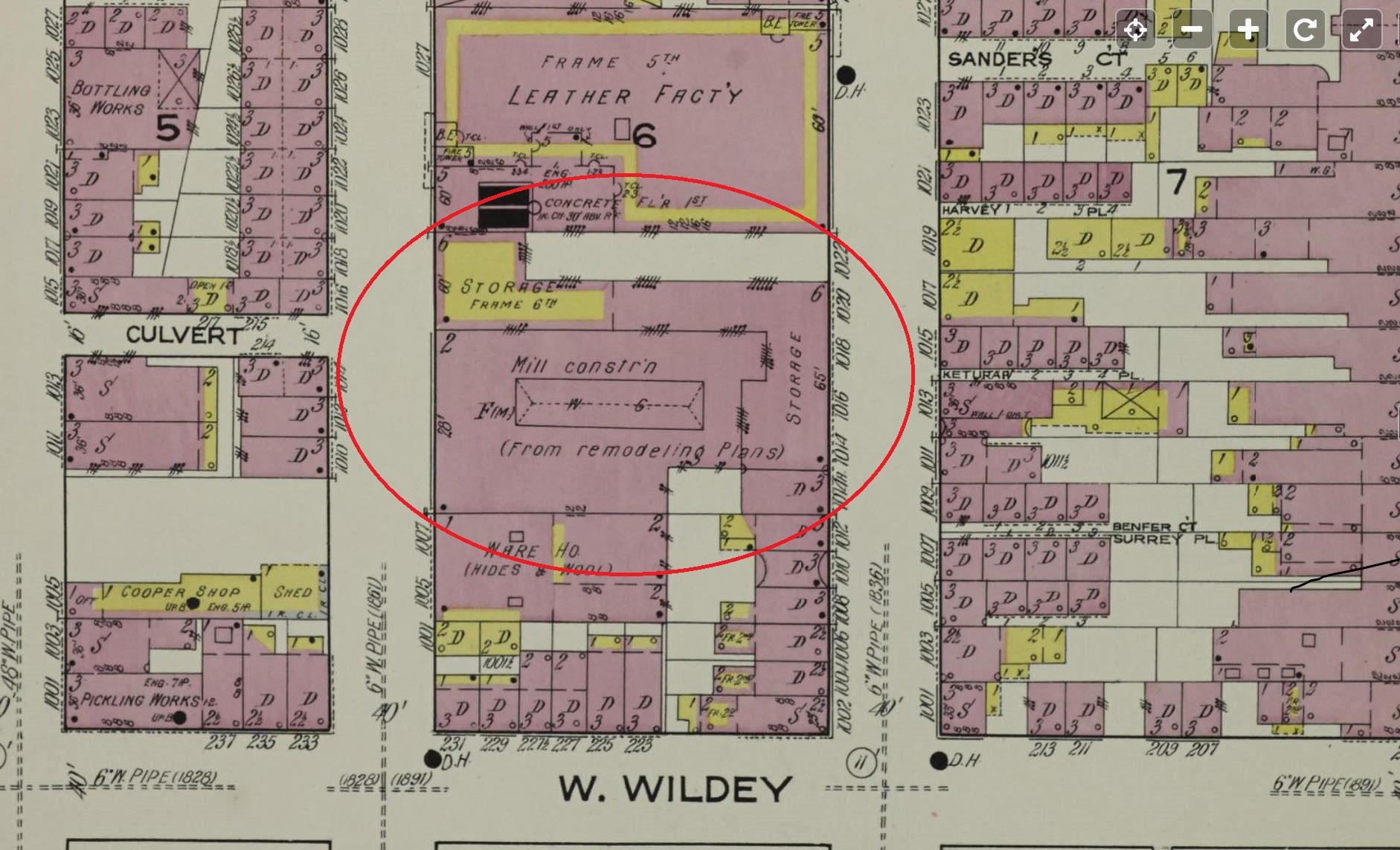
Detail from the 1916 Sanborn fire insurance map that shows the configuration of the warehouse (circled in red) and the exposure buildings in the congested neighborhood.
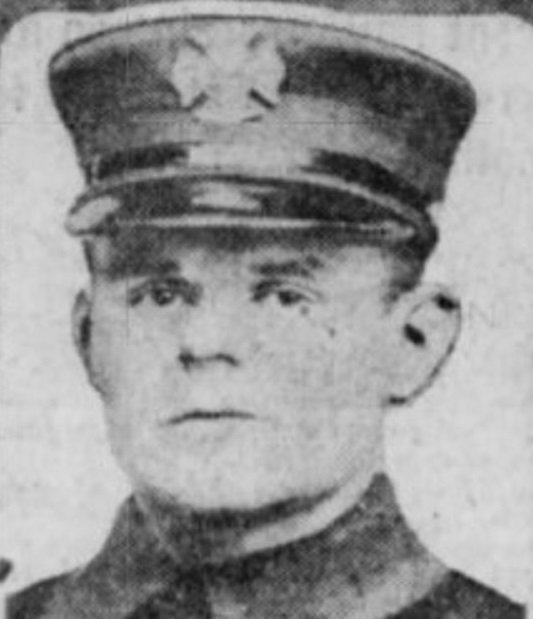
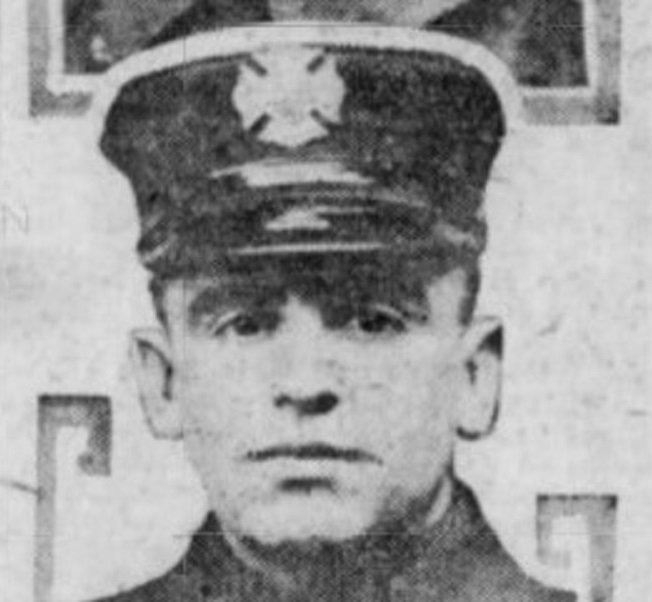
It appeared that Firemen Patrick Murray, Jr., one of the four men who lost their lives in the elevator, was acting lieutenant of Engine 21, the first at the scene of the fire. During the day, Murray had been at City Hall taking a Civil Service examination to qualify as a lieutenant. His companions believed he was ambitious to make a record and attempted the impossible. “At any rate, he led his men.” was the comment of one man at the station house.
Get Out There And Know Your Local!!!
