
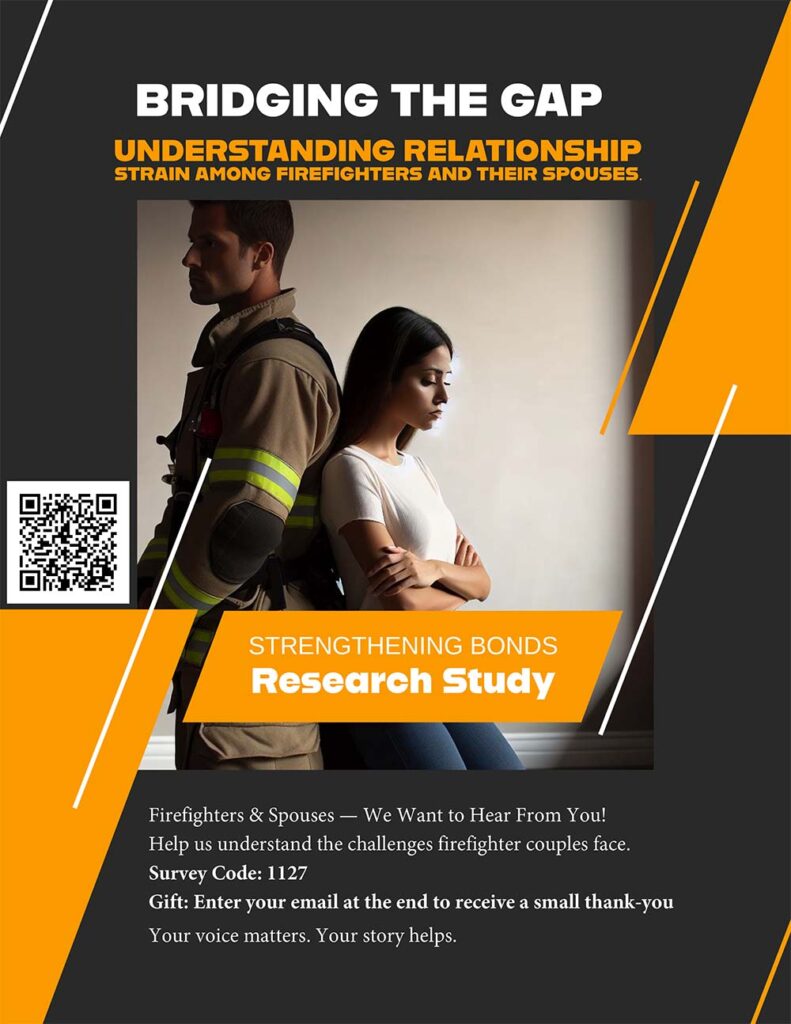
- Firefighters are trained to manage chaos and danger but often internalize job-related stress, which can affect their home lives.
- A study on firefighter families reveals significant emotional strain on both firefighters and their spouses due to shared stress levels.
- Emotional withdrawal from firefighters after difficult shifts can lead to feelings of disconnection and confusion for their spouses.
- Family-focused training is essential for improving communication and understanding trauma responses within firefighter families.
From day one, firefighters are trained to be strong, decisive, and composed under pressure. We are expected to walk into chaos, manage danger, and return ready for the next call. Most of us learned to handle job experiences internally. We deal with them, compartmentalize, and keep moving. Yet part of the job stays with us after the shift.
It truly follows us home.
Over the past year, I have led a university-approved study on how firefighting affects not just firefighters but also their families. Focusing on firefighter-spouse pairs, the research examines how hypermasculinity, attachment styles, and perceived stress levels affect communication, emotional connection, and relationships. Participants represent a wide range of fire departments, shifts, and years of service, offering a rare glimpse into their home lives.

The purpose of this study is to understand what firefighter families experience so we can create more effective support systems for those living with this job daily. Oftentimes, our families are our first line of defense. They see it long before we do. Early research indicates that the impact on families is significant and that every firefighter, officer, and chief should take it seriously.
A Scene Every Firefighter Family Knows
Imagine this.
A firefighter walks through the front door after a rough 48-hour tour. There were medical calls that would not end, a bad wreck on the highway, and a pediatric incident that is still replaying in his head. He is exhausted, emotionally drained, and still running on adrenaline. His nervous system has not caught up to the fact that he is home.
His spouse has been holding everything together. She has managed the kids, the meals, the house, and the everyday stresses of life while he was gone. She has been looking forward to reconnecting and to finally having him back.
He drops his bag, barely speaks, and sinks into the couch. She feels shut out. No one did anything wrong, but the distance is real.
The firefighter on the couch is not distant out of indifference. His mind is still on the last call. The smell of smoke, a mother’s scream, or the image of a wrecked car remains in his nervous system. For the brain, those events do not end just because the truck is back at the station.1
Spouses try their best to understand but often find this behavior confusing. They may feel like they are competing with something invisible, unsure of what happened, how bad it was, or how long it will last. Without context, emotional withdrawal can feel like rejection, irritability can feel like anger, and silence can seem like disinterest. Firefighters often feel as if they are protecting their loved ones by not sharing these events. This gap between what firefighters feel and what their families see is where much of the relationship strain begins. Not because either side is wrong, but because neither side has been taught what trauma looks like at home.
The Stress Does Not Stay at the Station
Firefighters in the study consistently report elevated levels of psychological stress, emotional overload, and fatigue. That, of course, is not surprising. What is surprising, however, is that their partners, answering separate surveys, report nearly identical levels of stress within the relationship.
In other words, the stress is not just being felt by the firefighters. They are bringing it home and sharing it with their spouses.
When we plotted perceived stress scores for firefighters and spouses side by side, the numbers were remarkably similar. Families are carrying almost as much of the emotional weight of the job as the firefighters themselves.
This is not a matter of people being too sensitive. It is how the nervous system works. After difficult calls, the brain remains on high alert. Even when firefighters physically go home, they may still be emotionally and physiologically in survival mode. 1, 4 That makes it harder to listen, connect, and engage in everyday family life. Oftentimes, the firefighters don’t even know they are doing it. It slowly becomes the norm.
Firefighters often describe coming home feeling empty, numb, or exhausted. Spouses often describe feeling lonely, disconnected, or unsure about what happened to the person they know. Both experiences are real.
Withdrawal Is Often More Damaging Than Anger
One of the strongest themes in the data is that emotional withdrawal creates more long-term strain in relationships than anger.
When overwhelmed, many firefighters do not lash out. They shut down. They talk less. They share less. They pull inward or rely on substances as a way to cope and protect themselves from overload. In their minds, they are trying not to bring the job home.
Spouses often experience that same behavior as emotional abandonment. They feel like their partner is physically present but emotionally gone. Over time, this creates confusion, resentment, and loneliness, even in otherwise strong relationships.
Both sides are trying to survive. Without shared understanding, they drift apart. This disconnect is one of the most common pathways from operational stress to relationship strain.
Sleep and Shift Schedules Matter More Than We Think
One of the clearest drivers in the study is sleep disruption. This is where shift schedules play a critical role.
Firefighters working longer rotations, heavy overtime following their normal shift schedules, or irregular rotations, report significantly worse sleep quality than those with more predictable recovery time.5,6 Their partners report feeling the impact of that fatigue at home through irritability, emotional withdrawal, and lower relationship satisfaction.
Firefighters often think of fatigue as simply being tired. In reality, chronic sleep disruption alters how the brain processes emotions, threats, and social connections. Research in occupational and military psychology has consistently shown that poor sleep reduces impulse control, increases irritability, and lowers the ability to feel empathy.4,6
When a firefighter comes home after a long tour, they may not just be tired. They may be neurologically less able to be patient, listen, and engage emotionally. Their spouse feels that shift immediately, even if they cannot name it.
Our data suggests that families on longer or more irregular schedules experience this strain more intensely. That does not mean those schedules are wrong or unsafe from an operational standpoint. It means they carry hidden emotional costs that departments need to acknowledge and address.
Two People, Two Nervous Systems
Firefighters and spouses often see the same relationship very differently. Firefighters may say things are “fine,” that they are just tired, or that they do not want to bring work home. Spouses may feel emotionally disconnected, unheard, or unsupported.
Neither side is lying. They are experiencing the relationship through different nervous systems shaped by different daily realities.
Firefighters operate in high-risk, high-intensity environments. Spouses manage the emotional and logistical realities of holding a household together while worrying about someone they love who’s on the job. Both experiences are stressful. They just look different.
When families understand that emotional withdrawal, irritability, and numbness are common trauma responses, those behaviors can be addressed with compassion instead of conflict.¹ That knowledge alone can change how families survive the job.2,3,7
What Firefighter Families Are Asking For
The data shows that spouses report high levels of uncertainty, emotional disconnection, and relationship strain following difficult shifts. Elevated scores on perceived stress and relationship satisfaction scales indicate that many partners feel unsure what is normal, what is concerning, and how to respond when their firefighter comes home emotionally distant or exhausted.8
Firefighters, in turn, show high levels of emotional withdrawal and reluctance to share work-related stress, suggesting a strong tendency to withhold experiences to protect their families from added burden. When viewed together, these patterns indicate that both partners are trying to protect each other, yet the result is often emotional distance rather than connection.8
Training breaks that cycle. When families know what to expect, silence becomes less frightening, and conversations become safer.7
Why This Research Points Toward Family-Focused Training
One of the most important implications of this study is that firefighter mental health training cannot end with the firefighter.
Most programs focus on peer support teams, supervisors, or crisis intervention. Very few departments provide structured education for spouses and partners. Yet this research shows that families are the front line.
Spouses see the changes first. They feel the emotional shift first. They often know something is wrong long before anyone at work does.
Family-focused training is not about turning spouses into therapists. It is about giving families a shared language for what they are experiencing. When both partners understand that things like shutting down, bad sleep, and irritability are trauma responses, those moments stop feeling like personal attacks and start feeling like something you can actually work through.1,4 Simple education can prevent years of unnecessary conflict.2,3
The fire service can make a lasting difference by offering this kind of education, just as they train firefighters to operate safely on the fireground.
What Chiefs and Officers Can Do Right Now
You do not have to wait for a peer-reviewed paper to start making a difference.
Departments can include spouses in wellness and mental-health education, provide training on sleep and recovery, normalize emotional decompression after hard shifts, encourage healthy communication at home, and support family-focused peer and professional resources.
Strong families keep firefighters alive, stable, and in the profession.2,3,7
This Study Is Still Open
This research is ongoing, and more firefighter-partner pairs are needed.
It does not matter what shift you work, how long you have been on the job, or whether your relationship is strong or struggling. Both partners complete their own confidential surveys. No names, departments, or identifying information are collected.
The attached flyer contains the QR code and instructions for participating. Your family’s experience helps shape the future of firefighter wellness.
Final Thoughts
Firefighters are exceptional at handling emergencies. We are not always trained to handle what those emergencies leave behind. Understanding how the job affects our families is not a sign of weakness. It is a step toward resilience, connection, and long-term survival in one of the most demanding professions in the world.
Endnotes
- van der Kolk, B. (2014). The Body Keeps the Score: Brain, Mind, and Body in the Healing of Trauma. New York, NY: Viking.
- Violanti, J. M., et al. (2018). Police and firefighter stress and suicide risk. American Journal of Industrial Medicine.
- Carleton, R. N., et al. (2018). Mental disorder symptoms among public safety personnel. Canadian Journal of Psychiatry.
- Harvey, A. G., et al. (2015). Sleep disturbance as a transdiagnostic risk factor for mental health disorders. Current Psychiatry Reports.
- Åkerstedt, T. (2003). Shift work and disturbed sleep and wakefulness. Sleep Medicine Reviews.
- Monk, T. H., and Folkard, S. (1992). Making Shiftwork Tolerable. London, England: Taylor and Francis.
- Regehr, C., et al. (2013). Social support, self-efficacy, and trauma in firefighters. Journal of Nervous and Mental Disease.
- Thorpe, M. (2026). Bridging the Gap: Understanding Relationship Strain Among Firefighters and Their Spouses. University-approved research study.

Matthew Thorpe holds a master’s degree in psychology. He is the director of occupational extension and fire academy programs at Guilford Technical Community College in North Carolina, where he oversees firefighter training, continuing education, and regional partnerships. He previously served as an accreditation manager at the North Carolina Office of State Fire Marshal and has worked extensively in firefighter standards, training, and mental health advocacy. His current research focuses on firefighter families, stress, and resilience.
When the Shift Comes Home: What Firefighter Families Are Telling Us
