Conflagration Sweeps Several Blocks of City Following Explosions at Manufacturing Plant Killing Ten Persons including One Firefighter – R. M. Hollingshead Corporation Fire – Camden, New Jersey – July 30, 1940
On July 30, 1940, a fire following a series of explosions in the R. M. Hollingshead Corporation plant in Camden, New Jersey quickly assumed conflagration proportions due to ignition of large quantities of flammable liquids used in the manufacture of such items as auto grease, oil, anti-freeze, metal polish, wax, auto-top dressing, tire coating, brake fluid, paint remover, soap, antiseptics, and insecticides. Ten persons including one firefighter, lost their lives as a result of the explosions and resulting fire during a scorching heat wave. More than one hundred others received treatment for injuries. In addition to destroying a block of factory buildings, the blaze spread to nearby rows of brick and frame dwellings, leaving sixty families homeless. The total loss was estimated at close to $2,000,000 and is considered one of the largest fires in the history of the industrial city.
The R. M. Hollingshead Corporation was founded in 1888 by Richard M. Hollingshead in Camden, New Jersey to manufacture harness dressing. The company expanded to manufacture household chemicals. The company’s headquarters and its compact group of plant buildings occupied a triangular block 255 feet along North 9th Street and 158 feet along Market Street in center city. The complex backed up to a railroad right of way for 240 feet. These buildings were mainly of five-story and basement brick, plank and timber construction, and were numbered 1, 2, 3,4, and 6. The buildings were fully occupied for the manufacture of a wide variety of materials, involving the use of flammable oils and solvents in various portions of the buildings. There were apparently many mixing and storage tanks located throughout this main group of plant buildings and the explosion hazard was recognized to be severe.
The original plant was a five-story building of Type IV Heavy Timber/Mill construction shown on the plot plan as Building 1. An extension of the number of products included a metal polish and numerous other polishes using benzine and other solvents of low flash point. About 1915, two three-story buildings also of heavy timber construction were built to house all processes involving the use of highly flammable liquids. These buildings, shown as 3 and 4 on the plan, were the buildings in which the initial blast occurred. At later dates Buildings 2 and 6 were constructed, combining the group essentially into one large building, subdivided by fire walls with single or double non-standard automatic fire doors on communicating openings between Nos. 3 and 4, between Nos. 2 and 3 and- between Nos. 1 and 6.
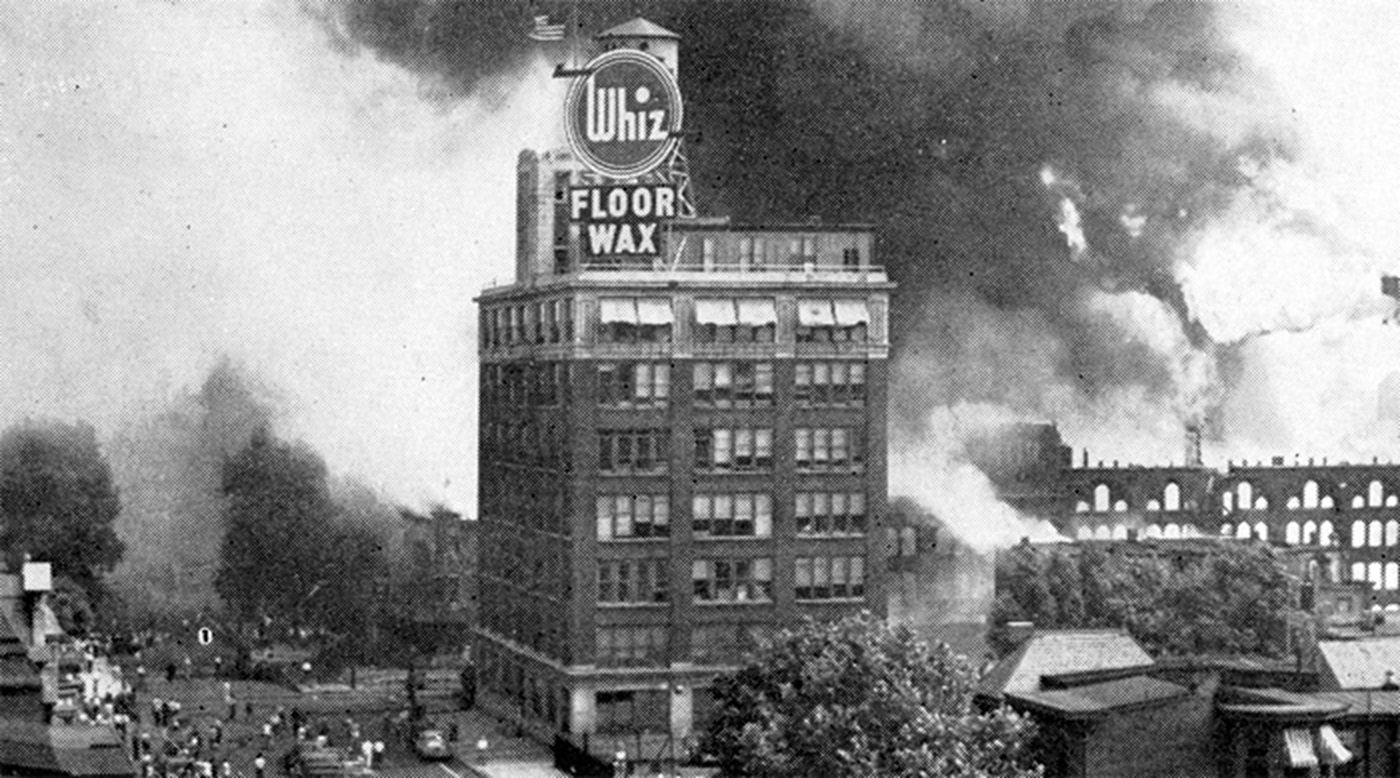
Windows facing a blind court between Buildings 1 and 6 were of plain glass in wooden frames in Building 1 and wired glass in metal frames in Building 6. The windows in the upper floors of Building 2 overlooking Building 3 were also of wired glass in metal frames. There were unprotected openings between Buildings 1 and 2. Across the railroad tracks at the rear of the main group was Building 5, a two-story brick building, and Building 15, a three-story brick building. Eighty feet distant across North 9th Street on the opposite side of the main group of plant buildings was Building 14, an eight-story with basement building of Type I Fire-Resistive construction protected by automatic sprinklers. This building was occupied in the basement and first floor by a wholesale liquor dealer and on the fourth floor by a corset manufacturer, but elsewhere by the R. M. Hollingshead Corporation for office, printing and storage purposes. Also across North 9th Street was a small one-story garage designated as Building 9.
With the exception of the two small buildings, Nos. 5 and 9, all plant buildings in the fire area were fully sprinklered with wet pipe systems having three water supplies, including pressure tanks, gravity tanks, and city water supplemented by a 750-gallon electrically driven centrifugal booster pump. In addition, each building of the main group except Building 4 had a vertical standpipe with hose connected at each floor, and chemical fire extinguishers and water pails, well distributed.
Processes in Buildings 1, 2 and 6 included the manufacture of soaps, greases, insecticides and the filling of containers with these products, as well as the blending and canning of lubricating oils. All liquids used in the processes in these buildings were in a class with kerosene or had higher flash points. In Buildings 3 and 4 processes involved the use of such low flash point solvents as naphtha, alcohol and gasoline. Products included polishing wax, rubber cement, gasket cement, cigarette lighter fluid, and auto top dressing. Processes also included the filling of containers with these materials.
Flammable liquids were stored in underground tanks located near the intersection of North 9th and Cooper Streets, and along the east side of 9th Street, whence they were piped to the basements of Buildings 3 and 4. Distribution from there was carried on through steam driven pumps; with storage tanks more than half full, these pumps would be under a gravity head. In addition to these materials, which were used in bulk, smaller quantities of miscellaneous solvents in drums were stored on the fourth floor of Building 2.
In Buildings 3 and 4 were large, vertical mixing tanks of up to about 500 gallons capacity, extending from the third down through the second floor, and terminating on the first floor in gravity-fed fill pipes used for filling containers with the finished product. Ingredients were put into the mixers at the third floor level. Covers were provided for tanks, each being held open by a fusible link, and the tanks were grounded. Solvents were piped to tanks from pumps in the basement. Mixing vanes in the tanks were operated by belts from a shaft extending through walls from Building 2, where an induction type electric motor driving the shaft was located. Tanks used for such processes as the manufacture of wax polish were heated by steam jacket. The steam plant was located in the basement of Building 1.
A 36-inch fan was located in one of the windows on the third floor of Building 4; as far as can be ascertained, this was the only provision in either Buildings 3 or 4 for the removal of vapors. Several lighting fixtures in Building 4 were of the vapor-tight type, and an electric motor on the first floor of Building 3 was of explosion-proof type; all other electrical equipment in these two buildings was of non-explosion-proof type.
The City of Camden is the county seat of Camden County, New Jersey. Camden is part of the Delaware Valley (Philadelphia metropolitan area) and is located directly across the Delaware River from Philadelphia, the nation’s sixth most populous city. At the 2020 U.S. census, the 10.34 square mile city had a population of 71,791, a decrease of 5,553 (−7.2%) from the 2010 U.S. census count of 77,344. Beginning in the early 1900s, Camden was a prosperous industrial city and remained so throughout the Great Depression and the Second World War. During the 1950s, Camden manufacturers began gradually closing their factories and moving out of the city. With the loss of manufacturing jobs came a sharp population decline. The city has lost almost one half of its peak population of 124,555 residents since 1950.
The city is protected by the Camden Fire Department which traces its beginnings to 1810 when a group of volunteer residents formed the Perseverance Fire Company. Before long, several additional volunteer fire companies were organized. In 1869, a municipal department was formed as the first career fire service in New Jersey and among the oldest in the United States. In 1916, the Camden Fire Department was among the very first in the nation to have a fleet of fully motorized fire apparatus while such cities as Philadelphia and New York still used fire horses. Today the department operates from 6 firehouses with 178 career firefighters staffing 5 engine companies, 3 ladder companies, 1 squad company, 1 rescue company, 2 battalion chiefs and 1 deputy chief/tour commander. The department responds to about 10,000 calls for service each year.
On the morning of Tuesday, July 30, 1940, the city was in the grip of a prolonged two-week heat wave with temperatures soaring above the 100 degree mark. Operations were carried on as usual at the plant that morning. It is reported that the only process carried on in Building 4 was the filling of containers with polishing wax; no operations were carried on in Building 3. At the time of the fire most of the employees had returned from lunch, with four female employees returning to the first floor of Building 4 to carry on with the operation of filling containers with polishing wax. One male employee was also working on the first floor of Building 4. An employee went to the basement of Building 3, presumably to work in the rag-washing room. It is reported that the plant watchman was on the second floor of Building 3, at his locker near the elevator shaft, eating his lunch; that one other employee was in the same part of the building.
There are reports indicating that there was a breakdown in the machinery which sent molten wax by gravity from wax tanks on the third floor to the filling room where cans were automatically filled before employees placed lids on the cans. It is said that hot wax had backed up in a vat and that several employees had started up to the third floor to report the difficulty when the initial blast occurred.
The first explosion is reported to have occurred in the lower floors of Building 3 near the northern apex of the triangular group of plant buildings. The explosion was described as a deep rumbling sound and appears to have been of considerable violence. A number of windows in Buildings 3 and 4 were blown out and some reports state that portions of the brick walls were also blown out.
Portions of the first floor dropped into the basement and it is reported that employees from both the first floor and basement were trapped in the flaming debris. Several employees are said to have been blown from the plant by the explosion. In any event, three men were found on the 9th Street side of Building 2 with their clothing ablaze. Two others were found on the railroad tracks near the freight door of Building 3 with their clothing also ablaze. A man working in Building 4 was also found on the tracks behind the building with his clothing aflame.
At the time of the first explosion between 1:05 and 1:10 p.m. about 300 employees were in the building. About fifty others had not returned from lunch due to staggered periods. A number of employees in the sections nearest to the initial explosion found themselves trapped by flames and were forced to jump from windows to escape. Others are reported to have struggled down crowded inside stairways or outside iron fire escapes. It is indicated that a man who tended the wax filling machine was on the third floor repairing the faulty wax feed when the explosion occurred, and he escaped with his life. The effect of the explosions were felt over a considerable area. Windows in a three-block area were broken, with the flying glass adding to the number of injured.
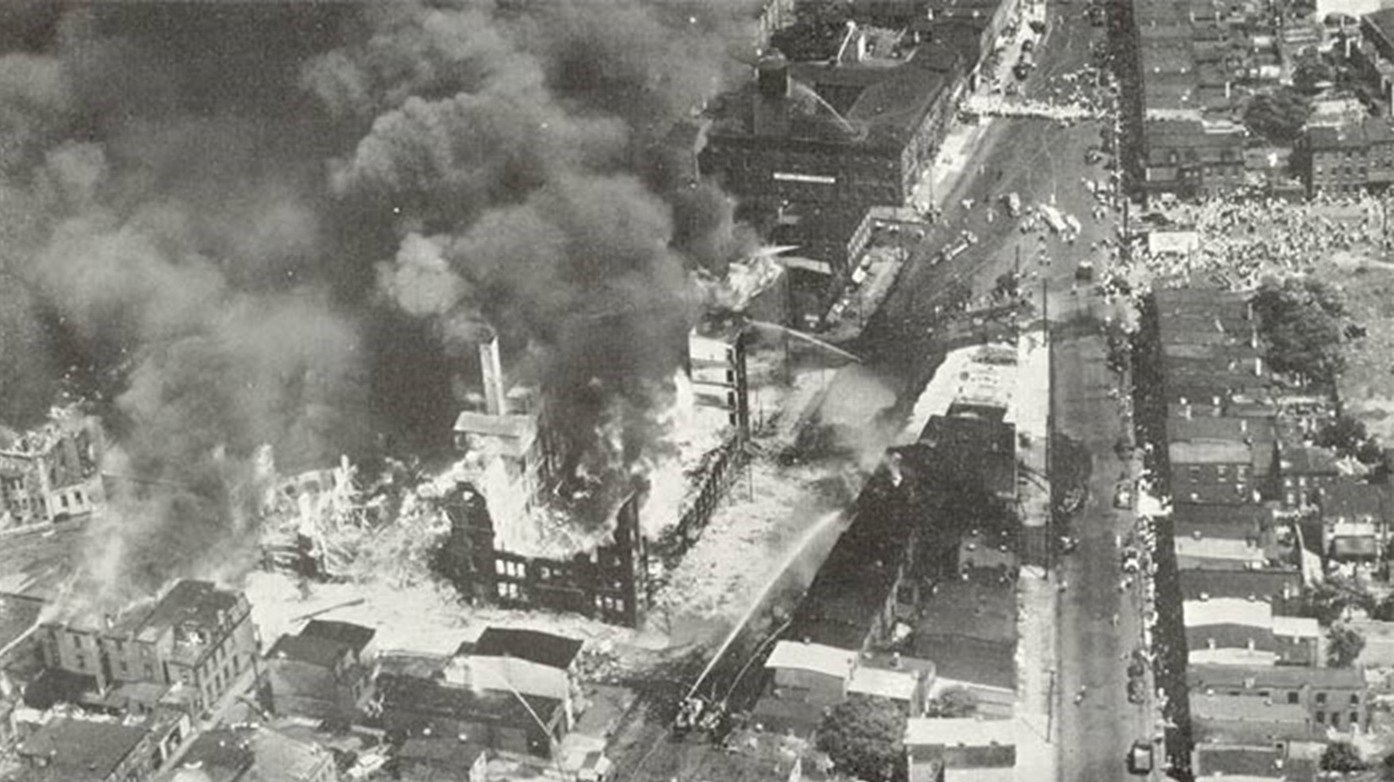
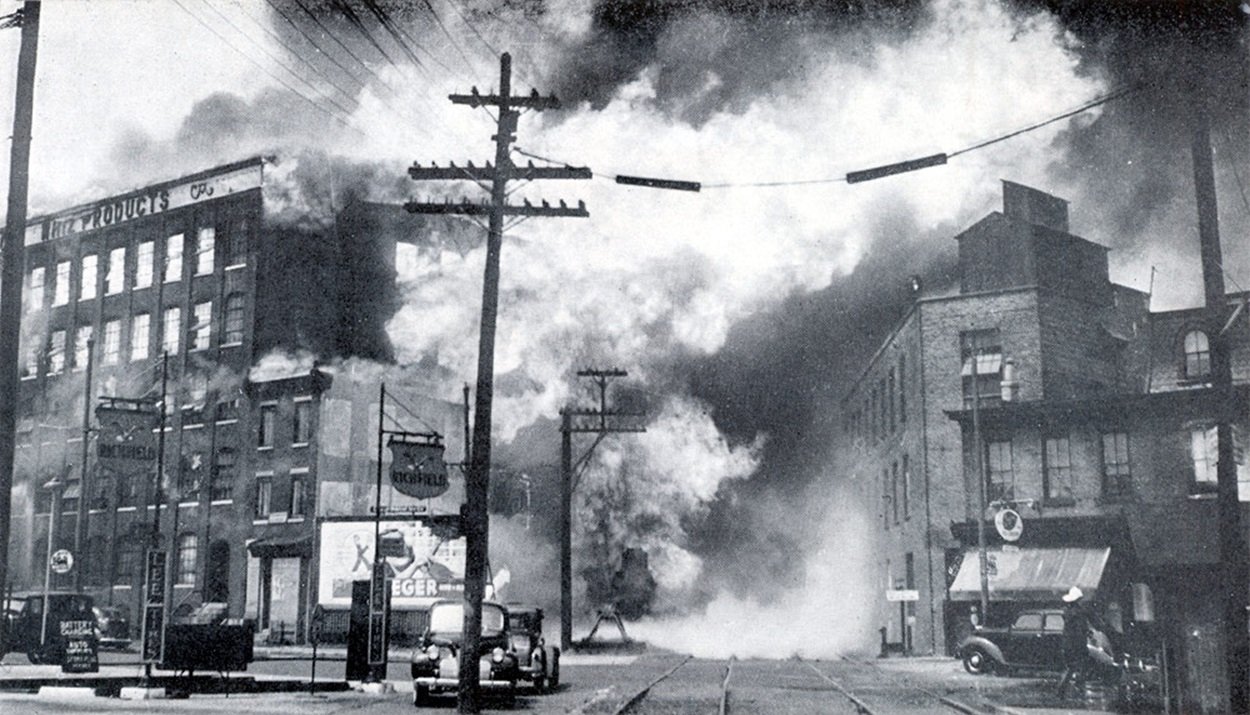
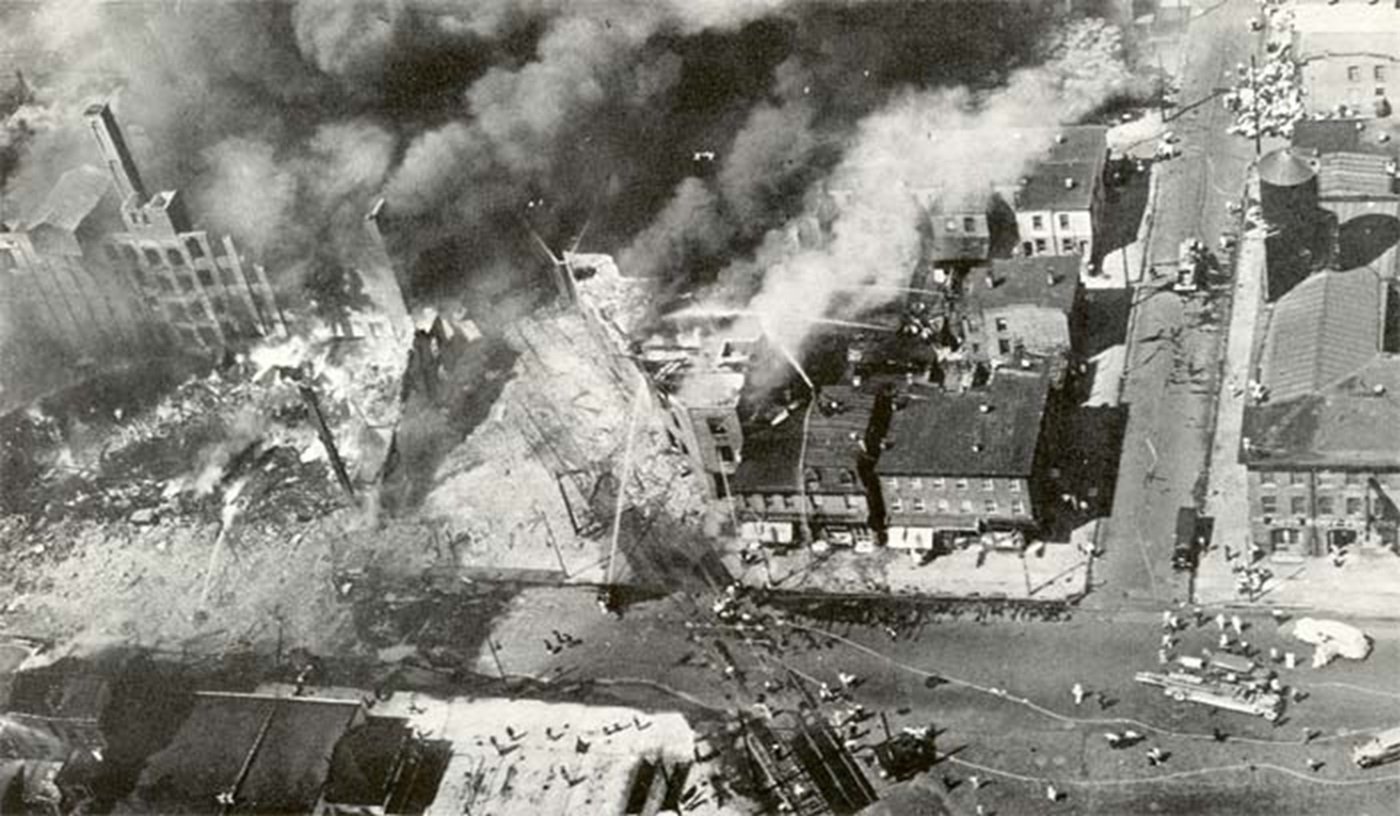
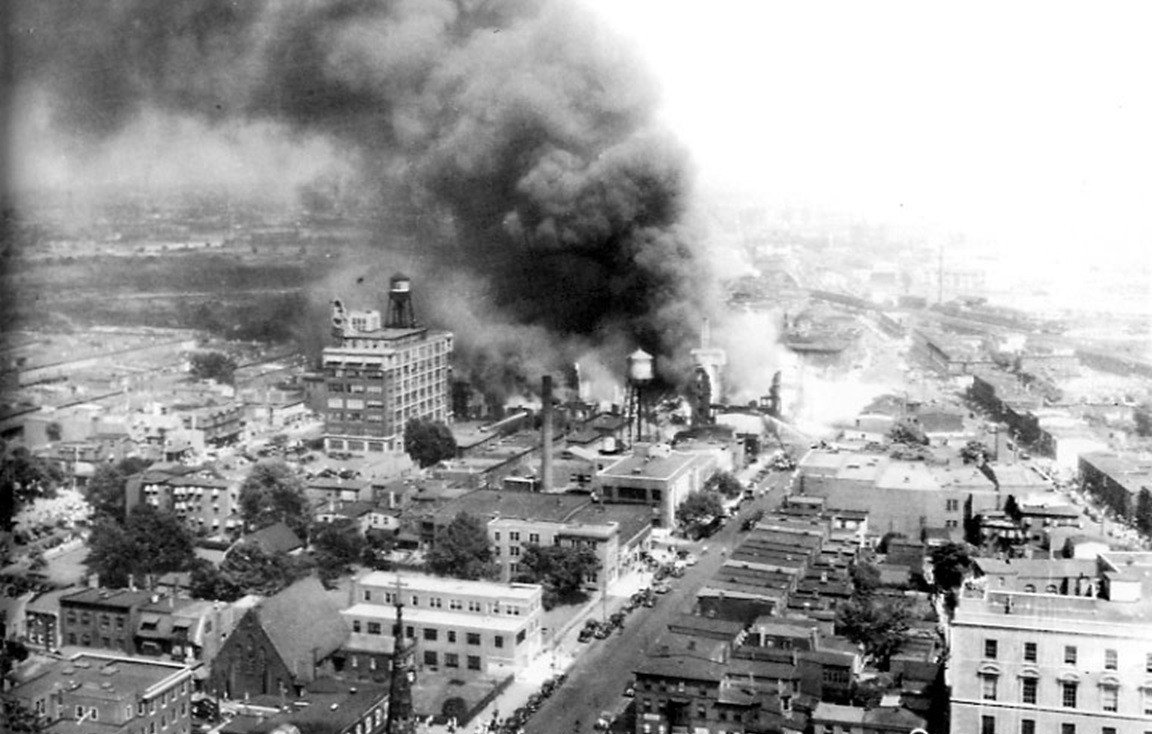
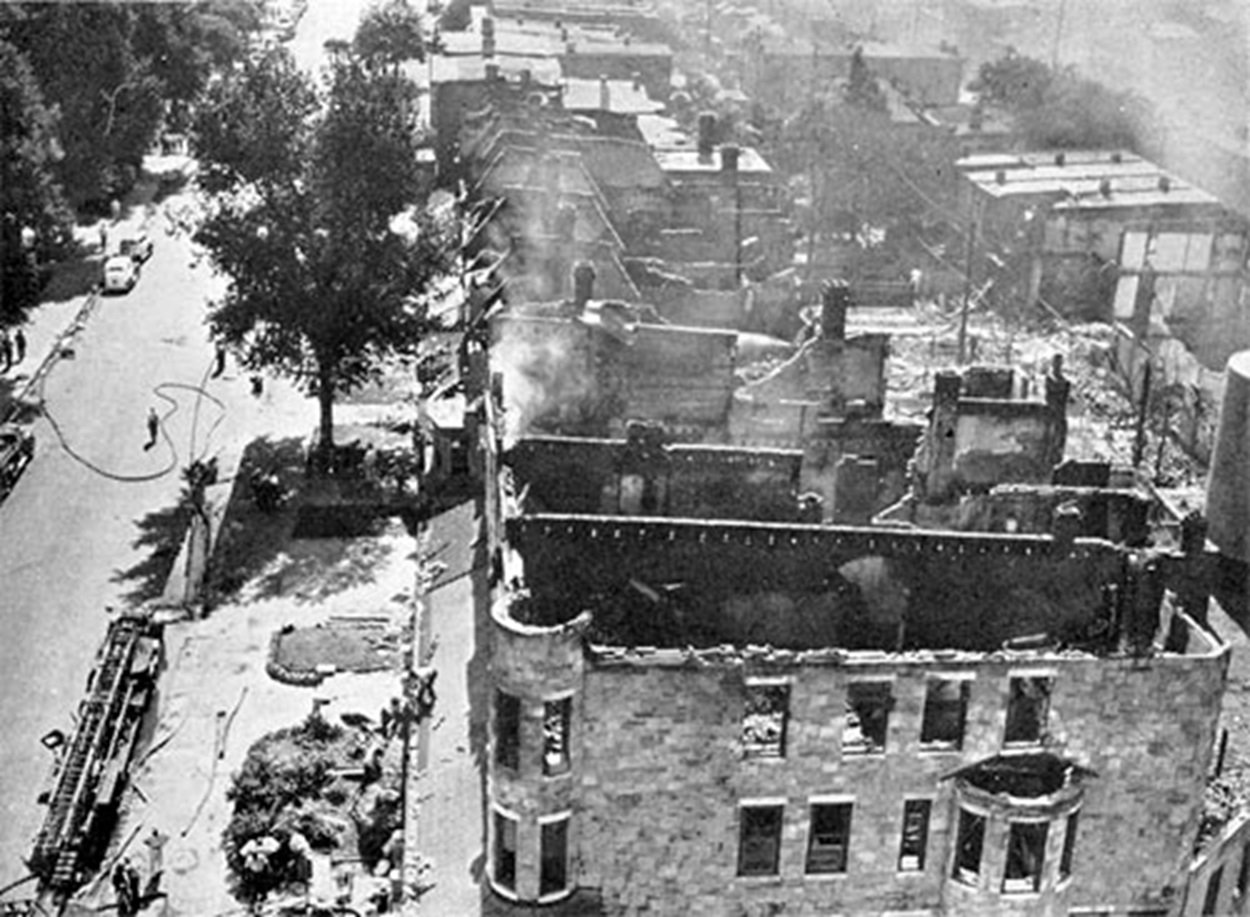
The fire quickly involved large quantities of flammable liquids and spread throughout the main group of buildings. The wind carried the fire across the railroad tracks and radiated heat ignited buildings across Ninth Street. Dwellings along Cooper and Carpenter Streets were ignited and destroyed. It is said that explosions caused the roofs of some of these dwellings to be sprayed with burning flammable liquids, hastening their destruction.
A half hour after the fire started two tank cars on a siding beside the plant exploded. Another car filled with alcohol previously was pushed out of danger by workmen. Three large undiked alcohol storage tanks east of the railroad tracks were protected with hose streams and did not ignite. They were equipped with screened vents and at least one of them overflowed, probably due to expansion of the contents.
The first alarm was received at Camden fire alarm headquarters at 1:15 p.m. from a fire box at the corner of 9th and Penn Streets, one block north of the nearest building involved in the fire. An aerial ladder and two engine companies, together with a deputy chief, responded. Department Chief John Lennox also responded since he desired to investigate the explosion.
Upon the arrival of the fire companies, Buildings 2 and 3 appeared to be totally involved, together with parts of Buildings 4 and 1. The fire was extending rapidly across the upper floors of Building 1. Pumpers were connected to hydrants and a hoseline was taken in and up the stairway between Buildings 1 and 6. Before this hoseline had been put into operation, a second explosion took place, occurring somewhere in the vicinity of Building 3. The fire then extended across the court and through the door and window openings into Building 6. The hoseline was withdrawn and played into the lower floor windows along the west side of Building 6, in an attempt to check the fire at the north wall of this building. A ladder pipe was put in service in the same location with a similar intent. However, within ten minutes after the first alarm it became obvious that the plant could not be saved.
Fire alarm operators reported that the first explosion occurred some five to eight minutes before the first alarm was received at 1:15 p.m. The extent of the fire could be observed from fire alarm headquarters. Accordingly, when an alarm was received at 1: 17 p.m. from a fire box located at the corner of 11th and Cooper Streets, it was treated as a second alarm and two engine companies, and an additional ladder company were sent to the fire. This box was sounded again at 1:19 p.m., and two more engine companies were dispatched. At the same time one of the principal pumping stations of the water department was notified by telephone.
Chief Lennox ordered a general alarm by telephone at 1:28 p.m. and all companies in the city were dispatched to the fire. The total response comprised nine engine companies and three ladder companies, with a total of 18 pieces of apparatus. At 1:38 p.m., Camden Mayor George Brunner made an urgent call to Philadelphia Mayor Lamberton asking for help. Mayor Lamberton at once called his Public Safety Commissioner, James H. Malone, ordering Philadelphia to “Give Camden all the help she needs – now!” Malone relayed the order to Deputy Chief Engineer William Simmer and within two minutes, Philadelphia fire companies were rolling over the Benjamin Franklin Bridge into Camden. Thirteen minutes later they were pumping water on the fire. At that time, Philadelphia was using two-piece engine companies with hose wagons and pumpers. Units of the Philadelphia Fire Department that initially responded were Engine Companies 8, 17, 21, 27 and 33, with Trucks 9 and 23. A large number of policemen and an ambulance also responded from Philadelphia.
The Camden Fire Department devoted its services to protecting exposures on the south, east and west of the plant complex. An attempt to prevent the fire from crossing the railroad tracks from the Market Street end was thwarted by the intense heat and flames. Companies from Philadelphia were assigned to Cooper Street, fighting the fire as it spread throughout the dwellings along the southern side of this street.
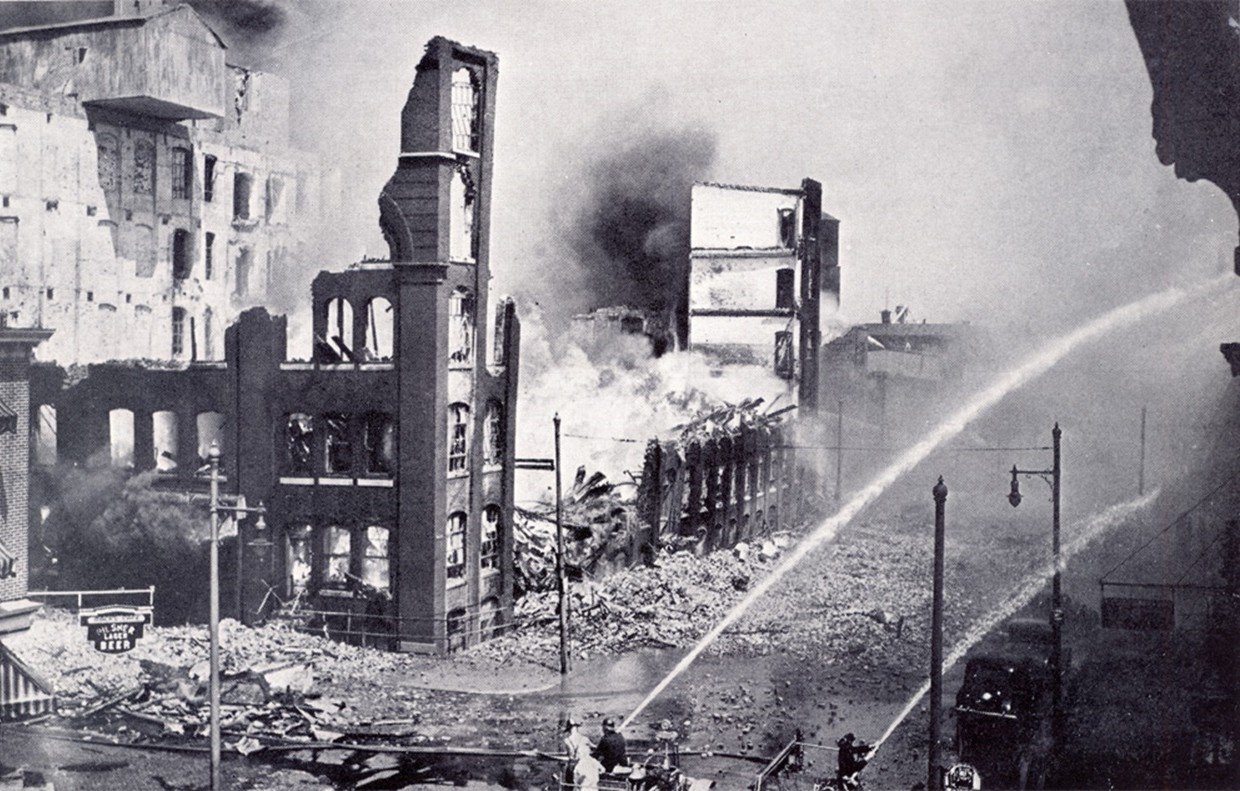
Tremendous radiant heat generated by the blaze, coupled with a water shortage caused by heavy demand during the heat wave, made effective firefighting especially difficult. Engine companies were forced to draft water from the Cooper River, one-half mile away from the fire. Worse, some 28 explosions rocked the plant as stores of gasoline, naphtha, paint and grease were ignited. The fire spread involving other factory buildings in the Hollingshead complex and also extended to scores of surrounding dwellings and businesses.
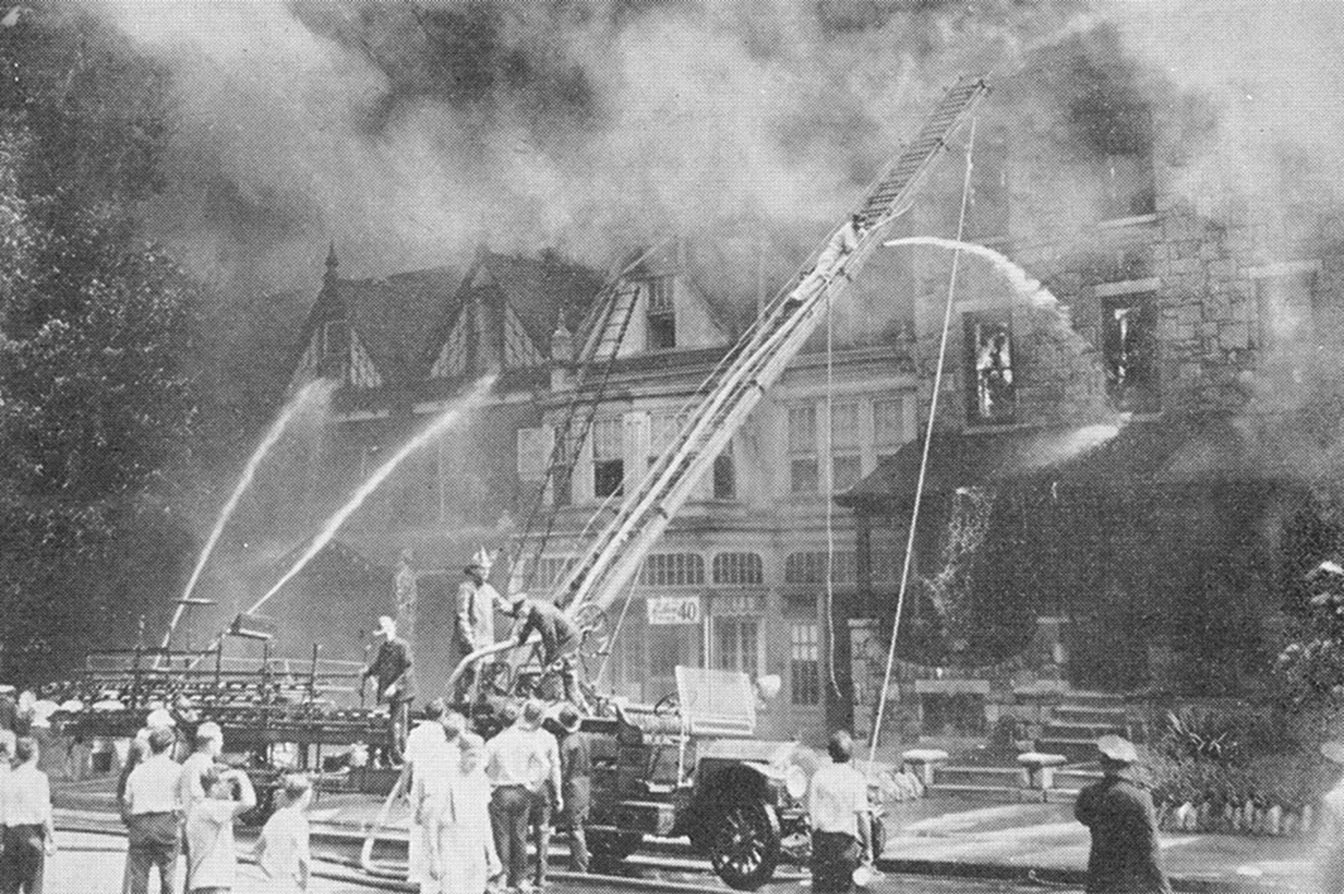
At the height of the fire, it is estimated that 28 hoselines, with 1-inch or 1-1/8-inch tips, were in use; in addition, a ladder pipe with a 1-1/2-inch tip, as well as three turret nozzles, each with 1-3/4-inch tips, mounted on hose wagons, were used. Off-shift members of the fire department were not called, but a number of them responded to the fire grounds voluntarily upon learning of the fire.
Little information is available as to the action of the private fire protection in the plant. It was reported, however, that upon arrival the fire department found several hoselines connected to the header of the private fire pump, but no information was obtainable as to when or where these lines may have been used. The lack of information regarding these hoselines suggests the possibility that a fire had occurred previous to the first explosion. The possibility that either the first explosion ruptured the sprinkler piping or that sprinklers were shut off following the fire, was said to be under investigation.
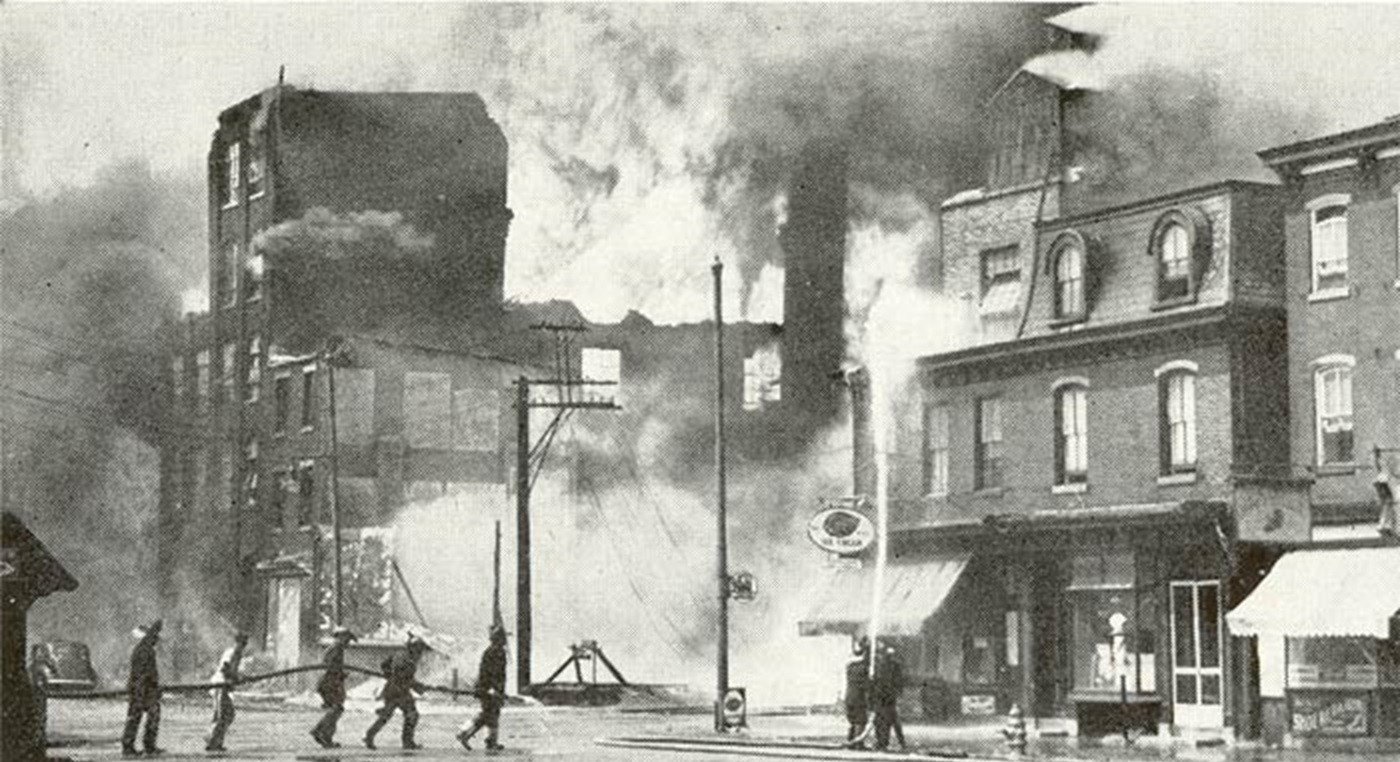
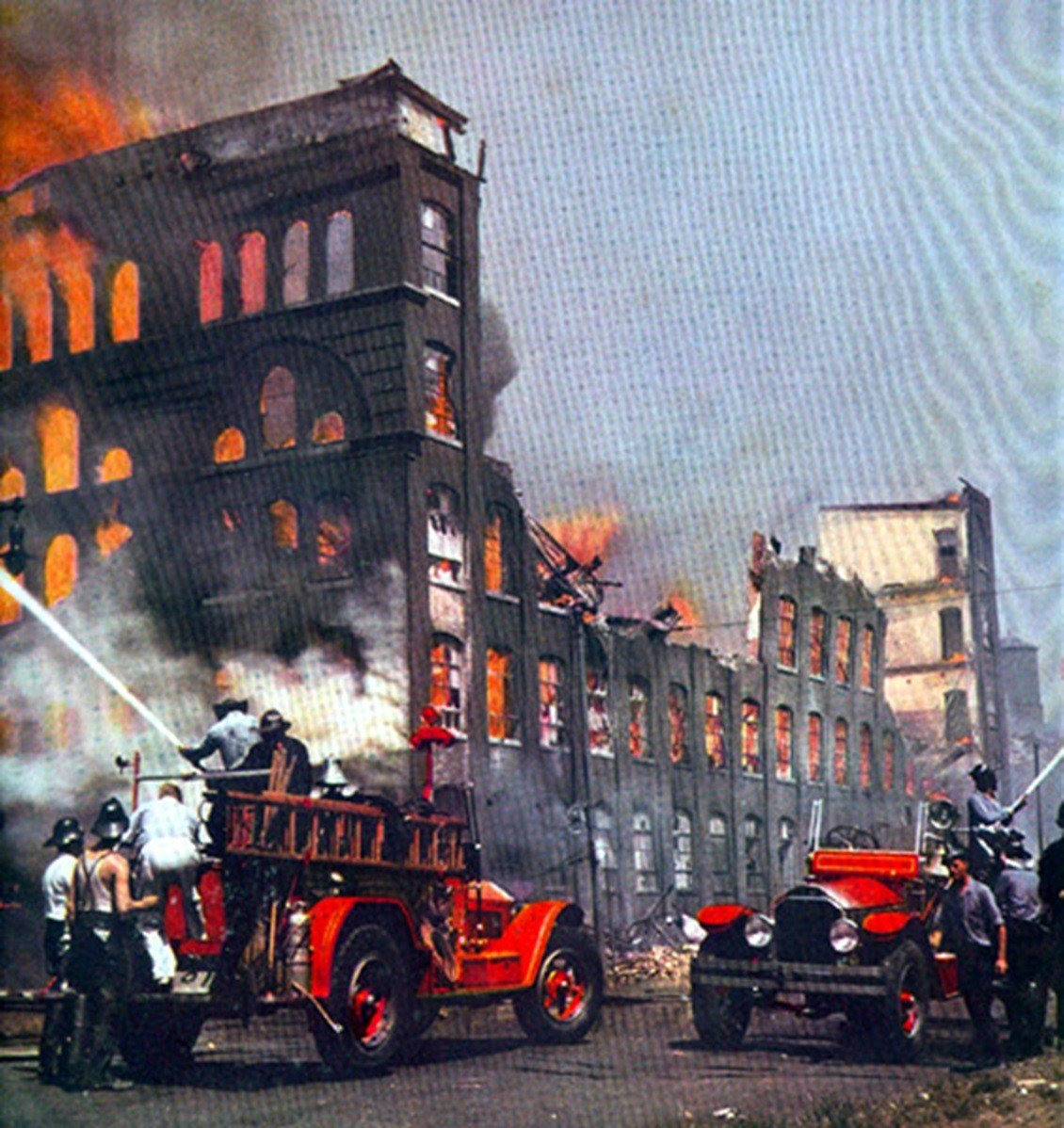
By 2:30 p.m. the walls of the Hollingshead plant began to collapse. Much water was wasted from broken sprinkler piping and hydrants. By the time Building 15 across the railroad right-of-way became ignited the sprinklers in that building were apparently without water due to the rupturing of sprinkler mains resulting from the collapse of the main plant buildings.
In accordance with outside aid arrangements recently completed, companies were called into the city from Audubon, Collingswood, Merchantville and Haddon Heights. These went in service at fire stations previously assigned. Apparatus put in service consisted of four pumpers, a city service ladder truck, and a pumper-ladder truck. These companies remained in service until 11: 25 a.m. on July 31, when the first company was released. The last company left early Monday morning, August 5. During the time that outside aid companies were in service in Camden, twenty-two alarms of fire were received at fire alarm headquarters. Operators and officers of these companies were familiar with the city and had been schooled in the operation of the Camden system of dispatching companies. In general, these departments had volunteer firemen with paid drivers. Some seven or eight other neighboring towns, hearing of the extent of the fire, sent companies to the fire. These included the departments of Haddonfield, Mount Ephraim, Pennsauken, Gloucester, and Westville.
The first aid squad and ambulance of the Gloucester Fire Department were on duty throughout the night. Sixty members of the R.C.A.-Victor Corporation first aid squad also worked to relieve firemen suffering from the terrific heat. The Philadelphia Navy Yard sent several truckloads of U.S. Navy floodlights. These were useful to aid in patrolling the fire area after dark, as well as aiding the firemen.
While outside fire companies were being welcomed, radio stations were asking sightseers to keep away from the city. To enforce this request the Federal Street bridge over the Cooper River was raised to stop the flow of cars into town. It is reported that several homes were looted during the fire. The American Legion called out three hundred men to guard the furniture of fire refugees until the National Guard arrived. About 10: 30 p.m., firemen wearing asbestos suits and gas masks attempted to search the ruins for bodies of the victims but were forced to give up due to the intensity of the fire.
The public water supply stood up well during the fire. Extra pumps were started promptly, and the pressure was raised about twenty pounds above normal. After a few hours, this extra pressure was found to be unnecessary, and it was discontinued. It is estimated that about five million gallons of water was used on the fire, but because the Campbell Soup Company, which uses an average of ten million gallons daily during the summer season, voluntarily shut down, the total consumption in the city on the day of the fire was less than on either the day previous or the day following. Large mains in the vicinity of the fire helped to maintain good pressure. As an additional precaution street sprinklers and public pools were shut off during the fire. During the height of the blaze there were six extra waterworks pumps in use and an ample number were in reserve.
Fire companies responding from outside departments were directed to pump from the Cooper River about four blocks from the fire. One of the Philadelphia pumpers operating at this point nearly worked itself into the river and had to be towed to safety. It is evident that adequate quantities of water at moderate pressure were available in the larger mains in the vicinity of the fire. Four-inch mains in several of the streets in the neighborhood may have limited the supply to several pumpers, and at least one was forced to relocate at a larger main. As most of the operation was from hydrants on the larger mains there was no shortage of water which would handicap the fire department.
The cause of the initial explosion and subsequent fire was attributed to the ignition of flammable vapors. Lack of complete explosion-proof electrical equipment introduced numerous sources of ignition. In addition, an employee reported to have been repairing equipment in Building 3 may have struck a spark. That there was a large accumulation of flammable vapor appears indicated by the fact that men in Buildings 3 and 4 were found outside with their clothing on fire. Whatever the source of ignition, there was many opportunities for accumulations of flammable vapors. High atmospheric temperatures on the day of the fire, together with inadequate facilities for the removal of vapors from the buildings, provided an ideal condition for the formation of explosive mixtures in the basements and lower floors of the plant.
In addition to the complete destruction of the main group of plant buildings, the fire-resistive office Building 14 sustained general damage to windows by the explosions and the basement was flooded. It is also reported that girders supporting the water tank at the roof of this building were damaged. Plant Buildings 5 and 15 across the railroad tracks were also destroyed. A large safe dragged from the ruins of the Hollingshead factory by firemen was opened the day after the fire. Two thousand formulas dating back twenty years had been destroyed, but duplicates kept in the main office building were available. These were transferred to safe deposit boxes for safekeeping.
Thirty-two dwellings on Cooper, Carpenter, North 9th, and Market Streets were destroyed and thirty-one others were damaged by the fire and explosions. Nearly 60 automobiles parked on streets in the fire area were destroyed or badly damaged. The total loss resulting from this conflagration has been estimated at about $2,000,000, with insurance losses of between $1,000,000 and $1,500,000, including substantial use and occupancy losses.
Following the fire, the N.F.P.A. Committee on City Planning and Zoning made an inquiry as to whether Camden had a zoning ordinance at the time of the fire, and if so in what zone the factory was located. The Committee was informed by the City Clerk that the city had no zoning ordinance and that the dwellings that were destroyed or damaged were built both prior to and subsequent to the erection of the factory.
The weather at the time of the fire was almost ideal for a conflagration. The temperature reached a peak of 94 degrees during the fire and averaged 85 degrees for the entire day. A fifteen to twenty-one mile per hour southwest wind was blowing. It is interesting to note that a wind-squall of almost “hurricane force” occurred between 6: 30 and 7 p.m., just an hour after the fire was declared to be under control. It is said that this wind threatened to spread the fire further and it is considered fortunate that it did not occur earlier.
Persons who lost their lives as a result of the fire included four female employees working in the basement wax department and five male employees including the watchman. During the fire, Chief Lennox was overcome by heat prostration and Deputy Chief Walter Mertz took charge. Fireman William Merrigan of Engine Company 3 died from a heart attack induced by heat exhaustion while working at the fire. A number of other firemen were overcome or injured. Several firemen were overcome when a seam let go in some gas tanks that they were trying to protect with hose streams. Others were said to have been overcome by fumes given off by the ruins of the factory after the fire was under control.
Fireman William J. Merrigan, age 50, was an 18-year veteran of the Camden Fire Department. After serving in the military during the First World War, he joined the department in April of 1922. In October of 1935, Fireman Merrigan, then assigned to Engine Company 10, had been injured at a three-alarm fire in a warehouse when an interior partition wall collapsed trapping him under debris. He was rescued by other members of his unit who had themselves narrowly escaped the collapse. He returned to duty and was assigned to Engine Company 3 at the time of his death. Merrigan was survived by his wife, Florence, and sons William James Merrigan Jr. and Kenneth P. Merrigan. He was buried at Evergreen Cemetery in the city. His son, William J. Merrigan Jr., served as a member of the Hi Nella New Jersey Fire Department from 1960 to 1985.
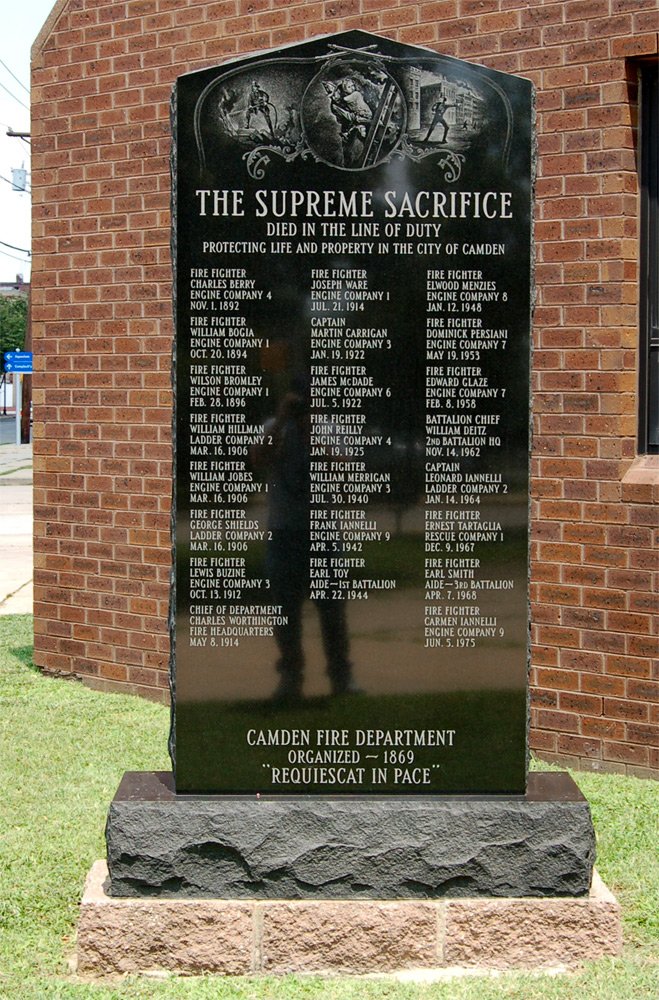
The name of Fireman William J. Merrigan has been inscribed on the Camden Firemen’s Memorial at Camden Fire Headquarters at 3rd and Federal Streets in the city. The names of the 23 Camden firefighters who have lost their lives in the line of duty are written on the black granite memorial that was dedicated on September 9, 2006.
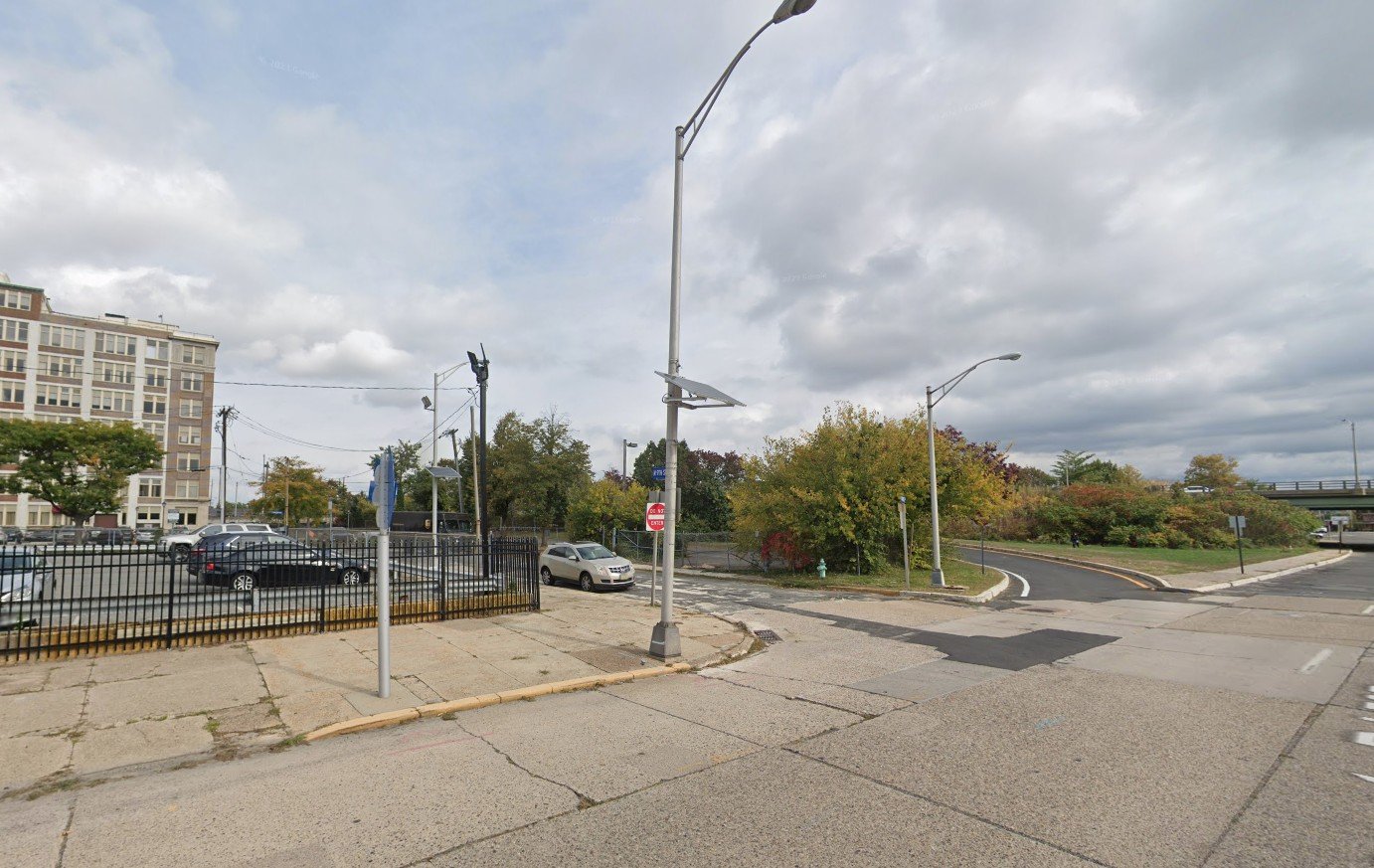
The site of the Hollingshead plant and the surrounding neighborhood of dwellings is now occupied by an interchange for Interstate Route 676. There is no memorial marker at the site.
Commentary:
In many urban communities during the 19th and early 20th centuries in North American, it was common to erect manufacturing plants, factories, foundries, refineries and mills within the city limits. These heavy industries were often surrounded by row houses built to accommodate a burgeoning workforce as the country was transitioning from an agrarian economy to an industrial base. Little thought was given to providing protection to these often cheaply built structures, many of which were constructed of brick and wood frame construction. Many of these structures, including mercantile shops and general stores were built by the owners of the local industries to house and supply the needs of their employees.
Fire protection was focused on the mill and factory buildings as they were viewed by the owners as the most valuable real estate. While the Hollingshead plant was largely covered by an automatic fire sprinkler system, several explosions involving flammable liquids quickly rendered the system inoperative. The resulting conflagration conditions as the massive fire fed by high winds, dry conditions and high temperatures were no match for responding firefighters who quickly realized the plant buildings were lost and turned their attention to exposure protection as the main body of fire raged for several hours.
Well involved fires in large area Type IV Heavy Timber/Mill construction buildings are notorious for developing into conflagrations that threaten surrounding neighborhoods. Once a serious fire has taken hold in a mill building, it will spread very rapidly. Extreme radiant heat, flying brands, and falling walls are characteristic fire conditions of a fully involved mill. The fire flow needed to protect the threatened exposures will often overtax the local water system and may require drafting operations to supplement the water supply.
Firefighters must recognize the potential for conflagration conditions to develop should a fire break out in these types of occupancies and fire operations including additional fire resources and alternative water sources must be preplanned prior to such an event.
This incident shares similarities with another conflagration involving Type Heavy Timber/Mill construction buildings in Passaic, New Jersey on September 6, 1985:
On Labor Day, September 6, 1985, the last holiday of the summer, two young boys spent the day exploring an aging factory complex in Passaic, New Jersey. Large vats of naphthalene, a flammable white crystalline solid used in the manufacture of moth balls and toilet deodorizers, stored against one of the factory walls was the target of their mischief. They tossed lighted matches into the containers. The result was the largest fire in the city’s history. The conflagration consumed 23 houses and the factories of nearly 60 businesses, which accounted for one quarter of Passaic’s industrial base. One hundred families were displaced and 2,200 people lost their jobs. Monetary losses were estimated at $400 million. More than 300 firefighters from the city and surrounding communities were required to contain the flames. One mutual aid firefighter suffered a fatal medical emergency while battling the blaze and 11 other firefighters were injured.
https://www.facebook.com/groups/192218352449074/permalink/1313896293614602/
We have attached photos and maps from the incident. Special thanks to the Delaware Valley RBS website for much of the content of this article.
Honor the service of Camden Fireman William J. Merrigan by conducting a pre-incident planning inspection of a manufacturing complex in your local response district with your crew members today.
Remember Fallen Brothers.
Get Out There And Know The History Of Your Local!!!

Photo: Firemen play master streams on the plant complex at the corner of 9th and Market Streets as a section of the wall fails.
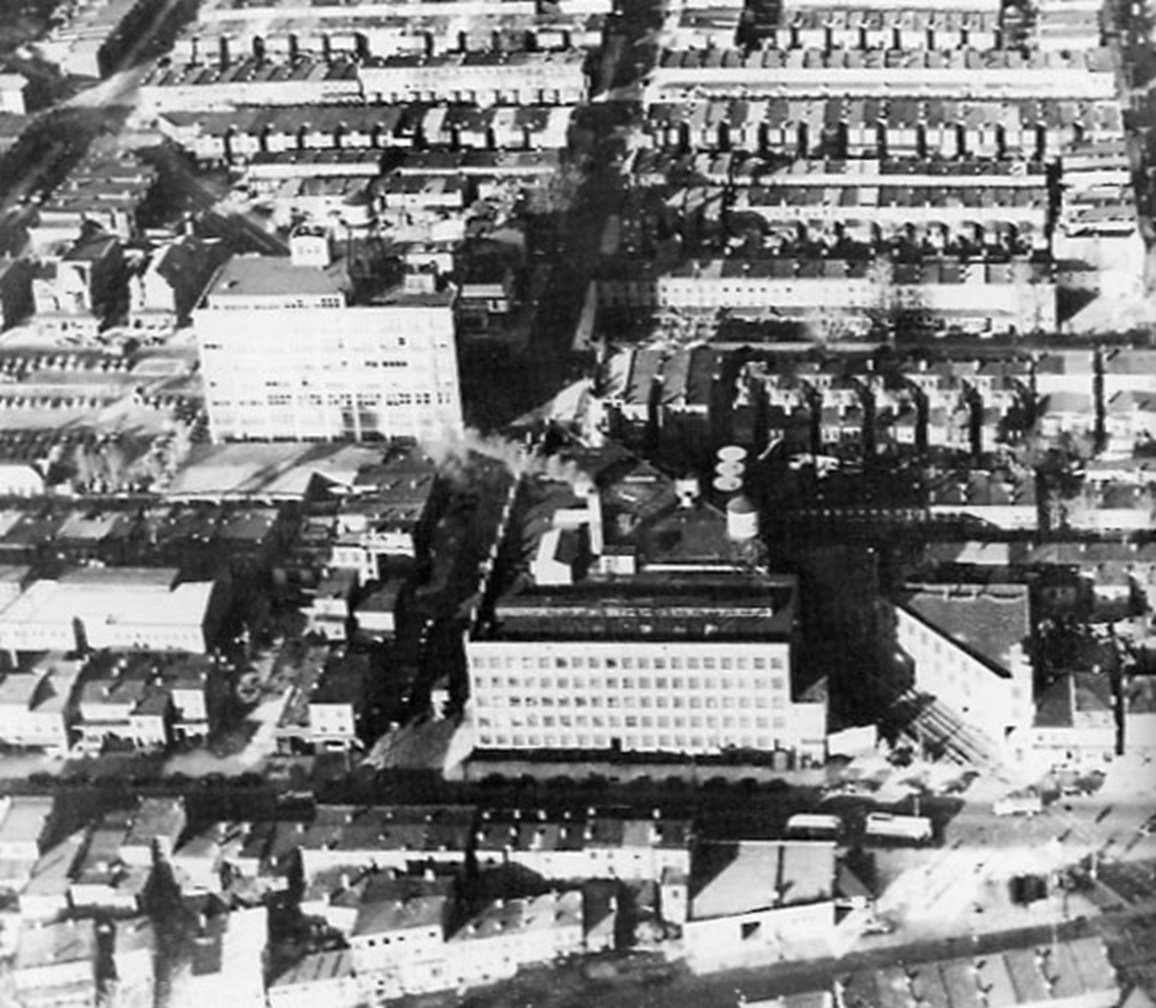
Aerial photo of the plant complex surrounding by residences.
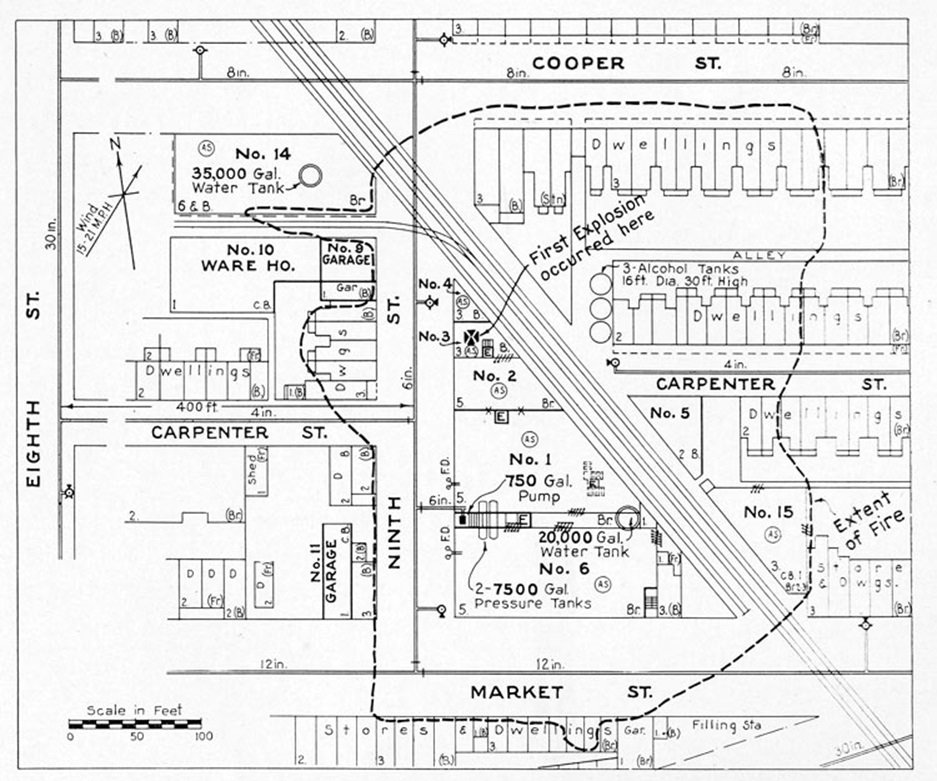
Map of the plant complex and the surrounding exposures including brick and frame row houses.
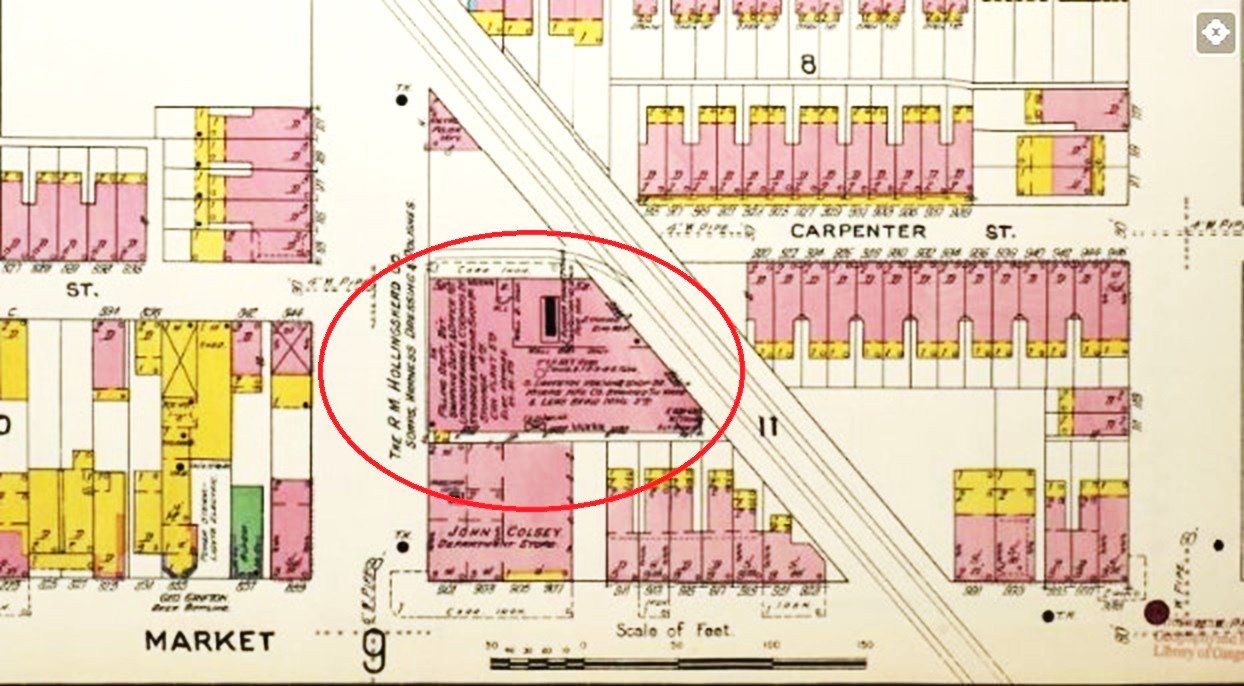
With the exception of the two small buildings, Nos. 5 and 9, all plant buildings in the fire area were fully sprinklered with wet pipe systems having three water supplies, including pressure tanks, gravity tanks, and city water supplemented by a 750-gallon electrically driven centrifugal booster pump. In addition, each building of the main group except Building 4 had a vertical standpipe with hose connected at each floor, and chemical fire extinguishers and water pails, well distributed.
Detail from the 1906 Sanborn map of the plant and surrounding neighborhood. Note by the time of the explosion and fire in 1940, the plant had expanded to adjacent lots on the north and south side of the main building shown here.