Fire Lieutenant Killed in Pier Warehouse Fire While Searching for Lost Firefighters – Charlestown, Boston, Massachusetts – June 24, 1994
On June 24, 1994, Boston Fire Lieutenant Steven Minehan of Ladder 15 died after leading his company in a successful search for two other trapped firefighters at a smoky nine alarm blaze in a vacant waterfront pier warehouse in the Charlestown section of Boston. Lieutenant Minehan became disoriented in the heavy smoke conditions and was separated from his company as they rescued the trapped firefighters. He radioed that he was trapped but several rescue efforts to find him were unsuccessful. He died of smoke inhalation and his body was recovered by his company several hours later. The two firefighters who were rescued were critically injured but survived after being airlifted to a Connecticut hospital for treatment in a hyperbaric chamber for smoke inhalation and carbon monoxide poisoning. Four other firefighters suffered minor injuries in the blaze that took five hours to bring under control. Fire investigators suspected that the pier fire may have been intentionally set after two witnesses reported seeing a burning boat tied up under the pier, but remains of the boat were never located. The cause of the fire remains undetermined. Lieutenant Minehan was the 168th Boston firefighter to die in the line of duty.
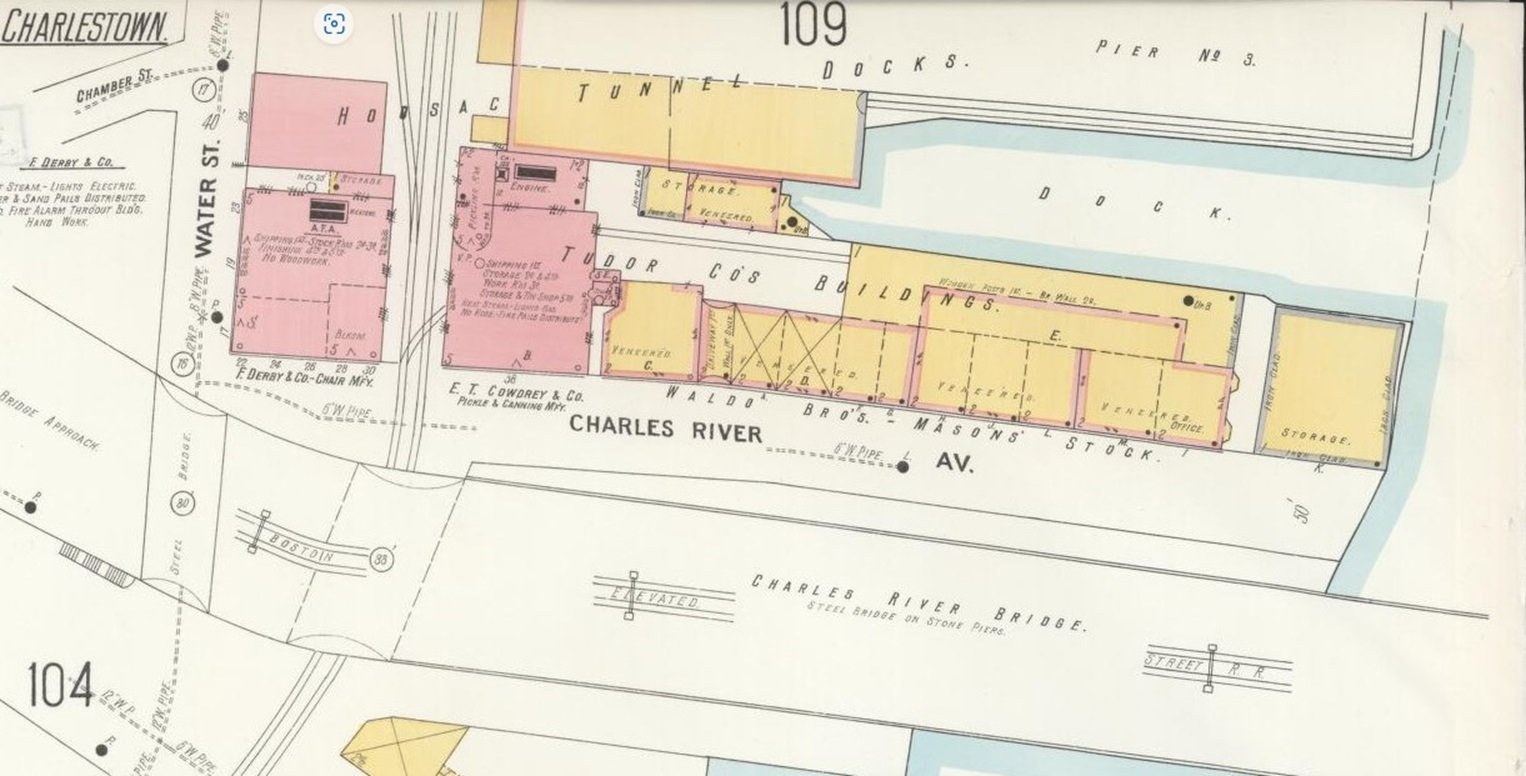
The structure involved in the incident was a large complex of one- and two-story brick veneer and corrugated metal siding over wood frame warehouses built in 1937 atop a pier that extended out over the waterfront of Boston Harbor in the Charlestown area of the city. The warehouse was located at 44 Charles River Avenue adjacent to the North Washington Street Bridge and measured about 100 feet wide by 350 long and covered more than 67,000 square feet. The warehouse was adjacent to the Boston National Historical Park, part of the Charlestown Navy Yard where the historic USS Constitution is docked. The warehouse was constructed above a concrete pier supported by wood pilings driven into the shoreline. The warehouse had been formerly used by the Rapids Furniture Company for storage and was vacant for about ten years prior to the time of the fire. Land access to the pier was partially limited on Sides Bravo, Charlie, and Delta by the waters of the harbor. The structure was not equipped with a fire alarm system or an automatic fire sprinkler system. Several fire hydrants were available in the area.
The City of Boston is the capital and most populous city of the Commonwealth of Massachusetts and the 24th-most populous city in the country. The city proper covers 48.4 square miles with a 2020 U.S. census population of 675,647, also making it the most populous city in New England. The city is the economic and cultural anchor of a substantially larger metropolitan area known as Greater Boston, the tenth largest metropolitan statistical area in the country and home to a census-estimated 4.8 million people in 2016. The city is protected by the Boston Fire Department with 1,606 members operating from 35 fire stations with 33 engine companies, 20 ladder companies, 2 tower ladder companies, 2 heavy rescue companies, 9 district chiefs (battalion chiefs), 2 deputy chiefs, 1 marine unit, and numerous specialty units. The department responds to more than 90,000 emergency calls annually including fires, emergency medical calls, motor vehicle accidents, hazardous material incidents, electrical hazards, floods, and technical rescue/USAR incidents.
The incident occurred in Charlestown, the oldest neighborhood in Boston. Located on a peninsula north of the Charles River, across from downtown Boston, Charlestown also adjoins the Mystic River and Boston Harbor waterways. Charlestown was laid out in 1629 and was originally a separate town and the first capital of the Massachusetts Bay Colony. Charlestown became a city in 1848 and was annexed by Boston in 1874. It has had a substantial Irish American population since the migration of Irish people during the Great Irish Famine of the 1840s. Since the late 1980s, the neighborhood has changed dramatically because of its proximity to downtown Boston and resulting gentrification of the area. Today Charlestown is a largely residential neighborhood with much housing near the waterfront overlooking the Boston skyline.
The Charlestown area of the city is protected by fire units of the Boston Fire Department:
- Engine 50 – 34 Winthrop Street – 0.4 miles from the fire building.
- Engine 32 and Ladder 9 – 525 Main Street – 1.5 miles from the fire building.
Weather conditions on the night of the incident included an air temperature of 73 degrees F with the humidity level at 55% with a light west-northwest wind at 5 mph under cloudy skies (Weather Underground). The weather conditions did not appear to have a significant effect on fire development or the outcome of the incident.
In the early morning hours of Friday, June 24, 1994, Bruce Laughen and Pete Saunders, who were relaxing on Laughen’s boat at a neighboring marina, spotted smoke and ran to see what was happening. They saw a small runabout completely on fire tied up tight to the pier of a large warehouse on the waterfront near the North Washington Street Bridge. The men quickly turned in the alarm.
At 12:30 a.m., Box 4113, City Square near Main Street, was transmitted for a report of a fire in a large vacant warehouse on a pier at 44 Charles River Avenue in the Charlestown area of the city. Fire units arrived to find the sprawling building that was formerly used as a furniture storage warehouse to be involved in fire. Firefighters began fire control, search and ventilation operations as hoselines were stretched into the building. Initially, conditions inside the warehouse were tenable as light smoke and heat conditions were encountered by the interior fire crews. Conditions, however, deteriorated rapidly as the fire fed on the combustible contents with thick smoke and heat enveloping the building. The order was given to withdraw from the building however two members of the interior team became disoriented and were trapped in the cavernous warehouse.
Ladder 15 under the command of Lieutenant Stephen Minehan responded to the multiple alarm fire from their firehouse on Boylston Street more than four miles away. Upon arrival, they were given the task of searching for and rescuing the trapped members who were running low on air. The crew of Ladder 15 donned their self-contained breathing apparatus (SCBAs) and entered the building. The missing members were located and successfully guided out of the warehouse; however, Lieutenant Minehan became separated from his crew and was disoriented and trapped in high heat and heavy smoke conditions in the vast structure.
Fire Commissioner Martin Pierce said firefighters entered the burning warehouse when they first arrived, but flames and smoke spread so quickly they were ordered out within minutes. After withdrawal, two firefighters were reported missing and Deputy Chief Kevin Mochen, in charge of fighting the fire, said he told Minehan, “Stevie, go in and get those guys.” Firefighter Kevin Callow was in Minehan’s crew. He said he was holding on to Minehan’s coat as they moved through the smoke-filled warehouse, following a hoseline, heading outside. But somehow, Minehan slipped away. “I got to the door and stood there waiting,” Callow said. “But Stevie didn’t come out.”
Callow and other firefighters yelled for Minehan and went back in several times to find him. Seconds later, Minehan radioed for help, saying he was trapped, but never giving his location in the building. Firefighters mounted desperate attempts to locate the missing Lieutenant while continuing to battle the flames. Minehan apparently became disoriented in the heavy smoke conditions and was separated from his company as they rescued the trapped firefighters. Several rescue efforts to find him were unsuccessful.
Continued search and rescue efforts to locate Minehan had to be halted due to the heavy fire conditions. Deputy Chief Mochen then ordered firefighters out of the building because the smoke and fire were too intense, and the roof was about to collapse. More than 200 firefighters poured thousands of gallons of water on the blaze from land, from the department’s fireboat, from underneath the pier, and from tower ladder trucks on the nearby North Washington Street Bridge.
The body of Lieutenant Minehan was located later that morning at 7:30 a.m. in the smoldering ruins of the warehouse by members of his company. He apparently died from inhalation of smoke and gases as his SCBA facepiece was off when he was found in the building. “We believe he might have got lost in the heavy smoke and fire conditions and perished in that way,” Commissioner Pierce said. “He died doing what he loved to do.”
Six other firefighters were injured, two critically. The two most seriously injured, Firefighters Darrell Johnson and Terrance Jones, who were rescued by Minehan’s crew, were flown by a U.S. Coast Guard helicopter to a special hyperbaric oxygen chamber at Norwalk Hospital in Connecticut to be treated for smoke inhalation. The others were treated at Massachusetts General Hospital and Boston City Hospital and released.
Some 200 firefighters battled the blaze as heavy smoke choked parts of the city, closing roads and causing traffic jams on the central traffic artery and the Mystic-Tobin Bridge that carried traffic in and out of the city to the north. Fire officials said the metal-clad exterior of the warehouse helped contain the blaze, but that wood and creosote in the building’s frame fed the fire and caused thick smoke.
The cause of the fire was not immediately determined, but officials said a burning 14-foot powerboat was spotted by two witnesses tied up beneath the pier shortly before the flames broke out. Divers searched the waters beneath the fire-ravaged pier but the remains of the boat were never located. The cause of the fire remains undetermined.
Firefighters Darrell Johnson and Terrance Jones spent several days being treated in a specialized hyperbaric chamber for severe smoke inhalation. Both had been given a series of two-hour treatments in the chamber, which contains pure, high pressurized oxygen. The treatments remove carbon monoxide from the blood cells and infuse oxygen into the cells.
Fire Lieutenant Steven Francis Minehan, age 44, was a 20-year member of the Boston Fire Department and a lifelong resident of the city. He started his career at Ladder 26 in Roxbury, one of the busiest fire companies in the city. Minehan was promoted to Lieutenant on April 5, 1989 and was assigned to Ladder 15. He was a third-generation member of the department; his father and grandfather also served in the Boston Fire Department. Minehan grew up in the Fields Corner section of Dorchester, attended parochial schools and two years of college. Prior to joining the Fire Department, he served as a volunteer ambulance driver and emergency medical technician. While off-duty, he helped evacuate several children from a burning dwelling on Minot Street in Dorchester in 1987 before firefighters arrived, for which he earned a commendation. In 1995, Lieutenant Minehan was posthumously awarded the John E. Fitzgerald Medal for the Most Meritorious Act in the rescue of the two disoriented firefighters during the pier fire. Minehan was active in his church, St. Brendan’s in Dorchester and was also active in union affairs at Florian Hall, the headquarters for Boston Firefighters Local 718. He was survived by his wife Kathy, his son Joseph, and three daughters, Kelly, Meagan, and Katie, his mother Dorothy Minehan, and three brothers, four sisters, and a large family of nieces and nephews.
On June 26, more than 8,000 firefighters from the Boston area and around North America attended the funeral with full departmental honors for Lieutenant Minehan at St. Brendan’s Church in Dorchester. Interment followed at Cedar Grove Cemetery in Dorchester.
On November 13, 1994, a memorial plaque dedication was held at the quarters of Engine 33 and Ladder 15 at 941 Boylston Street in memory of the late Fire Lieutenant Stephen F. Minehan, who died in the line of duty on June 24, 1994.
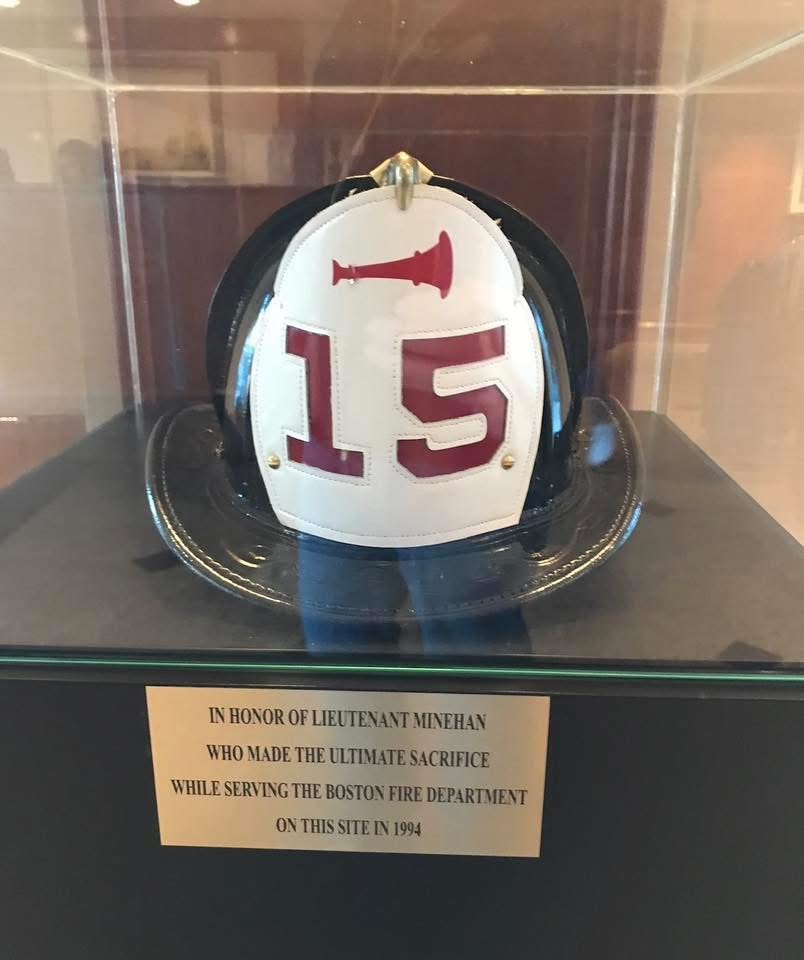
A memorial plaque honoring Lieutenant Stephen F. Minehan has been placed on the pier at the site of the warehouse fire. The pier is now occupied by the Residence Inn on Tudor Wharf hotel in Charlestown. A replica of Lieutenant Steven Minehan’s helmet is displayed in his honor in the lobby of the hotel.
The name of Lieutenant Stephen F. Minehan has been honored at the Massachusetts Fallen Firefighters Memorial located on the grounds of the State Capitol in Boston.
The name of Lieutenant Stephen F. Minehan has been inscribed on the 1994 plaque displayed at the National Fallen Firefighters Memorial on the campus of the National Fire Academy in Emmitsburg, Maryland.
Twenty-seven years after Lieutenant Stephen Minehan made the ultimate sacrifice trying to save two fellow firefighters, his son, Joseph, was promoted to the rank of District Chief in the Boston Fire Department. Lieutenant Minehan’s daughter works as a fire dispatcher at the city Fire Alarm Office.
Commentary:
Fire operations in large open area buildings such as warehouses, big-box and department stores, manufacturing plants, and aircraft hangers pose significant challenges to firefighters. Maintaining orientation is critical to firefighter safety and survival while operating in such structures. Large open area buildings often have high undivided ceiling areas where large volumes of smoke and high heat can accumulate above the heads of unsuspecting interior firefighters. Early search and fire control operations may begin under light smoke and heat conditions that often deteriorate rapidly trapping firefighters sometimes hundreds of feet from an exit. The use of large area search techniques such as deployment of search rope lines to assist members with maintaining orientation within the burning structure should be deployed early in the operation before conditions change.
We have attached photos from the incident and a detail from the 1950 Sanborn fire insurance map showing the configuration of the warehouse and the surrounding exposures.
We have also attached an article on search rope basics for large area structures by John Miles and John Tobin published in Fire Engineering magazine:
https://www.fireengineering.com/firefighting/search-rope-basics-for-large-areas/\
Remember the service of Lieutenant Stephen Minehan by touring a large open area occupancy in your local response district with your crew members and note the floor layout and available egress points in the building. Also practice search rope techniques for large open area structures with your crew members today.
Thanks to multiple media sources for the content of this article.
Remember Fallen Brothers.
Get Out There And Know Your Local!!!

Photo: Several fireboats attack the fire from the waterside.
The structure involved in the incident was a large complex of one- and two-story brick veneer and corrugated metal siding over wood frame warehouses built in 1937 atop a pier that extended out over the waterfront of Boston Harbor in the Charlestown area of the city. The warehouse was located at 44 Charles River Avenue adjacent to the North Washington Street Bridge and measured about 100 feet wide by 350 long and covered more than 67,000 square feet. The warehouse was adjacent to the Boston National Historical Park, part of the Charlestown Navy Yard where the historic USS Constitution is docked. The warehouse was constructed above a concrete pier supported by wood pilings driven into the shoreline. The warehouse had been formerly used by the Rapids Furniture Company for storage and was vacant for about ten years prior to the time of the fire. Land access to the pier was partially limited on Sides Bravo, Charlie, and Delta by the waters of the harbor. The structure was not equipped with a fire alarm system or an automatic fire sprinkler system. Several fire hydrants were available in the area.
Detail from the 1950 Sanborn fire insurance map showing the configuration of the warehouse and the surrounding exposures.
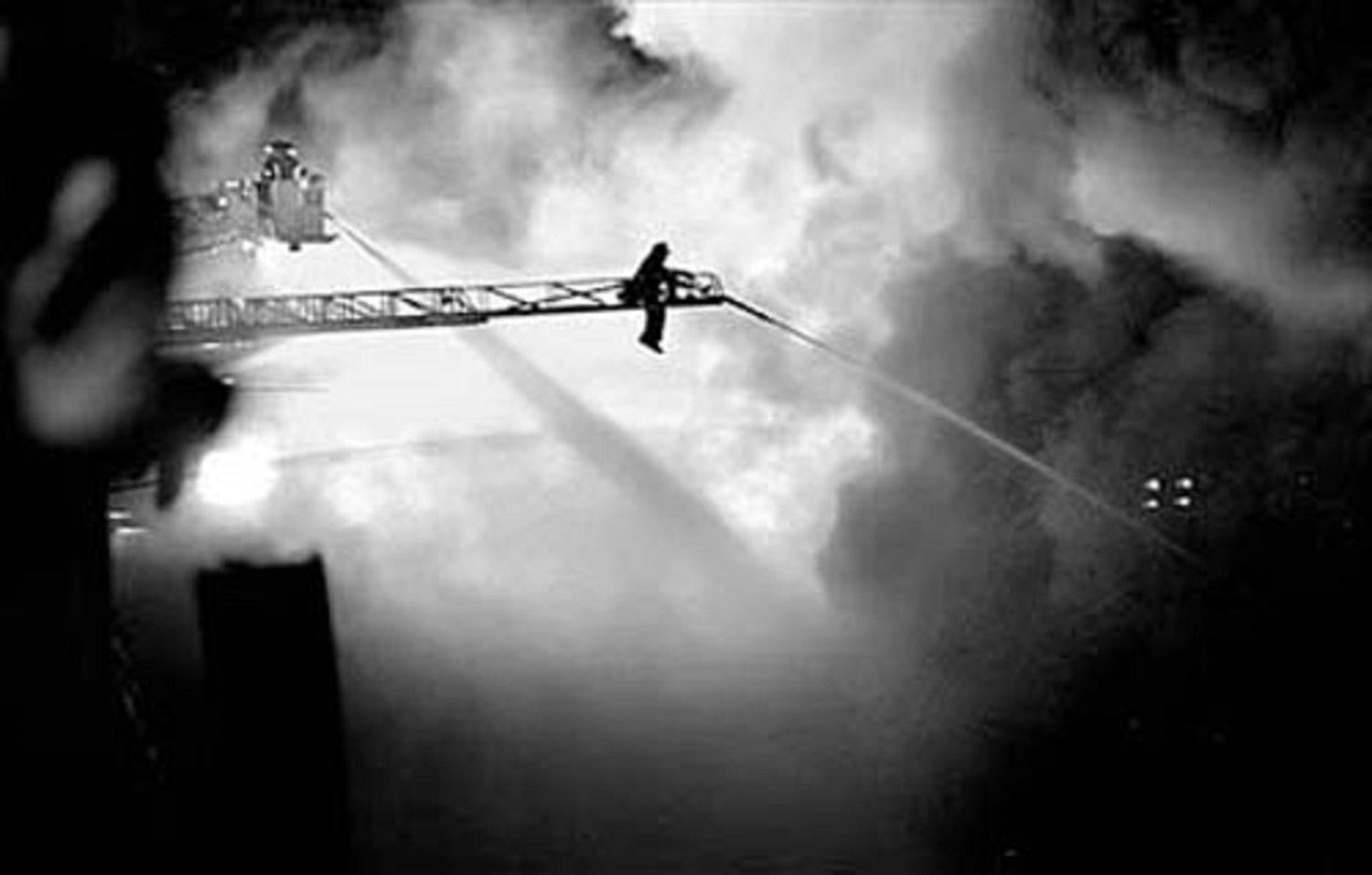
Ladder pipes attack the smoky nine-alarm fire from a nearby bridge overpass.
Fire Commissioner Martin Pierce said firefighters entered the burning warehouse when they first arrived, but flames and smoke spread so quickly they were ordered out within minutes. After withdrawal, two firefighters were reported missing and Deputy Chief Kevin Mochen, in charge of fighting the fire, said he told Minehan, “Stevie, go in and get those guys.” Firefighter Kevin Callow was in Minehan’s crew. He said he was holding on to Minehan’s coat as they moved through the smoke-filled warehouse, following a hoseline, heading outside. But somehow, Minehan slipped away. “I got to the door and stood there waiting,” Callow said. “But Stevie didn’t come out.”
Callow and other firefighters yelled for Minehan and went back in several times to find him. Seconds later, Minehan radioed for help, saying he was trapped, but never giving his location in the building. Firefighters mounted desperate attempts to locate the missing Lieutenant while continuing to battle the flames. Minehan apparently became disoriented in the heavy smoke conditions and was separated from his company as they rescued the trapped firefighters. Several rescue efforts to find him were unsuccessful.
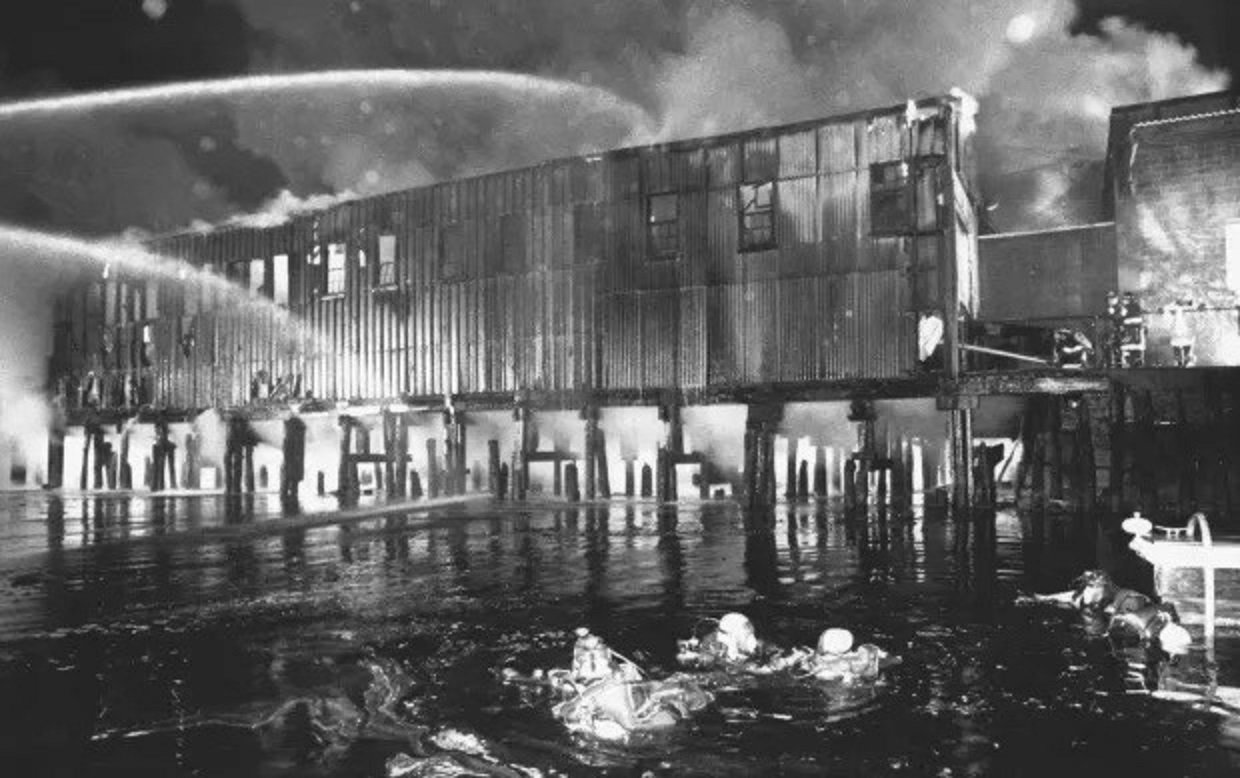
Continued search and rescue efforts to locate Minehan had to be halted due to the heavy fire conditions. Deputy Chief Mochen then ordered firefighters out of the building because the smoke and fire were too intense, and the roof was about to collapse. More than 200 firefighters poured thousands of gallons of water on the blaze from land, from the department’s fire boat, from underneath the pier, and from tower ladder trucks on the nearby North Washington Street Bridge.
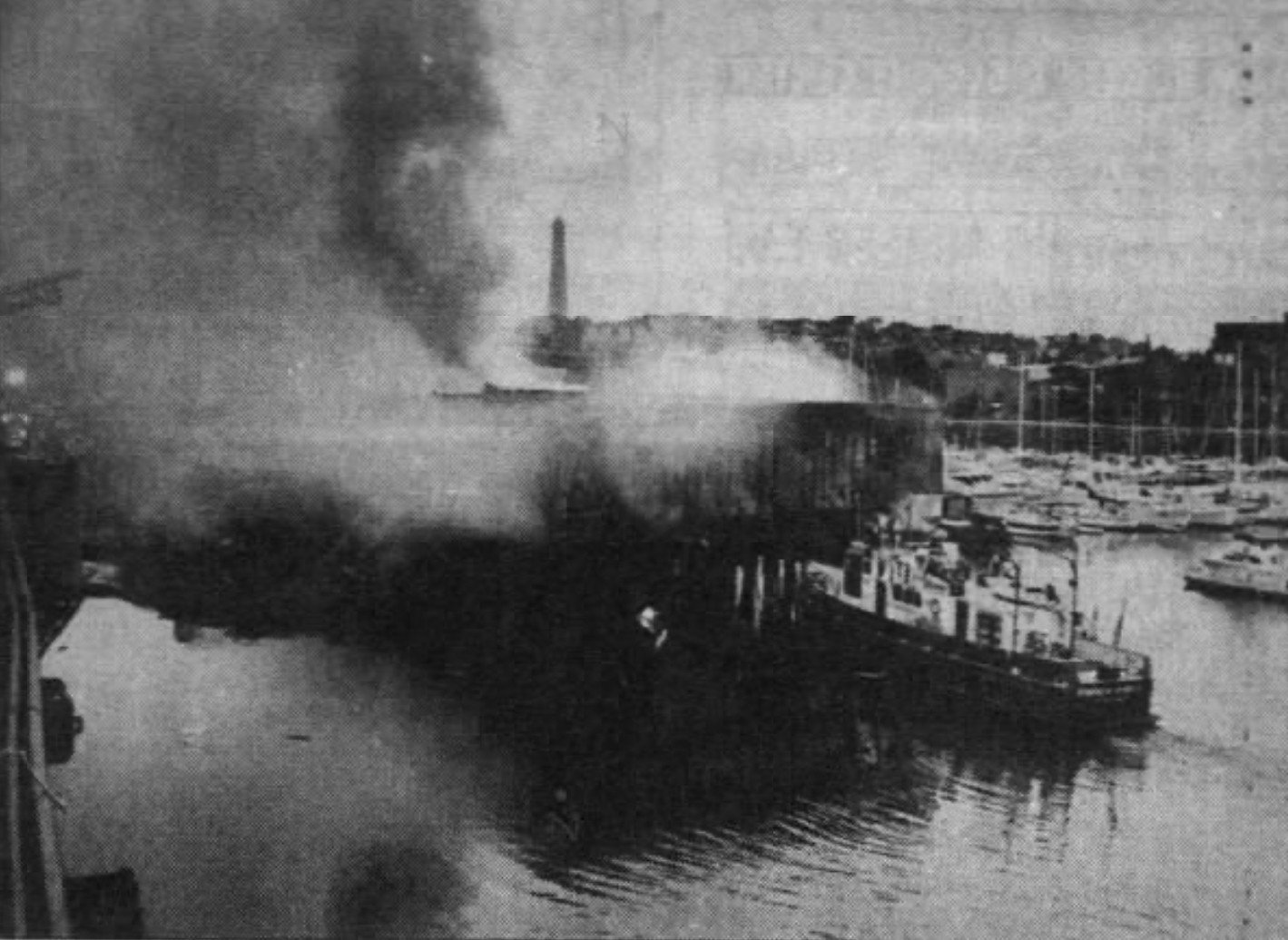
A fireboat attacks the warehouse fire from the waterfront.
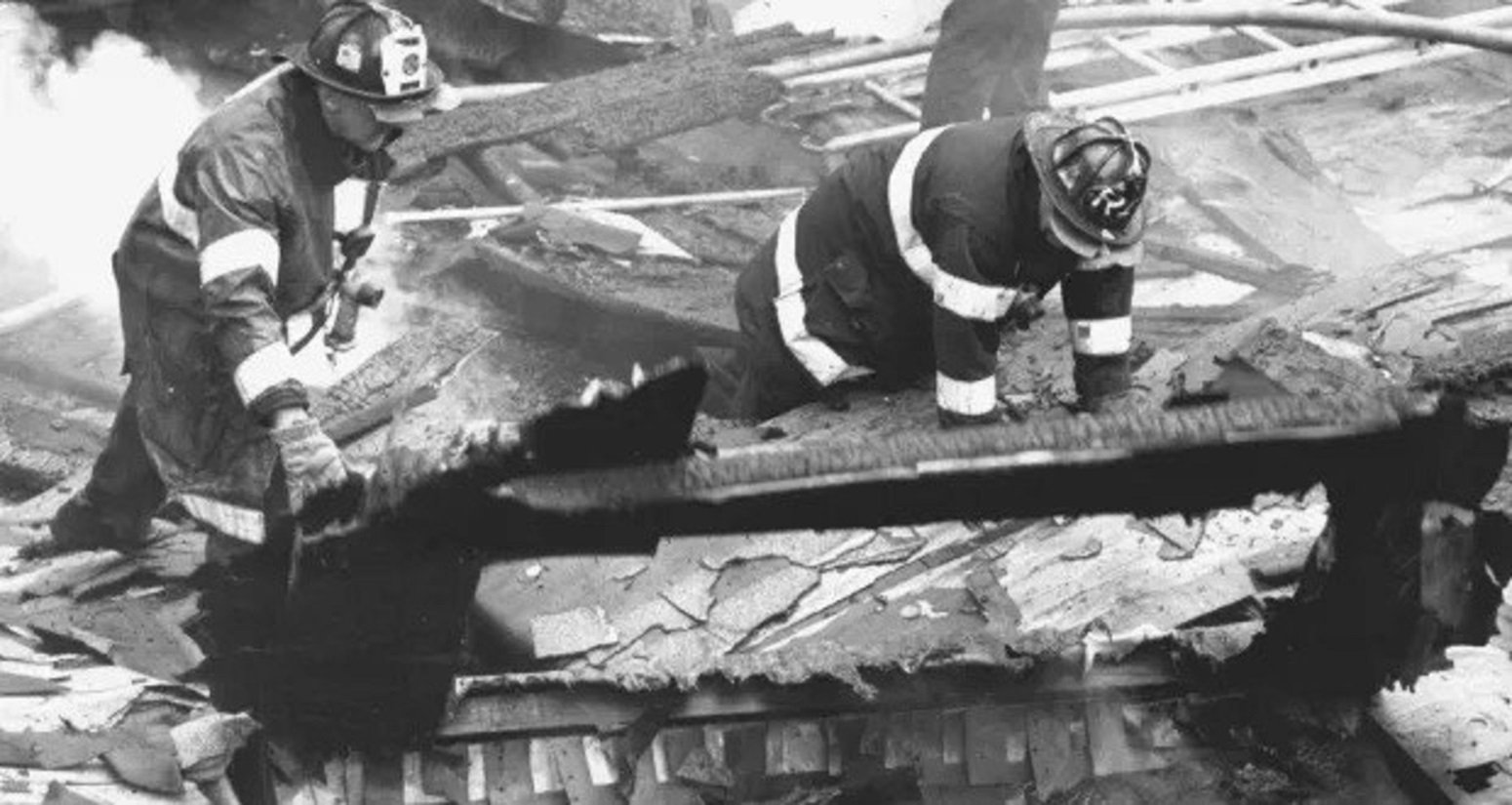
The body of Lieutenant Minehan was located later that morning at 7:30 a.m. in the smoldering ruins of the warehouse by members of his company. He apparently died from inhalation of smoke and gases as his SCBA facepiece was off when he was found in the building. “We believe he might have got lost in the heavy smoke and fire conditions and perished in that way,” Pierce said. “He died doing what he loved to do.”
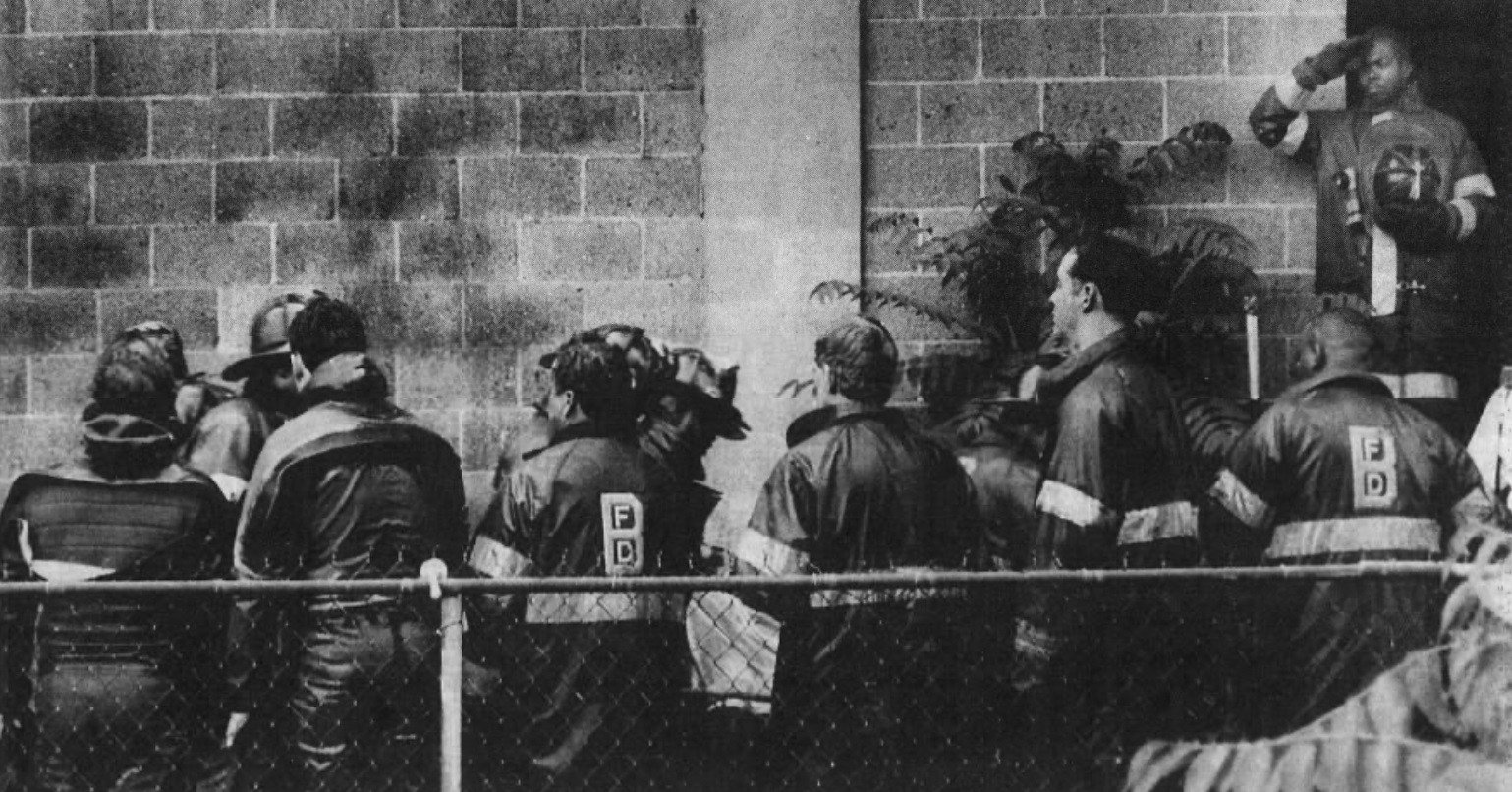
Firefighters salute as the body of their fallen comrade is removed from the scene.
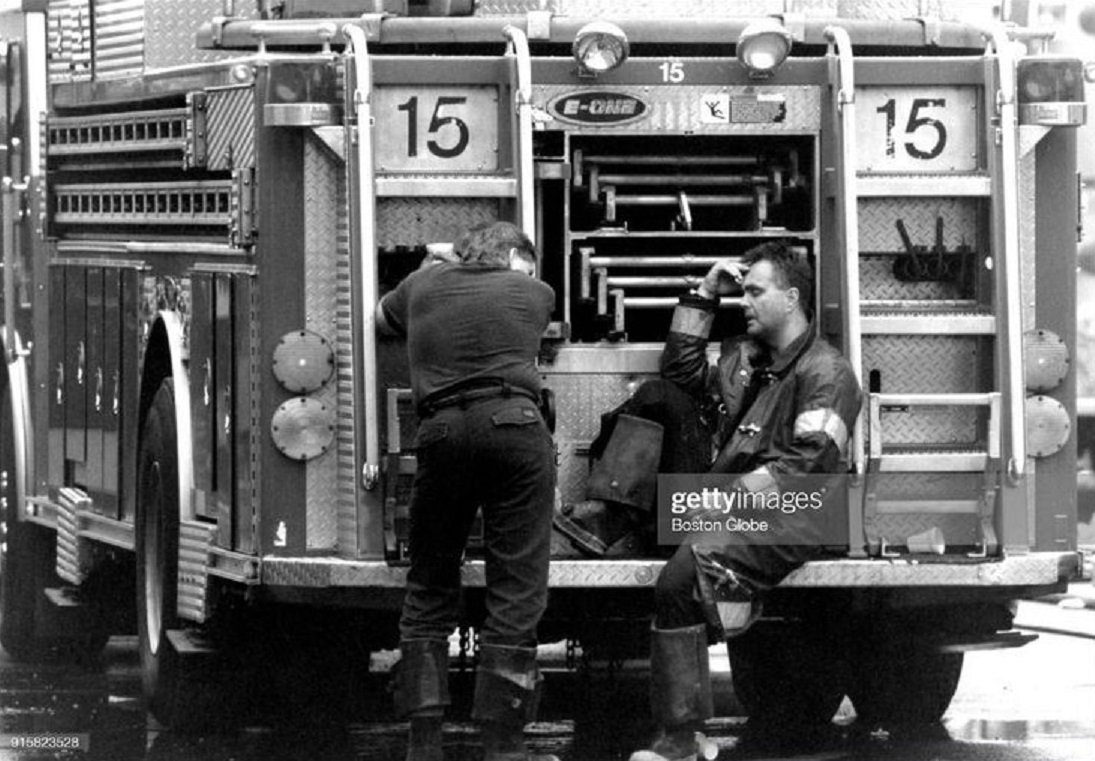
Firefighters from Ladder 15 react to the loss of their company officer.
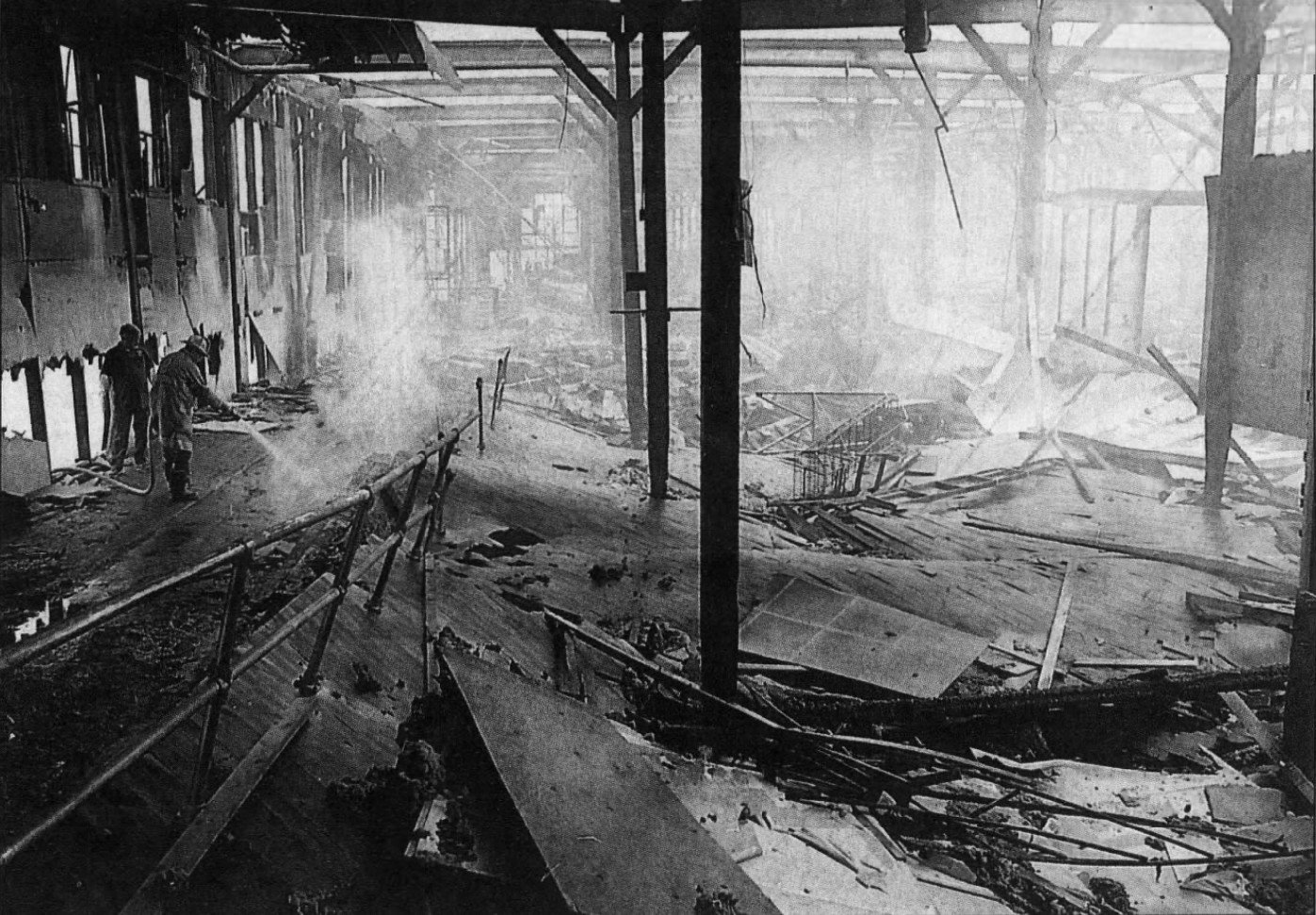
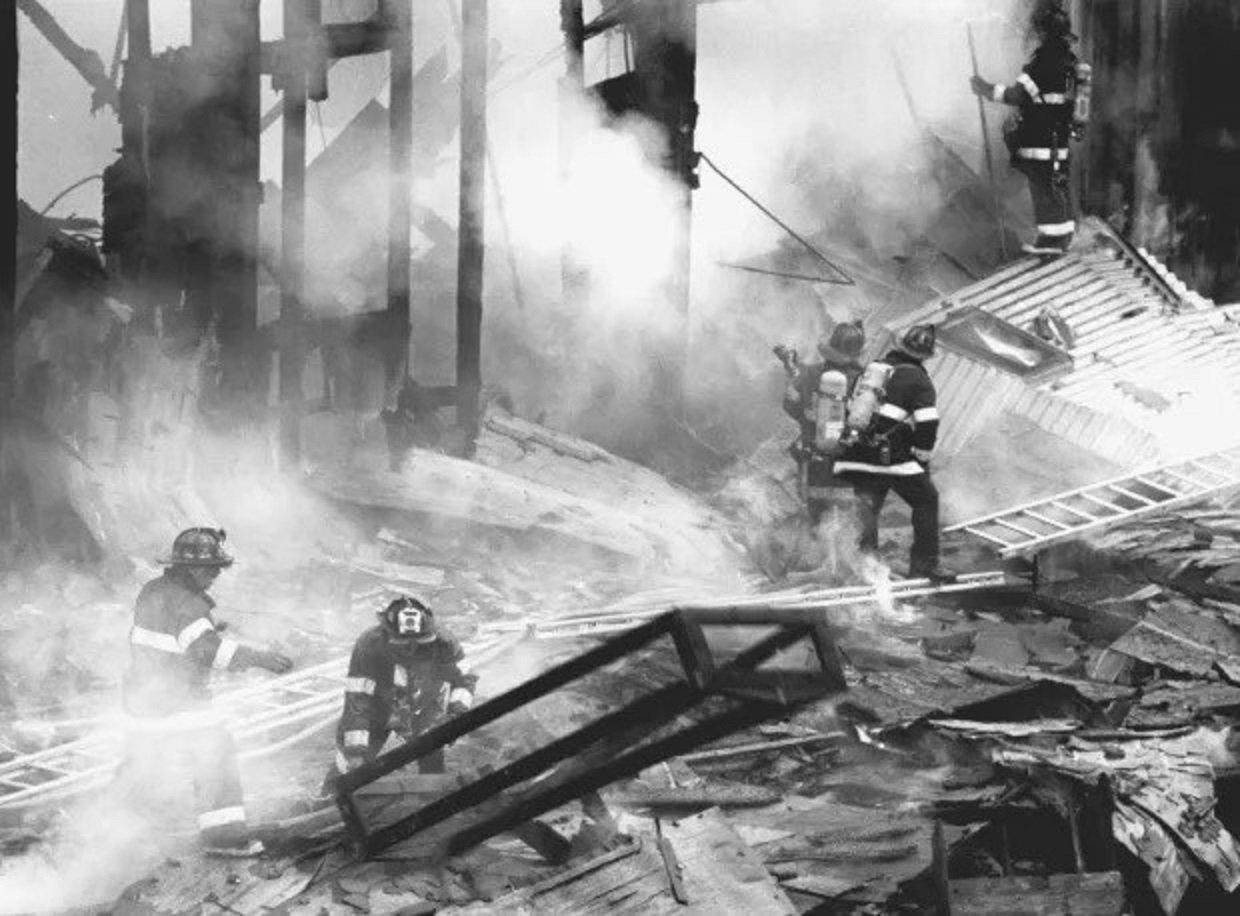
Photo of the gutted interior of the warehouse showing the vastness of the building.
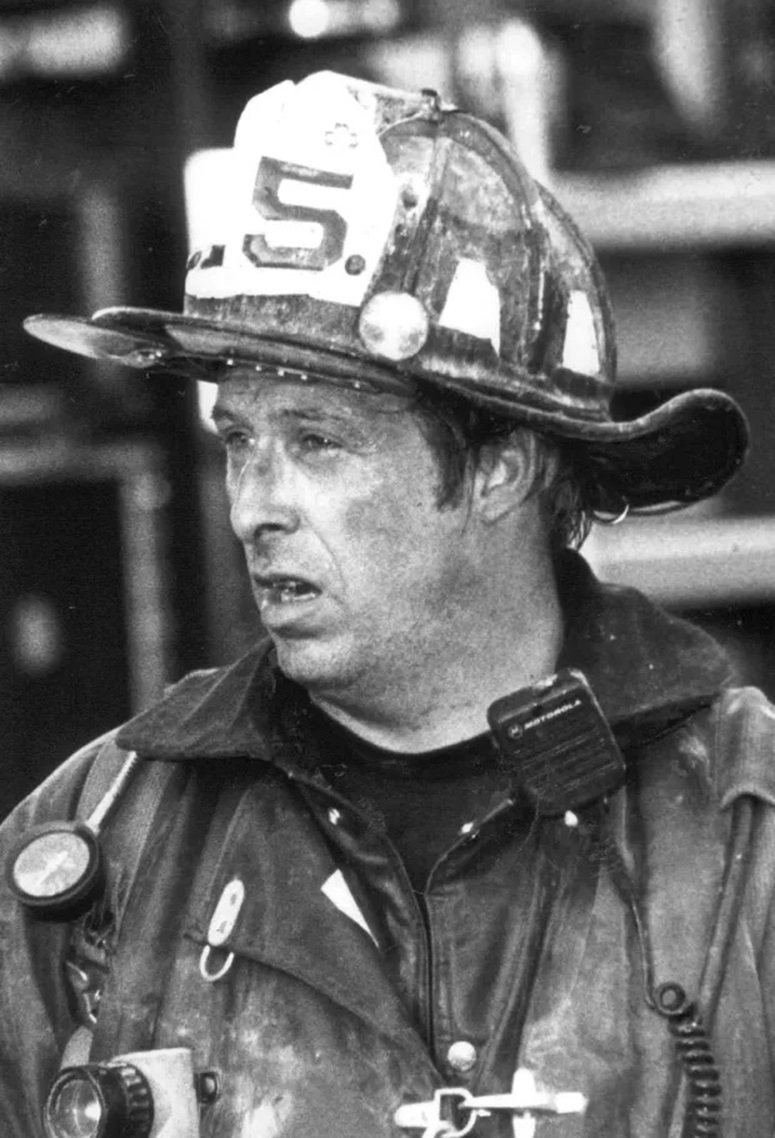
Fire Lieutenant Steven Francis Minehan, age 44, was a 20-year member of the Boston Fire Department and a lifelong resident of the city. He started his career at Ladder 26 in Roxbury, one of the busiest fire companies in the city. Minehan was promoted to Lieutenant on April 5, 1989 and was assigned to Ladder 15. He was a third-generation member of the department; his father and grandfather also served in the Boston Fire Department. Minehan grew up in the Fields Corner section of Dorchester, attended parochial schools and two years of college. Prior to joining the Fire Department, he served as a volunteer ambulance driver and emergency medical technician. While off-duty, he helped evacuate several children from a burning dwelling on Minot Street in Dorchester in 1987 before firefighters arrived, for which he earned a commendation. In 1995, Lieutenant Minehan was posthumously awarded the John E. Fitzgerald Medal for the Most Meritorious Act in the rescue of the two disoriented firefighters during the pier fire. Minehan was active in his church, St. Brendan’s in Dorchester and was also active in union affairs at Florian Hall, the headquarters for Boston Firefighters Local 718. He was survived by his wife Kathy, his son Joseph, and three daughters, Kelly, Meagan, and Katie, his mother Dorothy Minehan, and three brothers, four sisters, and a large family of nieces and nephews.
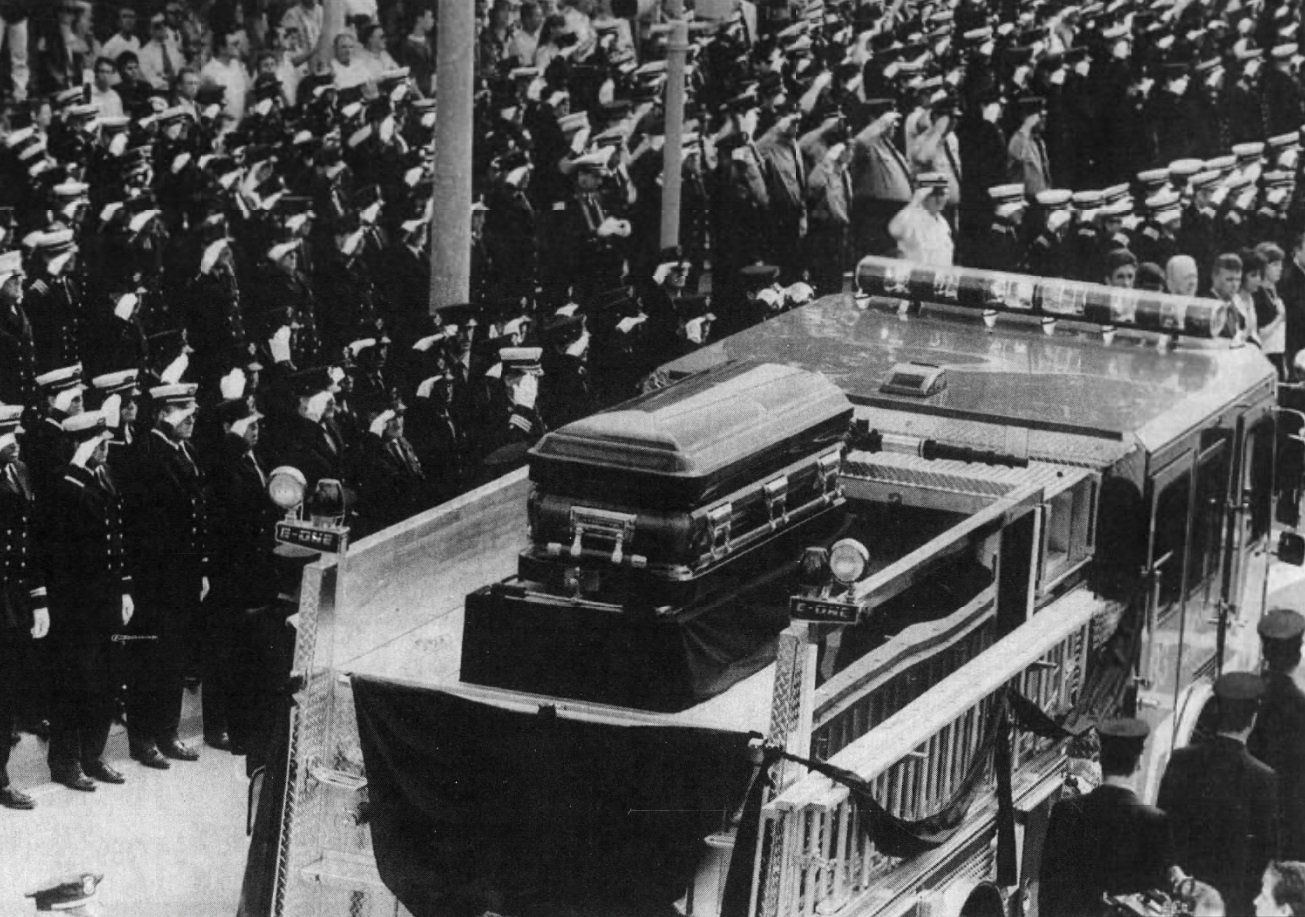
On June 26, more than 8,000 firefighters from the Boston area and around North America attended the funeral with full departmental honors for Lieutenant Minehan at St. Brendan’s Church in Dorchester. Interment followed at Cedar Grove Cemetery in Dorchester.
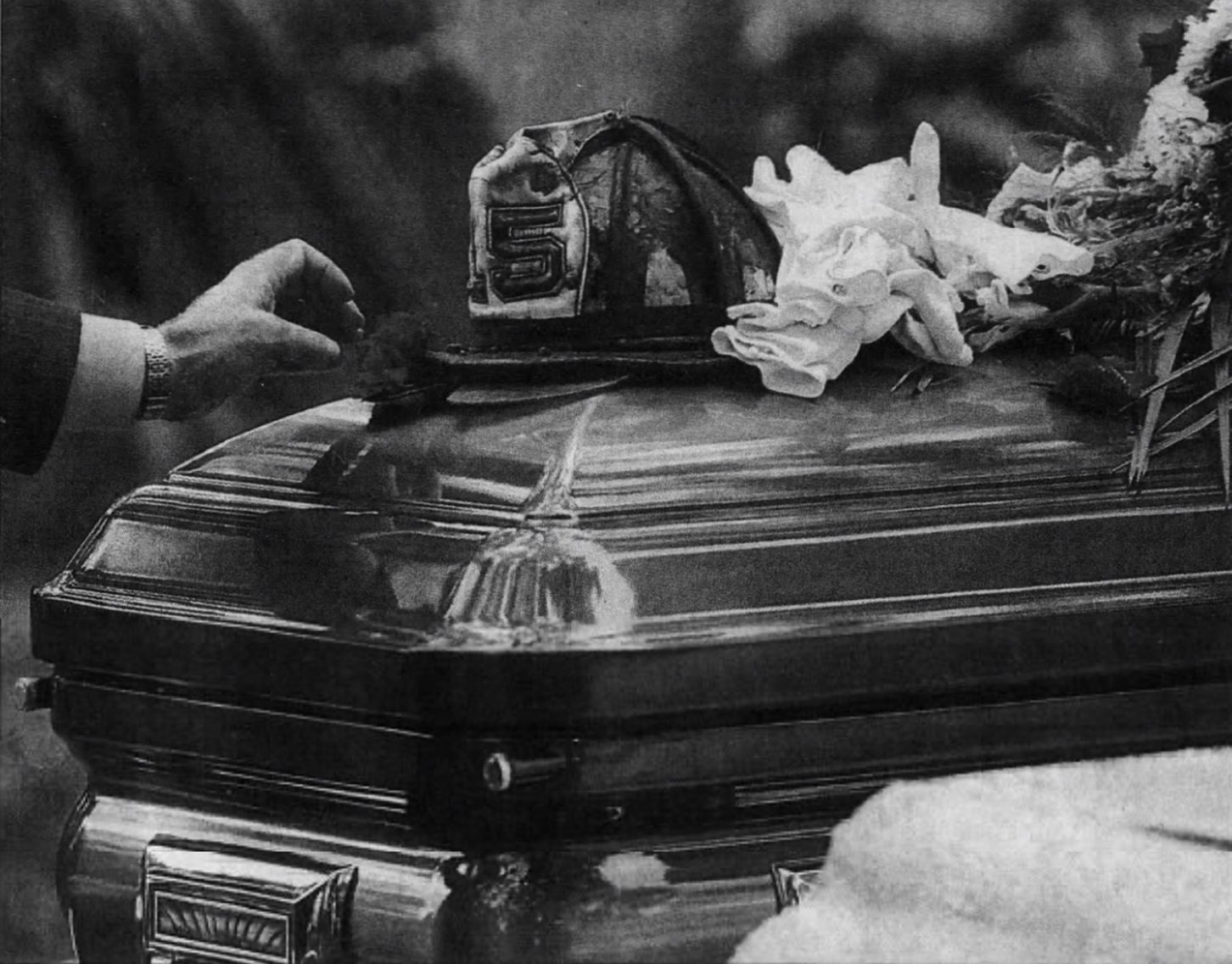
The battered fire helmet of the fallen fire officer was laid atop his casket during his burial ceremony.
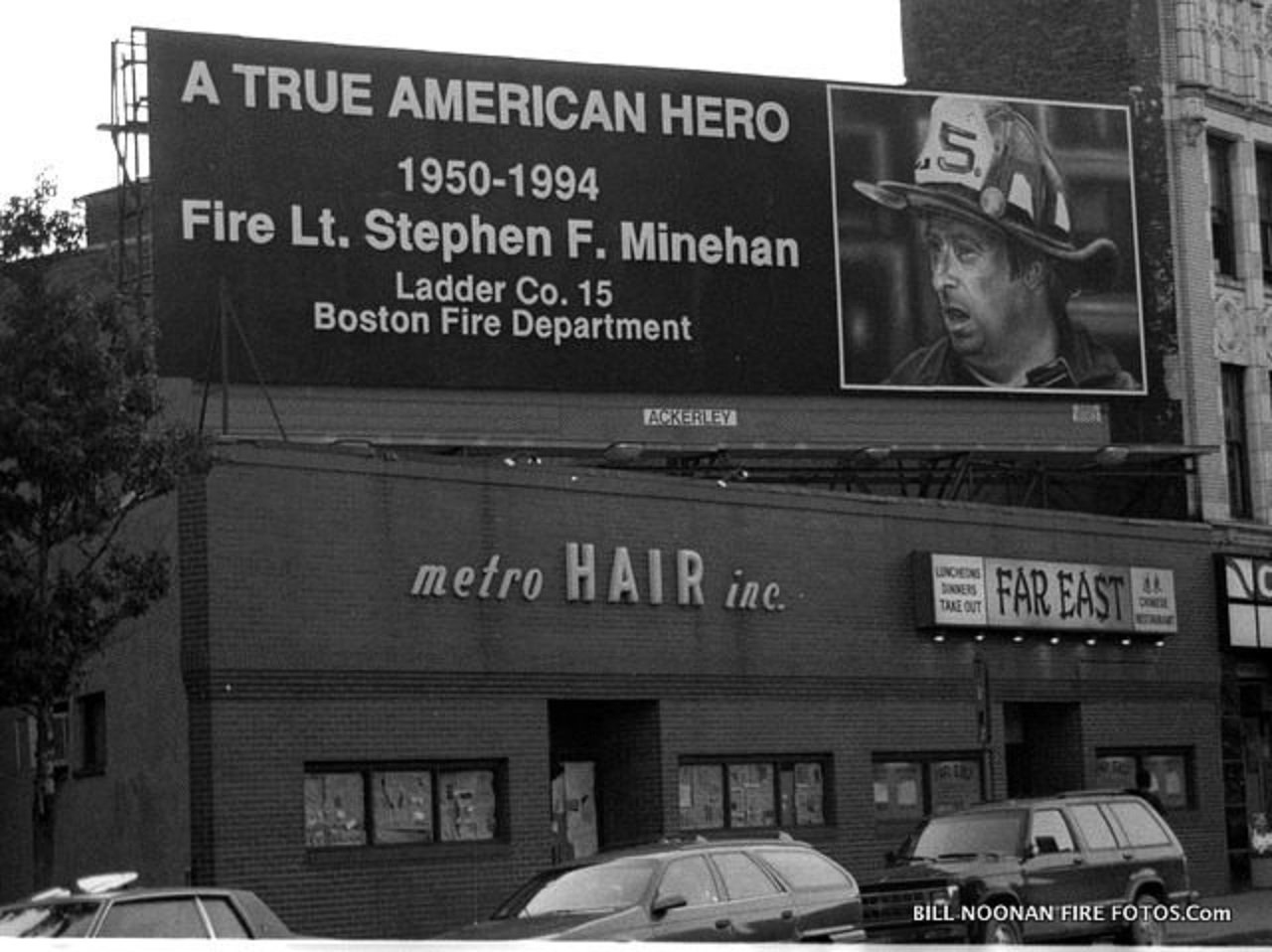
Billboard atop a building in Boston honoring the fallen Lieutenant.
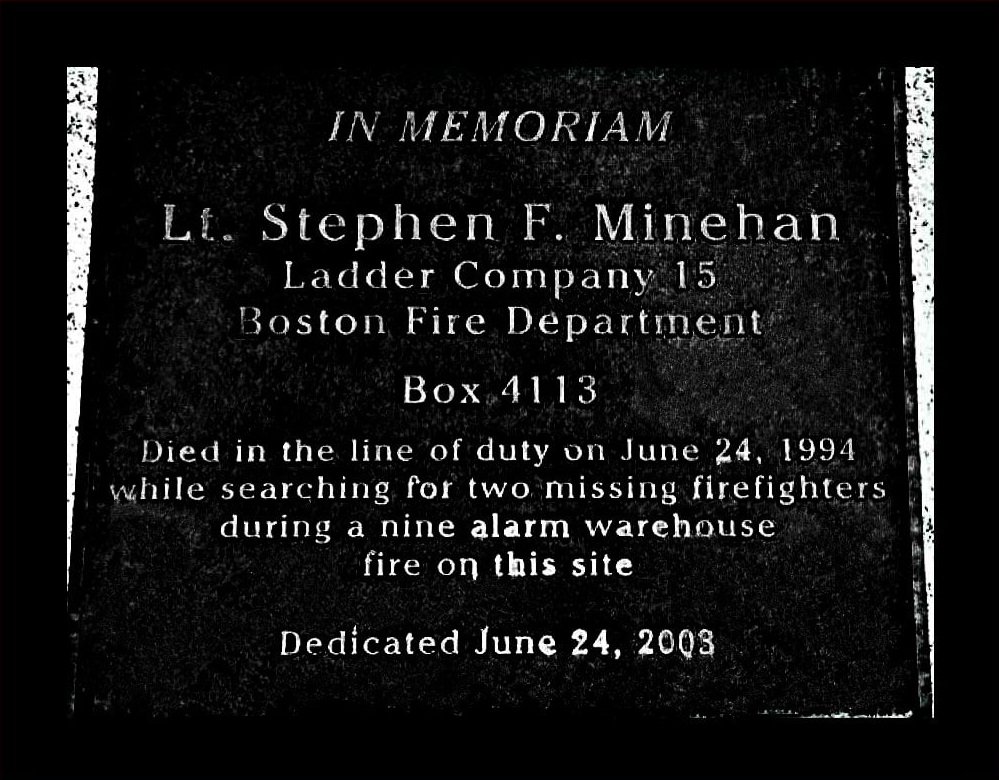
A memorial plaque honoring Lieutenant Stephen F. Minehan has been placed on the pier at the site of the warehouse fire.
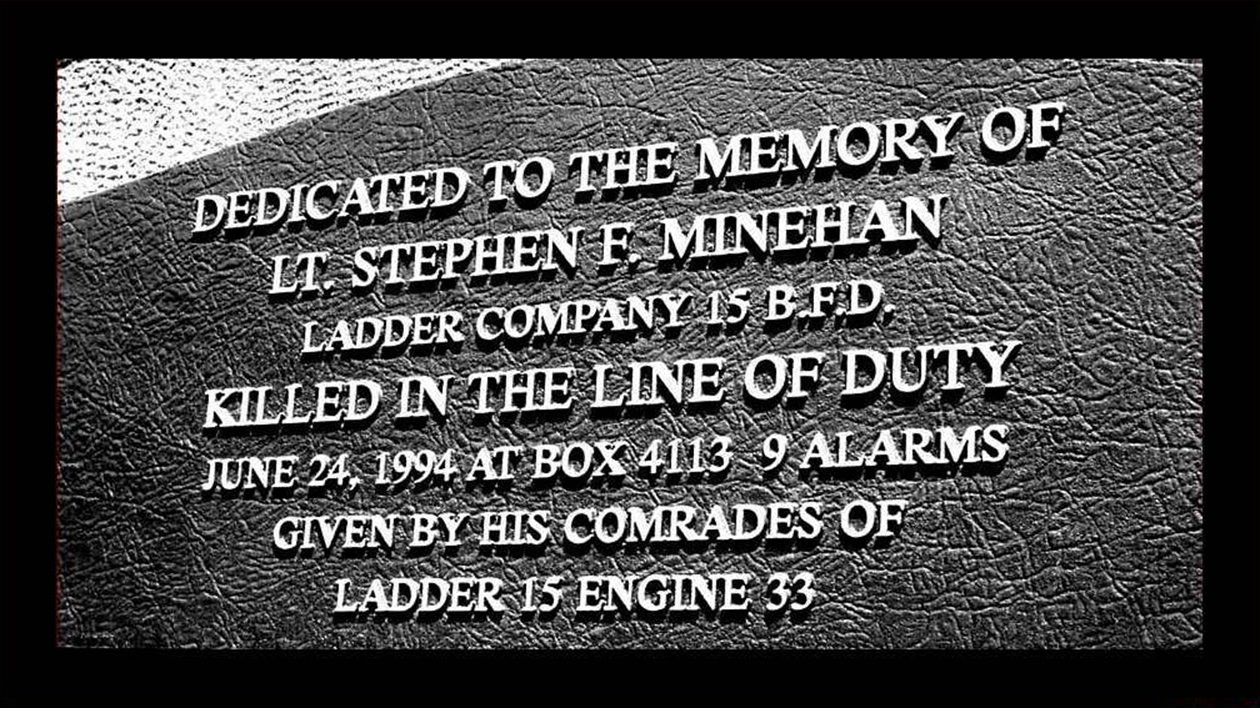
On November 13, 1994, a memorial plaque dedication was held at the quarters of Engine 33 and Ladder 15 at 941 Boylston Street in memory of the late Fire Lieutenant Stephen F. Minehan, who died in the line of duty on June 24, 1994.
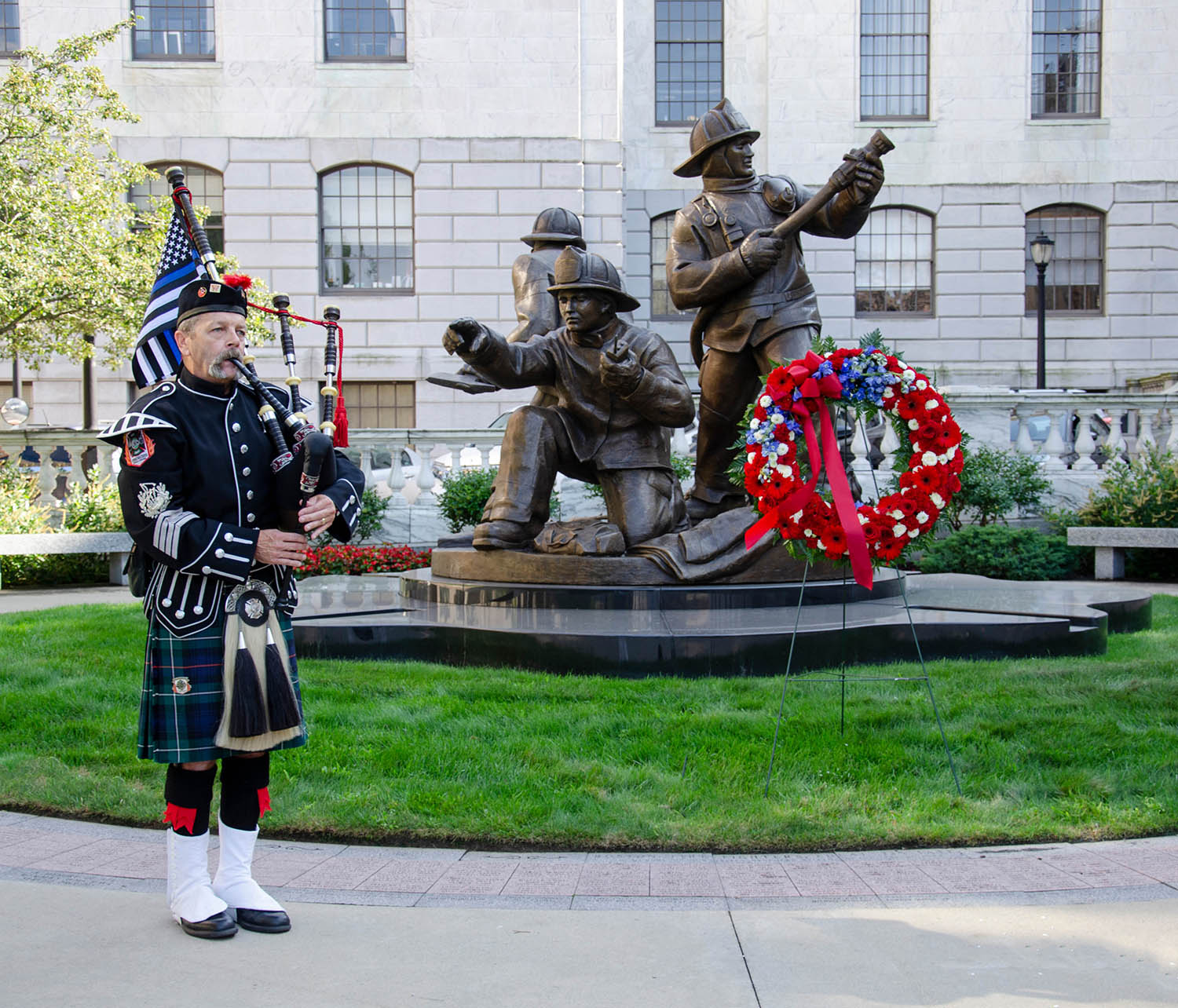
The name of Lieutenant Stephen F. Minehan has been honored at the Massachusetts Fallen Firefighters Memorial located on the grounds of the State Capitol in Boston.
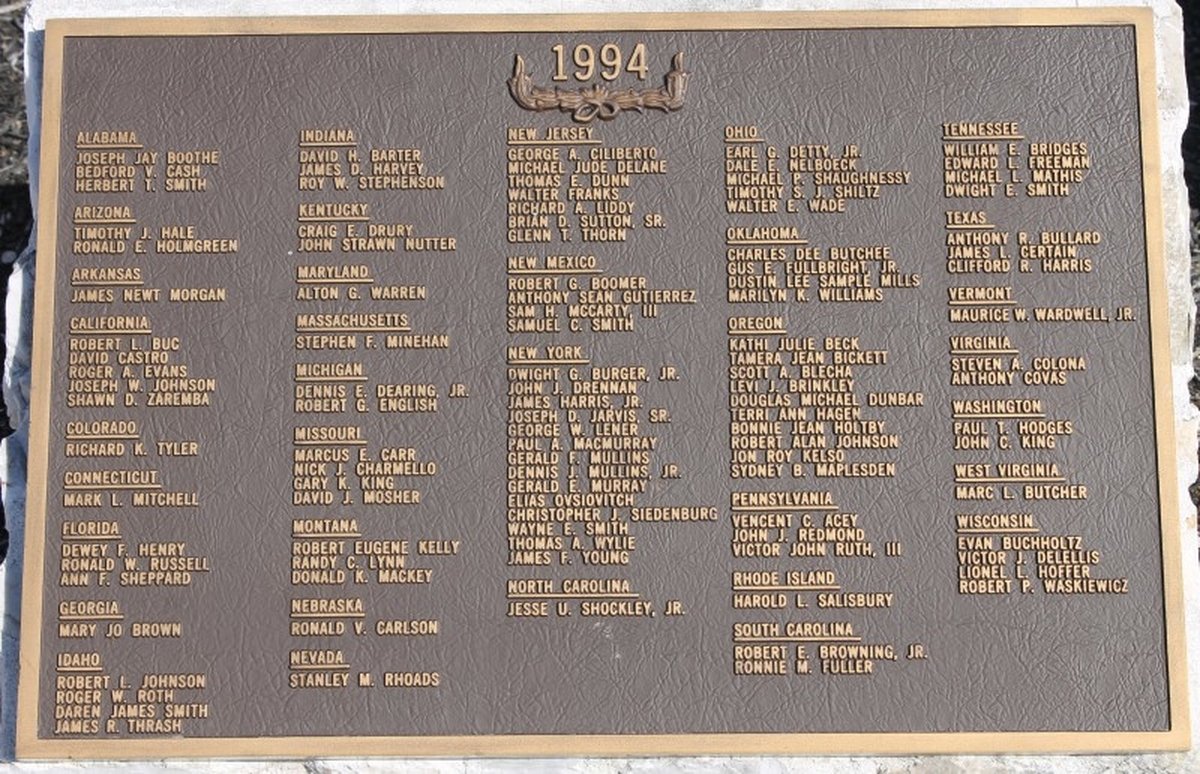
The name of Lieutenant Stephen F. Minehan has been inscribed on the 1994 plaque displayed at the National Fallen Firefighters Memorial on the campus of the National Fire Academy in Emmitsburg, Maryland.
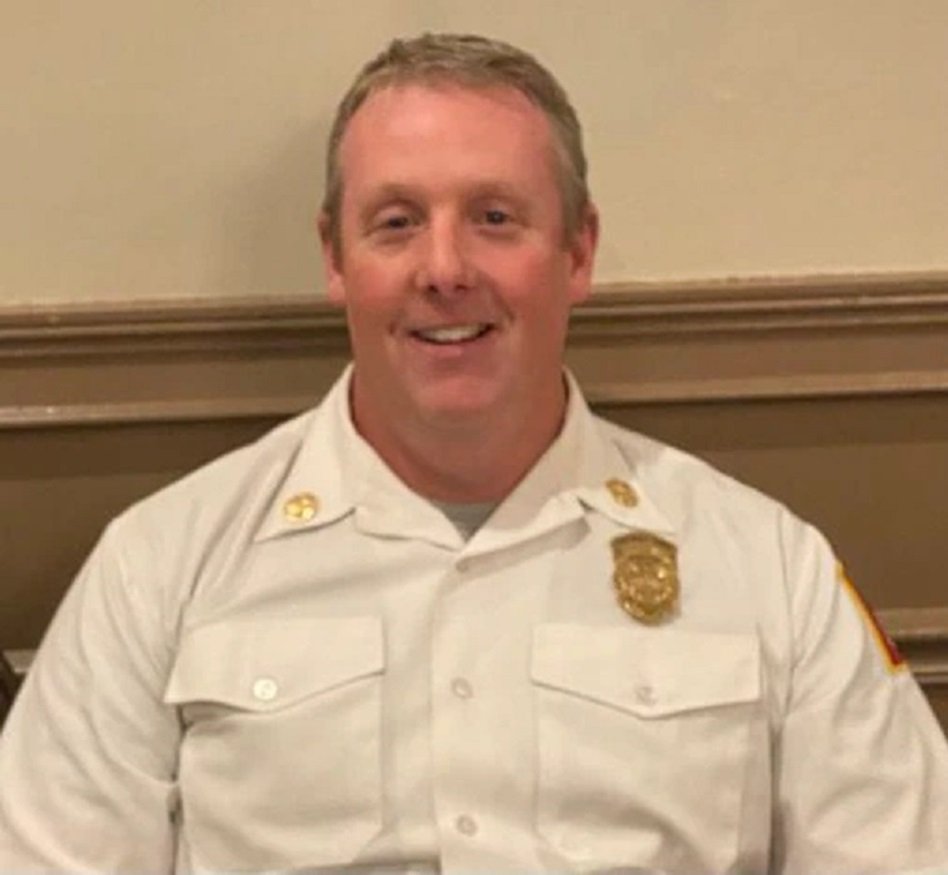
Twenty-seven years after Lieutenant Stephen Minehan made the ultimate sacrifice trying to save two fellow firefighters, his son, Joseph, was promoted to the rank of District Chief in the Boston Fire Department. Lieutenant Minehan’s daughter works as a fire dispatcher at the city Fire Alarm Office.
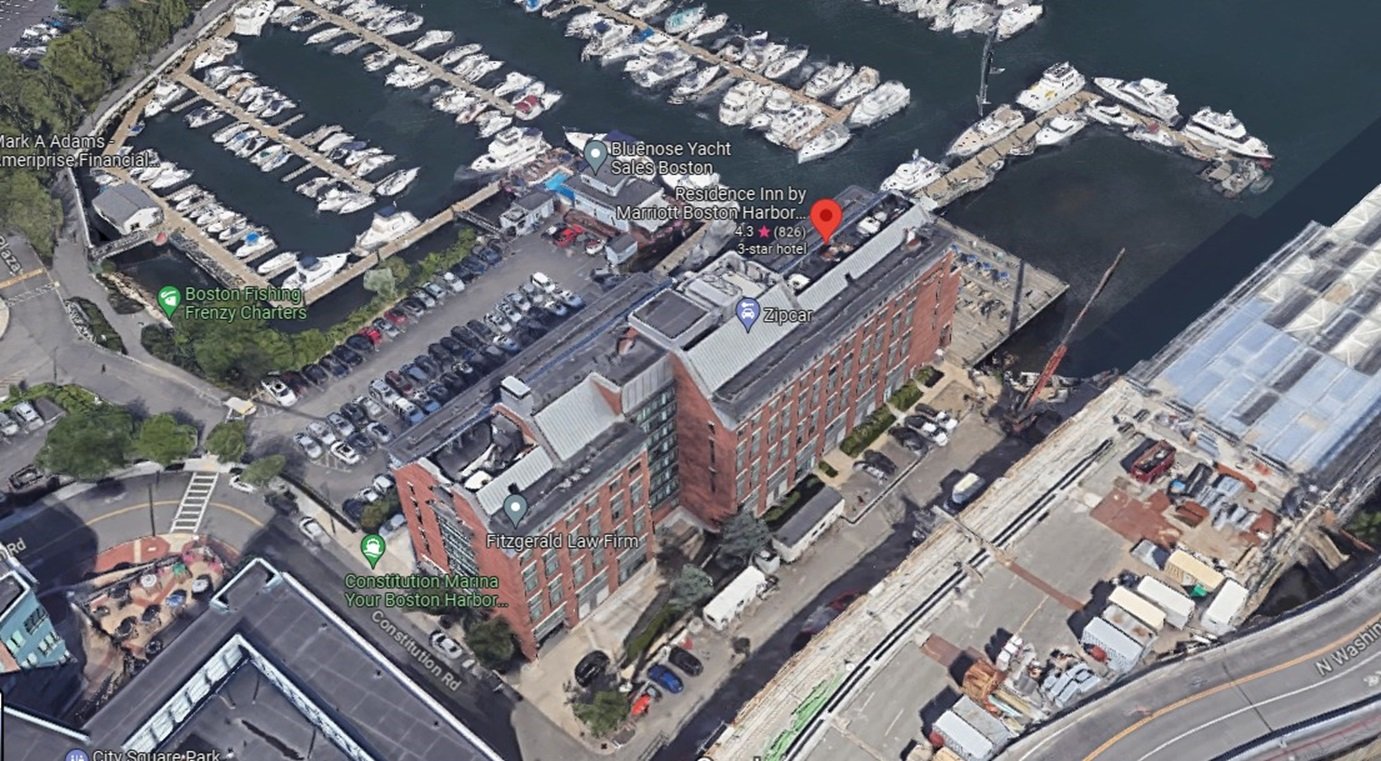
The site of the warehouse fire is now occupied by the Residence Inn on Tudor Wharf hotel in Charlestown.