
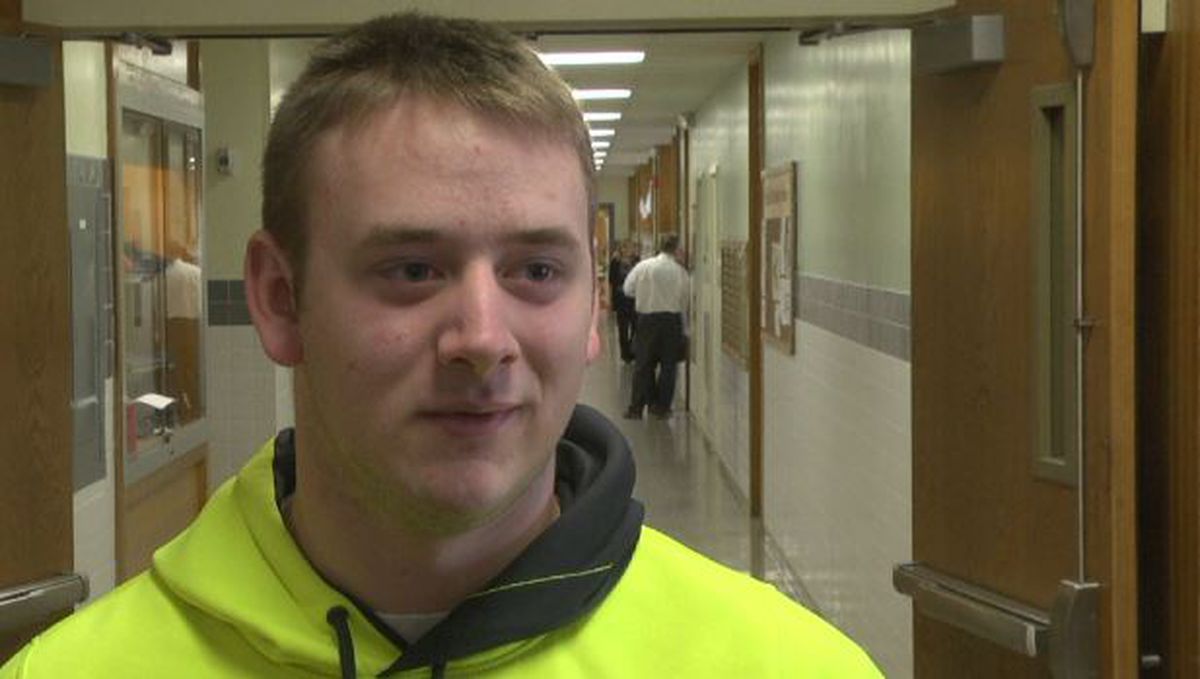
WATERTOWN — The breathing apparatus that city firefighter recruit Peyton Morse wore could provide clues to what happened when he was stricken with a medical emergency at the state fire training academy on March 3.
Data collected from his self-contained breathing apparatus, or SCBA, could show the events that led to him becoming unresponsive during the training exercise at New York State Fire Academy of Fire Science at Montour Falls, near Watkins Glen, said Daniel Daugherty, president of the Watertown Professional Firefighters Association, Local 191.
Mr. Morse, 21, who died Friday after fighting for his life in a Pennsylvania hospital, went into cardiac arrest during that March 3 training exercise in which he was wearing a breathing apparatus.
“I honestly don’t know why he went into cardiac arrest, and I’m trying to find out why he went into cardiac arrest,” Chief Matthew Timerman said Saturday. “I’m trying to find answers.”
The SCBA data will show when low-air alarms and other alerts went off while he was going through the mask confidence training exercise. It will also indicate the length of time the alarms were sounding, fire officials said. That data could be crucial in determining what happened and why he suffered the medical emergency. It could rule out that the apparatus was to blame, Chief Timerman said.
During that “Mask Confidence” and “Firefighter Survival” week of training, the main purpose was to see how the recruits perform while wearing masks and breathing apparatuses during a series of tests. Some refer to the rigorous training as “Hell Week.”
Mr. Morse, who also served as an assistant fire chief for the LaFargeville Volunteer Fire Department, wore a breathing apparatus — a Model G1 manufactured by MSA in Pittsburgh — that he brought with him from the Watertown Fire Department, said former city Fire Chief Dale C. Herman, who has been an instructor at the state fire academy since 1999 and taught recruits as recent as last week.
“You bring your own apparatus from your home department,” Chief Herman said.
The state police and the Public Employee Safety and Health Bureau are investigating what went wrong. The National Institute for Occupational Safety and Health, or NIOSH, is also expected to open an investigation this week.
On the day of the incident, 39 trainees were participating in mask confidence exercises in the state academy’s gymnasium, located in a converted garage at a former monastery in Schuyler County. They were simultaneously going through different “evolutions” or stations that were set up in the converted garage when the young firefighter became unresponsive, Chief Herman said.
The props often include: going through a maze; working in a building collapse station; and maneuvering through a corrugated draining pipe. At least a couple instructors typically supervise each prop, Chief Herman said.
It’s unclear which prop the young firefighter was inside when the incident occurred, Mr. Daugherty said. Chief Herman stressed that he doesn’t know what happened because he “wasn’t there.”
The goal of the training is to see how a recruit “can get out of a situation” while wearing the SCBA even while its alarms would be going off, Chief Herman said. The mask on the breathing apparatus Mr. Morse was wearing was covered with plastic wrap so he couldn’t see out of it, he explained.
As for the type of props, the collapsed building station would contain PCB piping, wiring and copper piping to act as obstacles and make it more difficult to get through it. Instructors press firefighters to work their way out of the situation.
When the low air alarm goes off, a firefighter can see two green lights, a yellow light and a red light in the vision of the apparatus’s mask, indicating how much air remains in the air cylinder.
As there is less air in the cylinder, the lights go from green to yellow, and then from yellow to red, Chief Herman said.
If a firefighter becomes motionless for any reason, an audible alarm also goes off to alert that they are in need of help. The only way the alarm can be turned off is if a firefighter physically resets and pushes a button, he said.
The city fire department has taken possession of the apparatus used by Mr. Morse that day. It remains locked in Chief Timerman’s office until a complete evaluation of the gear can be completed to rule out if there was a malfunction.
A MSA company representative completed a preliminary look at it, but so far, there’s no evidence there was something wrong with it, Chief Timerman said.
“There was something wrong with the apparatus, the academy or the prop,” he said, stressing the need of a thorough investigation.
While Chief Herman doesn’t know if any other trainee has ever died as a result of training at the state academy in its history, a Rochester-area fire department sounded its own alarms about an increase in injuries that have occurred during training at the facility in recent years.
Last year, Steven Mills, now retired fire chief of the Ridge Road Fire Department in Greece, sent a letter to state fire administrator, Francis Nerney Jr., expressing concerns about an increase in injuries suffered by the department’s recruits. He wrote that two recruits suffered shoulder injuries and another one was hospitalized after having a staph infection in 2019. One of the injuries occurred during mask confidence training.
Chief Herman said shoulder injuries can occur when firefighters take off and put on their apparatus and take it off and put it back during training.
Chief Mills wrote that he thinks there was “questionable conduct” by instructors, noting recruits rely on them because instructors are veteran firefighters from across the state.
Current Ridge Road Fire Chief Steve Johnson is now increasingly concerned about the training following the incident with Mr. Morse. He immediately drove down to Montour Falls to pick up his four recruits.
He talked to the four recruits and then removed them from further training after hearing what they witnessed during the incident. Chief Johnson took their statements and filed them internally with the Greece department in case investigators want to know what they saw, he said.
The city of Rochester Fire Department also withdrew its seven recruits following what happened.
When he conducted training last week, 29 recruits remained training at the academy, Chief Herman said. Mr. Daugherty thinks the academy training should have stopped the fire schooling until the investigations were completed.
On the day Mr. Morse had his medical emergency, Mr. Daugherty also drove down to the academy to pick up Watertown’s other recruit. He asked an academy official whether the 29 recruits gave statements to the facility about what happened and whether they were advised of their legal right to do so. They did give statements, but without getting their legal rights, the official told him.
Mr. Daugherty, the head of the Watertown fire union, asked if he could have copies of the statements. He was informed they would not be given to him, and that he would have to file a Freedom of Information Law request to get them.
On Wednesday, Chet Lasell, assistant director of communications at the state Division of Homeland Security and Emergency Services, said he could not comment about the status of the state police inquiry because it was an “ongoing investigation.”
PESH is a state investigative agency; the fire academy is owned by the state and oversaw by the Office of Fire Prevention and Control, which, in turn, is under the auspices of the state division of Homeland Security.
