
DOVER, NJ FIRE CHIEF – FIRE A WARNING SHOT ABOUT STAFFING9/11/2023 – RESOURCES FOR FIREFIGHTERS (Especially Our Younger Ones)While we all take time to remember the attacks on our nation, and the murderers of thousands, below are some documentaries and clips related to that day.…OF IMPORTANT NOTE: A heartbreaking milestone haunts this year’s 9/11 anniversary — 341 FDNY members have now died of Ground Zero-related illnesses, nearly equaling the death toll for Firefighters who perished in the 2001 terror attack. Last Wednesday, the FDNY added 43 new names to its World Trade Center Memorial Wall commemorating Firefighters, Paramedics, and civilian support staff members who’ve died from illnesses related to the rescue and recovery efforts after the 9/11 attacks, the second largest group to be added to the memorial wall since it was created 12 years ago with 55 names.9/11 RESOURCES
HERE are some articles, radio traffic and videos we thought you would find of importance:
FDNY Chief …
‘WE ARE ALMOST AT ROCK BOTTOM’: FACING BUDGET CONSTRAINTS, TEAYS VALLEY FIRE CUTS BACK ON SERVICESTEAYS VALLEY FIRE DEPARTMENT WILL CUT SERVICE AMID BUDGET SHORTFALL911 SERVICE DELAYS POSSIBLE FOLLOWING BUDGET CUTS TO FIRE DEPARTMENTFIRE STATION TO CLOSE DUE TO LOW STAFFING – CALIFORNIAVALLEY SPRINGS — “Closed due to staffing” — the message draped across a Calaveras Consolidated Fire Protection District station reads loud and clear.The chief said he has no choice.This weekend, the fire district was forced to brown out one of its two fire stations for a day, and more closures are ahead. Chief Rich Dickinson said that big banner, with letters written in fire engine red, is the best way to let his community know.Chief Dickinson said it’s a decision he wishes he didn’t have to make.“We’re going to be browning out more. I decided to buy that sign, to put it upfront so that people understand the firehouse is closed and why it’s closed,” he told CBS Sacramento via Zoom.The fire district’s staff is now down to just 13 firefighters, and Chief Dickinson said he’s lost 40 since he started here six years ago.The attrition problem comes from competition …LAFD RELEASES STUDY ON “STANDARDS OF COVER” – CALIFORNIAA newly-released examination of how the LA Fire Department handles emergency calls shows the department sometimes exceeds ideal response times because of traffic, a few neighborhoods in need of dedicated fire stations, and a lack of personnel.The “Standards of Cover” analysis looked at data collected between 2018 and 2020 to help fire administrators forecast needs for hiring and resources. The findings will form the basis for requesting new money for the department, beyond its existing $900 million-plus annual budget.The report also found that 911 calls are dispatched very quickly, firefighters are able to dress and leave their stations rapidly, and most stations are well-positioned to provide coverage to most of the city.“Where we are at our weakest, we are killing our people, way overworking our people, at rates that surprised a lot of us,” LAFD Deputy Chief David Perez told the Board of Fire Commissioners during a …WHY MOUNT HOLLY FIRE DEPARTMENT NEEDS TO ADD 12 NEW POSITIONS, TWO FIRE ENGINESJAMESTOWN CITY COUNCIL SUSPENDS HIRING FREEZE AND BEGINS SEARCH FOR EIGHT NEW FIREFIGHTERSFULLY-STAFFED NASHVILLE FIRE DEPARTMENT RECEIVES 81 NEW FIRE TRUCKS, AMBULANCES


What’s Been Happening?
What the Public, the Politicians, and the Press Are Saying


Our last report was in January of 2012. In the interim, the editor has been preparing the resources necessary to assist modern public safety managers with the data, references, statistical, analytical, and consultative services that will assist them in creating agencies that are responsive, adaptive and effective for their communities. Please feel free to reach out to us if we can be of service to you.
As the initial wave of cutbacks and reductions in fire services, and the subsequent lack of substantial consequences was mitigated through reliance on federal SAFER grants, the fire service is seeing the coming year with fewer resources than ever, no increase in budgets, and an uncertainty towards continued support from the SAFER grant program. Doing ‘more with less’ has been accomplished through the persistence and tenacity that characterizes the fire service, thus emboldening public officials to now ask ‘do even more with even less.’ The challenges continue.
Interest and discussion in this historic re-sizing of public fire protection services has greatly diminished. TSL reader email contributions all but stopped. (Do you recall sending any updates, lately?) While updating the many changes with departments, we completed yet another project (#3) to summarize the totals of budgetary actions and their impact on personnel and physical resources. These are summarized in the Multi-Year Summary Report below.
The STAFFING PAGE has been updated and loaded with information, statistics, commentary and advice to aid the readers – managers, policy makers, labor leaders, researchers, community leaders, reporters, and all who have a stake in the public safety of their community. Feel free to use this information as a guide for comparison, inspiration, provocation and education. Let us know if we can be of further help.
1 – From the many comments that the budgetary crisis did not begin with the recent economic crash, but in fact, has been draining some fire departments since 2000, we researched the American Fire Services archives and brought out the cuts, closures, and staff reductions for the last ten years. Noted also is the Staffing page has reported only on the departments for which you submitted information. Again, we scoured the archives to include those departments that we had not heard about. The bad news? – It was a huge task. The good news? – We finished three months early. The results? – Considerably more career fire departments are in trouble than initially reported.
2 – Analyze and summarize what has happened due to budget cuts in the past year. It is evident that fire departments are being targeted nationwide. The primary objectives are contracts, salaries, and benefit packages. The secondary losses, coming directly from reduced staffing, are losses of stations and companies. Small and mid-size city fire departments are being hit the hardest. Massachusetts and Michigan lead the losses. A more detailed comparison is being researched. In reviewing hundreds of fire department reduction articles, it is clear that municipal officials, both elected and appointed, are resolved and determined to redefine public funded fire suppression. For the most part, resistance by the fire service community has been ineffective. We offer a few of the most common Do’s and Don’ts.
3 – Multi-Year Summary Report
Note the article from the January 2011 issue of “GOVERNING” by Jonathan Walters and read what policy makers are thinking and saying!
Do rotating “Brownouts” serve the public’s safety and “share” the risk? Read what’s happened in San Diego.
“Despite the cuts, the fire district says service won’t be affected,” Look at what tax payers, politicians, and the media are saying.
Also, check out the latest “Amazing Quotes” – The things public policy makers are saying to people.
Document your services to the community.
Document your successful operations and programs.
Document your prevention and education activities.
Document your community presence at every opportunity.
Document the assets, the jobs, and the tax base, that you are preserving.
Talk about company availability.
Treat the public with professionalism, kindness, and courtesy.
When they need you, they are not usually having a good day. Remember, you may have been to dozens of fires, hundreds of wrecks, and thousands of sick calls, but must people are experiencing their first and only one, and it is tragic for them.
Remember that your mostly secure job has been funded by the taxes of others who may have recently lost their own jobs.
Overemphasize response time.
They are not listening. Most people long to live and vacation in settings where response do not matter as much.
Talk about reaching medical calls in three minutes every time.
They know about having to wait for hours in hospital emergency rooms, doctors offices, and clinics.
Brownout stations or companies.
If you don’t need them 24/7/365 – you don’t need them.
Implement rotational brownouts.
Don’t tell them that a company isn’t needed, but that by rotating closures; you can’t prioritize which ones you don’t need. You are actually telling them that you don’t need any from the rotation schedule. Russian roulette has 5 blanks and one bullet – you see the bullet, they see the blanks.
Abuse sick time.
The media is watching.
Do anything that you would not do in front of your parents.
Acts of stupidity, recklessness, and criminal arrests make great headlines.
Inflate your run statistics.
Non duty responses will be scrutinized.
Play the “Buildings will burn and people will die” game.
All fires left alone will go out by themselves eventually and the sick will either get better or worse. You know it – they know it. Talk about what you do for them – not what will happen to them.

This report’s updates are in three sections. New and updated information is listed first. Consequences of fire department budget cuts are listed next and cumulative information is listed last. It is there so that you can use it for ideas when you are defending your department against cuts. Please take a moment to review and update the fire departments that you know about and send us the information. If you are forwarding a print article, please send the article rather than just the link. [email protected] We are in this together.
Times are tough. What’s a public system to do?
As public budgets continue to shrink, how can EMS leaders make smart but tough choices that keep their doors open and let them keep serving the public? A report by well-known consultants Fitch & Associates, Making Smart Choices About Fire and Emergency Medical Services in a Difficult Economy, looks at problems being faced by emergency services managers and presents a variety of solutions that are working for some.
In many communities, public safety funding makes up as much as two-thirds of the municipal budget. In today’s economy, where real estate values have dropped significantly, budgets that rely on property taxes have been impacted dramatically. When community leaders slash budgets in response, emergency managers are left to determine how to save money without costing lives.
According to the authors of the report—Fitch’s Joseph J. “Jay” Fitch, PhD, and Michael Ragone and the RedFlash Group’s Keith Griffiths, who produced it for the International City/County Management Association (ICMA)—this financial squeeze will not end any time soon. They cite U.S. Fire Administration officials who say that even once the economy rebounds, it will take 1–3 years for municipalities to see increased revenues. Fire-rescue agencies can expect a 3–5-year wait before seeing their budgets increase.
A public agency’s sheer size and exposure in the public eye make it an easy target for cuts. One easy and often-used technique is across-the-board cuts that affect every municipal department. The intent is to “share the pain” by treating everyone the same. But not every unit of government has the same mandates and measures to define success. This means across-the-board cuts are liable to have unintended consequences because the budget “fix” has not been thoroughly thought through. A more accurate process is to have serious policy discussions that take into account what the community really values, then prepare budgets accordingly.
Personnel costs are often a high percentage of agencies’ budgets, as well as municipalities’ overall expenses. An example in the report cites that public pensions represent 20% of Los Angeles’ budget costs. One way cities are lowering these costs is by moving from defined benefit plans to more 401(k)-style defined contributions plans. Another money-saving technique is a tiered system where new hires earn fewer benefits initially, but their benefits increase with tenure.
Attempts to maximize payroll dollars include the ongoing debate over whether it is cheaper to pay overtime and work existing employees more hours, or hire additional responders to save overtime costs. According to the report, the general rule says that if it costs more than 50% of pay to hire and provide benefits to new employees, then it is cheaper to pay overtime to current staff. However, strongly held beliefs and traditions also come into play when trying to decide how to proceed, which makes the overtime-vs.-new-hire decision process unique to each agency considering it.
Some agencies explore using alternative service delivery methods to achieve more (or at least maintain) with less money. But Fitch cautions EMS managers to keep the medicine in mind when looking into solutions that affect response capabilities. “Decisions on how to respond need to be based on sound medical evidence,” Fitch says. He notes that response time targets need to reflect how they affect outcomes, not necessarily just some arbitrary performance standard.
The report’s authors cite two different concepts that are finding success. In suburban Portland, OR, Tualatin Valley Fire & Rescue runs ALS-equipped and -staffed engines and uses a private third party for transports. The department deploys peak-demand engine companies or rescue response vehicles to answer calls and maintain response times during busy periods.
The San Jose, CA, Fire Department has devised a resource management strategy called dynamic deployment to minimize the impacts on service of shutting down fire companies. They faced some upfront costs for software, communications personnel and ongoing data gathering and analysis, but officials expect to reduce service-level impacts to the most critical calls.
Several other communities are using different means of triaging calls at their dispatch centers and offering callers alternatives such as nurse-assist lines or appointments with and transportation to clinics. Costs are lowered, risk is reduced from fewer emergency runs, and resources remain in service for true emergencies.
The report offers good advice on patient transports for EMS managers trying to decide if ending transports by contracting with third parties would be better. Fitch says this process can be complicated because most requests for proposals only ask applicants what they can do. This makes it hard to evaluate competitors. According to Fitch, a more objective procurement process will clarify the agency’s service expectations and ask applicants how they can meet them. RFPs written in this fashion will result in responses that can be objectively compared based on how well applicants meet the designated standards.
Fitch says the bottom line to any decisions that affect response-to-service requests is unique to every agency. “Whatever is decided has to work for that agency based on its mission, staffing, attitudes and local needs,” he says.
Grand Rapids Press
“Insurers alone decide on what rates they will charge and what insurance markets to do business in,” said ISO spokeswoman Jessica Riccardi in an e-mail. “As such, ISO cannot speculate on how a fire classification change will affect local property insurance premiums.”
If a fire breaks out in your home or apartment, how soon will firefighters arrive? How quickly can they put out the blaze?
The answer depends on where you live, the time of the day and if there’s a fire hydrant nearby.
Most homeowners don’t think about it much. But the insurance companies have a pretty good idea.
How they calculate the risks depend on the insurance company and their assessment of your community’s fire protection.
Many insurers rely on the Insurance Service Office (ISO) “Fire Suppression Rating Schedule” that rates protection in each community.
It’s produced by ISO, a private company that sells the information to the insurance industry.
Based on a 1-10 scale, ratings are assigned to each community on the basis of three community factors. More about that later.
The city of Grand Rapids carries West Michigan’s highest and best ISO rating at 3, thanks to its full-time staffing in all 11 stations scattered strategically throughout the city.
Other cities with full-time departments such as Holland and Kentwood carry a 4 rating. Communities with a blend of full-time and “paid-on-call” firefighters typically are given ratings from 5 to 7.
Areas with no access to fire hydrants and reliance on all “paid-on-call” staff tend to be assigned a 9.
The panhandle region of Wyoming has been assigned a 10 ever since the city closed the fire station serving that area in 2004.
Although the city has arranged for “automatic aid” to the panhandle from Grandville fire department, the 10 rating still reflects the neighborhood’s distance from the nearest Wyoming fire station.
ISO bases its ratings on periodic visits to fire departments, where evaluators assess manpower, level of training, equipment, availability of water and dispatching capabilities.
Fifty percent of the rating is based on the department itself, 40 percent is based on the availability of water and 10 percent is based on a community’s dispatching service, according to ISO.
There are no statewide standards for the level of fire protection in a community, State Fire Marshal Ronald Farr said.
“It’s a local decision,” said Farr, a former Kalamazoo Township fire chief who took the job two years ago. “They have to do a risk assessment for their community and determine the type of protection they want to provide.”
For some sparsely populated communities, the high cost of protection out-weighs the risk.
Advocates of improved protection argue that a lower rating means lower homeowner’s insurance premiums that offset the higher tax rates that property owners pay to achieve the higher ratings.
ISO officials avoid the argument and declined to comment for this article. “Insurers alone decide on what rates they will charge and what insurance markets to do business in,” said ISO spokeswoman Jessica Riccardi in an e-mail. “As such, ISO cannot speculate on how a fire classification change will affect local property insurance premiums.”
But on its website, ISO argues the classifications do make a difference.
“On average, per $1,000 of insured property, communities in the worst classification had homeowner fire losses more than twice as high as communities in the best classification,” the website said.
“On average, across the country, the cost of fire losses for homeowners policies in communities graded Class 9 is 65 percent higher than in communities graded Class 5.”
The difference is greater when commercial property is considered, according to the website. Communities in the worst category had fire losses more than three times as high as communities in the best categories.
Some large insurance companies, such as State Farm and Auto-Owners, say they base premiums on their own calculations.
“We use our own database of claims experience as a substitute for ISO” said State Farm spokeswoman Angie Rinock. “Because we’re the largest homeowners insurance company in the nation, we have big enough database to be able to do that.”
Andy Flanagan, a spokesman for Auto-Owners, downplayed ISO in his company’s rate-setting policies.
“The exposure to loss from other insured perils may also change (a premium), both up and down, based on a company’s loss experience,” Flanagan said in an e-mail.
A survey of homeowner insurance rates by the Michigan Office of Financial and Insurance Regulation also raised questions about the role ISO ratings play in setting insurance premiums.
For example, the survey indicated many insurers charged identical rates for homes in Clare, rated a 7, as 3-rated Grand Rapids.
On the other hand, Flint and Lansing, both rated 3, saw several insurers charge higher rates than Grand Rapids.
Nonetheless, fire departments and community leaders pay attention to their ISO ratings.
Grandville Mayor James Buck recently urged citizens to call their insurance agents after ISO upgraded the city’s classification from a 5 to a 4.
Fire Chief Mike May said Grandville earned the new rating, effective July 1, because of improved dispatch and communication, training documentation, automatic aid agreements with Wyoming and a strong water supply.
“Always ask about discounts,” said Lori Conarton, communications director for the Insurance Institute of Michigan.
Many insurers offer discounts for nonsmokers, newer homes, homes with sprinkler systems and hard-wired smoke detectors, Conarton said. Rates also can vary based on the amount and type of coverage and the level of deductibles.
“It’s very competitive here in Michigan,” Conarton said. “We have hundreds of companies that operate here and each one operates a little differently, based on their own loss experiences.”
BY: Jonathan Walters | January 2011 Governing
As a matter of political gospel — and survival — firefighters are sacrosanct. No matter the depths of a municipality’s budget crisis, neither the firefighters’ ranks, pay nor benefits are touchable. There are no reductions in force for firefighters. And yet, in cities all across the country, that’s exactly what has been happening. The men and women in red are becoming as vulnerable to budget cuts as other municipal employees.
The new landscape has clearly been shaped by the brutal fiscal conditions in localities. In an era of such severe economic uncertainty, high-level municipal officials — elected and otherwise — have not been shy about portraying firefighters as a group that has vacuumed up more than its fair share of municipal resources — whether it’s for salaries, equipment and firehouses, or for some of the most generous retirement packages offered by local governments today.
But other factors have contributed to the new view, and one is a question of efficacy. There’s a growing discussion about whether — in a world with fewer fires and more emergency medical-related incidents and automobile accidents — firefighters are deploying resources to maximum effect.
The Cost-Efficiency of Firefighters
Right now, the cost of paying a firefighter is foremost on city officials’ minds. Take San Jose, Calif. Over the past decade, the cost of firefighter wages and benefits in the big California city has increased 100 percent, while city revenues have only risen by 20 percent, according to Michelle McGurk, a spokeswoman for the mayor’s office. The average firefighter, she says, now costs the city more than $180,000 per year. Moreover, the highest-paid employees in San Jose aren’t high-level city managers — or even the city manager — but upper-level members of the city fire service. Firefighters with 30 years of service can retire as early as age 50, with 90 percent of their salary.
That was just the beginning of the tough line that the San Jose mayor’s office took when it handed out pink slips to 49 firefighters last fall, a decision that the city laid directly at the feet of the San Jose firefighter’s union, Local 230. “Let me be very clear,” McGurk says, “we didn’t have to lay off firefighters. It was the decision of Local 230. They could have come through with concessions.”
With an open contract — the firefighter union’s collective bargaining agreement expired in June 2009 — the city asked Local 230, along with all other city unions with open contracts, to give back roughly 10 percent in wage and benefit concessions in a deal that would have saved the 49 firefighter positions. But Local 230 summarily rejected the idea, arguing that the city wasn’t in as bad fiscal shape as it claimed and that firefighters were being asked to bear more than their fair share of cuts.
Painting firefighters as something of a pampered class — well paid with retirement packages that would be the envy of anyone in either the private or public sectors — would have been unheard of just a few years ago. Today, it’s a widespread practice. Having spent a decade on a post-9/11 pedestal, the profession has been on the receiving end of more stringent scrutiny. Government officials and the public they represent appear to be taking a much harder look at exactly what they are buying when asked to spend bigger and bigger bucks on firefighters, firefighting equipment and emergency response.
In cities where firefighter layoffs haven’t occurred, it has frequently been due to concessions wrung from unions — despite unions’ reputation as tough negotiators. But it’s not that the unions have caved in easily to city demands. In Jacksonville, Fla., for instance, the firefighters’ union at first rejected a contract calling for a two-year, 2 percent pay cut, and that for the first time ever required single firefighters with no dependents to contribute to their health insurance. In the face of rejection, the city promptly followed through on its threat to lay off 15 firefighters, a messy process that involved bumping another two dozen active firefighters to lower-level jobs.
The move was the culmination of several years of tough budgets for Jacksonville, says Misty Skipper, a city spokeswoman. In a city looking at escalating employee costs of 20 percent in the next five years, it means that every employee in government must sacrifice. It’s part of a new reality. “In the past, our public safety sectors — police and fire — have essentially been held harmless,” Skipper says. “This year we knew the gap couldn’t be addressed just through nonpublic safety areas.”
In the face of layoffs, the Jacksonville firefighters’ union capitulated. Besides the 2 percent pay cut, single firefighters without dependents will now contribute 5 percent to their health-care coverage. While the 15 laid-off firefighters were reinstated with the recent ratification of the firefighters’ contract, the city will still eliminate 15 fire and rescue positions through attrition.
“Obviously, a pay cut is never good, especially when you’re already on the low end of the pay scale,” says Randy Wyse, president of the Jacksonville Association of Firefighters. (Starting pay for fire and rescue personnel in Jacksonville is just more than $34,000, with additional pay available for medical training, firefighting-related educational advancement and longevity.) “But my members understood the economic times and responded.”
What irritates Wyse about the firefighter cuts — over and beyond the sacrifice his members are making — is that in his view, the city is spending millions to keep its professional football team, the Jaguars, happy, and to develop local amenities like a $600,000 riverwalk. Given that, Wyse thinks the city has the cash for luxuries while it squeezes public safety. He is inclined to label the city’s budget crisis “contrived.”
Even if city resources may be somewhat constrained, he says, “there’s no recession in demand for our services.” The number of fire and emergency medical services (EMS) calls is increasing every year. Firefighters are, he says, “becoming the first line in someone’s health care.”
If Jacksonville — a consolidated city/county government experiencing less budget pain than most large municipalities — is forcing cuts to fire and rescue, it’s easy to predict what’s going on in the rest of the country. The litany of cuts, compromises, give backs and service reductions is astonishing.
In the wake of losing 23 firefighter positions in the summer of 2010 — an almost 25 percent reduction in manpower — Lowell, Mass., is now counting heavily on mutual aid from surrounding towns for fire suppression services. Firefighters in Muskegon, Mich., ratified a three-year contract that allows the use of more part-time firefighters. In Baltimore, firefighters were given the option of taking five to eight furlough days or risk losing 100 positions. In Elgin, Ill., a Chicago suburb, firefighters agreed to a “no raise, no layoff” contract for 2011 that also reduced its minimum staffing level from 36 to 34, saving the city a reported $750,000 a year.
In Newark, N.J., firefighters joined in a court challenge at the end of last year to contest a city budget that called for laying off hundreds of municipal employees, including two dozen firefighters. San Diego instituted a “rolling brownout” system, whereby certain firehouses are temporarily closed — an initiative that takes more than one-tenth of the city’s fire and rescue complement off the street each day, saving the city nearly $12 million per year. Meanwhile, New York City Mayor Michael Bloomberg recently unveiled a plan to significantly reduce municipal manpower — a plan that includes closing some fire stations at night. He is also embracing a proposal by the New York Fire Department to charge motorists up to $490 to respond to accidents and car fires.
“It’s one of the most challenging times I’ve ever seen,” says Tom Wieczorek, former city manager for Ionia, Mich., and now director of the International City/County Management Association (ICMA) Center for Public Safety Management. In the past, police and fire support staff might have gotten cut, Wieczorek says, but usually front-line police and fire were kept whole. “We’re now seeing communities that have been cutting budgets for the past eight years,” he says, “but you can only cut parks and recreation so much.” Given that 40 to 80 percent of municipal budgets go to public safety, it was inevitable that cuts would eventually hit uniformed services.
One of the big questions right now is whether the fire service is actually learning anything amidst the constant threat of cuts, especially about smarter ways to deploy resources in an era of shrinking budgets and departments. While police departments, especially in larger cities, have embraced a more sophisticated and data-driven approach to the work they do — allowing them to maintain relatively high performance levels — there’s been less willingness on the fire service’s part to embrace data as a way to revamp how fire suppression, EMS and other calls are handled.
For the most part, firefighting is still based on geographically distributed, fixed stations staffed by a set number of personnel who stand by and wait to be dispatched when needed. For the fire service to continue to perform in these leaner times, Wieczorek says, it is now going to have to actively embrace change — and that’s not something that comes easily to the fire service. “The old saying in the fire service,” Wieczorek says, “is ‘100 years of tradition unimpeded by progress.’”
One of the most significant and widely recognized changes in the fire and rescue service is that on average, most calls to fire departments now are for medical emergencies and not fires — running about 80 percent EMS to 20 percent fire in most jurisdictions where the fire service handles both. At the same time, most calls are either false alarms or not particularly serious. Yet too few fire departments have adapted very well to these realities. For example, San Jose still sends an attack pumper with a full complement of four firefighters to all emergency medical calls.
Tying up four firefighters and a rig for what usually winds up being minor medical emergencies doesn’t make any sense, says Bruce Hoover, chief of the Fargo Fire Department in North Dakota. Fargo’s protocols used to mirror San Jose’s exactly. But now Fargo fire trucks only roll if “there’s bleeding, breathing complications or trauma,” Hoover says. “We now only respond for true medical emergencies, and that’s cut our run count back by 1,000 a year, and has kept apparatus and manpower in place for real emergencies.”
But asking tough questions about manpower and deployment is difficult for many municipal officials who don’t feel confident tangling with the community’s best and bravest. A way to do that, however, without going toe-to-toe with the fire service, Wieczorek says, is simply to ask departments for solid, up-to-date data on demand, along with what measurable results a city is getting for its fire service dollars.
What most municipalities will find when they start to ask good questions about budgets, deployment and service demands is that there aren’t many answers to those questions. “We are routinely called into communities to look at manpower and deployment,” Wieczorek says. “We find across the board in small and large jurisdictions that data is either nonexistent or totally wrong.”
What drives firefighting in the U.S., for the most part, is long-standing practice, not good, current information on what’s actually happening on the ground, including number of calls, response times, seriousness of the incident, geographical distribution and time of day, all measured in relation to the geometry of fire service manpower, equipment and deployment.
For example, in one jurisdiction that asked the ICMA to come in and do a thorough analysis of demand, resources and deployment, the ICMA team looked at the busiest five minutes the fire department had in a year. What did the team find? Even at its busiest moment of the year, the city still had seven idle units standing by ready to respond, with 28 available firefighters. Those are just the sorts of analyses — in combination with the current budget crisis — that have emboldened policymakers and budget writers to start asking tougher questions about what fire departments really need and how they do business — and asking them to either hold the line on budgets or cut back.
Looking at both budgets and at more creative and data-driven ways to handle staffing and deployment are key. “Don’t get caught up in the hysteria trap of believing that if you pursue things like brownouts and budget cuts that children are going to die and senior citizens will burn up,” Wieczorek says. “That might happen, but only if we keep doing business in the same old ways.”


Late 2008, as the economic fantasy bubble burst, it became apparent that government revenues and the municipal budgeting process would be poorly suited for surviving the impending recession. Municipalities would be cutting services. Firefighter Close Calls decided to document this impact on municipal fire protection as it became evident that the magnitude of the cuts would rival the cuts of earlier generations and foreshadow a revolutionary change in public perception of how the fire service does business.
In the ensuing months, the municipal fire service has seen sizable decreases that can be generally categorized into three distinct areas. Changes have been made in compensation and benefit packages, reductions in staffing have been implemented, and stations and fire fighting units have been discontinued.
Changes in compensation packages have affected not only the fire service but all public sector employees and average working tax payers as well. Significantly, a large percentage of the fire service has secured their compensation and benefits by contractual agreements. In many cases, municipalities did not foresee the reduction of income and were trapped by long term contracts. Municipalities have frequently chosen to involve union labor to offer changes in benefits by forgoing or deferring general wage increases, expanding health insurance co-payments, rescinding promotional opportunities and eliminating overtime. Often these changes have been accepted as bitter-sweet – bitter as concessions of hard won benefits, and sweet for the saving of younger members livelihoods.
Deeper cuts took the form of employee layoffs. Staffing reductions have appeared in several ways. Municipalities froze hiring and overtime, effectively limiting shift staffing to the number of employees that showed up to work each shift. Public perceptions of sick leave abuse lead to official and media audits of work attendance. Employee layoffs have resulted in unit staffing reductions. Larger fire departments have managed to compensate by altering dispatch policies to send more units. Smaller departments that do not have broader resources or automatic aid agreements are simply deploying fewer staff. “Do more with less” and “Do the best you can with what you have” attitudes have capitalized on the fire service’s traditional “Can Do” culture.
The third method of cutting services has been to close units and stations. A common approach has been “brownouts.” These are characterized as temporary eliminations of services to specific neighborhoods or areas, while simultaneously leaving others intact. Some municipalities, in a perception of fairness, have eliminated and restored services from one neighborhood to another, on a rotational basis. Permanent reductions of services have occurred where units and stations have been closed outright. Yet, the job is still getting done.
Which fire departments are getting cut most severely and which ones are remaining intact? Significantly, and perhaps obviously, these issues are affecting the career fire service. Very little in the way of reductions and cuts have been reported from the volunteer fire service. It is the cost of compensation that is driving reductions. In the time immediately following the September 11 murders, the fire service enjoyed a period of approval, adulation and support. The perception of heroes among working people was strong. As the economic recession has swelled the unemployment rate above 10%, public perception has altered. The apparent security and benefits of fire service positions are no longer understood. The frequently used justification that “people will die”, is no longer threatening. Municipal leaders have even justified publishing brownout schedules in the belief that advance publicity will encourage people to be more careful.
“Response times will increase.” This statement no longer impresses the average citizen. While the survivability of a person in cardiac arrest is directly documented to the time that CPR is initiated, the time for a fire to double in size has been reported variously from 10 seconds to 10 minutes. To the individual who calls 911, response time is always from too long to forever, regardless of how long it actually is. Station and unit closures increasing response times are less effective arguments when the public remembers units being closed to increase staffing on others, without protest from the fire service.
Police agencies can document crime rates increasing when fewer officers are deployed. Sanitation services can document increased vermin populations when garbage is allowed to accumulate. School teachers can document declines in student grades when classroom sizes increase, but there is no correlation between the number of fires and how many stations are open. People will march and demonstrate when a fire house closes but seldom will they notice when a fire prevention office is eliminated. The work of the fire service has changed. There are fewer fires even as the population has exploded. Hazardous conditions and medical emergencies have grown, but the fire service still talks about fires. The fire service seldom demonstrates its abilities in front of huge crowds at big fires as often as it shows them to a few people at a time at motor vehicle crashes and medical emergencies.
Stand alone; isolated career municipalities have taken the greatest hits. City managers have made reductions based on perceptions of priorities and concepts of fairness to citizens and employees. Accusations of politics, retribution, and malice have been made. Departments lacking adequate staffing to begin with, are most easily cut, as the inadequacy is already present and only becomes more acute. Largely untouched are departments that serve regions or that participate in extensive automatic aid. Their efficiencies of scale have already been proven. In Fire & EMS departments, reductions are being made primarily on the fire side. EMS in general is not being cut. Some departments are shifting suppression personnel to EMS duties.
Physical resources are essentially unchanged. New stations continue to be constructed and major apparatus are still being purchased. In fact, some municipalities are stimulating their local economies by advancing their capital construction and station renovation projects. As the economy continues towards the bursting of the next bubble, the fire service needs to review the methods by which it expresses the relationship between the value of its services and the preservation of the community’s vital interests. It must extensively document the economic impact of its activities against the necessary expenses to achieve community goals. Citizen consumers must be continually educated of the services and benefits provided by the fire service for their hard earned taxed income.


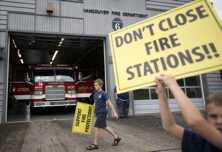

Round 1 (FY2008/2009) – Concessions to avoid cuts,
Round 2 (FY2009/2010) – Concessions and Brownouts,
Round 3 (FY2010/2011) – Nothing left to concede, more brownouts, and services cuts
Round 4 (FY2011/2012) – Nothing left to concede, more brownouts, more services cuts,consolidations and mergers
Round 5 (FY2012/2013) – Nothing left to concede, more brownouts, more services cuts, consolidations, mergers, and regionalization
Round 6 (FY2013/2014) – SAFER grants are expiring
What’s Next? – Stay tuned and keep an eye on Canada
Please take a look at the information for your area or department and take a moment to bring us up to date for the next Report. [email protected]


