
Fire Captain Killed After Falling Through Roof Skylight During Factory Fire – Veneer Barrel Company – 60-62 Water Street, Brooklyn, New York – November 3, 1911
Submitted by Rick DeGroot
On November 3, 1911, FDNY Fire Captain James. A. Hagen of Engine 107 was killed when he fell through a rooftop skylight while fighting a very smoky and stubborn fire at the Veneer Barrel Company works at 60-62 Water Street in Brooklyn. As Captain Hagen led a group of firefighters operating a hoseline on the roof of the burning four-story brick and joist structure, the roof became compromised. Captain Hagen, sensing that the fire-weakened roof was about to collapse, immediately ordered the firefighters to evacuated the roof via a portable ladder. The Captain remained on the roof until the last of his company members had scrambled down the ladder. Then as he turned to make his escape, he stumbled on a low wall and fell through a skylight some thirty feet into the burning structure, striking beams on the way down. The roof structure and heavy machinery on the top floor then collapsed and fell into the building. Members of his company quickly located Captain Hagen in the debris in the basement and removed him to the exterior. He suffered a fractured skull and died instantly from his injuries. The fire was ruled accidental when nearby combustibles were ignited by an oil stove.
The structure involved in the incident was a four-story brick and wood joist Type III Ordinary construction factory building that manufactured wooden barrels. Located in a manufacturing area in the Fulton Ferry District at the foot of the Brooklyn Bridge, the building had several tenants including the barrel making firm. Side Alpha fronted on 50-foot-wide Water Street with a very large four-story brick warehouse named the Empire Stores across the street. Exposure Bravo was a similar five-story brick factory building housing a metal works company that was equipped with a fire call box located inside the building. Several three-story brick row houses were on Side Charlie that also fronted on a narrow alley named Harrison Court. Side Delta was an open lot. Several skylights were on the flat roof. A masonry cornice topped a one-foot parapet wall at the roofline on Side Alpha. An unenclosed elevator shaft ran the height of the building which was not equipped with a fire alarm system or an automatic fire sprinkler system. There were several fire hydrants located on the block fed by a six-inch water main. A fire alarm call box was located a short distance from the building to the north at the corner of Water and Main Streets.
Brooklyn is one of five boroughs that make up the City of New York. With a population of 2,736,074 residents according to the 2020 U.S. census, if Brooklyn were ranked as a city, Brooklyn would rank as the third-most populous in the country, behind Los Angeles and Chicago. The area where the incident occurred is along the waterfront of downtown Brooklyn that at the time was an area of factories, mercantile and manufacturing lofts, and warehouses. Brooklyn was a rapidly growing borough at the turn of the 20th century with an expanding population fueled by the arrival of thousands of European immigrants. In the twenty years between 1890 and 1910, the population of the borough doubled from 838,547 to 1,634,351 residents. Many of the new arrivals worked in the factories, warehouses, and on the docks along the waterfront.
At the time of the fire the downtown waterfront area was protected by the members of Engine 107 quartered at 124 Pearl Street, about one half mile from the fire building. In 1913, the engine company was redesignated Engine 207. Today, Engine 207 is quartered with Ladder 110, Satellite 6, Battalion 31, and Division 11 at 172 Tillary Street in downtown Brooklyn.
On Friday, November 3, 1911, at about 10 p.m., an oil stove set fire to a wooden partition in the four-story Veneer Barrel Company factory at 60-62 Water Street in Brooklyn. Captain James Hagen of Engine 107 found the crew of Engine 106 already on the scene when he reached the barrel works building. Hagen instantly ordered his men to the roof, toward which the flames were making their way up the elevator shaft. The engine crew with the Captain at their head dragged a line of hose up an extension ladder raised to the roof.
Flames rose from the upper windows of the building and curled around the coping on the roof, but Hagan and his men held their places, keeping a stream pouring down through an open scuttle into the mass of fire which roared just beneath them. To reach this vantage point, they had to leave their ladder, though the tip rose reassuringly above the edge of the roof.
Suddenly there was an ominous swaying beneath their feet and Hagan, quick to recognize the feel of a weakening roof, shouted instantly to his men: “Back to the ladder! Don’t lose a moment. This roof is going in in about a second.”
There was a scramble across the now trembling roof, which swayed and rocked like the deck of a steamer in a heavy sea. Captain Hagan, at the far end of the line of hose, urged his men toward the ladder, pushing and driving them, but keeping himself as the last man from the safety of the ladder tip. His voice still rose behind them as the last man threw himself over the edge of the roof to grip the ladder top in his hands. Suddenly a crashing, rending noise behind him caused the last man to look around. Hagan had disappeared. Unknown to the firefighters, the Captain had stumbled and fallen into a large skylight on the roof.
Then the roof of the building collapsed. Down through the building went the sound of breaking timbers and twisting steel and iron, till finally the last sound died out in a mighty crash far below the feet of the men on the ladder. Heavy machinery on the top floor had fallen through to the basement, and the top supports had dragged the roof with them.
Hagan’s men slid down the ladder, shouting as they went, and in the street cried out the news that the Captain had gone down in the crash. Every man of Hagan’s crew and of the crew of Engine 106 except for a few who still had to stick to their hoselines went plunging through the smoke and flame into the lower floor of the building. Deputy Chief O’Hara led the men himself, though about them dropped burning embers and bits of wood and steel girders and supports were still falling from the wrecked floors above.
In this mass of debris, glowing hot and lighted by the flames above, they found Captain Hagan, his body crushed by heavy timbers and pieces of machinery. They dragged him out into the street, beating out the fire in his clothing and praying that he might be alive. One look by an ambulance surgeon, however, told him that the Captain was dead, probably killed instantly by the fall.
The firemen returned to the work of quenching the flames and in a few moments had subdued the blaze raging through the now wrecked building. Only one alarm was needed to conquer the fire, and not more than $25,000 damage had been done, but Captain Hagan was dead.
Captain James Hagen was a well-respected member of the Fire Department. His advance through the ranks was rapid for he exhibited marked intelligence in his work. The dead Captain’s motto was “I will never send my men where I will not go myself.” He was particularly proud of the men of his engine company. He often told a personal friend that the house was not the finest in the city, but the men were the best set he ever worked with.
An investigation into the fire which caused the death of Captain Hagen was conducted by Fire Marshall Thomas P. Brophy who disclosed that the fire was due to carelessness of John Dougherty, the watchman in charge of the building. Dougherty testified that he had been in the building shortly before the fire and that he had gone outside to get some fresh air. He said that he heard some crackling of the fire and tried to get back to the building, but the smoke was so dense he was unable to do so. He called to a man who was passing the building at the time and this man sent in the alarm from the fire box at the corner of Water and Main Streets. The Fire Marshal was inclined to think the fire was suspicious at first but later changed his mind and decided it was the fault of the watchman. He gave Dougherty a very severe reprimand for his carelessness and apparent indifference. It was brought out that after the fire started that the watchman had gone to the lodging house where he makes his home and had gone to bed, even while the fire was in progress.
“There is no doubt in my mind,” said Brophy, “that the fire was caused by your carelessness. And the indirect responsibility for the death of Captain Hagen rests with you. How you could go home after the fire started and go to bed and to sleep as if nothing had happened while Captain Hagen and his men were out there facing death. As it happened poor Hagen died and the only reason that others did not follow him was because of his courage and thoughtfulness of his men. You are one of the most heartless men that I have ever met.”
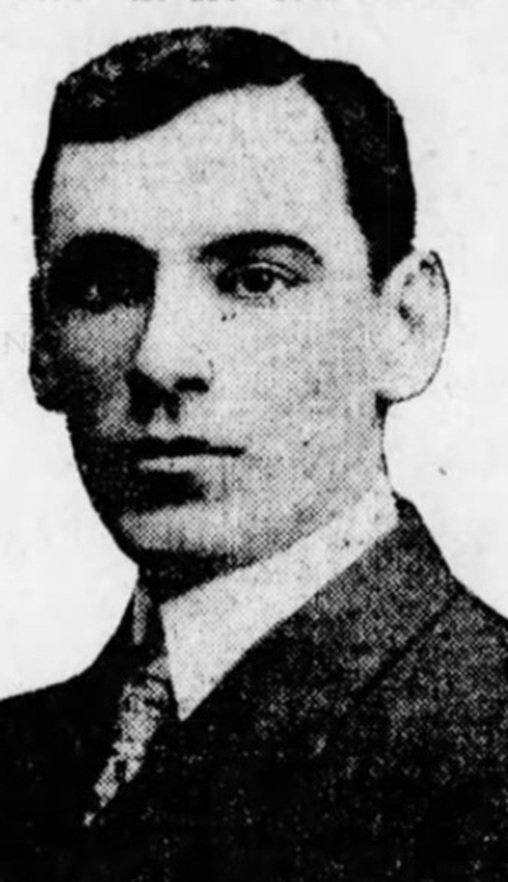
Captain James A. Hagen, age 34, was a ten-year member of the FDNY and was assigned to Engine 107. Appointed to the Fire Department in 1901, Hagen was promoted in 1907 as an Assistant Foreman. He was appointed Captain 18 months before his death. Hagen was married to his wife of three years, Ruth, and the couple had an 18-month-old daughter, Ruth.
On November 7, 1911, the funeral of Captain James Hagen was held at St. Matthew’s Church. The funeral was attended by Fire Commissioner Joseph Johnson, Deputy Commissioner Philip Farley, Fire Chief John Kenlon, and Deputy Fire Chief Thomas Lally. The funeral escort was comprised of a battalion of three companies of ten men each commanded by Foreman James Heffernan. The men of Hagen’s engine company followed the hearse from Hagen’s home to the church and later to the Holy Cross Cemetery in East Flatbush, Brooklyn. While the dead officer’s men were thus honoring him, special men from various companies were assigned for the day to Engine 107 to provide coverage.
Captain James A. Hagan has been honored at the New York Firemen’s Memorial on Riverside Drive at 100th Street in Manhattan, New York. The memorial honors the members of the NYFD and the FDNY who have made the ultimate sacrifice in the line of duty. Built in 1913 on a hillside facing the Hudson River, the memorial comprises a grand staircase, a balustraded plaza, a fountain basin, and the central monument. Made of Knoxville marble, the monument is a sarcophagus-like structure with a massive bronze bas-relief of horses drawing an engine to a fire. To the south and north are allegorical sculpture groups representing “Duty” and “Sacrifice.” More than 1,150 fallen members of the FDNY have been honored at the memorial since the paid municipal fire department was founded in 1865. The members of the FDNY hold an annual remembrance ceremony each Fall at the Memorial to honor their fallen members.
The name of Captain James A. Hagan has been inscribed at the New York State Fallen Firefighters Memorial on the grounds of the New York State Capitol in Albany. The memorial honors the men and women of the fire service who have perished in the line of duty in the Empire State. The memorial is located between the Justice Building and The Egg in a park-like area bordered by Norway maple trees. Dedicated in 1998, it consists of a ten-foot-high bronze statue of two firefighters rescuing an injured comrade backed by a granite wall fifty-four feet long and fifteen feet high inscribed with the names of New York state firefighters who gave their lives to save others. The memorial is placed on a plaza of charcoal and red brick pavers forming a Maltese Cross. As of October 2025, there are 2,818 names on the wall. The earliest name on the wall is from the year 1811.
The site of the factory building is now occupied by an upscale mixed-use retail and office building. There is no memorial marker at the site.
Commentary:
Operating over the fire on a roof is a challenging environment for firefighters. The condition of the roof deck must be continually monitored for stability. Rooftop hazards such air shafts, open scuttles, and skylights can prove deadly when operating in low visibility conditions. The presence of low parapet walls and cornices can become trip hazards. Rooftop equipment such a HVAC units, communications equipment and solar panel installations can be an impediment to operations on roofs. Any ventilation holes that may have already been cut need to be safeguarded so that fire personnel do not accidentally fall through and into the building. Maintaining at least one point of egress from the roof is essential for the safety of the crew should conditions change rapidly. Ideally a second means of egress should also be considered when feasible.
In the early days of firefighting before equipment like water towers, deck guns, aerial ladder pipes, aerial platforms and tower ladders were available, firefighters often had to manually position their hoselines on roofs and on raised ground ladders to operate heavy streams into openings in the fire building. This often placed personnel in close proximity to the fire building increasing the likelihood that they may be injured or killed in the event of a sudden roof or wall failure. With the evolution of modern fire apparatus, we no longer need to place our personnel in close proximity to the building during exterior defensive operations while taking advantage of the reach provided by aerial devices and master hose streams.
Unfortunately, there are no photos or illustrations from the fire. We have attached a detail from the 1908 Sanborn fire insurance map showing the configuration of the fire building and the surrounding exposure buildings.
We have also attached an article on flat roof operations published in Fire Engineering magazine by group member Chief Anthony Avillo: https://www.fireengineering.com/leadership/flat-roof-operations-from-the-street-to-the-roof-and-back/
Thanks to multiple media sources for the content of this article.
Honor the service of Captain James Hagen by reviewing your department’s procedures for conducting roof operations on flat roof buildings and by touring a flat roof commercial building in your local response district with a focus on rooftop hazards such as skylights, air shafts, and scuttle covers with your crew members today.
Remember Fallen Brothers.
Get Out There And Know Your Local!!!

The structure involved in the incident was a four-story brick and wood joist Type III Ordinary construction factory building that manufactured wooden barrels. Located in a manufacturing area in the Fulton Ferry District at the foot of the Brooklyn Bridge, the building had several tenants including the barrel making firm. Side Alpha fronted on 50-foot-wide Water Street with a very large four-story brick warehouse named the Empire Stores across the street. Exposure Bravo was a similar five-story brick factory building housing a metal works company that was equipped with a fire call box located inside the building. Several three-story brick row houses were on Side Charlie that also fronted on a narrow alley named Harrison Court. Side Delta was an open lot. Several skylights were on the flat roof. A masonry cornice topped a one-foot parapet wall at the roofline on Side Alpha. An unenclosed elevator shaft ran the height of the building which was not equipped with a fire alarm system or an automatic fire sprinkler system. There were several fire hydrants located on the block fed by a six-inch water main. A fire alarm call box was located a short distance from the building to the north at the corner of Water and Main Streets.
Detail from the 1908 Sanborn fire insurance map showing the configuration of the fire building (circled in red) and the surrounding exposure buildings.
On November 7, 1911, the funeral of Captain James Hagen was held at St. Matthew’s Church. The funeral was attended by Fire Commissioner Joseph Johnson, Deputy Commissioner Philip Farley, Fire Chief John Kenlon, and Deputy Fire Chief Thomas Lally. The funeral escort was comprised of a battalion of three companies of ten men each commanded by Foreman James Heffernan. The men of Hagen’s engine company followed the hearse from Hagen’s home to the church and later to the Holy Cross Cemetery in East Flatbush, Brooklyn. While the dead officer’s men were thus honoring him, special men from various companies were assigned for the day to Engine 107 to provide coverage.
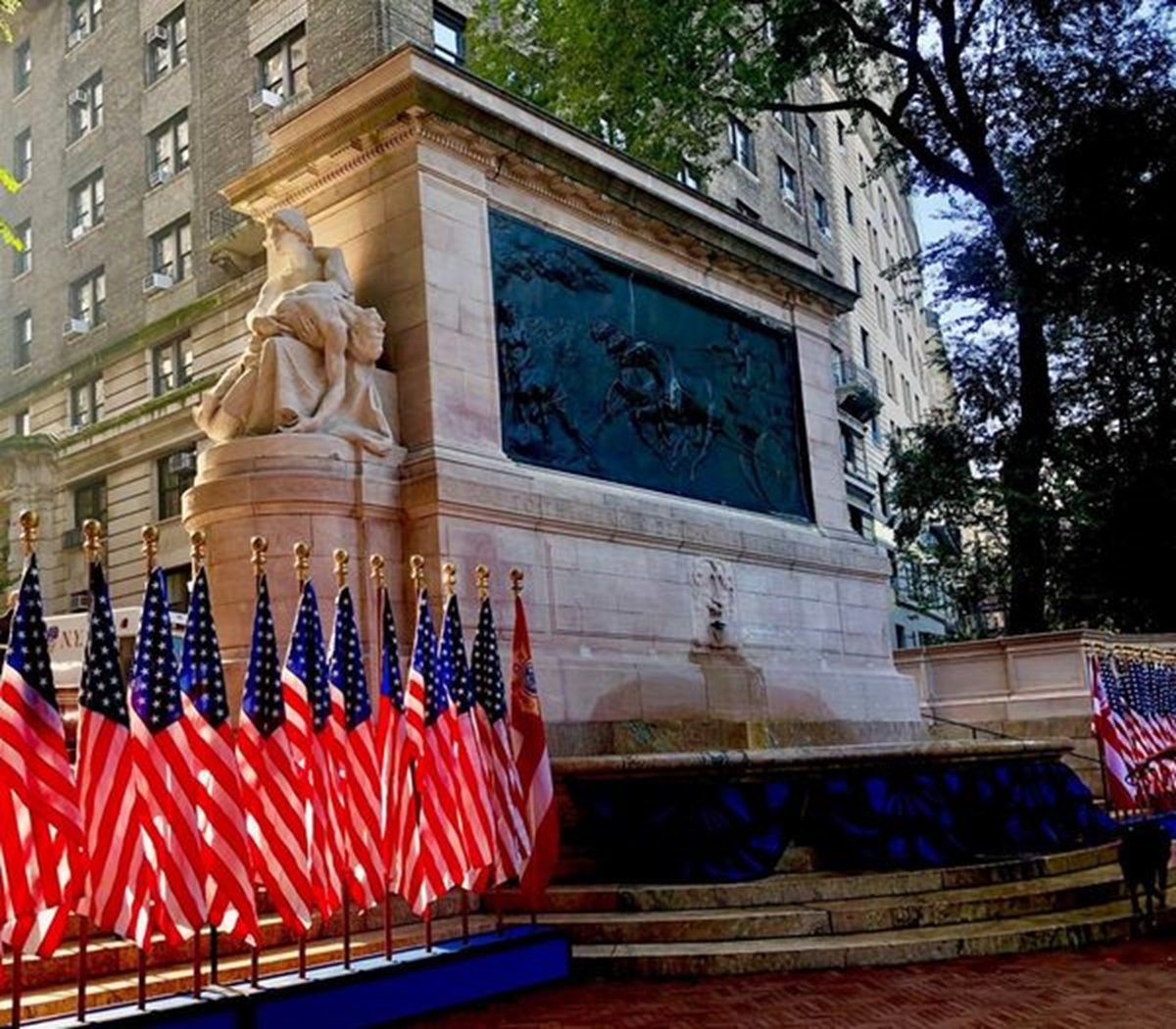
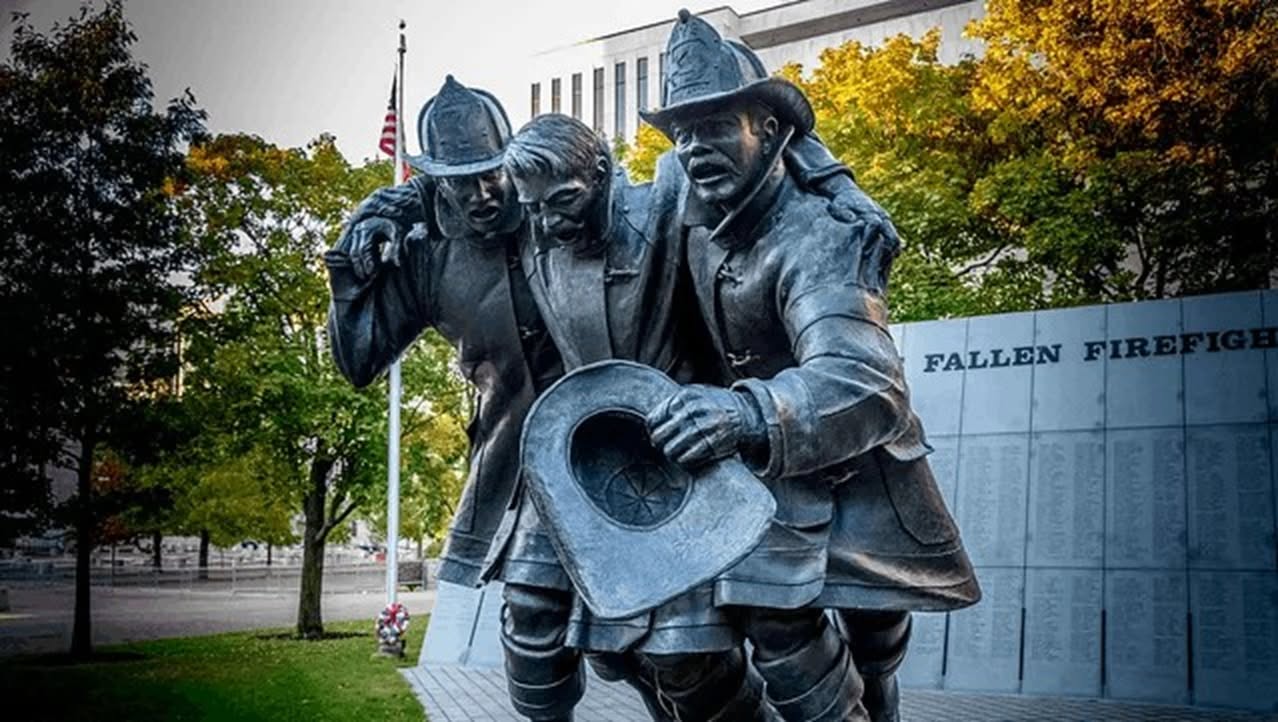


Photo credit: Anthong Avillo – Fire Engineering.


Photo: Multiple tower ladder streams in operation during a fifth-alarm fire in The Bronx.
