
Chief Officer Seriously Burned Fighting Townhouse Fire – Newark, Delaware – October 29, 2000 – NIOSH Firefighter Injury Report F2000-43
Submitted by Rick DeGroot
On October 29, 2000, Volunteer Assistant Chief Kevin Eichinger of the Aetna Hose Hook and Ladder Fire Company in Newark, Delaware was seriously burned while attempting to make an emergency evacuation from the interior during a townhouse fire. The injured chief was transported to the regional Level I trauma center for immediate medical treatment. He was then airlifted to the regional burn center where he was placed on a ventilator and hospitalized for 19 days. Two other firefighters were injured. Firefighter #1 received second-degree burns to his wrists while conducting fire suppression efforts and was transported to the regional hospital for treatment. Firefighter #2 received first-degree and second-degree burns to the wrist and ears while exiting the building. Fire investigators ruled that the fire was accidental and was the result of an unknown malfunction of the fireplace/chimney, which ignited nearby combustible materials inside the wood frame enclosure of the chimney, allowing the fire to spread to the interior of the home via the voids inside the floor trusses and into the attic space.
The site of the incident was a two-story middle-of-the-row Type V Lightweight Wood Frame townhouse with a walkout basement. The building used parallel chord lightweight wood trusses supporting each of the floor levels and triangular lightweight wood trusses supporting the roof. The townhouse had vinyl siding on Sides Alpha and Charlie. A masonry block wall separated each of the townhouse dwelling units. The involved townhouse unit had a wood burning fireplace insert on Side Charlie with an insulated metal chimney within a wood frame box enclosure that ran from the first floor to above the eave line of the unit. The unit interior walls were finished with drywall and the floors were wood subfloor covered with carpeting.
New Castle County is the northernmost of the three counties in Delaware. As of the 2020 U.S. Census, the population was 570,719 residents making it the most populous county in Delaware, with nearly 60% of the state’s population of 989,948. The county seat is Wilmington, which is also the state’s most populous city. Newark is a small city in New Castle County located 12 miles west-southwest of Wilmington. According to the 2020 U.S. Census, the population of the 9.43 square mile city is 30,601 residents. Newark is also home to the University of Delaware that has a population of 23,613 graduate and undergraduate students.
In New Castle County there are 21 independent fire companies with a mix of career and volunteer staff and the all-career City of Wilmington Fire Department. All county fire agencies are dispatched by the New Castle County Emergency Communications Center (NCCECC). At the time of this incident, the city was protected by the Aetna Hose Hook and Ladder Company consisting of three stations with a total of 150 uniformed firefighters. The department served a population of 70,000 in a geographic area of 25 square miles in and around the city of Newark. The department required all new firefighters to serve a one-year probationary period and complete 66 hours of training in basic firefighting, rescue, and EMS. Assistant Chief Kevin Eichinger, age 26, was a Certified NFPA Fire Fighter Level I and II, and NFPA Officer Level I, and had six years of volunteer firefighting experience.
According to Weather Underground, the temperature on the evening of October 29, 2000, was in the low 50s F with northwest winds gusting to 22 mph with zero precipitation under clear skies. Note: Research by the National Institute of Standards and Technology (NIST) has shown wind speeds on the order of 10 to 20 mph are sufficient to create wind-driven fire conditions in a structure with an uncontrolled flow path [Madrzykowski and Kerber 2009]. The windy weather conditions likely had a significant impact on fire development and the outcome of the incident.
On Sunday, October 29, 2000, at 1909 hours, a call came into NCCECC reporting a chimney fire in a townhouse. Aetna Stations 7, 8, and 9 were toned out. The units responding at 1914 hours included Engine 9 staffed by Assistant Chief Kevin Eichinger, a driver/operator, and one firefighter (Firefighter #1), Engine S7 staffed with an assistant chief, a driver/operator, and two firefighters, and Ambulance 8 staffed with two Emergency Medical Technicians (EMTs). At 1916 hours, Engine 8 staffed with a captain, a driver/operator, a firefighter, and Firefighter #2 responded to the incident. Assistant Chief Eichinger on Engine 9 requested a ladder truck after a report came in from NCCECC of fire with extension to the roof. At 1919 hours, NCCECC reported that police were on the scene and reported a working fire. At 1920 hours, Mill Creek Ladder 21 responded with an assistant chief, a captain, a driver, and five firefighters.
At 1922 hours, Engine 9 arrived on the scene, and Assistant Chief Eichinger reported to NCCECC that smoke was showing. After conducting a size-up of the scene, at 1923 hours, the Assistant Chief reported “smoke showing with fire extension to the roof.” He reported that they were “in-service with a 1.75-inch hose line.” As Engine 8 approached the scene, the captain reported that they were laying a supply hoseline from a hydrant. Assistant Chief Eichinger met with the resident of the townhouse to confirm that all of the occupants had exited and to get information on the layout of the townhouse. He then proceeded with Firefighter #1 and stretched 200 feet of charged 1.75-inch hoseline from Engine 9 into the townhouse’s front door and up the stairs toward the back bedroom.
At 1924 hours, Engine 8 arrived on the scene, and the Engine 8 Captain assumed Command and sent a firefighter (Firefighter #2) from Engine 8 with a portable radio into the structure to provide assistance to the Assistant Chief. Command then requested the assignment of a Tactical Channel for this incident from NCCECC and was assigned Tactical Channel 5. All units on Tactical Channel 3 (operations channel) were advised to switch to Tactical Channel 5. Firefighter #2 followed the hoseline until he met up with Assistant Chief Eichinger and Firefighter #1 at the top of the stairs. At 1924 hours, Engine S7 arrived on the scene. A second 1.75-inch hoseline was being stretched from Engine 9 to the front door of the townhouse.
Firefighters who were arriving on the scene at this time reported to the NIOSH investigator that light smoke was coming from the eaves and that the fire appeared to have been knocked down. The Captain of Engine 8 transferred Command to the Assistant Chief of Engine S7. Command then noticed that the conditions had quickly changed, and that thick black smoke was pushing out of the front door. At approximately 1925 hours, a police officer (also a deputy fire chief) and a civilian (off-duty firefighter) used an extension ladder to ventilate the second-story windows above the front door. Note: The police officer and off-duty firefighter assisted the driver of Engine 9 in laying the 5-inch supply line to the hydrant. The police officer and off-duty firefighter then ventilated the second-story front windows using the tip of the extension ladder. They left the ladder positioned under the front bedroom window as a possible means of egress for the firefighters inside.
Upon entering the back bedroom, Assistant Chief Eichinger, who was on the nozzle, quickly knocked down a fire that was burning from floor to ceiling near the window in the back corner of the bedroom. He advanced the hoseline to the window and broke it out so that he could attack the fire on the outside of the building near the top of the chimney. Two firefighters from Engine S7 advanced the second hoseline into the townhouse as a backup for the first crew. The heavy black smoke was almost to floor level, causing the crew on the second hoseline to miss the hoseline going up the stairs. Command noted that heavy, black smoke was now pushing out of the front door as well as the two vented windows on the second floor.
Command then sent the police officer around to Side Charlie of the building to check on conditions. A ladder was pulled from Engine 8 and positioned for access to the roof for possible roof ventilation. The nozzle man and the firefighter on the second hoseline proceeded down the hallway approximately five feet past the base of the stairs. Note: The firefighter on the nozzle of the second hoseline did not realize that the attack crew had gone up the stairs. He believed that they were on the first level in front of him. The heavy black smoke made it impossible for him to visually confirm the first crew’s location.
While attacking the fire on the second level, Assistant Chief Eichinger had Firefighter #2 search for fire extension above the bedroom ceiling. Using a Halligan tool, Firefighter #2 began pulling ceiling in the bedroom and encountered heavy black smoke and an increase in heat. On the first level, the firefighter on the nozzle of the second hoseline heard a loud noise, sounding like a “bang,” come from the area in front of him. Note: It is believed that the “bang” may have been drywall falling from the ceiling. He noticed that the heat banked down on top of him and was intensifying rapidly. The nozzle man, believing that the first crew was in front of him, held off from applying water. While Assistant Chief Eichinger was leaning out of the second-story window attacking the fire around the chimney, he noticed fire coming from the window directly below him. He shut down the nozzle and proceeded toward the bedroom door. Firefighter #1 and Firefighter #2 grabbed the nozzle and began applying a straight stream into the attic space where they had removed the ceiling. At 1929 hours, Mill Creek Ladder 21 arrived on the scene.
Assistant Chief Eichinger proceeded toward the top of the stairs where he encountered intensifying heat. He yelled to Firefighter #1 and Firefighter #2 that they needed to get out. Firefighter #1 and Firefighter #2 dropped to their knees and followed the hoseline toward the bedroom door. At 1930 hours, Command called NCCECC to request an emergency evacuation signal after he had received reports from firefighters exiting the townhouse that the interior conditions were deteriorating. Command then received a report from the police officer that there was heavy fire on Side Charlie. At the top of the stairs, the heat was intensifying, forcing Eichinger to get down on the floor. The carpet began melting and sticking to his bunker gear. Note: The Assistant Chief reported to the NIOSH investigator that the heat made his neck, ears, and the sides of his face feel like they were on fire. The damage to the chief’s helmet (occurring at the top of the stairs) indicates that the temperature was in excess of 1100 degrees.
As Assistant Chief Eichinger began hearing the sirens and air horns signaling an emergency evacuation, he turned and saw the other two firefighters coming toward the top of the stairs. He then forced himself to descend the stairs through the intense heat. When he got to his feet, he believed he was standing outside the front door because the air around him felt much cooler. Note: In the NIOSH respirator investigation report on the Assistant Chief’s SCBA, it was reported that the facepiece lens was considerably dirty, had several surface scratches on the lens hard coating, and the visibility through the lens was poor. The nozzle man on the second hoseline decided to apply a fog pattern to the back area of the townhouse. He wanted to knock down the heat in an attempt to reduce the potential for a flashover.
When Firefighter #1 and Firefighter #2 reached the bedroom door, they encountered intense heat. Looking for another means of egress, they retreated to the window in the back corner of the bedroom. The window at this time was fully involved with fire, forcing them back toward the top of the stairs. Note: They heard the sirens and air horns signaling for an emergency evacuation at this time. Assistant Chief Eichinger, who was now standing in the kitchen on the first floor, removed his helmet, facepiece, and hood. After taking a breath, he quickly realized that he wasn’t at the front door but was still inside the townhouse. He could see light coming through a window (kitchen window). He used his helmet to break the window and began climbing out. The captain from Engine 8 and a police officer pulled him out of the window.
Firefighter #1 and Firefighter #2 now reached the top of the stairs and forced themselves to descend the stairs through the intense heat. Firefighter #2, followed by Firefighter #1, went down the stairs head-first on their stomachs. Their helmets were knocked off as they ran into the closet door at the base of the stairs and again when they fell over personnel on the second hoseline. Firefighter #2 was able to find his way out by first following the stream of water being applied to the stairs by a crew from Ladder 21 and then by assistance from personnel standing at the front door. The nozzle man and the firefighter on the second hoseline had also felt the extreme heat and had begun exiting when they heard the sirens for the evacuation. The nozzle man was assisted out of the front door by the driver of Ambulance 8.
Firefighter #1 had gone into the kitchen after falling over the crew on the second hoseline. He was then assisted out the front door by personnel from Ladder 21. Assistant Chief Eichinger was taken to Ambulance 8 and provided medical treatment. He was then transported to the regional trauma center for immediate medical treatment and then airlifted to the regional burn center where he was placed on a ventilator and hospitalized for 19 days. Firefighters #1 and #2 were both transported to the hospital for further treatment and release. Firefighter #1 was treated for second-degree burns to his wrists. Firefighter #2 was treated for first-degree and second-degree burns to his wrist and ears.
The State Fire Marshal’s Office ruled that the fire was accidental and was the result of an unknown malfunction of the fireplace/chimney, which ignited nearby combustible materials. The fire occurred inside the enclosure of the chimney, allowing the fire to spread to the interior of the home via the voids inside the floor trusses and into the attic space.
NIOSH investigators concluded that to minimize the risk of similar occurrences fire departments should
- ensure that the department’s Standard Operating Procedures (SOPs) are followed and refresher training is provided.
- ensure that firefighting teams check each other’s personal protective equipment (PPE) for complete donning.
- ensure that a Rapid Intervention Team (RIT) stands by with equipment, ready to provide assistance or rescue.
- ensure that the Incident Commander conducts a complete size-up of the incident and continually evaluates the risk versus gain during operations at an incident.
- ensure that firefighters report conditions and hazards encountered to their team leader or Incident Commander.
- ensure that team continuity is maintained.
- ensure that a separate Incident Safety Officer (ISO), independent from the Incident Commander, is appointed.
- ensure that the assignment of a tactical channel is established by NCCECC prior to personnel entering a hazardous environment.
- consider providing firefighters with a Personal Alert Safety System (PASS) integrated into their Self-Contained Breathing Apparatus (SCBA).
- ensure that ventilation is closely coordinated with the fire attack.
In the aftermath of this fire, NCCECC no longer dispatches a single fire company to any reported structure fire. A box alarm system was instituted sending multiple fire companies on the first alarm with as many as 5-7 companies dispatched to certain high hazard occupancies.
Commentary:
Two modern construction features came into play in this incident that allowed for rapid fire development within the ceilings and floors of the structure. The wood framed box enclosure for the fireplace chimney allowed the fire to quickly travel vertically within the structure. The undivided horizontal “trussloft” voids between the floors and ceilings created by the parallel chord lightweight wood floor trusses allowed for fire to extend overhead and underneath the unsuspecting firefighters. As we continue to see the use of lightweight truss building components in both new construction of structures, and renovations and additions to existing buildings, the Fire Service must adjust our tactics to meet this threat. The use of a thermal imaging camera prior to entry and during offensive interior operations is a critical tool to assist firefighters with determining the fire location and travel paths within structures. Some states and jurisdictions have taken proactive measures such as the placarding of truss-equipped buildings and collecting data on such buildings in their locals to assist in identifying the presence of these building components that can have deadly consequences for firefighters. Weather conditions including gusty winds in the area at the time of the incident and the uncoordinated ventilation of a second-floor window may also have had an impact on rapid fire spread within the dwelling.
We have attached photos from the incident. The link to the NIOSH report is here: https://stacks.cdc.gov/view/cdc/163890
We have also attached a link to an article published in Fire Engineering magazine by group member Anthony Avillo on the dangers of fighting fires in lightweight wood frame construction: https://www.fireengineering.com/fire-prevention-protection/avoid-tactical-breakdown-respect-lightweight-construction/
And we have attached an alert issued by NIOSH – Preventing Injuries and Deaths to Firefighters due to Truss System Failures: https://stacks.cdc.gov/view/cdc/11415
And we have attached the link to an Emergency Traffic podcast reviewing the incident produced by group member Paul Prevost: https://open.spotify.com/episode/7sRLsOd2PLhIuG1n2c03Vr?si=qbcdbyQsQmqMN4LEe8OV8A.
Honor the service of these injured firefighters today by touring buildings in your local response district and identifying the presence of lightweight wood floor and roof trusses.
Get Out There And Know Your Local!!!
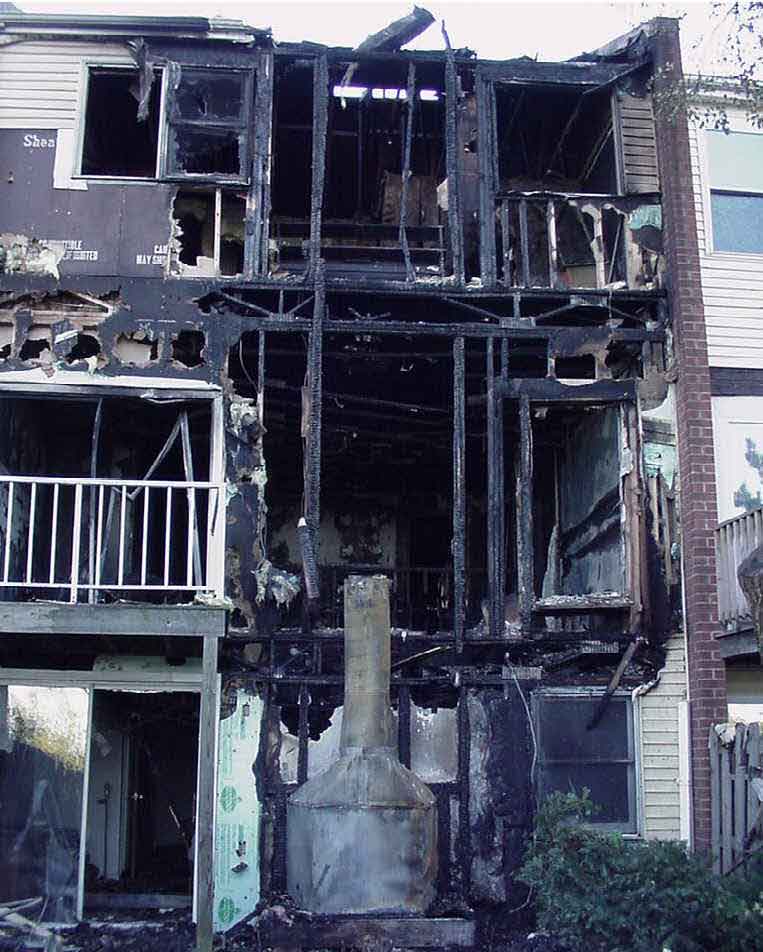
View of Side Charlie of the fire building.


